Daily Archives: June 20, 2017

The Death of Free Speech: The West Veils Itself by Giulio Meotti

  • The West has capitulated on freedom of expression. Nobody in the West launched the motto “Je Suis Avijit Roy,” the name of the first of the several bloggers butchered, flogged or jailed last year for criticizing Islam.

  • Germany’s Chancellor Angela Merkel, sided with the Turks. She condemned the German comedian’s poem, called it a “deliberate insult,” then approved the filing of criminal charges against him for insulting the Turkish president.
  • The West is veiling its freedom of speech in the confrontation with the Islamic world: this is the story of Salman Rushdie, of the Danish cartoons, of Theo van Gogh, of Charlie Hebdo.
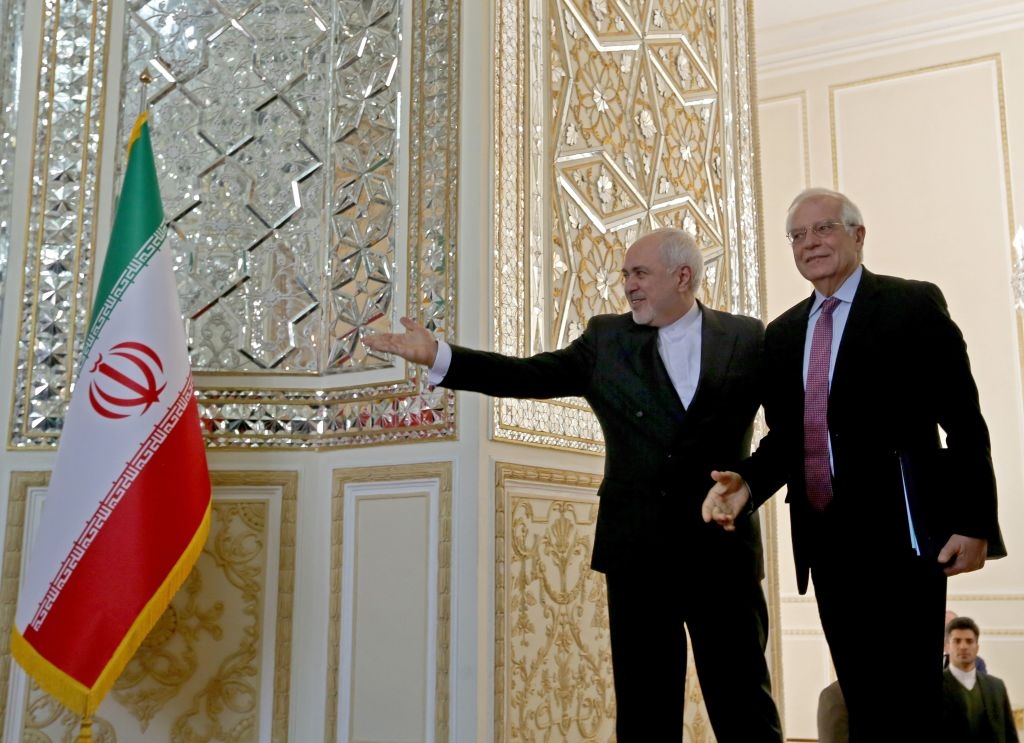
  • Iran’s foreign minister, Javad Zarif, just released an interview with Italy’s largest newspaper, Il Corriere della Sera, where he suggested a kind of grand bargain: We Iranians will discuss with you our human rights situation, if you Europeans suppress freedom of expression on Islam.

Last week, Nazimuddin Samad sat at his computer at home and penned a few critical lines against the Islamist drift of his country, Bangladesh. The day after, Samad was approached by four men shouting “Allahu Akbar!” (“Allah is great!”) and hacked him to death with machetes.

These killings have become routine in Bangladesh, where many bloggers, journalists and publishers are being killed in broad daylight because of their criticism of Islam. There is a hit list with 84 names of “satanic bloggers.” A wave of terrorism against journalists reminiscent of that in Algeria, where 60 journalists were killed by Islamist armed groups between 1993 and 1997.

But these shocking killings have not been worth of a single line in Europe’s newspapers.

Is it because these bloggers are less famous than the cartoonists murdered at Charlie Hebdo? Is it because their stories did not come from the City of Light, Paris, but from one of the poorest and darkest cities in the world, Dhaka?

No, it is because the West has capitulated on freedom of expression. Nobody in the West launched the motto “Je Suis Avijit Roy,” the name of the first of these bloggers butchered last year.

From Bangladesh, we now receive photos of writers in pools of blood, laptops seized by police looking for “evidence” and keyboards burned by the Islamists. We receive images reminiscent of the riots in Bradford, England, over Salman Rushdie’s The Satanic Verses in 1989, ten years after the Ayatollah Khomeini had revolutionized Iran into a stronghold of Islamic extremism.

Yet the stories of these bloggers from outside Europe remain shrouded by a ghastly transparency, as if their death has been only virtual, as if the internet had become their grave, as if these fallen bloggers did not deserve the virality of social networks.

There is also the case of Raif Badawi, in Saudi Arabia, sentenced to 1,000 lashes, ten years in jail and a fine of $270,000 for blogging thoughts such as, “My commitment is…to reject any repression in the name of religion…a goal that we will reach in a peaceful and law-abiding way.” The lashing order added that he should be “lashed very severely.” In addition to that, Badawi’s human rights lawyer, Walid Abu al-Khayr, was sentenced on July 6, 2014, to 10 years in prison. He was accused of: “inciting public opinion,” “disobedience in matters of the sovereign,” “lack of respect in dealings with the authorities,” “offense of the judicial system,” “inciting international organizations against the Saudi kingdom” and, finally, for having founded illegally, or without authorization, his association “Monitor of Human Rights in Saudi Arabia.” He was also forbidden to travel for fifteen years after his release, and fined 200,000 riyals ($53,000) according to Abdullah al-Shihri of the Associated Press.

Also in Saudi Arabia, in a clear violation of international law, according to Amnesty International, on March 24, the journalist Alaa Brinji was sentenced to five years in prison, an eight year travel ban and a fine of $13,000 for a few tweets allegedly “insulting the rulers,” inciting public opinion,” and “accusing security officers of killing protestors in Awamiyya,” the kingdom’s eastern province where the oil fields and the Shiites are.

Unfortunately, Western governments never raise Badawi’s case when they visit Saudi Arabia’s rulers, and turn a blind eye to the way this country treats its own citizens.

Look also at what happened not in the poor and Islamic Bangladesh, but in the wealthy and secularized Germany, where a comedian named Jan Böhmermann mocked and insulted Turkish president Recep Tayyip Erdogan on a television show. The prosecutor of Mainz just opened a case against Böhmermann under paragraph 103 of the German Penal Code, which provides up to five years in prison for insulting a foreign head of state. Chancellor Angela Merkel sided with the Turks. She condemned the comedian’s poem, called it a “deliberate insult,” then approved the prosecution against him.

Meanwhile, the German public television station, Zdf, removed the video from their website, and Böhmermann raised the white flag by suspending his show. The comedian, after Islamist death threats, got police protection.

The West is veiling its freedom of speech in the confrontation with the Islamic world: this is the story of Salman Rushdie, of the Danish cartoons, of Theo van Gogh, of Charlie Hebdo.

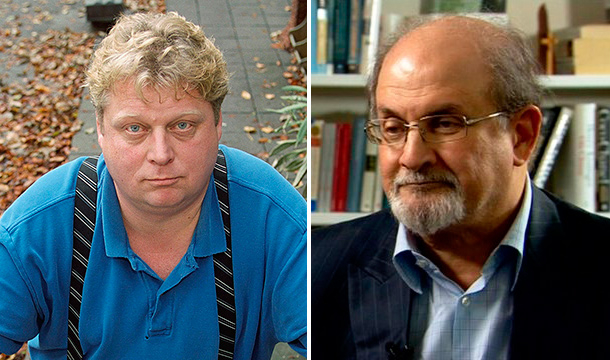
Theo van Gogh (left) was murdered by an Islamist because he made a film critical of Islam. Salman Rushdie (right) was lucky to stay alive, spending many years in hiding, under police protection, after Iran’s Supreme Leader ordered his murder because he considered Rushdie’s novel The Satanic Verses “blasphemous.”

A few weeks ago, at Rome’s Capitoline Museum, a famous repository of Western antiquities, the government of Italy called for “respect” for the sensibilities of Iran’s President Rouhani and placed large boxes over nude sculptures.

Iran’s foreign minister, Mohammed Javad Zarif, just released an interview with Italy’s largest newspaper, Il Corriere della Sera, where he suggested a kind of grand bargain: We Iranians will discuss with you our human rights situation, if you Europeans suppress freedom of expression on Islam: “Human rights are reason for concern for everyone,” Zarif said. “We are ready to dialogue. We shall make our observations on alienation of the Muslim communities in many European societies, or how freedom of expression is abused to desecrate the symbols of Islam.”

And that is exactly what is happening right now — of course with no mention of how freedom of speech or human rights are abused in “many Muslim societies.” Or how violent repression there “is abused to desecrate the symbols of the free world.”

The Iranian ayatollahs recently added to the bounty on the head of Salman Rushdie. And as it happened with Saudi Arabia’s or Bangladesh’s bloggers, nobody in Europe protested and Mrs. Merkel has been willing to abandon the German comedian to the autocratic Turkish Islamists.

In Pakistan, a Christian woman, Asia Bibi, is now fighting for her life in prison, where, condemned to death for “blasphemy,” she awaits her fate. European public opinion, which is always generous in rallying against “the persecution of minorities,” did not fill the streets and the squares to protest Asia Bibi’s imprisonment.

Further, for Europe’s journalists and writers, it has become increasingly difficult to find publishers. This is true of, for instance, Caroline Fourest, author of the French book Eloge du blasphème. “The treatment of her work by the publishing industry shows how much has been lost” wrote the British journalist, Nick Cohen. “No Anglo-Saxon publisher would touch it, and only fear can explain the rejection letters.”

“No American or British publisher has been willing to publish the book” Mrs. Fourest told this author. “‘There is no market for this book’, I was repeatedly told, to justify their desire not to touch something explosive. It was an important project which Salman Rushdie tried to sponsor with his own publishing houses. It is alarming because more and more I see that my colleagues behave as useful idiots.”

Europe is also suppressing freedom of expression for the very few moderate Islamic voices. On January 31, 2016, an Algerian writer named Kamel Daoud published an article in the French newspaper Le Monde on the events of New Year’s Eve in Cologne, Germany. What Cologne showed, says Daoud, is how sex is “the greatest misery in the world of Allah.”

A few days later, Le Monde ran a response by sociologists, historians and anthropologists who accused Daoud of being an “Islamophobe,” Jeanne Favret-Saada, an orientalist at the École Pratique des Hautes Études, wrote that Daoud “spoke as the European far-right.” Daoud has been defended only by a few other Arab writers exiled in Europe.

The affair is the mirror of Europe’s forsaking freedom of expression: a great Arab writer expresses precious truths and the mainstream European media and intellectuals, instead of protecting Daoud while Islamists threatened him with death, press the novelist to choose silence.

Giulio Meotti, Cultural Editor for Il Foglio, is an Italian journalist and author.

The Death of Facts by Douglas Murray

  • Needless to say, none of this is true. Nowhere has Heather Mac Donald suggested that black people or any other type of person has “no right to exist”. The accusation is levelled without evidence. But as with all anti-free-speech activists today, the line is blurred not merely between actual words and violence, but between wholly imagined words and violence.

Every week in America brings another spate of defeats for freedom of speech. This past week it was Ann Coulter’s turn (yet again) to be banned from speaking at Berkeley for what the university authorities purport to be “health and safety” reasons — meaning the health and safety of the speaker.

Each time this happens, there are similar responses. Those who broadly agree with the views of the speaker complain about the loss of one of the fundamental rights which the Founding Fathers bestowed on the American people. Those who may be on the same political side but find the speaker somewhat distasteful find a way to be slightly muted or silent. Those who disagree with the speaker’s views applaud the banning as an appropriate response to apparently imminent incitement.

The problem throughout all of this is that the reasons why people should be supporting freedom of speech (to correct themselves where they are in error, and strengthen their arguments where they are not) are actually becoming lost in America. No greater demonstration of this muddle exists than a letter put together by a group of students at Claremont McKenna College earlier this month to protest the appearance on their campus of a speaker with whom they disagreed.

Heather Mac Donald is a conservative author, journalist and fellow of the Manhattan Institute in New York. Her work has appeared in some of the world’s most prestigious journals. Of course, none of that was enough to deter students at Claremont from libelling her as much as possible in advance of her speech and then preventing her speech from taking place. At Claremont McKenna College, where Mac Donald was due to speak about her recent book, The War on Cops, angry students surrounded the building, screamed obscene words and banged on the windows. Mac Donald ended up giving the speech to a mainly empty room via live video-streaming and then fleeing the university under the protection of campus security. As recent events, such as the hospitalisation of a professor at Charles Murray’s recent speech at Middlebury College have shown, intimidation and violence are clearly regarded by today’s North American students as legitimate means to stop people from speaking.

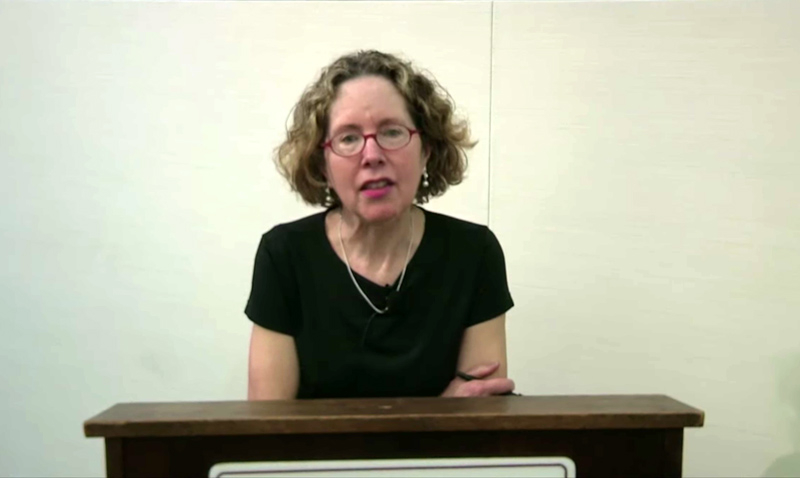
Heather Mac Donald, speaking at Claremont McKenna College on April 6, addressed a mainly empty room via live video-streaming, as angry student protesters surrounded the building. She then fled the college under the protection of campus security. (Image source: Claremont McKenna College video screenshot)

The reason, if any, may well come down to the possibility that facts have become diminished in importance on American campuses and have gradually lost out to the greater imperative of short-term political “narratives” and victories that come from thuggish intimidation. A letter sent to university authorities at Claremont ahead of Mac Donald’s speech is one of the most important recent documents chronicling the descent of this most crucial American value, freedom of speech.

The letter to university authorities from “We, few of the Black students here at Pomona College and the Claremont Colleges” loses no time in libelling their subject:

“If engaged, Heather Mac Donald would not be debating on mere difference of opinion, but the right of Black people to exist. Heather Mac Donald is a fascist, a white supremacist, a warhawk, a transphobe, a queerphobe, a classist, and ignorant of interlocking systems of domination that produce the lethal conditions under which oppressed peoples are forced to live.”

Needless to say, none of this is true. Nowhere has Mac Donald suggested that black people or any other type of person has “no right to exist”. The accusation is levelled without evidence. But as with all anti-free-speech activists today, the line is blurred not merely between actual words and violence, but between wholly imagined words and violence. Thus the students write:

“Advocating for white supremacy and giving white supremacists platforms wherefrom their toxic and deadly illogic may be disseminated is condoning violence against Black people. Heather Mac Donald does not have the right to an audience at the Athenaeum, a private venue wherefrom she received compensation. Dictating and condemning non-respectable forms of protest while parroting the phrase that ‘protest has a celebrated’ place on campus is contradictory at best and anti-Black at worst.”

Amid the semi-literacy, linguistic ostentation and intellectual dishonesty, it is hard to single out what is worst about this letter. But, against stiff competition, what is worst is that the whole thing is built on one massive misunderstanding which might also be described as a false premise.

“Historically, white supremacy has venerated the idea of objectivity, and wielded a dichotomy of ‘subjectivity vs. objectivity’ as a means of silencing oppressed peoples. The idea that there is a single truth–‘the Truth’–is a construct of the Euro-West that is deeply rooted in the Enlightenment, which was a movement that also described Black and Brown people as both subhuman and impervious to pain. This construction is a myth and white supremacy, imperialism, colonization, capitalism, and the United States of America are all of its progeny. The idea that the truth is an entity for which we must search, in matters that endanger our abilities to exist in open spaces, is an attempt to silence oppressed peoples.”

As the English philosopher Roger Scruton wrote in his book Modern Philosophy, “A writer who says that there are no truths, or that all truth is ‘merely relative,’ is asking you not to believe him. So don’t.”

Of course, the students at Claremont go farther than this. They make claims about people that are lies, yet state them as though they are categorical truths. And then they declare that “truth” is a “construct” — and one that they do not believe in. Their letter makes that plain, without them having any need to state the fact. But that they have stated it is convenient; it saves any honest observer from having to expend much energy considering the validity of their other claims. Anyone studying the decline of education in privileged Western democracies in the early 21st century will find documents like this immensely rewarding as historical testaments, and also a warning of what can happen when the thinking goes wrong.

Douglas Murray, British author, commentator and public affairs analyst, is based in London, England.

The Bigotry against Israel in the UN by Salim Mansur

  • “[U]nlike America, Europe is inherently anti-Semitic. This anti-Semitism is spread more or less evenly across the political spectrum and, therefore, it translates into widespread hostility to Israel. Europeans hate the Jews. Consequently, they hate the Jewish state.” — Robin Shepherd, A State Beyond The Pale: Europe’s Problem With Israel.

  • No “Palestinian” leader has publicly disavowed jihad against Jews. Instead, every aspect of engagement by “Palestinians” with Jews and Israelis is considered an obligation for advancing this jihad until its final expected objective of pushing the Jews out of “Palestine” has been reached.
  • The doublespeak of the Palestinian leadership made no difference within the UN. Since the June 1967 war, the UN began to tilt away from being fair and balanced toward Israel, and extended support to Arabs of the “occupied” West Bank and Gaza as an indigenous “Palestinian” people supposedly wronged by Jews.
  • “The long march through the UN has produced many benefits for the PLO. It has created a people where there was none; an issue where there was none; a claim where there was none. Now the PLO is seeking to create a state where there already is one.” — Jeane Kirkpatrick, U.S. ambassador to the UN (1981-85).
  • All of this occurred with the complicity of member states of the once-Christian West in the UN against one single and much maligned Jewish state, Israel, surrounded by hostile Arab and Muslim states in the Middle East.

The passage of the UN Security Council Resolution 2334 just before Christmas 2016, with the United States abstaining, was an IED-wrapped Chanukkah gift that lame-duck President Barack Hussein Obama delivered to Israel. It was another signal to Palestinians that they may continue their “rejectionism” of Israel, and stage another round of jihadi terrorism providing the UN the excuse to deliver pre-packaged condemnations of any Israeli reaction to the maiming and murder of Jews in the so-called “occupied” territories.

The U.S. abstention was an appalling betrayal of a people wrongly maligned by a sitting American president who for the past eight years went about assuring American Jewry, especially liberal Jews loyal to his party, that he was the most pro-Israel occupant of the White House. Instead, Obama’s decision, as a parting shot before he left office, not to veto Res. 2334 lifted the veil over the unspoken animus that he not only harbors within himself but also one that still stirs many within Western nations against Israel despite their solemn public denunciations of anti-Semitism.

This is evident in the language of Res. 2334. It exclusively condemns Israel stating: “settlements in the Palestinian territory occupied since 1967, including East Jerusalem, has [sic] no legal validity and constitutes a flagrant violation of international law”. It also effectively revokes Security Council Res. 242 of 22 November 1967.

There was no pretense in Res. 2334 to be fair, and hold Palestinian Authority (PA) and with Hamas equally responsible for inciting terrorist violence against civilians within Israel, thus poisoning any diplomatic effort required for a negotiated settlement between the parties. The adoption of Res. 2334 was a “gang up” by France, Eurabia, the US and the 57 countries of the Organization of Islamic Cooperation (OIC) against Israel. It was reminiscent of the long, shameful history of Jews as a minority people, abused and tormented by the majority among whom they resided.

For the past half century, Res. 242 was the keystone in the UN framework for peace in the Middle East. It laid out the process envisaged in the “land-for-peace” formula between parties in conflict following the June 1967 war. And on the basis of this formula Israel reached peace agreements with Egypt and Jordan in the aftermath of the October 1973 war.

But Res. 2334, instead, categorically states, the UN “will not recognize any changes to the 4 June 1967 lines, including with regard to Jerusalem, other than those agreed by the parties through negotiations.” In other words, the demand is on Israel to return to the 1949 armistice lines an outcome pre-determined by Res. 2334.

If Israel cannot now trade “land-for peace”, since land held after June 1967 war is deemed “illegal,” then there is no further reason for any negotiated settlement.

Israel cannot simply accept a status quo ante bellum that would be untenable for Israel’s security — Israeli Minister of Foreign Affairs Abba Eban called then the “Auschwitz borders” — and the PA, with backing of the UN.

Res. 2334 is then a formula for continued terrorist violence by Palestinians against Israelis. The adoption of Res. 2334 — not unintentionally — has driven a nail into the promise of the “two-State solution.” The Security Council was warned ahead of the December 23 vote by President-elect Donald Trump that the United States under his administration will not accept this blatantly anti-Israel resolution.

It needs to be asked — political correctness set aside — of the other four permanent members of the Security Council (Britain, China, France, and Russia): Why, at this time — when the situation in the Middle East has gone from bad to worse — has the Security Council decided to weigh in against Israel, the only democracy and oasis of sanity in the region that has imploded through an excess of Arab-Muslim bigotry and fanaticism?

And, why did the Security Council, whose record in the Middle East is one of abysmal failure in providing “peace and security” to people most in need — the beleaguered Christians, Yazidi, and Kurdish minorities of Iraq and Syria — decide to revoke the long-standing Res. 242 on the patently false excuse of “salvaging the two-State solution”, when the Palestinian leadership has continually refused to engage with Israelis in direct negotiations?

These questions require credible answers, but none can be given.

The real story in the adoption of Res. 2334 lies in the persistence of anti-Semitism within the UN.

Islamists, and Muslim states singly, or together, cannot advance any anti-Semitic policy in the UN detrimental to the security of Israel without the support, direct and indirect, of the Christian West. The Security Council vote on December 23 is the definitive proof. The ugly truth that many Israelis know, is that without Western complicity anti-Jew hatred of Arabs and Muslims post-Holocaust could not take root and flourish within the UN.

***

The last act of Obama’s presidency, in the grim shadow of Aleppo’s destruction, will be Obama’s legacy — of playing Brutus to Israel.

Obama conned a majority of liberal American Jews, throughout his two-terms, into believing he would keep Israel secure against her enemies. The liberal American Jews, as loyal supporters of and donors to the Democratic party, willingly subscribed to Obama’s smooth sale pitch directed at them: that he would be, as the first black president, a steadfast friend and protector of Israel in a world insanely hostile against Jews.

The facts about Obama and his politics, however, were contrary to the image crafted for him and that duped liberal American Jews.

Obama was groomed in the anti-Vietnam War ideological stew of anti-Americanism blended with a potpourri of new left cultural Marxism of Herbert Marcuse; the left-wing anarchism and utopianism of Noam Chomsky; the radicalism of the community organizer Saul Alinsky; the reflexive anti-imperialism and anti-colonialism of “third world” ideologues, such as Frantz Fanon and Edward Said; the radical politics of student activists, such as Tom Hayden and Abbie Hoffman, of the nineteen-sixties; and the Black “identity” politics of Jesse Jackson, Al Sharpton, and Obama’s mentor Reverend Jeremiah Wright in Chicago that snugly fit with the filthy anti-Jew politics of Louis Farrakhan and his “Nation of Islam.”

This ideological mixture was apparently a potent, mind-warping, brew. When fed to young minds in schools and colleges, as it was with Obama, with little experience of the real world and even less familiarity with world history, it infected many of them with the politics of grievance to turn resentful against their own society.

It took an outsider, like Dinesh D’Souza, an immigrant from India, to see through Obama’s mask the angry face of a mulatto. In The Roots of Obama’s Rage, D’Souza described the psychological motive behind Obama’s politics as a misfit in the America of his mother (a white woman), in the Africa of his father (a black man raised in the midst of anti-colonial struggle against imperial Britain in Kenya), and in a part of Asia of his stepfather (an Indonesian caught in the currents of anti-communism in his country under military dictatorship).

Obama needed support of American Jews as part of his strategy in winning and retaining the White House in the control of Democrats. The party, however, had moved so far to the left since the era of Bill Clinton’s presidency that for the rank-and-file members, support for Israel became increasingly contentious.

The leftward drift meant that domestically the Democratic party, in the name of “Progressivism,” embraced “third world” anti-capitalism and, in the realm of foreign policy, the UN’s “one world” agenda. It also meant adopting “identity” politics, and mobilizing a coalition of ethnic minorities among whom Muslim immigrant voters are headed in the near future to outnumber Jewish voters

The party of Truman embracing Israel had morphed into the party of Obama embracing anti-Zionism.

The results of the November 2016 election made redundant the charade surrounding Obama’s posturing as a faithful friend of Jews and Israel. For eight years Obama watched and contributed to the worsening of political disorder in the Middle East with a series of policy decisions — most notably the Iran deal lifting sanctions on vague promises from Tehran of putting a halt to its nuclear weapons program — that not only is funding the Iranian nuclear program it was purportedly supposed to stop — but it also greatly exacerbated Israel’s security environment.

Many believe that Obama’s refusal to veto a Security Council resolution was orchestrated by his own administration. But Obama’s national-security adviser, Ben Rhodes, sought to dismiss this betrayal, by blaming Israel.

According to Rhodes, as reported by the New York Times, “Absent this acceleration of settlement activity, absent the type of rhetoric we’ve seen out of the current Israeli government, I think the United States likely would have taken a different view.”

It did not matter to Obama that his explanation encourages Palestinian-Arab-Muslim view that their jihad in the long term will prevail against Israel. The Western powers delusionally believe that accommodation with Muslim states is of greater self-interest than indefinitely protecting the Jewish state against a hostile Muslim world.

The reason it did not matter is that Obama never publicly spoke out against the idea of Israel as a Western colonial outpost in the Arab heartland. It is a view he likely holds given his predisposition to embrace “third world” political grievances. Moreover, his friends, such the late Edward Said, Rashid Khalidi, and their academic cohorts in Western universities have peddled the view that Israel is, in the words of the late French Marxian historian, Maxime Rodinson, a “colonial-settler state.”

Europeans, led by France, began to tilt toward the Arab countries before the October 1973 Arab-Israeli war. A Euro-Arab Dialogue paved the way, as French leaders, beginning with De Gaulle saw in Arab North Africa, after French withdrawal from Algeria in 1962, a bridgehead for a Europe-Arab partnership, along with affordable oil and hopefully less terrorism.

France had supported Israel diplomatically and with military assistance during the period of the Algerian War (1954-62), which included the fateful alliance of France and Israel during the Suez War of 1956. But a crack opened in the Franco-Israeli relations after the June 1967 war.

Most likely in a fantasy of promoting France by currying favor with the Muslim states for more low-cost oil and optimistically less terrorism, De Gaulle turned on Israel.

Europeans increasingly came to view Israel, as the French leader depicted her. De Gaulle had used the word “occupation” in a reprimand of Israel, and the word lent support to Arab propaganda against Israel. This Euro-Arab Dialogue paved the way, as Bat Ye’or, the peerless historian of the Middle East and Islam, described, as the making of “Eurabia.”

In Europe, or “Eurabia”, it has become an article of “faith” that Israelis have wronged the “Palestinian” Arabs and have proceeded systematically, in the words of Charles de Gaulle, to “oppress,” “repress,” and “expropriate” them.[1] In supporting Arabs of Israeli “occupied” territories, Europeans can also assuage their guilt over the anti-Semitism of their past, and re-balance their sense of political morality by embracing Arabs and Muslims as people of the “third world” to atone for their past sins of colonialism.

But this European consensus on the Israeli-Palestinian conflict since the nineteen-seventies cannot obscure the ugly reality beneath. Europeans have not expunged anti-Semitism from their midst. As Robin Shepherd writes,

“[U]nlike America, Europe is inherently anti-Semitic. This anti-Semitism is spread more or less evenly across the political spectrum and, therefore, it translates into widespread hostility to Israel. Europeans hate the Jews. Consequently, they hate the Jewish state.”[2]

The American left finds itself ideologically at home with Europe’s mainstream politics, which mostly “Left”-leaning. Obama as a man of the “Left” is similarly at home with the European views about the world. Obama did not hide this affinity with Europeans from Americans; instead he publicized it when he took his campaign for the White House to Berlin in 2008.

Americans in general admire and support Israel. For Americans, the “special relationship” with Israel is special. Consequently, even as Obama shared the European consensus on Israel and did not hide his disdain for Prime Minister Benjamin Netanyahu, he kept his pretense of being a friend of Israel until nearly the end of his presidency.

At a deeper level, Obama’s animus, exposed over Res. 2334, also revealed his woeful ignorance of world history. All his foreign policy catastrophe have come from that: his reset button” with Russia; his courtship of other dictatorships such as Cuba and Iran; his premature withdrawal from Iraq thereby creating a vacuum filled by ISIS; his release of hard-core terrorists from Guantanamo Bay; his indifference to the Iranian people after the fraudulent elections of 2012; his enabling Iran’s nuclear program under the pretense of “preventing it; his murder by default of America’s ambassador to Libya and three other heroes; and his abandonment of Syria, creating more than half a million deaths to name but a few.
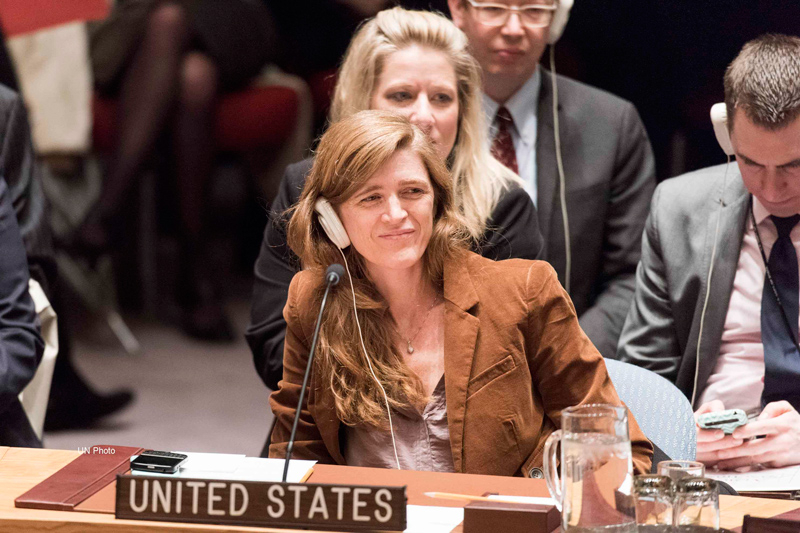
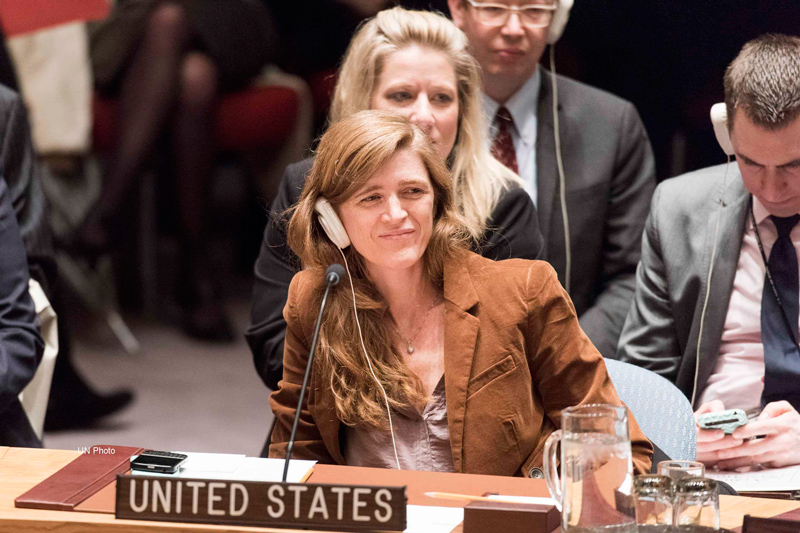
Samantha Power, Permanent Representative of the United States to the UN, at a Security Council meeting, on February 24, 2016. (Images source: United Nations)

Res. 2334, in falsely declaring Israeli settlements on disputed territories illegal, has ruled out negotiations by predetermining the outcome.

Israel is now denied control over the most sacred part of Jerusalem — the Temple Mount area and the Western Wall — that is at the heart of Jewish history, and the longing of Jews since their eviction from the City of David by the Romans in the first century C.E.

UN machinations also fabricated a previously non-existent identity for a people — the so-called “Palestinian” Arabs. In the process, the UN lent itself to the Arab and Muslim states, or the Organization of Islamic Cooperation (OIC), to advance their not-so-hidden agenda of undermining Israel’s security by demanding the establishment of a “Palestinian” state with boundaries existing prior to the June 1967 war.

In UN Security Council Res. 242 (1967), there is no mention of “Palestinian” people. They did not exist. After the dissolution of the Ottoman Empire in 1923, the area was mandated by the British who called it Palestine. Anyone born there — Jew, Arab or Christian — had Palestine stamped on his passport and was a Palestinian.

Resolution 242 called for a “just settlement of the refugee problem” without defining the refugees. Leaving “refugee” undefined meant that parties in conflict when negotiating would need to recognize that the partition of Palestine and the establishment of Israel led to the making of refugees among both Arabs and Jews — Arabs dislocated or evicted due to the partition and the war that followed, as were Jews from Arab states in the Middle East and North Africa.

The non-mention of “Palestinian” people, or “Palestinian Arabs, or “Palestinians” in Res. 242 was consistent with all previous resolutions, statements, and declarations made by the UN or its predecessor, the League of Nations.

***

In all but name, the wish to consummate Hitler’s “final solution” for Jews has animated a substantive segment of Arab and Muslim thinking since the establishment of Israel.[3] Each of the wars Israel has had to fight, beginning with the war in May 1948 against the combined Arab armies, if lost, had the potential of Jews being exterminated by Arabs in Palestine.

The Mufti Haj Amin al-Husseini escaped from Europe after the Nazi defeat and made his way into Egypt. The Allied powers never indicted him as a war criminal; he eventually retired as an Arab hero to Lebanon, where he died in 1974. The leaders of the “Palestinian” movement since 1945 have been the progeny of the Mufti.

The Mufti’s politics of jihad declared against Jews, beginning with the riots of 1921, has since then grown in intensity. No “Palestinian” leader has publicly disavowed jihad against Jews. Instead, every aspect of engagement by “Palestinians” with Jews and Israelis is considered an obligation for advancing this jihad until its final expected objective of pushing the Jews out of “Palestine” has been reached.

After the overwhelming defeat suffered by Egypt, Syria, and Jordan in the six-day war of June 1967, a practical response was needed by the Arab leaders to quell the seething anger of their people against them and re-direct that anger against Israel, while buying time to rebuild Arab strength. One response came in the Arab League Summit in Khartoum, Sudan, in August-September 1967. There the Egyptian leader, President Gamal Abdel Nasser, spelled out the “three no’s” — “no recognition, no negotiation, no peace” — in defining the collective Arab stand against Israel.

The other response was to build support for a resistance movement of Arabs both in Gaza (under Egyptian control until June 1967 war) and in the West Bank (under the control of the Kingdom of Jordan). Israel had warned Jordan to stay neutral during the buildup of the crisis ahead of the June 1967 war. But when King Hussein imprudently joined forces with Egypt and Syria against Israel, Jordan’s military defeat came with the loss of control over the West Bank. Arab governments officially designated the resistance movement launched from the “occupied” territories as the “Palestinian” struggle against Israel.

In the UN, after the June 1967 war, the great powers met with renewed energy to seek a diplomatic resolution in containing the Arab-Israeli conflict that might be spinning out of control. The result was Resolution 242, carefully crafted and unanimously adopted by the Security Council.

The resolution’s preamble, emphasizing “the inadmissibility of the acquisition of territory by war” was a pious wish with no basis in history or law, for if it did then much of the history of Western powers and their acquisitions of territories as result of wars would need revision. But even more to the point, Arab and Muslim states have continued to contravene the intent of the clause — Pakistan has occupied parts of Kashmir, Turkey has occupied parts of Cyprus, Morocco has occupied the Spanish Sahara, Russia has occupied Georgia, Ukraine and Crimea, and China has occupied Tibet.

The key point in the English version of Res. 242 with reference to Israel was withdrawal of its armed forces “from territories occupied in the recent conflict”. Arthur J. Goldberg, the U.S. ambassador to the UN (1965-68) involved in drafting the resolution, explained,

“The notable omissions in regard to withdrawal, from Israel’s viewpoint, are the words allthe, and the June 5, 1967 lines. The Israeli emphasize that there is lacking a declaration requiring Israel to withdraw from all of the territories occupied by it on and after June 5, 1967.”[4]

According to Goldberg, Israel tied its withdrawal “from territories” to the principle Res. 242 affirmed that every State in the area is entitled “to live in peace within secure and recognized boundaries free from threats or acts of force”. Since then, every American administration, until Obama’s, has supported this formula of “land-for-peace” without prejudging the outcome of the land that would be returned by Israel in reaching a final agreement with each of its opponents.

Arab states in the years since the adoption of Res. 242 eventually came to accept it as the framework for peace in the region. The reasoning was, again Goldberg, “the Arab States came to the conclusion that the language of the Resolution was the best they could hope for from the United Nations.”

Arab leaders also shrewdly sensed the tide of support for Israel as the “underdog” within the UN was shifting as new members, former colonies of the European powers, was emerging as a majority-voting bloc. These new members were more sympathetic to the cause of Arabs as the new “underdog” in the UN.

The leading Arab states in the decade and half after the June 1967 war — Egypt, Syria, Iraq, Algeria, Libya, Lebanon, Tunisia — continued to characterize their politics in terms of secular nationalism, even as support for Islamic fundamentalist parties began to grow among a new generation of radical youths. The Arab states became more diplomatically adept in pushing their interests at the UN and among the European powers. After the October 1973 war, Arab efforts to isolate Israel grew in tandem with the use of oil as a “weapon”.

It is during this period that the “Palestinian” movement under the banner of the Palestine Liberation Organization (PLO), and headed by Yasser Arafat, emerged from the shadows of internal Arab politics into the notice of the UN. In 1974 the Arab states with support of non-Arab Muslim countries, nonaligned members of the “third world”, and countries of the (former) Soviet bloc arranged for the UN General Assembly to invite Arafat to its opening session in New York. The following year the same group of countries adopted in support of Arab states the General Assembly resolution 3379 (1975) declaring, “Zionism is a form of racism and racial discrimination.” This resolution was revoked during the 1991 General Assembly session.

The PLO was not constrained by any of the recognized norms of an established state in waging its asymmetrical terrorist warfare against Israel. At the Munich Summer Olympics in 1972, a wing of the PLO — the “Black September” faction — took 11 Israeli athletes hostage and killed them. There were attacks on Israeli civilians and airplane hijackings by Palestinian terror groups, as the Arab war against Israel turned unconventionally terrorist.

The 1979 revolution in Iran under Khomeini was a victory for Muslim fundamentalists in the Middle East. Khomeini repudiated the idea of normalization between Muslims and Jews, between Israel and the Arab-Muslim states in the region and beyond. Khomeini invited Arafat to meet with him in Tehran, and he sharpened the language of jihad against Israel.

In October 1981 President Anwar Sadat of Egypt was killed by his own soldiers in a public military parade in Cairo. Sadat had signed a peace treaty with the Jewish state and had pushed for the normalization of Arab relations with Israel under the UN framework of Res. 242. Palestinians rejoiced over the murder of Sadat.

The Palestinian leadership spoke in a secular setting about Palestinian movement in terms of nationalist struggle, and in an Islamic setting in terms of jihad against Jews and Israel.

When Arafat was asked in South Africa in 1994 about the PLO accepting the Oslo Accords on the basis of Res. 242, he explained it as only a hudna (truce) with the enemy. He referred to the example of the treaty of Hudaibiyyah that Prophet Muhammad negotiated with his opponents in Mecca. In this treaty, Muhammad had promised a ten-year truce; but after he had strengthened his armies, he returned in only three years to obliterate the opposition.

The doublespeak of the Palestinian leadership made no difference within the UN. Since the June 1967 war, the UN began to tilt away from being fair and balanced toward Israel, and extended support to Arabs of the “occupied” West Bank and Gaza as an indigenous “Palestinian” people supposedly wronged by Jews.

After June 1967 war, Palestine came to no longer mean the territory designated for the establishment of Israel, as the Jewish homeland. It came to mean, instead, the land forcibly occupied by an alien people.

Until 1967, opposition to Jews and Israel, had been mounted in the name of Arabs, as was the jihad proclaimed by the Mufti Haj Amin al-Husseini on behalf of Arabs and Muslims against Jewish colonial-settlers in Palestine deemed an integral part of the Arab watan (homeland).

But in the years after 1967, Arabs of the territories “occupied” by Israel, and newly designated as “Palestinians,” came to be viewed in the Muslim world — enthusiastically backed by Europe, especially France — as the vanguard of a jihad against Jews. As Arafat said, agreements to him were merely hudnas (truces) with the enemy until the goals of the jihad — liberation of “al Quds” (Arabic for Jerusalem) and the annihilation of Israel, which Khomeini put forward as Islamic imperatives — were realized.

The mention of “Palestinians” as a people with inalienable rights, and not as refugees, was made for the first time in the UN General Assembly Resolution 2535 (XXIV), Section B, of December 10, 1969. From then onwards, the notion of the “Palestinian” people with “the right to self-determination” pushed by Arab and Muslim countries became a ritual in the UN. As Jeane Kirkpatrick, U.S. ambassador to the UN (1981-85), wrote:

“The long march through the UN has produced many benefits for the PLO. It has created a people where there was none; an issue where there was none; a claim where there was none. Now the PLO is seeking to create a state where there already is one.”

All of this occurred with the complicity of member states of the once Christian West, or Christendom, in the UN against one single and much maligned Jewish state, Israel, surrounded by hostile Arab and Muslim states in the Middle East.

***

The reputation of the UN for efficacy, justice, sense of history, is just about non-existent. Adam LeBor, a British author, in “Complicity with Evil”: The United Nations in the Age of Modern Genocide, has provided a grim indictment of the UN’s repeated failure to stop those who broadcast their genocidal intent to the world, as Hitler did.

When it comes to Israel, the United States and not the UN has protected her from the mob like behavior of the representatives of much of the world’s member states at its meetings. In the Security Council, there have been a few occasions, such as when the U.S. representative voted with the majority on a resolution condemning Israel in March 1980.

Daniel P. Moynihan, who had served as the U.S. representative to the UN (1975-76), in writing about what such a vote, instead of a veto, on the part of the United States at the Security Council meant, observed:

“The Security Council resolutions are time bombs. Ticking. The case has all but been made that Israel is an outlaw state, and indeed the General Assembly has now called on the Security Council to consider imposing sanctions against it. It will take the toughest minded diplomacy to dismantle the indictment now in place—thanks to the Carter administration; thanks to those who brought the Democratic party to such confusions. The new administration will have to deal also with the whole question of the Third World. It should be clearer now that hostility toward the West, toward the United States, is abiding and, it may be, burgeoning.”

As the new administration of President Donald J. Trump begins, it will take immense stamina and courage to stare down the “jackals” in the UN emboldened by Obama’s betrayal of Israel. Neither the late Daniel P. Moynihan, a distinguished and widely respected diplomat and Democratic Senator from New York, nor most Americans could have imagined that nearly four decades later another Democratic administration would sink lower than that of President Jimmy Carter in undermining America’s “special relationship” with Israel, the only liberal, open, pluralistic democracy in the Middle East.

Salim Mansur is a Distinguished Senior Fellow at the Gatestone Institute. He teaches in the department of political science at Western University in London, Ontario. He is the author of “Islam’s Predicament: Perspectives of a Dissident Muslim” and “Delectable Lie: A Liberal Repudiation of Multiculturalism.”

The Atrocious Scandal of the UNESCO Vote on Jerusalem by Salim Mansur

  • It was over the ruins of these sacred Jewish sites, left behind by the Romans, that Arab conquerors of Jerusalem in the seventh century built two mosques, the Dome of the Rock and Al-Aqsa, to lay claim on the City of David for Islam.

  • There can be no dispute about Jewish links with Jerusalem, and Jewish rights to their sacred sites that long pre-date the arrival of Arabs bearing Islam to the City of David. This latest effort by the UNESCO, however to deny the Jewish nature of Jerusalem is much more than a scandal; it is a Stalinist measure to airbrush history by an organization which, according to its own charter, is supposed to be devoted without prejudice to the preservation of historical records.
  • There is precedent for such a resolution to nullify the recent UNESCO resolution on Jerusalem. In December 1991, the UN General Assembly voted to repeal the UN resolution passed in 1975 that declared, “Zionism is a form of racism.”
  • Muslim denial of the Jewish links to the City of David and their ancestral rights over Judea and Samaria, or Palestine, is ironically contrary to the Word of God in their own sacred scripture.
  • Their claim on Jerusalem, or the holy land, on the basis of Islam is simply not found in the Quran. On the contrary, the Quran is explicit in addressing Jews as “children of Israel” and speaking of them, as in “Remember those blessings of Mine with which I graced you, and how I favoured you above all other people.” (2:47)

A resolution on “Occupied Palestine” this past October, at the 200th session of the Executive Board of the UNESCO (United Nations Educational, Scientific and Cultural Organization) in Paris, France, was orchestrated by Arab and Muslim member-states as another attempt to diminish Jewish links with Jerusalem. UNESCO’s World Heritage Committee, despite Israel’s opposition, adopted the resolution by a vote of ten countries in favour, two opposed, and eight abstentions.

In 1975, UNESCO was already an official supporter of the UN declaration that “Zionism equals racism.” So it should come as no surprise that in October 2016, a UNESCO resolution pointedly ignored the Biblical Jewish connection to two of the faith’s holiest sites in Jerusalem: the Temple Mount and the Western Wall, which pre-date Islam by hundreds of years.

Instead, the resolution refers to the Temple Mount compound solely in Arabic: The Al-Aqsa Mosque/Al-Haram Al-Sharif, as it is called by Muslims. The resolution also unfairly rebukes Israel’s caring oversight of these sacred places.

In effect, the passage of this resolution amounts to diplomatic jihad by Qatar and Arab-Muslim countries of the Organization of Islamic Cooperation (OIC) against Israel. As usual, unaffected by historical fact, a corrupt UN agency, which should protect heritage sites and not debauch them, has provided support to the knife-wielding jihad of Palestinians — the same who are encouraged to commit murder and who then are praised for it by Mahmoud Abbas of the Palestine Authority (PA).

The Arab-Muslim countries together, as the 57-member OIC, including the “Palestine Authority” — form the largest single bloc in the UN; their numbers alone are mostly responsible for the one-sided prejudicial treatment of Israel in the UN.

Any fair-minded individual, however, will agree with Italian Prime Minister Matteo Renzi, “To say that the Jewish people has no connection to Jerusalem is like saying that the sun creates darkness.”

A reasonable response at UNESCO, or in any other forum, to this deranged effort of OIC members to delegitimize Jewish and Israeli links to Jerusalem, would rest on evidence, and not on airbrushing historical records.

One may note how often the stories of the Old and New Testament were enacted in the precinct of the Jewish Temple, as in the story of Jesus’s confrontation with the moneychangers. Then one may take into account the eyewitness testimony of Josephus Flavius, a priest in the Jewish Temple during the Herodian era and a rebel against Rome who eventually surrendered to the Romans. Josephus witnessed the Romans destroy the Jewish Temple in AD 70 and wrote an account of what occurred in his book, The Jewish Wars, which we have at hand to give us evidence of events in Jerusalem two thousand years ago.

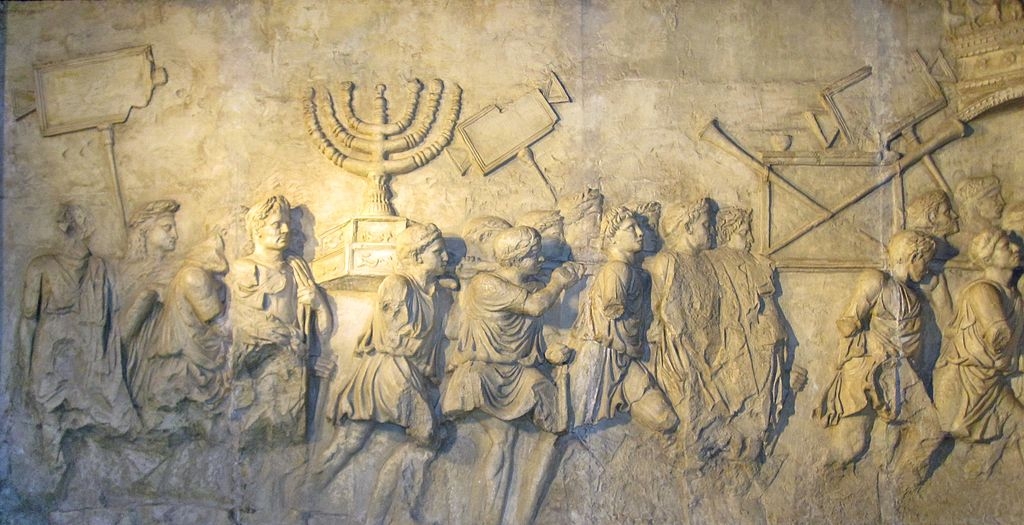
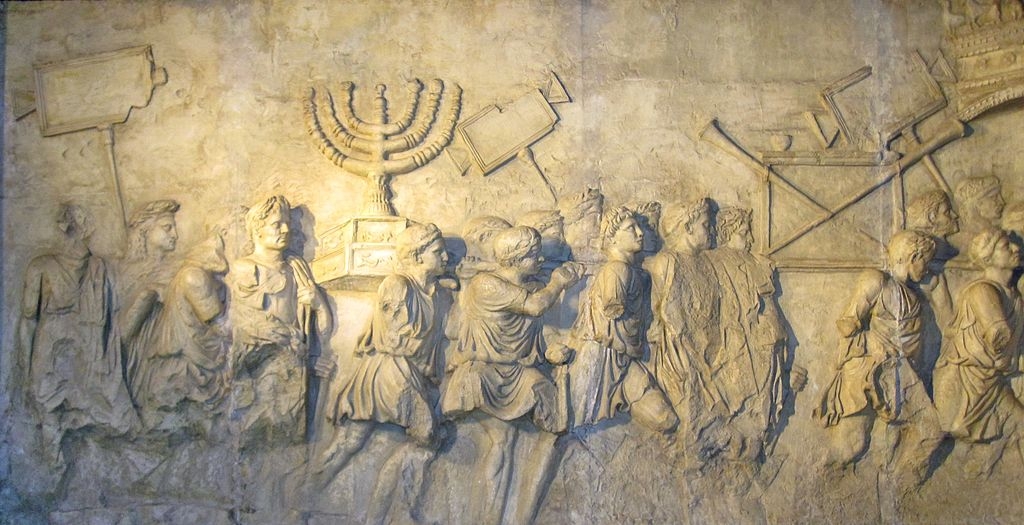
In Rome, any present-day tourist can behold, on the ancient Arch of Titus, the engraved likeness of the Jewish candelabra (Menorah), which the Romans brought back from Jerusalem after ransacking the Jewish Temple.

In Rome, any present-day tourist can behold, on the ancient Arch of Titus, the engraved likeness of the Jewish candelabra (Menorah), which the Romans brought back from Jerusalem after ransacking the Jewish Temple. Pictured: Photo of a panel copy from the Arch of Titus, displayed in the Beth Hatefutsoth museum in Israel. (Image source: Wikimedia Commons/Sodabottle)

Then those who want to study the history of the sacred sites of Jews in their ancient city may read The Temple of Jerusalem by Professor Simon Goldhill of Oxford University. It was over the ruins of these sacred Jewish sites, left behind by the Romans, that Arab conquerors of Jerusalem in the seventh century built two mosques, the Dome of the Rock and Al-Aqsa, to lay claim on the City of David for Islam.

There can be no dispute about Jewish links with Jerusalem, and Jewish rights to their sacred sites that long pre-date the arrival of Arabs bearing Islam to the City of David. This latest effort by the UNESCO, however, to deny the Jewish nature of Jerusalem is much more than a scandal; it is a Stalinist measure to airbrush history by an organization which, according to its own charter, is supposed to be devoted without prejudice to the preservation of historical records.

In such circumstances, when the UN is abused by the numerical weight of Muslim countries, it might be asked on the basis of fairness: would UNESCO adopt a resolution that declares Muslim claims on Jerusalem as a sacred city for Islam untrue? It might not be far-fetched to imagine such a resolution submitted at some future session of the UNESCO, and adopted by a majority vote.

The likelihood of reversing the UNESCO resolution on Jerusalem by another resolution that affirms Jewish rights to the Temple Mount and the Western Wall has increased with the forthcoming change of administration in Washington, led by Donald Trump elected as the 45th President of the United States. There is precedent for such a resolution to nullify the recent UNESCO resolution on Jerusalem. In December 1991, the UN General Assembly voted to repeal the UN resolution passed in 1975 that declared, “Zionism is a form of racism.”

It is undeniable that the Muslim claim on Jerusalem as one of Islam’s sacred cities — the other two, far more major ones, being Mecca and Medina — rests on exceedingly shaky grounds.

It is an article of Muslim faith that the Quran is the Word of God. And there is no explicit mention of Jerusalem in the Quran.

At the beginning of Muhammad’s prophetic mission, he prayed in the direction (qiblah) of Jerusalem. Then, according to a verse in the Quran, he was directed to pray by turning “toward a qiblah which is dear to thee” (2:144), that is the Ka’aba (the cube) in Mecca.

Then follows the claim based on the story of Muhammad’s heavenly “night journey” from “the Inviolable Place of Worship to the Far Distant Place of Worship the neighbourhood whereof We have blessed” (17:1). Again, there is no explicit mention of Jerusalem in this opening verse from the chapter in the Quran known as Bani Israil or “The Children of Israel.”

It was much later, and after Muhammad’s demise, that the ulema (religious scholars) agreed the location of the “far distant place of worship” was the Temple Mount. It is a stretch, however, by Muslims to take the Quran’s elliptical reference to the Temple Mount and deny any link the site has with the Jewish faith and history. It is simply dishonest to make such inference in delegitimizing Jewish rights to the site that is indisputable historically as the grounds on which the Jerusalem Temple once stood.[1]

According to the earliest historians of Islam, the grounds of the Temple Mount was piled high with garbage, deposited there over the centuries by the Byzantine Christian inhabitants of the city. The same historians — Tabari (d. AD 923) was the most notable — report that when the Arab armies took Jerusalem in AD 638, the Byzantine Patriarch or ruler, Bishop Sophronius, indicated he wished to surrender the key of the city to the Muslim leader in person. Hence Umar, the second Caliph, or Successor of the Prophet (AD 634-44), came to Jerusalem, and Sophronius received him on the steps of the Church of the Holy Sepulchre.

When it was prayer time, as we find in the narratives of Syed Ameer Ali and F.E. Peters[2], based on the earliest Muslim sources, the Bishop invited the Caliph to pray inside the Church. Umar declined Sophronius’s invitation by observing that if he did, then those Muslims who came after him in following his example might lay claim on the Church. Umar obviously knew well the mentality of his people. Instead, Umar prayed outside in an open area where now stands the Mosque of Umar adjacent to the Church of the Holy Sepulchre.

But when Umar wanted to learn about the sacred sites of Jerusalem, the same historians record that it was a Jew by the name of Ka’b al-Ahbar, who had embraced Islam and was accompanying the Caliph, who guided him around the sites. Umar ordered the removal of garbage from the Temple Mount area, and Jews were granted permission to pray on the site that had been denied them under Byzantine rule.

When Arabs and Muslims deny Jewish links to Jerusalem, they are also then in denial of their own history. Their claim on Jerusalem, or the holy land, on the basis of Islam is simply not found in the Quran.

On the contrary, the Quran is explicit in addressing Jews as “children of Israel” and speaking of them, as in “Remember those blessings of Mine with which I graced you, and how I favoured you above all other people” (2:47). Or, as the Quran recalls the words of Moses to his people, “O my people! Go into the holy land which God hath ordained for you. Turn not in flight, for surely ye turn back as losers” (5:20-21).

An objective reading of the Quran — setting aside the later exegesis of the ulema as more or less politically motivated — and the accounts of the earliest Muslim historians does not give unequivocal support to claims of Muslim countries over Jerusalem. Indeed, Muslim denial of the Jewish links to the City of David and their ancestral rights over Judea and Samaria, or Palestine, is ironically contrary to the Word of God in their own sacred scripture.

It is Muslims who are in the wrong over Jerusalem. And no amount of their fallacious efforts in UNESCO, or at the UN, can airbrush the historic links of Jews with the City of David and deny Jews their rights to the sites most sacred to them, in the words of the Quran, as the people of the Book.

Salim Mansur is a Distinguished Senior Fellow at the Gatestone Institute. He teaches in the department of political science at Western University in London, Ontario. He is the author of “Islam’s Predicament: Perspectives of a Dissident Muslim” and “Delectable Lie: A Liberal Repudiation of Multiculturalism.”

The Arabs’ Historic Mistakes in Their Interactions with Israel by Fred Maroun

  • We Arabs managed our relationship with Israel atrociously, but the worst of all is the ongoing situation of the Palestinians. Our worst mistake was in not accepting the United Nations partition plan of 1947.Perhaps one should not launch wars if one is not prepared for the results of possibly losing them.The Jews are not keeping the Arabs in camps, we are.

  • Jordan integrated some refugees, but not all. We could have proven that we Arabs are a great and noble people, but instead we showed the world, as we continue to do, that our hatred towards each other and towards Jews is far greater than any concept of purported Arab solidarity.

This is part one of a two-part series. The second part will examine what we Arabs can do differently today.

In the current state of the relationship between the Arab world and Israel, we see a patchwork of hostility, tense peace, limited cooperation, calm, and violence. We Arabs managed our relationship with Israel atrociously, but the worst of all is the ongoing situation of the Palestinians.

The Original Mistake

Our first mistake lasted centuries, and occurred well before Israel’s declaration of independence in May 1948. It consisted of not recognizing Jews as equals.

As documented by a leading American scholar of Jewish history in the Muslim world, Mark R. Cohen, during that era, “Jews shared with other non-Muslims the status of dhimmis [non-Muslims who have to pay protection money and follow separate debasing laws to be tolerated in Muslim-controlled areas] … New houses of worship were not to be built and old ones could not be repaired. They were to act humbly in the presence of Muslims. In their liturgical practice they had to honor the preeminence of Islam. They were further required to differentiate themselves from Muslims by their clothing and by eschewing symbols of honor. Other restrictions excluded them from positions of authority in Muslim government”.

On March 1, 1944, while the Nazis were massacring six million Jews, and well before Israel declared independence, Haj Amin al-Husseini, then Grand Mufti of Jerusalem, declared on Radio Berlin, “Arabs, rise as one man and fight for your sacred rights. Kill the Jews wherever you find them. This pleases God, history, and religion. This saves your honor. God is with you.”

If we had not made this mistake, we might have benefited in two ways.

Jews would likely have remained in the Muslim Middle East in greater numbers, and they would have advanced the Middle Eastern civilization rather than the civilizations of the places to which they fled, most notably Europe and later the United States.

Secondly, if Jews felt secure and accepted in the Middle East among Arabs, they may not have felt the need to create an independent state, which would have saved us from our subsequent mistakes.

The Worst Mistake

Our second and worst mistake was in not accepting the United Nations partition plan of 1947. UN resolution 181 provided the legal basis for a Jewish state and an Arab state sharing what used to be British-controlled Mandatory Palestine.

As reported by the BBC, that resolution provided for:

“A Jewish State covering 56.47% of Mandatory Palestine (excluding Jerusalem) with a population of 498,000 Jews and 325,000 Arabs; An Arab State covering 43.53% of Mandatory Palestine (excluding Jerusalem), with 807,000 Arab inhabitants and 10,000 Jewish inhabitants; An international trusteeship regime in Jerusalem, where the population was 100,000 Jews and 105,000 Arabs.”

Although the land allocated to the Jewish state was slightly larger than the land allocated to the Arab state, much of the Jewish part was total desert, the Negev and Arava, with the fertile land allocated to the Arabs. The plan was also to the Arabs’ advantage for two other reasons:

  • The Jewish state had only a bare majority of Jews, which would have given the Arabs almost as much influence as the Jews in running the Jewish state, but the Arab state was almost purely Arab, providing no political advantage to Jews within it.
  • Each proposed state consisted of three more-or-less disconnected pieces, resulting in strong geographic interdependence between the two states. If the two states were on friendly terms, they would likely have worked in many ways as a single federation. In that federation, Arabs would have had a strong majority.

Instead of accepting that gift of a plan when we still could, we Arabs decided that we could not accept a Jewish state, period. In May 1948, Azzam Pasha, the General Secretary of the Arab League, announced, regarding the proposed new Jewish part of the partition: that, “This will be a war of extermination, a momentous massacre, which will be spoken of like the Mongolian massacres and the Crusades.” We initiated a war intended to eradicate the new state in its infancy, but we lost, and the result of our mistake was a much stronger Jewish state:

  • The Jewish majority of the Jewish state grew dramatically due to the exchange of populations that occurred, with many Arabs fleeing the war in Israel and many Jews fleeing a hostile Arab world to join the new state.
  • The Jews acquired additional land during the war we launched, resulting in armistice lines (today called the green lines or pre-1967 lines), which gave Israel a portion of the land previously allocated to the Arab state. The Jewish state also acquired much better contiguity, while the Arab portions became divided into two parts (Gaza and the West Bank) separated by almost 50 kilometers.

Perhaps one should not launch wars if one is not prepared for the results of possibly losing them.

In May 1948, Azzam Pasha (right), the General Secretary of the Arab League, announced, regarding the proposed new Jewish part of the partition: that, “This will be a war of extermination, a momentous massacre, which will be spoken of like the Mongolian massacres and the Crusades.”

More Wars and More Mistakes

After the War of Independence (the name that the Jews give to the war of 1947/1948), Israel was for all practical purposes confined to the land within the green lines. Israel had no authority or claim over Gaza and the West Bank. We Arabs had two options if we had chosen to make peace with Israel at that time:

  • We could have incorporated Gaza into Egypt, and the West Bank into Jordan, providing the Palestinians with citizenship in one of two relatively strong Arab countries, both numerically and geographically stronger than Israel.
  • We could have created a new state in Gaza and the West Bank.

Instead, we chose to continue the hostilities with Israel. In the spring of 1967, we formed a coalition to attack Israel. On May 20, 1967, Syrian Defense Minister Hafez Assad stated, “The time has come to enter into a battle of annihilation.” On May 27, 1967, Egypt’s President Abdul Nasser declared, “Our basic objective will be the destruction of Israel”. In June, it took Israel only six days to defeat us and humiliate us in front of the world. In that war, we lost much more land, including Gaza and the West Bank.

After the war of 1967 (which Jews call the Six-Day War), Israel offered us land for peace, thereby offering us a chance to recover from the mistake of the Six-Day War. We responded with the Khartoum Resolutions, stating, “No peace with Israel, no recognition of Israel, and no negotiations with Israel”.

Not having learned from 1967, we formed yet another coalition in October 1973 and tried again to destroy Israel. We achieved some gains, but then the tide turned and we lost again. After this third humiliating defeat, our coalition against Israel broke up, and Egypt and Jordan even decided to make peace with Israel.

The rest of us remained stubbornly opposed to Israel’s very existence, even Syria which, like Egypt and Jordan, had lost land to Israel during the Six-Day War. Today Israel still holds that territory, and there is no real prospect for that land ever going back to Syria; Israel’s Prime Minister recently declared that, “Israel will never leave the Golan Heights”.

The Tragedy of the Palestinians

The most reprehensible and the most tragic of our mistakes is the way that we Arabs have treated Palestinians since Israel’s declaration of independence.

The Jews of Israel welcomed Jewish refugees from Arab and other Muslim lands into the Israeli fold, regardless of the cost or the difficulty in integrating people with very different backgrounds. Israel eagerly integrated refugees from far-away lands, including EthiopiaIndiaMoroccoBrazilIranUkraine, and Russia. By doing so, they demonstrated the powerful bond that binds Jews to each other. At the same time, we had the opportunity similarly to show the bond that binds Arabs together, but instead of welcoming Arab refugees from the 1947/48 war, we confined them to camps with severe restrictions on their daily lives.

In Lebanon, as reported by Amnesty International, “Palestinians continue to suffer discrimination and marginalization in the labor market which contribute to high levels of unemployment, low wages and poor working conditions. While the Lebanese authorities recently lifted a ban on 50 of the 70 jobs restricted to them, Palestinians continue to face obstacles in actually finding employment in them. The lack of adequate employment prospects leads a high drop-out rate for Palestinian schoolchildren who also have limited access to public secondary education. The resultant poverty is exacerbated by restrictions placed on their access to social services”.

Yet, Lebanon and Syria could not integrate refugees that previously lived a few kilometers away from the country’s borders and who shared with the country’s people almost identical cultures, languages, and religions. Jordan integrated some refugees but not all. We could have proven that we Arabs are a great and noble people, but instead we showed the world, as we continue to do, that our hatred towards each other and towards Jews is far greater than any concept of purported Arab solidarity. Shamefully to us, seven decades after the Palestinian refugees fled Israel, their descendants are still considered refugees.

The worst part of the way we have treated Palestinian refugees is that even within the West Bank and Gaza, there remains to this day a distinction between Palestinian refugees and native Palestinians. In those lands, according to the year 2010 numbers provided by Palestinian Refugee ResearchNet at McGill University, 37% of Palestinians within the West Bank and Gaza live in camps! Gaza has eight Palestinian refugee camps, and the West bank has nineteen. The Jews are not keeping the Arabs in camps, we are. Palestinian President Mahmood Abbas claims a state on those lands, but we can hardly expect him to be taken seriously when he leaves the Palestinian refugees under his authority in camps and cannot even integrate them with other Palestinians. The ridiculousness of the situation is rivaled only by its callousness.

Where We Are Now

Because of our own mistakes, our relationship with Israel today is a failure. The only strength in our economies is oil, a perishable resource and, with fracking, diminishing in value. We have not done nearly enough to prepare for the future when we will need inventiveness and productivity. According to Foreign Policy Magazine, “Although Arab governments have long recognized the need to shift away from an excessive dependence on hydrocarbons, they have had little success in doing so. … Even the United Arab Emirates’ economy, one of the most diversified in the Gulf, is highly dependent on oil exports”.

Business Insider rated Israel in 2015 as the world’s third most innovative country. Countries from all over the world take advantage of Israel’s creativity, including countries as remote and as advanced as Japan. Yet we snub Israel, an innovation powerhouse that happens to be at our borders.

We also fail to take advantage of Israel’s military genius to help us fight new and devastating enemies such as ISIS.

Worst of all, one of our own people, the Palestinians, are dispersed — divided, disillusioned, and utterly incapable of reviving the national project that we kidnapped from under their feet in 1948 and that we have since disfigured beyond recognition.

To say that we must change our approach towards Israel is an understatement. There are fundamental changes that we ourselves must make, and we must find the courage and moral fortitude to make them.

The Jews are not keeping the Arabs in camps, we are.

Fred Maroun, a left-leaning Arab based in Canada, has authored op-eds for New Canadian Media, among other outlets. From 1961-1984, he lived in Lebanon.

Translate »
Skip to toolbar