Daily Archives: June 20, 2017

The EU’s Kiss of Death by Judith Bergman

  • The European Union may yet come to realize that this latest ill-concealed jab at the Central- and Eastern European members of the European Union may signal the beginning of the unraveling of the European Union, an event which, considering the authoritarian structure of the organization, might be a good thing. The EU’s authority comes, undemocratically, from the top down, rather than from the bottom up; it is non-transparent, unaccountable and there is no mechanism for removing European Commission representatives.

  • “We especially do not like it when people who have never lived in Hungary try to give us lectures on how we should cope with our own problems. Calling us racists or xenophobes is the cheapest argument. It’s used just to dodge the issues.” — Zoltán Kovács, spokesman for Hungary’s Prime Minister Viktor Orban.
  • By persisting in pushing their agendas on European Union member states that still consider themselves sovereign and not merely provinces of the EU, Timmermans and his European Commission bureaucrats may just have given the European Union its kiss of death.

The European Union is hell-bent on forcing member states to take “their share” of migrants. To this end, the European Commission has proposed reforms to EU asylum rules that would see enormous financial penalties imposed on members refusing to take in what it deems a sufficient number of asylum seekers, apparently even if this means placing those states at a severe financial disadvantage.

The European Commission is planning sanctions of an incredible $290,000 for every migrant that recalcitrant EU member states refuse to receive. Given that EU countries such as Hungary, Poland, the Czech Republic, Slovakia and Austria have closed their borders to migrants or are in the process of doing so, it is not difficult to discern at whom the EU is aiming its planned penalties.

The EU may yet come to realize, however, that this latest ill-concealed jab at the Central- and Eastern European members of the European Union — if it passes muster by most member states and members of the European parliament — may just signal the beginning of the unraveling of the European Union, an event which, considering the authoritarian structure of the organization, might be a good thing. The EU’s authority comes, undemocratically, from the top down, rather than from the bottom up; it is non-transparent, unaccountable and there is no mechanism for removing European Commission representatives.

The migrant crisis has revealed a deep and seemingly irreconcilable rift between those countries that roughly two decades ago still found themselves on the wrong side of the Iron Curtain and have not forgotten it, and Western European countries spared from a merciless Soviet totalitarianism. The soft Western Europeans, instead, developed politically correct credos of “diversity” and “multiculturalism,” which they intractably push down the throats of those recently released from captivity, refusing to show the tolerance of which they themselves purport to be high priests.

In September, European Commission Vice President Frans Timmermans said,

“We should know more about Central European history. Knowing that they were isolated for generations, that they were under oppression by Moscow for so long, that they have no experience with diversity in their society, and it creates fear in the society.

“Any society, anywhere in the world, will be diverse in the future — that’s the future of the world. So [Central European countries] will have to get used to that. They need political leaders who have the courage to explain that to their population instead of playing into the fears as I’ve seen Mr Orbán doing in the last couple of months.”

Exactly because central Europeans were subjected to a totalitarian ideology for half a century, they are rather unenthusiastic about submitting to a new, increasingly totalitarian ideology, especially one which seeks to impose itself as the “only truth,” and in its intolerance is averse to any nonconformity — as Timmermans’ comments make condescendingly clear.

The European Union’s vision of an ideal “multicultural” and “diverse” society seems to be viewed by the central Europeans as humbug, perhaps because they have correctly observed that the “multiculturalism” on display in Western Europe is largely a monoculture of the Islamic variety.

If there is anything at which the Central Europeans became experts during their Soviet internment, it was deciphering the doublespeak of communist apparatchiks, which may account for their adeptness at deciphering the doublespeak coming from Eurocrats such as Timmermans. As the Hungarian Prime Minister’s spokesman, Zoltán Kovács, said in September, “… multi-culturalism in Western Europe has not been a success in our view. We want to avoid making the same mistakes ourselves.”

The magic that the European Union once held for Central European countries, which rushed to join the organization after the demise of communism — believing it to be the very antithesis of what they had just experienced under communist rule — is fast evaporating.

In February, Czech Prime Minister Bohuslav Sobotka said that, “If Britain leaves the EU, we can expect debates about leaving the EU in a few years too.” Three-fifths of Czechs say that they are unhappy with EU membership, and according to an October 2015 poll by the STEM agency, 62% said they would vote against it in a referendum.

In March, after the Brussels terrorist attacks, Polish Prime Minister Beata Szydło said, “I see no possibility at this time of immigrants coming to Poland.”

“Until procedures to verify the refugees are put in action, we cannot accept them,” Rafał Bochenek, a government spokesman, told reporters.

“The priority of the government is the safety of Poles … We understand the previous government … signed commitments which bind our country. We cannot allow a situation in which events taking place in the countries of Western Europe are carried over to the territory of Poland.”

In Poland, 64 percent of Poles want the country’s borders closed to migrants.
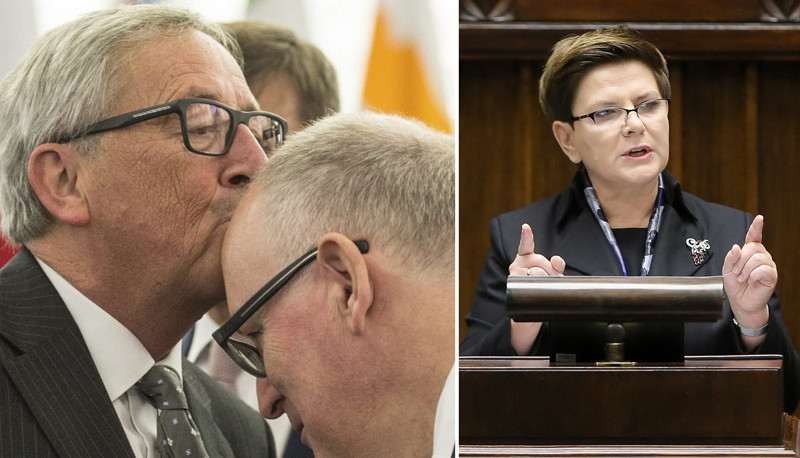
The European Commission, led by Jean-Claude Juncker and Frans Timmermans (left), is hell-bent on forcing member states to take “their share” of migrants. In March, Polish Prime Minister Beata Szydło (right) bluntly stated: “I see no possibility at this time of immigrants coming to Poland.”

In Hungary, Prime Minister Viktor Orban’s spokesman, Zoltán Kovács, stated:

“Mr. Timmermans is right that we have not had the same experience as Western Europe, where countries such as Holland, Britain and France have had mass immigration as a result of their colonial legacies. But we would like to deal with our problems in a way that suits us. And we especially do not like it when people who have never lived in Hungary try to give us lectures on how we should cope with our own problems. Calling us racists or xenophobes is the cheapest argument. It’s used just to dodge the issues.”

Even among those Eastern European countries still waiting to be admitted to the EU, the enthusiasm for the EU seems to have dwindled. “The EU that all of us are aspiring to, it has lost its magic power,” Serbian Prime Minister, Aleksander Vucic said in February, “Yes we all want to join, but it is no longer the big dream it was in the past.”

The reactions of countries such as Poland and Hungary are the normal, healthy reactions of nations who wish to remain prosperous, sovereign and safe for the sake of their own citizens. In addition, entertaining no illusions about “multiculturalism,” they appear to have a justifiable apprehension about the detrimental effects of the current migration crisis on national security and finances.

It is not only the newest members of the EU that have begun to realize that is a bad idea to defer decisions about borders and national security to an unelected supranational entity, which appears completely oblivious to the concerns of its member states.

In Norway, the government announced that it will not accommodate any more migrants beyond the 1500 that the country has already agreed to take during the next two years, as part of the EU’s refugee relocation scheme. “We have set a quota for refugees from the EU. Increasing it is not of current interest,” Immigration Minister Sylvi Listhaug said in April. Norway, in fact, has begun paying asylum seekers to return to their own countries.

In Austria, the government is imposing border controls at the Brenner Pass, the main Alpine crossing into Italy, and erecting a barrier between the two countries.

In the face of such resistance from member states, the European Commission’s plan to penalize them for not accepting “their share” of migrants could not possibly be more ill-timed and out of touch. It comes across as a desperate attempt by the EU’s executive body to force its way of handling the migrant crisis onto disobedient EU member states, like an authoritarian parent disciplining its unruly children. There is, however, such a thing as bending something until it snaps. By persisting in pushing their agendas on EU member states that still consider themselves sovereign and not merely provinces of the European Union, Timmermans and his European Commission bureaucrats may just have given the European Union its kiss of death.

Judith Bergman is a writer, columnist, lawyer and political analyst.
The EU is Coming to Close Down Your Free Speech by Douglas Murray

  • The German Chancellor was not interested in the reinforcement of Europe’s external borders, the re-erection of its internal borders, the institution of a workable asylum vetting system and the repatriation of people who had lied to gain entry into Europe. Instead, Chancellor Merkel wanted to know how Facebook’s founder could help her restrict the free speech of Europeans, on Facebook and on other social media.

  • Then, on May 31, the European Union announced a new online speech code to be enforced by four major tech companies, including Facebook and YouTube.
  • It was clear from the outset that Facebook has a definitional problem as well as a political bias in deciding on these targets. What is Facebook’s definition of ‘racism’? What is its definition of ‘xenophobia’? What, come to that, is its definition of ‘hate speech’?
  • Of course the EU is a government — and an unelected government at that — so its desire not just to avoid replying to its critics — but to criminalise their views and ban their contrary expressions — is as bad as the government of any country banning or criminalising the expression of opinion which is not adulatory of the government.
  • People must speak up — must speak up now, and must speak up fast — in support of freedom of speech before it is taken away from them. It is, sadly, not an overstatement to say that our entire future depends on it.

It is nine months since Angela Merkel and Mark Zuckerberg tried to solve Europe’s migrant crisis. Of course having caused the migrant crisis by announcing the doors of Europe as open to the entire third-world, Angela Merkel particularly would have been in a good position actually to try to solve this crisis.

But the German Chancellor was not interested in the reinforcement of Europe’s external borders, the re-erection of its internal borders, the institution of a workable asylum vetting system and the repatriation of people who had lied to gain entry into Europe. Instead, Chancellor Merkel was interested in Facebook.

When seated with Mark Zuckerberg, Frau Merkel wanted to know how the Facebook founder could help her restrict the free speech of Europeans, on Facebook and on other social media. Speaking to Zuckerberg at a UN summit last September (and not aware that the microphones were picking her up) she asked what could be done to restrict people writing things on Facebook which were critical of her migration policy. ‘Are you working on this?’ she asked him. ‘Yeah’, Zuckerberg replied.

In the months that followed, we learned that this was not idle chatter over lunch. In January of this year, Facebook launched its ‘Initiative for civil courage online’, committing a million Euros to fund non-governmental organisations in its work to counter ‘racist’ and ‘xenophobic’ posts online. It also promised to remove ‘hate speech’ and expressions of ‘xenophobia’ from the Facebook website.

It was clear from the outset that Facebook has a definitional problem as well as a political bias in deciding on these targets. What is Facebook’s definition of ‘racism’? What is its definition of ‘xenophobia’? What, come to that, is its definition of ‘hate speech’? As for the political bias, why had Facebook not previously considered how, for instance, to stifle expressions of open-borders sentiments on Facebook? There are many people in Europe who have argued that the world should have no borders and that Europe in particular should be able to be lived in by anyone who so wishes. Why have people expressing such views on Facebook (and there are many) not found their views censored and their posts removed? Are such views not ‘extreme’?

One problem with this whole area — and a problem which has clearly not occurred to Facebook — is that these are questions which do not even have the same answer from country to country. Any informed thinker on politics knows that there are laws that apply in some countries that do not — and often should not — apply in others. Contrary to the views of many transnational ‘progressives’, the world does not have one set of universal laws and certainly does not have universal customs. Hate-speech laws are to a very great extent an enforcement of the realm of customs.

As such it is unwise to enforce policies on one country from another country without at least a very deep understanding of that countries traditions and laws. Societies have their own histories and their own attitudes towards their most sensitive matters. For instance in Germany, France, the Netherlands and some other European countries there are laws on the statute books relating to the publication of Nazi materials and the propagation of material praising (or even representing) Adolf Hitler or denying the Holocaust. The German laws forbidding large-scale photographic representations of Hitler may look ridiculous from London, but may look less ridiculous from Berlin. Certainly it would take an enormously self-confident Londoner unilaterally to prescribe a policy to change this German law.

To understand things which are forbidden, or able to be forbidden, in a society, you would have to have an enormous confidence in your understanding of that country’s taboos and history, as well as its speech codes and speech laws. A ban on the veneration of communist idols, for instance, may seem sensible, tasteful or even desirable in one of the many countries which suffered under communism, wish to minimise the suffering of the victims and prevent the resurrection of such an ideology. Yet a universal ban on images or texts which extolled the communist murderers of tens of millions of people would also make criminals of the thousands of Westerners — notably Americans — who enjoy wearing Che Guevara T-shirts or continue their adolescent fantasy that Fidel Castro is an icon of freedom. Free societies generally have to permit the widest possible array of opinion. But they will have different ideas of where legitimate expression ends and where incitement begins.

So for Facebook and others to draw up their own attempt at a unilateral policy of what constitutes hate-speech would be presumptuous even if it were not — as it is — clearly politically biased from the outset. So it is especially lamentable that this movement to an enforced hate-speech code gained additional force on May 31, when the European Union announced a new online speech code to be enforced by four major tech companies, including Facebook and YouTube. Of course, the EU is a government — and an unelected government at that — so its desire not just to avoid replying to its critics — but to criminalise their views and ban their contrary expressions — is as bad as the government of any country banning or criminalising the expression of opinion which is not adulatory of the government.

That these are not abstract issues but ones exceedingly close to home has been proven – as though it needed proving – by the decision of Facebook to suspend the account of Gatestone’s Swedish expert, Ingrid Carlqvist. In the last year Sweden took in between 1 and 2% additional people to its population. Similar numbers are expected this year. As anyone who has studied the situation will know, this is a society heading towards a breakdown of its own creation, caused (at the most benign interpretation) by its own ‘open-hearted’ liberalism.

Countries with welfare models such as Sweden’s cannot take in such numbers of people without major financial challenges. And societies with a poor integration history cannot possibly integrate such vast numbers of people when they come at such speed. As anyone who has travelled around there can tell, Sweden is a country under enormous and growing strain.

There is a phase in waking up to such change which constitutes denial. The EU, the Swedish government and a vast majority of the Swedish press have no desire to hear critiques of a policy which they have created or applauded; the consequences will one day be laid at their door and they wish to postpone that day, even indefinitely. So instead of tackling the fire they started, they have decided to attack those who are pointing to the fact that they have set the building they are standing in on fire. In such a situation it becomes not just a right but a duty of free people to point out facts even if other people might not want to hear them. Only a country sliding towards autocracy and chaos, with a governing class intent on avoiding blame, could possibly allow the silencing of the few people pointing out what they can clearly see in front of them.

People must speak up — and speak up now, and speak up fast — in support of freedom of speech before it is taken away from them, and in support of journalists such as Carlqvist, and against the authorities who would silence all of us. It is, sadly, not an overstatement to say that our entire future depends on it.

Douglas Murray is a current events analyst and commentator based in London.

The Dutch Death Spiral From Paradise to Bolshevik Thought Police by Giulio Meotti

  • “It would have been better if the Dutch state had sent a clear signal [to terrorists] via a Dutch court that we foster a broad notion of the freedom of expression in the Netherlands.” — Paul Cliteur, Professor of Jurisprudence, Leiden University.

  • The historic dimension of Wilders’s conviction is related not only to the terrible injustice done to this MP, but that it was the Netherlands that, for the first time in Europe, criminalized dissenting opinions about Islam.
  • “I will never be silent. You will not be able to stop me… And that is what we stand for. For freedom and for our beautiful Netherlands.” — Geert Wilders, Dutch MP and leader of the Party for Freedom (PVV).
  • “We have a lot of guests who are trying to take over the house.” — Pym Fortuyn, later shot to death to “defend Dutch Muslims from persecution.”
  • Before being slaughtered, clinging to a basket, Theo van Gogh begged his assassin: “Can we talk about this?” But can we talk?

A country whose most outspoken filmmaker was slaughtered by an Islamist; whose bravest refugee, hunted by a fatwa, fled to the U.S.; whose https://www.google.it/&referrer=https://www.google.it/” target=”_blank”>cartoonists must live under protection, had better think twice before condemning a Member of Parliament, whose comments about Islam have forced him to live under 24-hour protection for more than a decade, for “hate speech.” Poor Erasmus! The Netherlands is no longer a safe haven for free thinkers. It is the Nightmare for Free Speech.

The most prominent politician in the Netherlands, MP Geert Wilders, has just been convicted of “inciting discrimination and insulting a minority group,” for asking at a really if there should be fewer Moroccans in the Netherlands. Many newly-arrived Moroccans in the Netherlands seem to have been responsible for a disproportionate amount of crime there.

Paul Cliteur, Professor of Jurisprudence at Leiden University, who was called as an expert witness, summed up the message coming from the court: “It would have been better if the Dutch state had sent a clear signal [to terrorists] via a Dutch court that we foster a broad notion of the freedom of expression in the Netherlands.”

Here are just a few details to help understand what Wilders experiences every day because of his ideas: No visitors are allowed into his office except after a long wait to be checked. The Dutch airline KLM refused to board him on a flight to Moscow for reasons of “security.” His entourage is largely anonymous. When a warning level rises, he does not know where he will spend the night. For months, he was able to see his wife only twice a week, in a secure apartment, and then only when the police allowed it. The Parliament had to place him in the less visible part of the building, in order better to protect him. He often wears a bulletproof vest to speak in public. When he goes to a restaurant, his security detail must first check the place out.

Wilders’s life is a nightmare. “I am in jail,” he has said; “they are walking around free.”

The historic dimension of Wilders’s conviction is related not only to the terrible injustice done to this MP, but that it was the Netherlands that, for the first time in Europe, criminalized dissenting opinions about Islam.

The Netherlands is a very small country; whatever happens to this enclave is seen in the rest of Europe. The Netherlands refused to surrender to the Spanish invasion. It was from Rotterdam, the second-largest Dutch city, that the Founding Fathers left to create the United States of America. It was to the Netherlands that some of the most brave, original European philosophers and writers — Descartes, Rousseau, Locke, Sade, Molière, Hugo, Swift and Spinoza — had to flee to publish their books. It is also the only corner of Europe where there were no pogroms against Jews, and where Rembrandt painted Jesus with the physical traits of Jews.

Take Leiden: “Praesidium Libertatis” (“Bastion of Freedom”) is the motto of the Netherlands’ most ancient university. Leiden was the university of Johan Huizinga, the great historian who opposed the Nazis and died in a concentration camp. Leiden was also the university of Anton Pannekoek, the mentor of Martinus Van der Lubbe, the Dutch hero who torched the Nazi Parliament in 1933.

In Leiden today, you meet brave intellectuals such as Afshin Ellian, an Iranian jurist who fled Khomeini’s Revolution in Iran and who also now lives under police protection for his observations on Islam. Ellian’s office is close to the former office of Rudolph Cleveringa. When the Nazis invaded the Netherlands and called on Dutch public officials to fill out a form in which they had to declare whether they were “Aryans” or “Jews”, everyone but Cleveringa capitulated. He understood the consequences of such commands.

Twelve years ago, the Netherlands was again plunged into fear for the first time since World War II. In Linnaeusstraat, a district of Amsterdam, Mohammed Bouyeri, a Muslim extremist, ambushed the filmmaker Theo van Gogh and slaughtered him, then pinned on his chest a letter threatening the lives of Geert Wilders and Ayaan Hirsi Ali. Before that murder, Pim Fortuyn, a professor who had formed his own party to save the country from Islamization, was shot to death to “defend Dutch Muslims from persecution.”

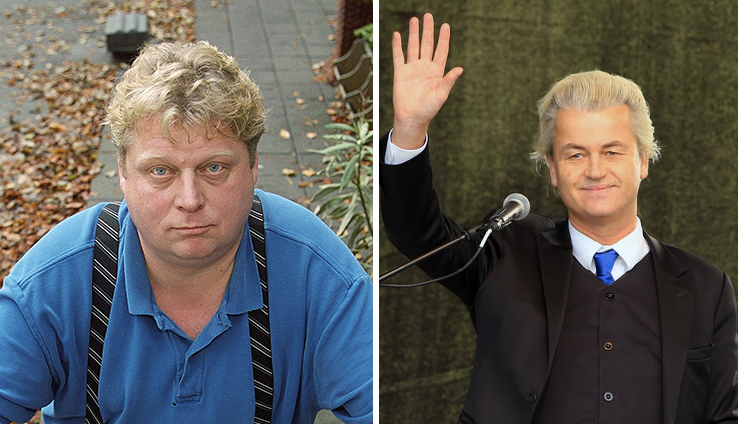
Twelve years ago, Dutch filmmaker Theo van Gogh (left) was assassinated by an Islamist who pinned on van Gogh’s chest a letter threatening the life of Geert Wilders (right). Today Wilders, the most prominent politician in the Netherlands, lives in hiding under round-the-clock protection.

Fortuyn had said, “We have a lot of guests who are trying to take over the house.”

Since then, many Dutch artists have capitulated to fear.

Sooreh Hera, from Iran, submitted her photos to the Gemeentemuseum Museum in The Hague. One of these works depicted Mohammed and Ali. After many threats, the museum proposed that it would acquire the photos without publishing them and that one day, perhaps, when the situation was calmer, they might show them then. Hera refused: it would have been self-censorship, a sad day for the West. Rants Tjan, director of Museum Gouda, bravely offered to exhibit her censored images, but that event was later cancelled, too. Hera was forced to go into hiding.

Paul Cliteur, a critic of multiculturalism, announced that he would no longer write for Dutch newspapers about Islam, for fear of reprisals: “With the murder of van Gogh, everyone who writes takes a certain risk. That is a scary development. What I am doing do is self-censorship, absolutely….”

Then a columnist, Hasna el Maroudi, from the newspaper NRC Handelsblad, stopped writing, after receiving threats.

The Dutch artist Rachid Ben Ali, irreverent about Islam, no longer satirizes Muslims.

Amsterdam, a city famous for its exuberant cultural life, had already lived through threats to artists: the occupation by the Nazis during World War II.

Several artists still refuse to mention Theo Van Gogh, so as not to “contribute to… divisions”, according to the New York Times. Translation: They are afraid. Who would not be?

In the Oosterpark, a steel sculpture by the artist Jeroen Henneman, dedicated to Van Gogh, is entitled “De Schreeuw” (“The Scream”). But it is a scream you hardly hear in the Dutch society.

What you do hear is the defiant protest after the conviction of a brave MP, Geert Wilders: “I will never be silent. You will not be able to stop me… And that is what we stand for. For freedom and for our beautiful Netherlands.”

Before being slaughtered, clinging to a basket, Theo van Gogh begged his assassin: “Can we talk about this?

But can we talk?

Ask Geert Wilders, just the latest brave victim of Europe’s Bolshevik thought police.

Giulio Meotti, Cultural Editor for Il Foglio, is an Italian journalist and author.

The Dragon of Islamic Terrorism by Dex Quire

  • The dragon’s first major tongue-dart at the West was the death threat — a fatwa with a bounty issued in 1989 by Iran’s Supreme Leader, Ayatollah Khomeini — on Salman Rushdie, a British citizen, for his novel, The Satanic Verses.

  • What the dragon learned with that initial thrust! The West was so genteel. The United Nations issued condemnations on — paper! Diplomats wrote scare-letters. Politicians said harrumph.
  • How different if politicians and diplomats in the West had delivered the simple and forceful message back to the Ayatollah: Unless you remove this threat, we will cancel all diplomatic visas.

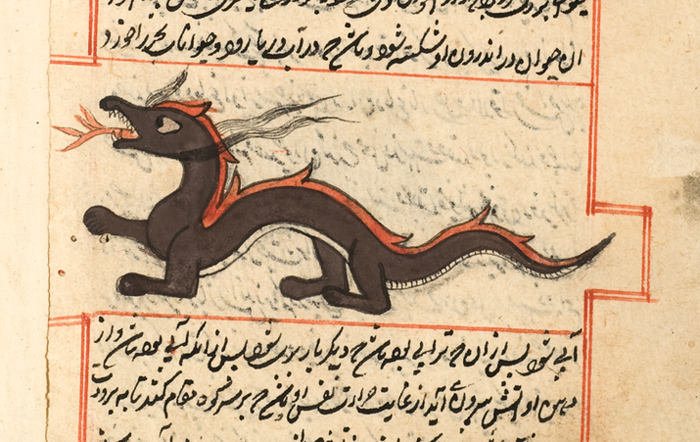
“The worst part of the dragon is in the tail.” You do not have to know what it means; it gives off a spooky authority. This thought was written by Guillermo Cabrera Infante, the great Cuban writer who knew something about dragons’ tails: he had confronted Fidel Castro and lived to tell about it. While on a diplomatic mission to Brussels in 1965, he denounced Castro, abandoned his post and lived out a life of exile in London until his death in 2005. He never went back.

For a minute, let us call the dragon Islamic Terror (we shall get back later to the tail). There is much about the dragon we do not know: where he lives exactly, his vulnerabilities, his comings and goings, his next attacks, his feeding schedule. We do know that he foments terror and inspires fear. From the front part of the dragon, his snout, emerges a tongue flick — tasting the air, sensing out fresh victims. His first major tongue-dart at the West was the death threat — a fatwa with a bounty issued in 1989 by Iran’s Supreme Leader, Ayatollah Khomeini — on Salman Rushdie, a citizen of Britain citizen, for his novel, The Satanic Verses.

What the dragon learned with that initial thrust! The West was so genteel. The United Nations issued condemnations on — paper! Diplomats wrote scare-letters. Politicians said harrumph.

(Image source: wikia.com)

Rushdie, on the other hand, was forced into hiding under armed, protective custody. Khomeini — who had just shoveled half a million young Iranians into a war with Iraq — in addition to exterminating thousands of “enemies of the Islamic Revolution” — also learned a lot about us. The response of the West was phlegmatic. The vast apparatus of publishing and communications zipped itself into a giant mouse suit and decided it looked great (so lifelike). Penguin Books chose not to print its address in the paperback edition of The Satanic Verses, as if that would hide it. Major book chains refused to stock the novel and libraries “disappeared” it from their shelves. Fellow novelists from around the world, from the safety of their hearths, proclaimed, “We are all Salman Rushdie.”

Even dragons know that novels, feeble though they may be, are the carriers of culture, core samples of a civilization’s memory. The dragon learned that in the West, it did not matter that fighter aircraft sear the skies at patriotic festivals, that nuclear submarines flow through ocean canyons, that warships ride the world’s watery trails. The West was not about to stick up for those who traversed the holies of Islam; instead, it clenched in fear and never unclenched.

How different the world would be if, in 1989, every publisher — large and small — had published some portion of The Satanic Verses on their front pages. How different if politicians and diplomats in the West had delivered the simple and forceful message back to the Ayatollah: Unless you remove this threat, we will cancel all diplomatic visas. But they did not, and this is now our world.

Novels tracking fundamentalist religious groups transplanting themselves into secular urban zones in the West go unwritten. Movies showing much of life under Islam go unfilmed. Satire of Muslim fundamentalism goes unproduced, while mockery of Christianity abounds. Comedians such as Penn Jillette, Sara Silverman, and Monty Python’s Michael Palin — entertainers who have grown wealthy proclaiming their atheism or mocking Christianity and Judaism — openly confess their fear of Islam; really just open confessions of cowardice. It should cover us in shame. “Cowardice,” wrote the novelist Mikhail Bugokov, in the darkest days of Stalin’s 1930s, “is the worst sin.”

The dragon doubtless now knows more about us than we know about him. But if we can reassert our freedoms — faith, speech, ideas, laughter and definitely mockery — we can still avoid his tail.

Dex Quire is a Seattle writer whose latest novel is Crocodile Words.

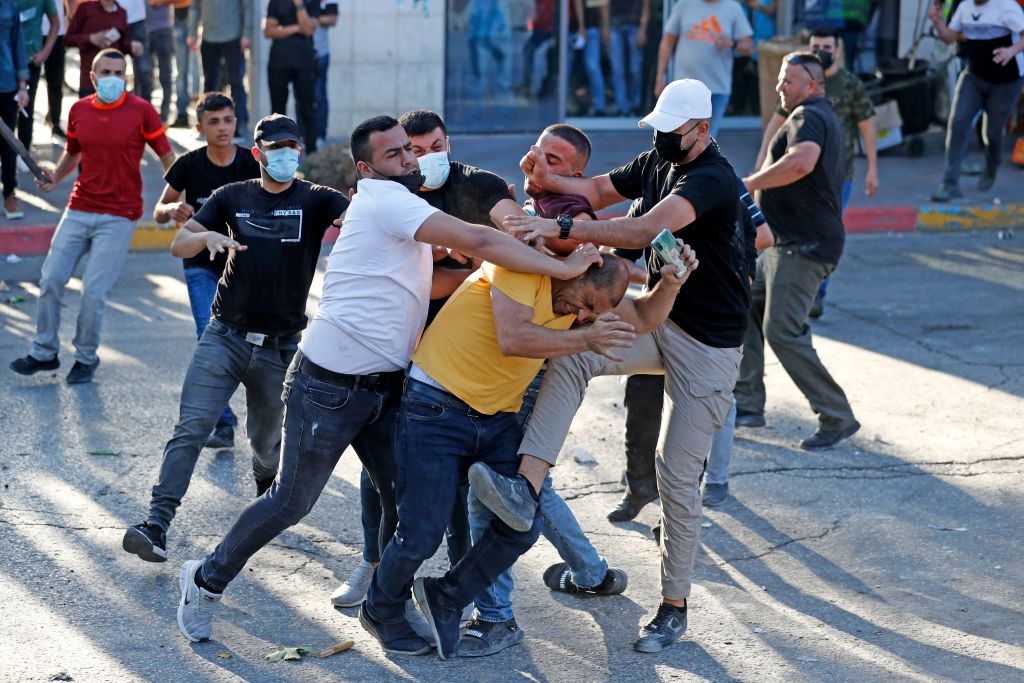
The Dirty Little Secret of Palestinian Journalism – with Agence France-Presse Collusion by Bassam Tawil

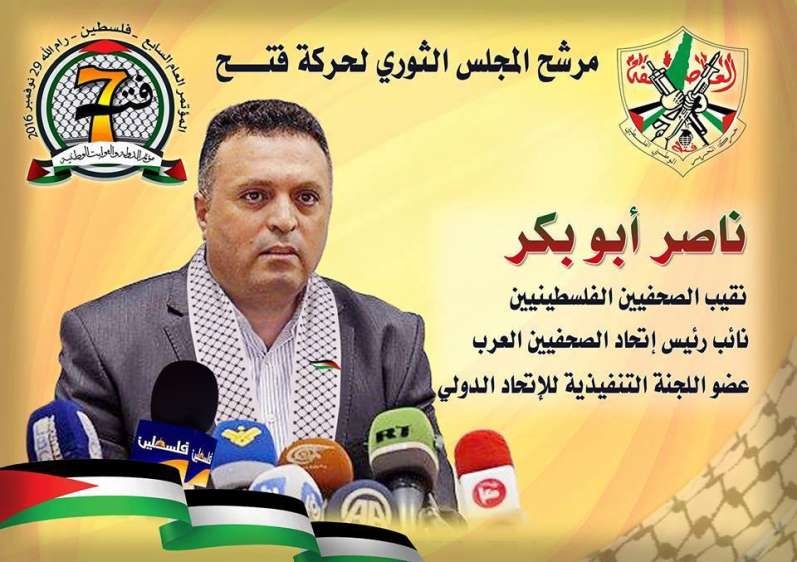
  • Nasser Abu Baker, Chairman of the Palestinian Journalists Syndicate (PJS), who also works as a correspondent for Agence France-Press (AFP), also lashed out at Al-Quds for publishing the Israeli advertisement. “We are determined to combat normalization and those who promote it,” he vowed.

  • Abu Baker, who recently ran in the election for the Fatah Revolutionary Council, is the architect of the PJS campaign to boycott Israeli journalists and media outlets. His political activism constitutes a flagrant violation of the regulations and principles of AFP, and a conflict of interest. However, this does not seem to bother his employers at the French news agency, who apparently do not see a problem with one of their employees running in the election for Fatah’s Revolutionary Council.
  • Abu Baker and his colleagues have one mission: to “combat normalization” with Israel. For them, this task far exceeds in importance exposing financial corruption in the Palestinian Authority (PA) or reporting about assaults on freedom of expression. It is also evidently more important than protesting the arbitrary arrest and torture of their colleagues at the hands of the PA and Hamas.
  • One can only imagine the response of the Western mainstream media if the chairman of the Israeli Journalists Union or the Government Press Office called for a boycott of Palestinian journalists.

Palestinian journalists are up in arms. The Palestinian Authority (PA) in the West Bank and Hamas in the Gaza Strip are arresting and torturing them, and imposing severe restrictions on their work and freedom of expression. But that is not what is upsetting them.

No, the journalists are angry because a Palestinian daily newspaper dared to publish a paid advertisement by the Israeli authorities. The journalists are now demanding that the newspaper, Al-Quds, apologize for running the advertisement by the Israeli Civil Administration in the West Bank.

Last week, dozens of angry journalists staged a protest outside the offices of the Fatah-controlled Palestinian Journalists Syndicate (PJS) in Ramallah, where they threatened to boycott the newspaper for “promoting normalization” with Israel by publishing the advertisement.

Murad Sudani, chairman of the Palestinian Writers Union, strongly condemned Al-Quds for running the advertisement and accused its editors of “promoting the Israeli narrative and settlements.” He also accused the newspaper of encouraging normalization with Israel, pointing out that Palestinian professional unions were in agreement over the need to oppose all forms of normalization with Israel.

Nasser Abu Baker, chairman of the PJS, who also works as a correspondent for Agence France-Press (AFP), lashed out at Al-Quds for publishing the advertisement. He told the protesters that Al-Quds should not “serve the policies” of Israel.

“We insist that Al-Quds remain a national institution of the Palestinian people,” he said. Abu Baker repeated his syndicate’s opposition to normalization with Israel and praised his colleagues for raising their voice against Al-Quds. Abu Baker demanded that the newspaper apologize to Palestinians in general and journalists in particular for allegedly promoting normalization with Israel. “We are determined to combat normalization and those who promote it,” he vowed.

Abu Baker, who recently ran in the election for the Fatah Revolutionary Council, is the architect of the Palestinian Journalists Syndicate’s campaign to boycott Israeli journalists and media outlets. His political activism constitutes a flagrant violation of the regulations and principles of AFP and a conflict of interests. However, this does not seem to bother his employers at the French news agency, who do not see a problem with one of their employees running in the election for Fatah’s Revolutionary Council.

Last year, Abu Baker and his syndicate called on Palestinian journalists and officials to boycott Israeli media outlets. In a statement, the syndicate claimed that Israeli journalists “enter the territories of the occupied State of Palestine and work there together with the occupation army and under its protection.” The statement accused Israeli journalists of being “unprofessional” and serving as a “mouthpiece for the occupation to justify its crimes against the Palestinian people.”

Still, AFP does not seem to see this call by one of its senior journalists as problematic. By accusing the Israeli journalists of serving as a “mouthpiece” for the Israeli authorities and working “under the protection” of the Israel Defense Forces, Abu Baker and his syndicate are actually endangering the lives of the Israeli journalists and turning them into supposedly legitimate targets. This is the case: a journalist working for a respected international news organization perpetrates incitement against Israeli reporters, and the AFP takes it in stride.

Nasser Abu Baker is a correspondent for Agence France-Presse and heads the Ramallah-based Palestinian Journalists Syndicate (PJS). He is also a political operative who recently ran in (and lost) an election for Fatah’s Revolutionary Council.

Abu Baker is not the only journalist working for an international media outlet who is involved in political activism. Several other Palestinian journalists who participated in the protest against Al-Quds and who openly advocate boycotts of Israel have long been serving as producers and reporters for Western media outlets. This is the “dirty little secret” that Western media outlets do not wish to reveal for various reasons. One of them is because they are afraid of losing access to sources in the Palestinian Authority. Another is because these media outlets sympathize with their Palestinian producers and reporters and see them as “victims” of Israel. Yet, hell would freeze over before they would employ an Israeli political activist as a reporter or producer.

The case of AFP’s Abu Baker spotlights the bias of the mainstream media against Israel. Journalists like Abu Baker are silent about anything that reflects negatively on the Palestinian Authority in general or Palestinians in particular. These journalists regard themselves as “soldiers” serving their leaders and cause. They are interested exclusively in the wrongdoings of Israel, and they are obsessed with news that paints Israel black.

This trend has even found its way to some Israeli news organizations, whose reporters actually avoid stories that could turn their Palestinian colleagues against them. Asked why he was not reporting about the conflict of interest of some Palestinian journalists who double as activists, one Israeli journalist explained that he does not want to “lose access” to Palestinian sources and he does not want to upset Palestinians he works with and seeks to interview.

Abu Baker and his colleagues have one mission: to “combat normalization” with Israel. For them, this task far exceeds in importance exposing financial corruption in the Palestinian Authority or reporting about assaults on freedom of expression. It is also evidently more important than protesting the arbitrary arrest and torture of their colleagues at the hands of the PA and Hamas.

The latest campaign against Al-Quds is not the first of its kind. In October 2016, the newspaper came under fire for interviewing Israeli Defense Minister Avigdor Lieberman. Again, the condemnations were spearheaded by Palestinian journalists who accused the newspaper of promoting “normalization” with Israel. The Palestinian Authority’s Ministry of Information accused Al-Quds of providing a “killer” with a platform.

Here it is worth noting that no such ban exists on Palestinian officials in the Israeli media. Palestinian officials, including President Mahmoud Abbas, Jibril Rajoub and Saeb Erekat are regularly interviewed by Israeli newspapers, television channels and radio stations. One can only imagine the response of the Western mainstream media if the chairman of the Israeli Journalists Union or the Government Press Office called for a boycott of Palestinian journalists.

The campaign against Al-Quds is in the context of the Palestinians’ war against “normalization” with Israel. The goal of the campaign is out-and-out intimidation — of any Palestinian who wishes to meet with an Israeli. As such, it is a campaign that severely damages peace prospects between Palestinians and Israelis.

Such a campaign of intimidation becomes even more dangerous when it is fueled by journalists, some of whom work for major Western media organizations. The Palestinian journalists’ “anti-normalization” onslaught shows that they have managed to infiltrate and influence Western news organizations, which almost always submit to the dictates of their Palestinian employees. No great wonder, then, that Israel is anathema in the Western media.

Bassam Tawil is a scholar based in the Middle East.

Translate »
Skip to toolbar