Daily Archives: June 19, 2017

Palestinians: Sex in Gaza City by Khaled Abu Toameh

  • A 27-year-old female journalist recounted that a Palestinian official working for the UN Relief and Works Agency (UNRWA) in Gaza invited her for a job interview. The official “tried to approach and touch her, but she walked away and left the office… The following day… he offered her the job in return for having sexual intercourse with him.”
  • The victim noted that under Palestinian law, UNRWA officials enjoy immunity from being prosecuted.

  • Palestinian journalist Amjad Yaghi found that the Palestinian Basic Law does not tackle the issue of sexual harassment in Palestinian society. Meanwhile, the Hamas connections of these criminals will keep them out of jail and in positions of power.
  • Where are the women’s rights organizations now? Where are the European and American overseers of the international human rights organizations in the Gaza Strip? Do they only awaken from their slumber when they smell fresh Israeli meat? How many women will be sexually assaulted while these watchdogs sleep?

Sex is a taboo topic in the conservative Palestinian society. So it came as a nasty surprise to many when the rampant sexual harassment in the Hamas-controlled Gaza Strip was recently brought to public attention.

A damning report, entitled “Gaza: Sexual Harassment and Bribery Chase Job-Seekers,” was published in the Beirut-based, Hezbollah-affiliated newspaper Al-Akhbar. Amjad Yaghi, the young Palestinian journalist who wrote the exposé, showed extraordinary courage in doing so.

Hamas, needless to say, was not amused.

Yaghi wrote that

“[some] public personalities in the Gaza Strip are no longer abiding by the professional standards of their moral work after being overcome by their sexual instincts and professional duties. They are exploiting their status, especially their decision-making regarding employment, appointments and providing services and funds to projects in light of the absence of working opportunities for women.”

According to Yaghi, the report was published in a Lebanese newspaper because the Palestinian media forbids stories that might enrage the public and “harm” Palestinian traditions and morals.

Yaghi sets out clearly the Catch-22:

“The victims do not have the freedom to talk about their experiences and that is why most of the women who are subjected to sexual harassment remain silent. … They are afraid that they could be deprived of new employment or that their reputation would be affected.”

The report found at least 36 Palestinian women working in various fields who had fallen victim to sexual harassment and exploitation. Reflecting Yaghi’s description of their dilemma, 25 of the victims refused to provide full details about their experiences, and the remaining 11 agreed to talk openly about the problem only on condition of anonymity.

Sexual crimes of various sorts were reported. Twenty of the women reported experiencing sexual harassment at their workplaces, while ten others said they were asked to provide “sexual bribes.” Six of the women told Yaghi that they had been sexually assaulted at work.

A 27-year-old female journalist told the Yaghi that a Palestinian official working for the United Nations Relief and Works Agency for Palestinian Refugees (UNRWA) invited her to his office for a job interview:

“When she came to his office, the official tried to approach and touch her, but she walked away and left the office… The following day, the official was more honest with her; he offered her the job in return for having sexual intercourse with him. She was shocked and stopped talking to him.”

The woman believes that the senior status of the official who sexually harassed her will protect him from being held accountable for his behavior. She also alluded to a larger and deeper problem in the Arab and Islamic world: “Our society doubts the integrity of a woman who talks about honor.” As a third obstacle to prosecution, she noted that under Palestinian law, UNRWA officials enjoy immunity from being prosecuted.

Immunity from prosecution for sexual crimes, however, apparently does not apply to the top echelons of internationally funded organizations. For example, the director of an international aid organization in the Gaza Strip, who purportedly offered a 28-year-old job applicant a highly-paid position in return for sex.

Lawyers in the Gaza Strip would seem to have enough to do without sexually harassing their employees. But a 23-year-old female legal trainee told the investigative journalist that her boss, a 45-year-old male attorney, made sexual advances to her and to three of her female colleagues. Another male lawyer offered a female colleague 50 shekels ($12) if she allowed him to touch her body.

According to the report, 13 female journalists in the Gaza Strip have also faced sexual harassment and assault in recent years.

Yaghi found that the Palestinian Basic Law does not tackle the issue of sexual harassment in Palestinian society. While the law does refer to corruption in the workplace, sexual harassment is not detailed as a form of corruption.

Much has been written recently about the widespread increase in child abuse in the Hamas-controlled Gaza Strip, where children are exposed to constant brainwashing by armed groups. Last week, a new video surfaced of how the radical Islamist groups in the Gaza Strip incite Palestinian children. The video features children dressed as Islamic Jihad militiamen, play-acting the detonation of a bomb near an Israeli tank. The audience, the parents of these child actors, can be heard cheering and applauding.

In a society where children are indoctrinated to murder Jews, it comes as no surprise that women are victims of different kinds of exploitation as well.

Yaghi keeps the identities of the male offenders out of the public eye. Yet these are clearly senior officials working in the private and public sectors. Just as clearly, the sexual harassment victim of the UNRWA official was right: the Hamas connections of these criminals will no doubt keep them out of jail and in positions of power.

Where are the women’s rights organizations now? And where are the European and American overseers of the international human rights organizations in the Gaza Strip? Could it be that these worthy watchdogs only awaken from their slumber when they smell fresh Israeli meat? Meanwhile, how many women will be sexually assaulted and harassed while these watchdogs sleep?
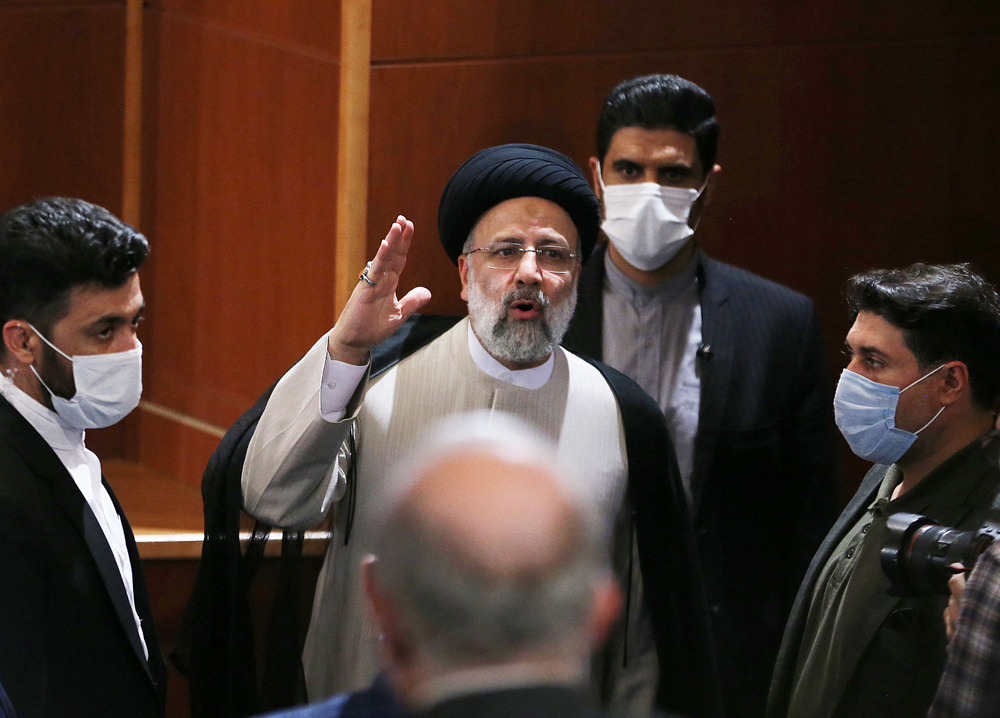
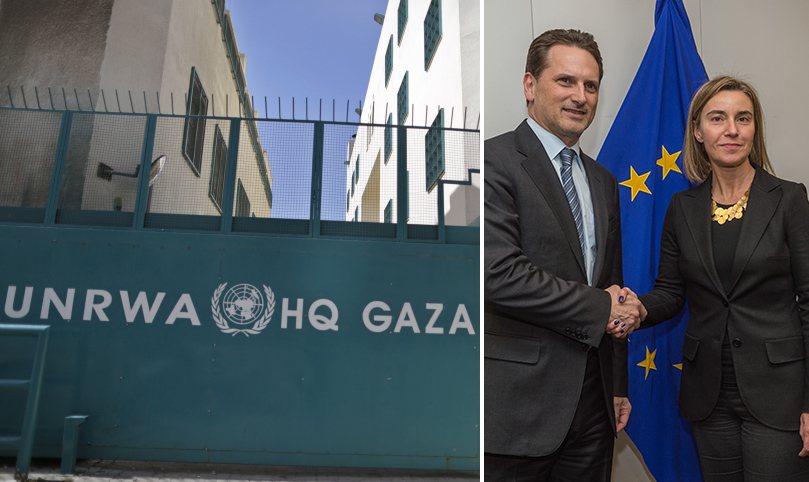
When it comes to sexual harassment, where are the European and American overseers of the international human rights organizations in the Gaza Strip? Under Palestinian law, UNRWA officials enjoy immunity from being prosecuted, and the Hamas connections of officials that engage in sexual harassment will no doubt keep them out of jail and in positions of power. Pictured at right: Pierre Krähenbühl, Commissioner-General of UNRWA, meets with Federica Mogherini, the EU’s High Representative for Foreign Affairs.

Khaled Abu Toameh is an award-winning journalist based in Jerusalem.
Palestinians: Laughing Their Heads Off by Khaled Abu Toameh

  • As in any comedy, there is a clown, and Biden was played for a fool by a Palestinian Authority leadership that finds that it pays to point its finger at Israel.

  • Here is a dirty little secret: the Palestinian attackers were not driven to murder Jews because of “settlements” and “checkpoints.”
  • Check their Facebook accounts: what fueled their hatred were the lies they had been fed for the past few years by President Abbas and other Palestinian leaders. Palestinian media outlets and spokesmen vomit poison against Israel.
  • And so the curtain rises on another act of the ceremonial, make-believe theater of the Middle East. In Abbas’s sneaky script, it is about settlements. In reality, it is about the refusal of the Americans to read, speak or even translate Arabic.

U.S. Vice President Joe Biden visited Ramallah last week, and Palestinian Authority (PA) President Mahmoud Abbas and his top officials are laughing their heads off.

Why not laugh? Biden arrived in the region hoping to persuade the Palestinian leaders to issue a “condemnation” of the reign of terror, which they continue to describe as a “popular and peaceful uprising.” This in itself reeks of gallows humor.

But what Biden got was even funnier, from the point of view of Abbas and his friends.

The Palestinian president offered “condolences” over the killing of a U.S. citizen in Jaffa the previous day: “The President [Abbas] offered his condolences over the killing of the US citizen, while stressing at the same time that the occupation authorities have killed 200 Palestinians over the past five months,” according to a statement released by the PA leadership in Ramallah.

Abbas’s crocodile tears were shed for Taylor Force, a West Point graduate from Texas who was stabbed to death by a Palestinian during a rampage on the Jaffa beachfront promenade. Abbas is doubtless also upset because Israel has killed Palestinian stabbers and shooters.

Just before Biden arrived in Ramallah, Abbas’s Fatah faction praised the murderer of Force, calling him a “martyr.” But Fatah was quick to delete the posts to avoid embarrassing the Palestinian leadership during Biden’s visit.

It seems that the murder of an American visitor is condemnable, but the murder of some 34 Israelis since last October, including a pregnant woman and civilians, is somewhat less so.

Where was the condemnation of the wounding of nine Israelis in the attack that killed Taylor Force? Where was the condemnation of the attacks the took place on that very day in Jerusalem and Petah Tikva?

But Abbas explained everything to Biden: Israel was in fact fully responsible for the “violence and bloodshed” because of the “occupation” and “settlements.”

Here is a dirty little secret: the Palestinian attackers were not driven to murder Jews because of “settlements” and “checkpoints.”

Check their Facebook accounts: what fueled their hatred were the lies they had been fed for the past few years by President Abbas and other Palestinian leaders, concerning Jews “desecrating” Islamic holy sites and plotting to destroy them. No checkpoint snags, no settlement issues, no protests against construction of new apartments in Jerusalem for Jewish families.

Many of these Palestinians went for Israeli blood because they have been taught — by Mahmoud Abbas, the Palestinian Authority, Hamas and other Palestinian groups — to hate Israel. And they do not give a damn whether that Jew lives in Jaffa or in the West Bank. They also do not give a damn if some of their victims are Arabs.

Yet the comedy continues. Biden is reported to have urged Abbas and the Palestinian leadership to stop the anti-Israel incitement in their official media and on social media. Abbas vehemently denied that this incitement was taking place, and indeed, explained that the US leader had gotten things mixed up entirely: it was Israel that was guilty of incitement against the Palestinians.

While Abbas was busy offering his condolences for the killing of the U.S. citizen, his ruling Fatah faction was busy glorifying Palestinian assailants who killed Israelis.

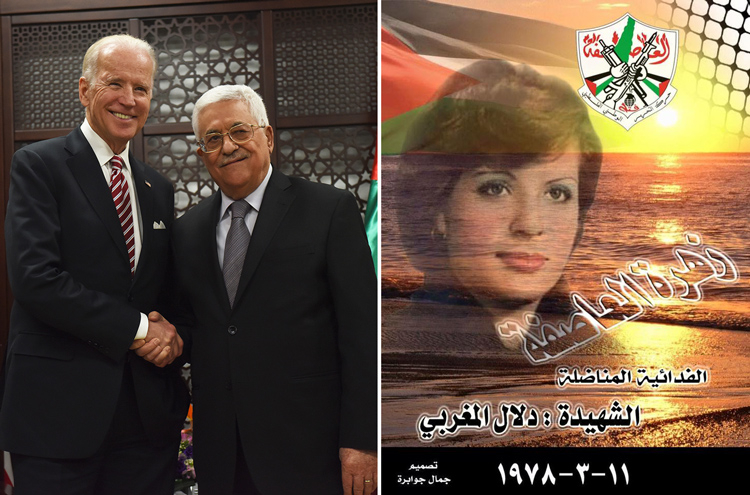
In one instance, Fatah published an announcement inviting Palestinians to mark the 38th anniversary of the “martyrdom” of Dalal Al-Mughrabi.

Al-Mughrabi was a Fatah member who participated in the 1978 Coastal Road massacre in Israel, in which 38 civilians were killed, including 13 children.

U.S. Vice President Joe Biden visited Palestinian Authority President Mahmoud Abbas in Ramallah on March 10, hoping to persuade Abbas to issue a “condemnation” of the wave of terror attacks against Israelis. The next day, Abbas’s Fatah party invited Palestinians to commemorate the 38th anniversary of the “martyrdom” of Dalal Al-Mughrabi. Al-Mughrabi was a Fatah member who participated in the 1978 Coastal Road massacre in Israel, in which 38 civilians were killed, including 13 children.

The condolence message was also long enough for Fatah to praise Palestinian assailants, including Abdel Malek Abu Kharoub, who carried out a recent shooting attack in Jerusalem. In a post on its official Facebook account, Fatah hailed Abu Kharoub as a “hero and martyr.”

Of course neither Biden nor any of his advisors and aides saw these posts. They prefer to continue burying their heads in the sand and pretending that once the “peace process” is revived, everything will be fine.

So it is business as usual for Abbas and crew. As in any comedy, there is a clown, and Biden was played for a fool by a PA leadership that finds that it pays to point its finger at Israel.

In Arabic, a language in which Western leaders are perhaps not fluent, Palestinian media outlets and spokesmen vomit poison against Israel. Condemnation of attacks on Israelis would be rather unlikely in such a drama.

And so the curtain rises on another act of the ceremonial, make-believe theater of the Middle East. In Abbas’s sneaky script, it is about settlements. In reality, it is about the refusal of the Americans to read, speak or even translate Arabic.

Khaled Abu Toameh, an award-winning journalist, is based in Jerusalem.

Palestinians: Kerry and the Game of Obfuscation by Khaled Abu Toameh

  • This “intifada” is simply a further phase in a larger plan to destroy Israel. When the plan began officially, with the establishment of the PLO in 1964, there were no “settlements” — not until after the June 1967 War — so what exactly were the Palestinians planning to “liberate”?

  • The current conflict is not about “defending” any mosque from being contaminated by the “filthy feet” of Jews: it is about seeing Israel forced to its knees. Abbas and others seek to reap delicious political fruits from this “intifada.”
  • Here is a novel idea: Kerry could put pressure on the Palestinian and Jordanian leadership to cease anti-Israeli incitement and indoctrination. Now that would be pressure well applied.
  • Abbas is expected to become a partner in the fight against ISIS and radical Islamist groups. All well and good. Why then is he not expected to stop cheering on and glorifying young Palestinians who attack Jewish Israelis?

U.S. Secretary of State John Kerry is back in town. This time he is meeting with Jordanian and Palestinian leaders about “ongoing security issues in the region and continued tensions between Israel and the Palestinians.”

For those not involved in political newspeak, here is a translation:

“Ongoing security issues” = the Islamic State terror group (ISIS).

“Tensions between Israel and the Palestinians” = the ongoing wave of Palestinian stabbing, car-ramming and shooting attacks that began in October 2015.

Jordan and the Palestinian Authority (PA) fighting ISIS? Now that’s an idea! Jordanian King Abdullah and PA President Mahmoud Abbas ending “tensions” between Israel and the Palestinians? Let’s think about that.

Kerry comes back, but never calls a spade a spade. The “tensions” to which he deceptively alludes are knifings and car-rammings. And what is the biggest spade that Kerry avoids calling by its name? The new generation of Palestinians brainwashed to believe that Israel can be defeated with knives and car-attacks.

This “intifada” is simply a further phase in a larger plan to humiliate and destroy Israel. This plan began officially, with the establishment of the Palestine Liberation Organization (PLO), in May 1964. At that time there were no “settlements” — not until after the June 1967 War — so what exactly were the Palestinians planning to “liberate”?

The plan continued in 1974, at the twelfth session of the Palestinian National Council in Cairo, with the 10-point “Phased Plan” (see Appendix below for full text of the Phased Plan). Article 2 called for “armed struggle” (terrorism) to establish “an independent combatant national authority” that is “liberated” from Israeli rule.

Contrary to Palestinian leaders’ pap, the current conflict is not about “defending” any mosque from being contaminated by the “filthy feet” of Jews: it is about seeing Israel forced to its knees. Abbas and others seek to reap delicious political fruits from this “intifada.”

That is why, in his meeting with Kerry, Abbas made it clear that he intends to pursue unilateral moves to impose a solution on Israel, with the help of the international community.

Abbas also told Kerry that he intends to continue with his efforts to seek a UN Security Council resolution condemning Israel over “settlement construction.”

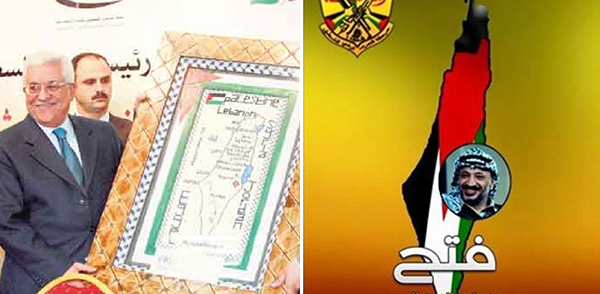
Never mind that on Palestinian maps, all of Israel is regarded as one big “settlement.”

Palestinian Authority leaders, official television, schools and media outlets often display maps showing Palestine stretching from the River Jordan to the Mediterranean Sea. The maps do not show the existence of Israel.

But back to Kerry. His “tensions” imply two sides engaged in some kind of a dispute that has aggravated a situation and strained relations between them, instead of what it really is: Palestinians openly trying to supplant Israelis — the entire state.

So the game of obfuscation continues. No doubt, we will witness more pressure on Israel to make concessions that will supposedly ease the “tensions.”

Kerry and his friends either do not “get it” or do not want to “get it.” Palestinians are waging an out-and-out war against Israel with the goal of making Israelis suffer to a point at which they will beg their leaders to capitulate. In the Palestinian view, such behavior pays off royally.

It is a Palestinian commonplace that the two previous uprisings — in 1987 and 2000 — brought major achievements to the Palestinians.

The first “intifada” led to Israel’s recognition of the PLO as the “sole legitimate representative of the Palestinians” — a move that was followed by the signing of the Oslo Accords and the creation of the Palestinian Authority.

The second “intifada,” the Palestinians argue, led to Israel’s full withdrawal from the Gaza Strip in the summer of 2005.

And so we arrive at the newest wave of attacks. As the saying goes: Step-by-step.

Kerry would like to see an end to the Palestinian attacks on Israeli Jews. The only problem is that his vacuous rhetoric prevents him from having a snowball’s chance in a Middle Eastern summer from attaining that goal.

Let us also not underestimate Palestinian Authority rejectionism. On the eve of the Kerry-Abbas meeting, Palestinian Authority officials were quoted as saying that they did not expect anything positive to come out of the talks “because the U.S. remains biased in favor of Israel.”

As always, the Palestinian stance is, “My way or the highway.”

Moreover, Kerry is dreaming if he thinks that President Mahmoud Abbas or King Abdullah are able to stop the attacks on Israelis. Neither has the mandate or the credibility to do so. In any case, they and their media outlets are too busy with their anti-Israeli ranting to do much on that score.

Thus far, not a word has been uttered by either of the two Arab leaders that could be even vaguely interpreted by their people as “stop killing Israelis.” In the Palestinian Looking Glass, it is Israel that is responsible for the deadly attacks. After all, claims that are untrue about Israelis “storming and desecrating the Al-Aqsa Mosque and other Islamic holy sites” are provocative, to say the least.

Here is a novel idea: Kerry could put pressure on the Palestinian and Jordanian leadership to cease anti-Israeli incitement and indoctrination. Now that would be pressure well applied. And it does not even require funding.

President Abbas is expected to become a partner in the fight against ISIS and radical Islamist groups. All well and good. Why then is he not expected to stop cheering on and glorifying young Palestinians who attack Jewish Israelis?

When Kerry and his crew finally wake up to the fact that it is precisely this incitement that is driving Palestinians into the open arms of ISIS, Hamas and other terror groups, perhaps, finally, we will be able to hope for “easing tensions in the region.”

Meanwhile, Kerry is back blathering about peace in the Middle East. Unfortunately, he seems incapable of calling a spade a spade — especially when that spade’s name is Palestinian prevarication.

Khaled Abu Toameh, an award-winning journalist, is based in Jerusalem.

Palestinians: Is Abbas Losing Control? by Khaled Abu Toameh

  • If Palestinian Authority President Mahmoud Abbas loses control of his Fatah faction, who gets to comfort him? Could it be his erstwhile rivals in Hamas?

  • Abbas seems firm in his refusal to pave the way for the emergence of a new leadership in the West Bank. A split within Fatah in the West Bank seems the inevitable result. Gaza’s Fatah leaders are furious with Abbas. The deepening divisions among Fatah could drive Fatah cadres in the Gaza Strip into the open arms of Hamas.
  • “The talk about Fatah-Hamas reconciliation is nothing but a smokescreen to conceal the growing discontent with President Abbas’s autocratic rule.” — Palestinian official.
  • Fatah is Israel’s purported “peace partner” — the faction spearheading efforts to establish an independent Palestinian state. Decision-makers in the U.S. and Europe might wish to keep abreast of the solvency of Abbas’s Fatah faction when they consider the wisdom of the two-state solution.

If Palestinian Authority (PA) President Mahmoud Abbas loses control of his Fatah faction, who gets to comfort him? Could it be his erstwhile rivals in Hamas?

Abbas has been facing increasing criticism in the past weeks from senior Fatah officials in both the West Bank and Gaza Strip. It seems that they have tired of his autocratic-style rule. Some of them, including Jibril Rajoub and Tawfik Tirawi, have even come out in public against the PA president, demanding that he share power enough at least to appoint a deputy president.

Fatah seems to be in even worse shape in the Gaza Strip. Fatah leaders and activists there have accused Abbas of “marginalizing” the faction, and are making unmistakable break-away noises.

At a meeting of Fatah cadres in the Gaza Strip last week, Abbas and the Palestinian Authority leadership were castigated for turning their backs on the faction there.

Fatah’s top representative in the Strip, Zakariya Al-Agha, said that the faction’s leaders, including Abbas, do not want to see Fatah (in the Gaza Strip) reorganize itself and “pick up the pieces.”

Another senior Fatah official in Gaza, Abdel Rahman Hamad, took advantage of the meeting to announce that, “Some were trying to turn Fatah in the Gaza Strip into a “weary and spiritless body.”

Fatah leaders in Gaza are furious with Abbas. They have a substantial list of grievances. First, Abbas has not paid the salaries of thousands of their members there, including policemen and security officers who have been sitting at home since Hamas seized control over the Strip in 2007.

Moreover, they point an accusing finger at Abbas’s failure to include any Fatah members from Gaza in a recent decree to appoint 130 Palestinians as senior officials within the Palestinian Authority.

Abbas’s failure to hold general elections for the Fatah faction is a further issue of contention. It is roundly suspected that the PA president is deliberately delaying the vote in order to prevent his rivals in the faction from winning key positions.

Amal Hamad, a resident of the Gaza Strip and member of the Fatah Central Committee, joined the chorus of Abbas detractors, declaring, “We wish to tell our (Fatah) brothers in the West Bank that we are an integral part of you. We are an original part of this homeland. It’s time to end the state of silence and put matters on their right track.”

Hamad’s remarks are the strongest yet to be directed against Abbas and the Fatah leadership in the West Bank. Palestinian political analysts read in Hamad’s words a signal that Fatah might well be facing the threat of splintering, one group in the West Bank and another in the Gaza Strip.

The deepening divisions among Fatah could also drive the Fatah cadres in the Gaza Strip into the open arms of Hamas. Hints to this effect have been dropped in recent weeks by Fatah officials in Gaza. They have noted that they do not rule out the possibility of joining forces with Hamas and Islamic Jihad and other Palestinian groups in the Gaza Strip as a way of protesting their continued “marginalization” by Abbas.

And then there is always Qatar. As the crisis in Fatah intensifies, reports have surfaced of a fresh Qatari effort to achieve “national reconciliation” between Fatah and Hamas. According to the reports, the two parties are scheduled to hold “secret talks” in Doha in the coming days in yet another bid to form a Palestinian national unity government.

Senior Fatah officials have dismissed these reports as simply the most recent in a long line of attempts by Abbas to divert attention from the crisis he’s facing in his own backyard (Fatah).

“Each time we hear about increased tensions in Fatah and criticism of President Abbas, we suddenly receive reports about renewed efforts to achieve reconciliation with Hamas,” one official said. “The talk about Fatah-Hamas reconciliation is nothing but a smokescreen to conceal the growing discontent with President Abbas’s autocratic rule.”

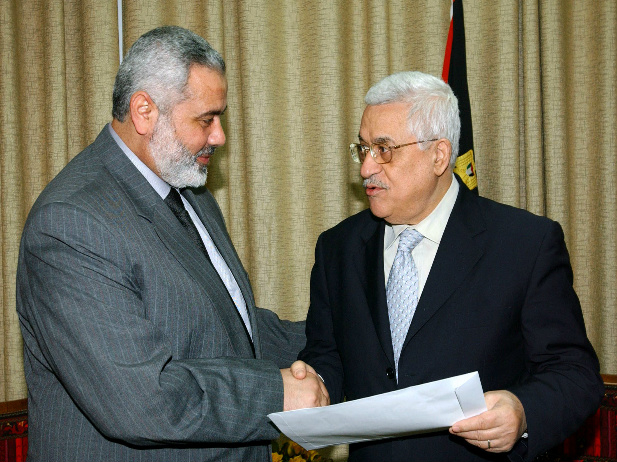
According to a Palestinian official, “The talk about Fatah-Hamas reconciliation is nothing but a smokescreen to conceal the growing discontent with President Abbas’s autocratic rule.” Pictured above, Palestinian Authority President Mahmoud Abbas (right) shakes hands with Hamas’s leader in Gaza, Ismail Haniyeh, during negotiations in 2007 for a short-lived unity government. (Image source: Palestinian Press Office)

Hamas aside, Qatar’s reconciliation ventures could be put to good use by Abbas: perhaps it would be willing to host a sulha (reconciliation) meeting to end the internal strife plaguing Fatah, the predominant power in the PA. Fatah’s festering dissension points to a Palestinian political scene that could be headed toward complete chaos — especially in the West Bank.

Abbas seems firm in his refusal to pave the way for the emergence of a new leadership in the West Bank. A split within Fatah in the West Bank seems the inevitable result. Palestinians may see several Fatah officials officially break away from the faction and create their own leaderships — turning the West Bank into so many cantons ruled by rival Fatah leaders. Of course, under such conditions, the Palestinian Authority would hardly hold its own as a central power in the West Bank.

As for the Gaza Strip, Fatah discontent is likely to escalate in the wake of Abbas’s continued policy of “marginalizing” the Fatah members there. Having already lost the Strip to Hamas, Abbas may soon lose his loyalists there. In the end, Gaza could see the emergence of a Fatah leadership that does not report at all to its sister in the West Bank.

Fatah is Israel’s purported “peace partner” — the faction that is spearheading efforts to establish an independent Palestinian state. Yet one wonders if Palestinians will live long enough to see their leaders lead them towards a state — or even a better life.

Decision-makers in the U.S. and Europe might wish to keep abreast of the solvency of Abbas’s Fatah faction when they consider the wisdom of the two-state solution.

Khaled Abu Toameh is an award-winning journalist based in Jerusalem.
Palestinians: Hunger Strike or Smokescreen? by Bassam Tawil

  • It is an integral part of the Palestinian strategy to undermine, isolate, delegitimize and destroy Israel.It is not only Palestinian Authority President Mahmoud Abbas who is in trouble. Marwan Barghouti, too, knows better than to air dirty Fatah laundry. What, then, is to be done? The traditional diversionary tactic: Direct the heat towards Israel.

  • Stripped of its Western trappings, Barghouti’s “hunger strike” is actually a struggle between Abbas and yet another Fatah pretender to the throne. And once again, Israel — the state that supposedly so “mistreats” incarcerated Palestinian terrorists — takes the heat.

Palestinians have an old habit of settling internal scores by diverting their grievances and violence towards Israel. This practice is clear to those who have been monitoring developments in the Palestinian arena for the past decades. It is an integral part of the Palestinian strategy to undermine, isolate, delegitimize and destroy Israel.

Those less familiar with Palestinian culture and tactics, however, have difficulty understanding the Palestinian mindset. Officials in Washington, London, Paris and other Western capitals rarely meet the ordinary Palestinian, the “man on the street” who represents the authentic voice of the Palestinians.

Instead, these officials meet Palestinian politicians and academics from Ramallah — the “experts” who are actually accomplished con artists. Such Palestinians grasp the Western mindset very well, and use their understanding to twist Western officials any which way they want.

The Western reaction to the hunger strike declared on April 17 by Palestinian prisoners held in Israeli jails is a case in point. The strike was initiated by Marwan Barghouti, a senior Fatah official who is serving five life terms for his role in terror attacks against Israelis. Barghouti has been in prison for 15 years so far.

Remarkably, despite Barghouti’s long-term imprisonment, this is his first hunger strike, apparently despite the poor incarceration conditions that have supposedly driven him to this move. Or might there be some other factor behind Barghouti’s sudden acute discomfort?

The hunger strike is, in fact, completely unrelated to conditions in Israeli prisons. Rather, Barghouti’s hunger strike is directly linked to a power struggle that has long been raging inside his Fatah faction. More than a move against Israel, the hunger strike is aimed at Palestinian Authority (PA) President Mahmoud Abbas (who is also chairman of Fatah).

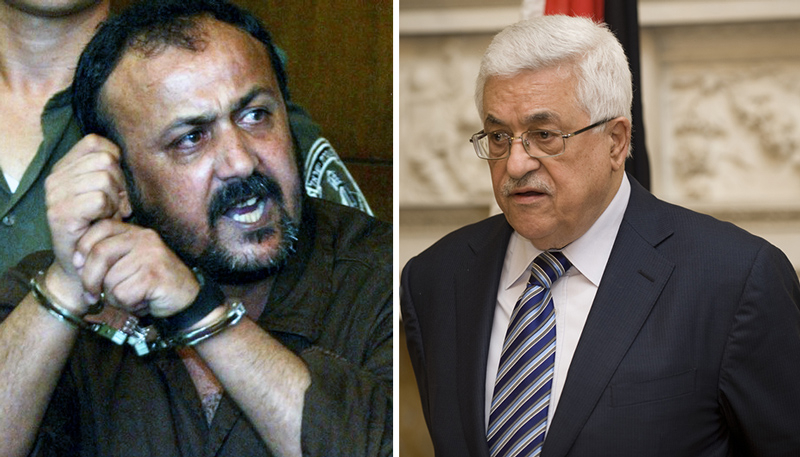
The hunger strike declared by jailed Palestinian terrorist Marwan Barghouti (left) is aimed at Palestinian Authority President Mahmoud Abbas (right). Barghouti’s supporters accuse Abbas and his loyalists of sidelining the jailed Fatah leader and seeking to “bury” him.

Last November, Barghouti emerged as the biggest winner in Fatah’s internal election. His status as a prisoner and his involvement in terrorism continue to be the main reason why he is so popular among Palestinians. Barghouti’s victory in the election meant that he was now number two after Abbas, and many expected the PA president to appoint him as his deputy.

This past February, however, the Fatah Central Council, a body dominated by Abbas loyalists, delivered a deliberate slap in the face to Barghouti, ignoring his landslide victory and appointing someone else (Mahmoud Aloul) as Deputy Fatah Chairman. The appointment of Aloul enraged Barghouti’s supporters, who rushed to accuse Abbas and his loyalists of sidelining the jailed Fatah leader and seeking to “bury” him.

Barghouti’s wife, Fadwa, even went as far as accusing Abbas of “succumbing” to threats by Israel. Israeli officials had strongly criticized the result of the Fatah internal election, which the Barghouti won, calling it a vote for terrorism. Fadwa Barghouti said that her husband had won the first slot in the election, “which means he is number two in Fatah. There is no ignoring Marwan Barghouti’s position.”

The charges leveled by Barghouti’s wife against Abbas are not the first. In the past, she has accused Abbas and the PA leadership of imposing a blackout on news concerning her husband. In a letter to Abbas, she expressed “regret and pain” over the failure of Abbas to help her in her campaign to secure the release of her husband. She also complained that neither Fatah nor the PA leadership had provided funds to support the campaign calling for her husband’s release.

It is no secret that Abbas detests competition. He has been waging war against anyone who dares to challenge his rule, especially from within his own Fatah faction. Mohammed Dahlan, for example, a former PA security commander from the Gaza Strip and considered the number one enemy of the PA president, was expelled from Fatah on orders from Abbas. Dahlan, a Fatah parliamentarian, was stripped of his parliamentary immunity by Abbas. Dahlan is currently living in the United Arab Emirates, but is wanted by Abbas for “corruption” and “murder.”

Barghouti, however, presents Abbas with an immediate problem. The Palestinian on the street will not tolerate the defamation, at least not in public, of any Palestinian sitting in Israeli prison. Abbas sees Barghouti as a real threat, particularly in the wake of public opinion polls suggesting that Barghouti could easily win any presidential election. Barghouti at large would be a nightmare for Abbas.

So, no love is lost between Abbas and Barghouti; the two are engaged in a behind-the-scenes power struggle. Barghouti wants to succeed Abbas, while Abbas is working hard to marginalize him. Palestinian sources say that Abbas is not happy with Barghouti’s hunger strike. He believes Barghouti is trying to steal the spotlight from him, especially on the eve of his visit to Washington for talks with President Donald Trump. Abbas, who wants to be in the news all the time, cannot stand that Barghouti is grabbing the headlines and was even invited to write an op-ed in the New York Times.

It is not only Abbas, however, who is in trouble. Barghouti, too, knows better than to air dirty Fatah laundry. What, then, is to be done? The traditional diversionary tactic: Direct the heat towards Israel. Barghouti is suddenly concerned about his prison conditions and is demanding more privileges. Israel, he claims, imprisons Palestinians for their “peaceful resistance.” Barghouti knows it is not popular to come out in public against Abbas. Similarly, Abbas is using the hunger strike to incite against Israel and demand that all Palestinian terrorists, including ones with blood on their hands, be released unconditionally. The hunger strike is a smokescreen for the real problems inside Fatah and has nothing to do with the conditions of prisoners in Israeli jails.

Stripped of its Western trappings, Barghouti’s “hunger strike” is actually a struggle between Abbas and yet another Fatah pretender to the throne. And once again, Israel — the state that supposedly so “mistreats” incarcerated Palestinian terrorists — takes the heat.

Bassam Tawil, an Arab Muslim, is based in the Middle East.

Translate »
Skip to toolbar