Daily Archives: June 19, 2017

Palestinians: The Real Goal of the Intifada by Bassam Tawil

  • Abbas seems intentionally to ignore that he and his Palestinian Authority are responsible for the violence, as a result of their daily incitement against Israel.


  • A recent poll found that 48% of Palestinians interviewed believe that the real goal of the “intifada” is to “liberate all of Palestine.” In other words, approximately half of Palestinians believe that the “intifada” should lead to the destruction of Israel, which would be replaced with a Palestinian state — one that now would be ruled by Hamas and jihadi organizations such as Islamic State and Al-Qaeda.

  • It is notable that only 11% of respondents said the goal of the “intifada” should be to “liberate” only those territories captured by Israel in 1967.

  • The Palestinians do not, according to the poll, have a problem with “settlements” or “poor living conditions.” They have a problem with Israel’s existence. Palestinians do not see a difference between a West Bank “settlement” and cities inside Israel — or differentiate between Jews living there. They are all depicted as “settlers” and “colonialists.”

  • This contradicts Abbas’s claim that the Palestinians want a “peaceful and popular” uprising. The Palestinians are not, as their leaders claim, seeking a two-state solution.

As the current Palestinian campaign of terrorism against Israel is about to enter its third month, it is still not clear to many what the Palestinians are trying to achieve. The Palestinians cannot even agree on a name for their campaign. Some are referring to it as an “intifada,” while others are describing it as a “Habba Jamahiriya” [“popular puff,” or “flurry”].

The Palestinians also have not been able to agree on the motives behind the stabbing, shooting, firebombing and car-ramming attacks. Palestinian Authority (PA) leader Mahmoud Abbas has repeatedly claimed during the past few weeks that the terrorists are setting out to kill Jews out of “despair and frustration” and the lack of a “political horizon.” But Abbas seems intentionally to be ignoring that it is he and his Palestinian Authority who are responsible — together with Hamas, Islamic Jihad and other Palestinian factions — for the violence, as a result of their daily incitement against Israel.

This is yet another instance in which anyone could have predicted what was going to happen. Throughout the past year, Abbas has been telling his people that Israel was planning to destroy the Al-Aqsa Mosque and “change the Arab and Islamic character and identity” of Jerusalem. He condemned Jews for “defiling the Aqsa Mosque with their filthy feet.” Abbas, his spokesmen and PA-controlled media outlets also have also repeatedly been telling Palestinians that Israel is committing “war crimes” and “summary executions” of innocent Palestinians.

This is, as Abbas knows, exactly the type of incitement that prompts Palestinian teenagers to grab a knife, run out into the street and murder the first Jew they see. Those young Palestinians are also tragic victims of the poisonous campaign of the inflammatory anti-Israeli language emanating from Palestinian leaders such as Abbas, mosque preachers, news outlets and social media.

Contrary to Abbas’s outrage, no one has yet found even one terrorist who claimed to have attacked a Jew out of “despair and frustration” at the “lack of a political horizon.” If you look through the social media accounts of these young terrorists, many have said that they set out to kill Jews to “defend” Al-Aqsa Mosque. They seem to have been influenced by the romantic notion of Abbas’s repeated fictitious claims that Jews were plotting to destroy the mosque, followed by high-flown fantasies of themselves as heroes charging forth to rescue it.

A public opinion poll published last week refutes Abbas’s claim that Palestinians are committing terrorist attacks out of “despair and frustration.” The poll, conducted by the Watan Center for Studies and Research, found that 48% of the Palestinians interviewed believe that the real goal of the “intifada” is to “liberate all of Palestine.” In other words, approximately half of Palestinians believe that the goal of the “intifada” should lead to the destruction of Israel.

What is notable, is that only 11% of respondents said that the true goal of the “intifada” should be to “liberate” only those territories captured by Israel in 1967. Another 12% of Palestinians said they believe that the goal of the “intifada” was to release prisoners held by Israel.

The results of the poll, which covered 1,167 Palestinians above the age of 18, show that a majority of Palestinians continue to seek the destruction of Israel. The poll shows that only a few Palestinians see only the West Bank, Gaza Strip and east Jerusalem as the future Palestinian state. They want the “intifada” to replace Israel with a Palestinian state — preferably, one that now would be ruled by Hamas and jihadi organizations such as Islamic State and Al-Qaeda.

These Palestinians do not see a difference between, say, Ma’aleh Adumim, a “settlement” on the outskirts of Jerusalem, and any city inside Israel. One only needs to look at reports in the Palestinian media to see that Tel Aviv, Rishon Lezion, Kiryat Gat and Ra’anana are all considered “settlements.” These reports also show that Palestinians do not see a difference between a Jew living in the West Bank and Israel — instead, they are all depicted as “settlers” and “colonialists.”

None of the Palestinians interviewed for the poll complained about “despair and frustration,” or the lack of a “political horizon.” Obviously, they are driven by hatred for Jews and Israel. They do not, however, have a problem with “settlements” or “poor living conditions.” They have a problem with Israel’s existence. A majority believes that Israel can — and should — be destroyed. They are not, as Palestinian leaders claim, seeking a two-state solution.

According to the poll, more than 75% of Palestinians support the use of violence against Israel. More than 44% of respondents support the use of firearms against Israel; 18% are in favor of using knives to kill Jews, and another 14% would like to see Palestinians use stones. This contradicts Abbas’s claim that the Palestinians want a “peaceful and popular” uprising.

Another noteworthy finding of the poll is that 72% of Palestinians want the current “intifada” to continue. In other words, an overwhelming majority of Palestinians would like to see their youths carry out more terror attacks against Israeli civilians and soldiers. They want to see more terror attacks because their leaders and journalists are telling them that those who kill Jews are “heroes” and “martyrs” who will have streets, squares, schools and tournaments named after them.

U.S. Secretary of State John Kerry, who visited Israel and Ramallah last week in a bid to end the Palestinian terror attacks, was unable to make any progress. Even before he arrived in Ramallah to meet with President Abbas, Kerry was strongly condemned for referring to the Palestinian violence as “terrorism.” Palestinians who demonstrated not far from Abbas’s office shouted slogans condemning the U.S. Administration for its attempt to stop the terror attacks against Israelis and called for boycotting Kerry. The protesters also declared Kerry persona non grata in Ramallah.

Kerry and the U.S. Administration should know by now that the Palestinians are waging war on Israel not because of “despair and frustration,” but because they aspire to destroy Israel, as the results of the recent poll show.

The goal of the Palestinians is the destruction of Israel. This fact is something that other Western parties need to understand — that the Palestinian “struggle” is mainly aimed at eliminating Israel, and not “the establishment of a Palestinian state that would live in peace and security alongside Israel.” The recent poll should be translated into English and distributed among all those “pro-Palestinian” groups that continue to shout about the conflict being the result of Israeli “occupation” of the West Bank, Gaza Strip and east Jerusalem.

Today, it is clear that the Israeli-Palestinian conflict is not really about the “occupation” that began with the creation of Israel in 1948. The last three Palestinian “intifadas” and previous Israeli-Arab wars had (and still have) one goal: to see Israel removed off the map.

Bassam Tawil is a scholar based in the Middle East.

Palestinians: The Power Struggle between Young Guard and Old Guard by Khaled Abu Toameh

  • Who is supplying Mohamed Dahlan with money? The United Arab Emirates (UAE). It is their cash that has enabled Palestinians in refugee camps in the West Bank and Gaza Strip to purchase weapons and buy loyalty for Dahlan in preparation for the post-Abbas era — especially disgruntled young Fatah activists in the West Bank who feel that Abbas and the PA leadership have turned their backs on them.

  • This power struggle will not end with the departure of Mahmoud Abbas. The next Palestinian president will surely be one of Abbas’s current loyalists. This in itself will drive Dahlan and his ilk to continue railing against the old guard.

Palestinian Authority (PA) President Mahmoud Abbas faces a real threat; its name is Mohamed Dahlan.

Abbas has become obsessed with Dahlan, according to insiders. The PA president, they report, spends hours each day discussing ways to deal with the man and his supporters. And, it is rumored, Abbas’s nights are not much better.

Backed by at least three Arab countries, Dahlan, a former Palestinian security commander from the Gaza Strip, seems to have unofficially joined the battle for succession in the PA.

The 54-year-old Dahlan, young enough to be Abbas’s son, continues to deny any ambition to succeed Mahmoud Abbas as president of the PA. Yet Dahlan’s continued efforts to establish bases of power in both the West Bank and Gaza Strip belie his claims.
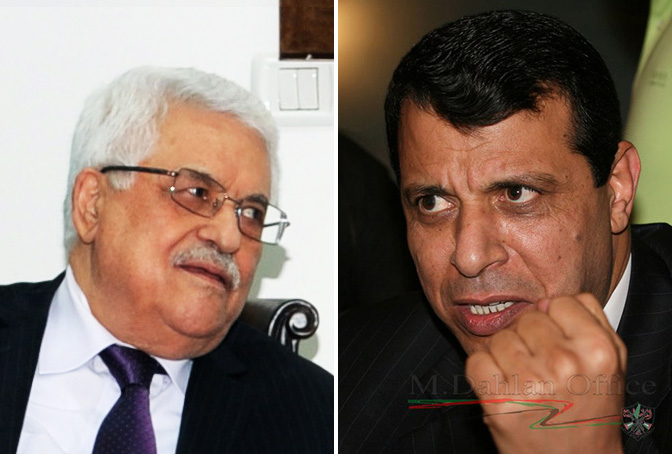
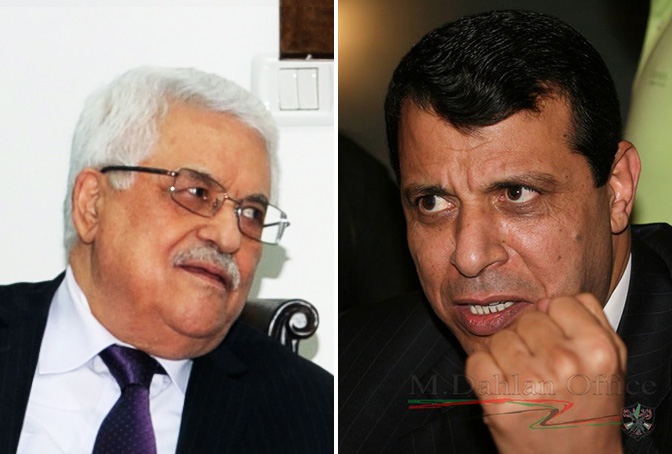
Palestinian Authority President Mahmoud Abbas (left) and Mohamed Dahlan (right), a former Fatah security commander, have, for the past five years, been at each other’s throats. The two were once close allies and had worked together to undermine the former PA president, Yasser Arafat. (Image sources: U.S. State Dept., M. Dahlan Office)

Abbas’s top aides talk about the cash that Dahlan has lavished on many Palestinians, thereby winning their support. Any Palestinian activist whose request for financial aid is turned down by Abbas’s office can always turn to Dahlan, who is not inclined to disappoint those who seek his help.

Who is supplying Dahlan with money? The United Arab Emirates. It is their cash that has enabled Palestinians in refugee camps in the West Bank and Gaza Strip to purchase weapons and buy loyalty for Dahlan in preparation for the post-Abbas era.

Unsurprisingly, Abbas and the PA leadership are less than enthusiastic about this turn of events. Since 2011, they have taken a series of measures to stop Dahlan, but to no avail.

First, Abbas ordered his security forces to raid Dahlan’s home in Ramallah and confiscate documents and equipment. Second, the Fatah Central Committee, a body dominated by Abbas loyalists, voted in favor of expelling Dahlan from its ranks. Third, the PA, at the behest of Abbas, filed charges in absentia against Dahlan, accusing him of financial corruption and embezzlement.

As part of a smear campaign, Abbas and the PA have claimed that Dahlan is a murderer who has Palestinian blood on his hands. They have also been saying that Dahlan stole hundreds of millions of dollars and is in collusion with the Palestinians’ enemies.

Still, Dahlan appears to be far from vanishing from the Palestinian political scene. In fact, the campaign against him seems to have increased Dahlan’s resolve to continue and even step up his efforts to bring down Abbas and his veteran loyalists in the Palestinian Authority.

So what is fueling Dahlan’s success? Abbas and some of his top aides point a finger at the United Arab Emirates (UAE), the wealthy Gulf country that has been harboring and funding Dahlan for the past five years. Dahlan’s ties with the ruling family in the UAE are so strong that he has been appointed as a “special advisor” to Sheikh Mohamed bin Zayed Al Nahyan, the Crown Prince of Abu Dhabi and Deputy Supreme Commander of the UAE Forces. Palestinian Authority officials in Ramallah call Dahlan the “spoiled lad” of Sheikh Al Nahyan.

United Arab Emirates money has helped Dahlan and his supporters buy loyalty among Palestinians, especially disgruntled young Fatah activists in the West Bank who feel that Abbas and the PA leadership have turned their backs on them.

But while the influential Gulf country provides Dahlan with shelter and funds, two other Arab countries — Egypt and Jordan — grant him a certain degree of legitimacy and a platform for his public activities, including those directed against Abbas and some of his top advisors and aides in Ramallah. Dahlan maintains a close friendship with Egyptian President Abdel Fattah el-Sisi, with whom he has met a number of times in Cairo over the past two years. Recently, Dahlan visited Amman and met with several Jordanians and Palestinians, much to the dismay of Abbas and the Palestinian Authority leadership.

Dahlan’s close ties with the Egyptians and Jordanians are the force driving the tensions that have erupted between Abbas and both Sisi and Jordan’s King Abdullah.

According to Palestinian sources in Ramallah, Abbas has expressed outrage over the way the Egyptians and Jordanians have openly embraced and endorsed the man he considers his greatest threat. Upon learning of Dahlan’s visit to Jordan, Abbas refrained from meeting with government officials in Amman (where he has a private house) on his way to visit other countries. (Abbas routinely travels around the world through Jordan). Abbas was particularly enraged when he learned that King Abdullah had given Dahlan and his family members Jordanian citizenship.

Dahlan’s visit to Jordan last April is believed to be in the context of his effort to establish bases of power among Palestinians living in the kingdom. According to some reports, Dahlan has already succeeded in rallying dozens of Palestinians from refugee camps in Jordan behind him.

“Dahlan is President Abbas’s worst nightmare,” remarked a senior Palestinian official in Ramallah who has been closely following the complicated ties between the two men over the past two decades. “You can be fired or punished in various ways if the president suspects that you are in touch with Dahlan.”

Dahlan founded and headed the Palestinian Preventive Security Force in the Gaza Strip shortly after the signing of the Oslo Accords. After the death of Yasser Arafat in 2004, he became one of Abbas’s closest confidants, later appointed by Abbas as National Security Advisor to the Palestinian Authority leadership. In 2006, he was elected as a Fatah member of the Palestinian Legislative Council for the Khan Yunis district in the southern Gaza Strip.

How Abbas and Dahlan came to be at one another’s throats is food for speculation. Some Palestinians believe that the ill-will between the two is purely personal, and began when Dahlan was overheard belittling Abbas’s two sons, Yasser and Tareq. Others say that Abbas decided to get rid of Dahlan because he suspected that Dahlan was plotting to stage a coup against him.

Then again, 81-year-old Abbas is highly suspicious of Palestinians such as Dahlan who have too much ambition and charisma. Abbas is also very overprotective of his family, particularly his two sons. Other Palestinian officials, such as Salam Fayyad and Yasser Abed Rabbo, who have dared to challenge Abbas in various ways have found themselves stripped of power and money. Abbas’s campaign against his critics has been notably successful so far, with the exception, of course, of Dahlan. Those officials who continue to live in the West Bank now keep their mouths shut. Dahlan, of course, does not.

Based in Abu Dhabi, Dahlan is beyond Abbas’s long arm. Dahlan’s close ties with the leaders of the United Arab Emirates, Egypt and, to some degree, Jordan, has given him immunity against Abbas, who is keen to pacify these three important Arab countries. Besides, Abbas is well aware that he is surrounded by too many wolves, and that opening a new front with Dahlan and his friends/patrons in the Arab countries could put him over the edge.

Buoyed by impressive political and financial aid, Dahlan pulls no punches when it comes to Abbas.

Last year, Dahlan chose a Jordanian online newspaper to launch a scathing attack on his former boss. In the eyes of some Palestinian political analysts, Dahlan’s platform was far from random. They argue that the online newspaper could not have published Dahlan’s statements had it not received permission from the highest echelons in the royal palace in Amman. Some Jordanian writers and journalists have in the past been imprisoned for insulting some Arab leaders or countries. Not in this case, where Dahlan made the charges against Abbas.

So what did Dahlan share in the interview with the Ammon News website, which described him as a charismatic leader and the number one enemy of Abbas?

Dahlan accused Abbas of “hiding” $600 million following the death of Yasser Arafat. According to Dahlan, former Prime Minister Salam Fayyad gave Abbas a total of $1.4 billion, but when Abbas was asked about the sum he claimed he had only received $800 million. He accused Abbas’s sons of corruption, claiming their fortune was estimated at over $300 million. He also reminded that Abbas was no longer a legitimate president because his term in office had expired in January 2009.

“What kind of a president is this who lives in Amman and rules in Ramallah?” Dahlan asked in the interview. “Abbas’s problem is that when the he sits with me he doesn’t feel he’s a president. No one respects him, not in Palestine and not abroad.”

Abbas’s aides have dismissed the charges as “lies and fabrications,” saying they are in the context of Dahlan’s ongoing effort to undermine the Palestinian Authority leadership and “serve the agenda of regional powers and foreign parties.”

Sources close to Abbas have also claimed that the Jordanian news website that gave Dahlan a platform for his attacks on the PA was on the payroll of Dahlan’s patrons in the United Arab Emirates. They also claim that Dahlan has similarly used UAE funds to purchase a popular Egyptian online newspaper.

The rivalry between Abbas and Dahlan is emblematic of the power struggle between the old guard and young guard in Fatah, the largest Palestinian faction that dominates the Palestinian Authority and the Palestine Liberation Organization (PLO).

This is a power struggle that has been raging for the past three decades. Dahlan is a representative of the young guard, whose members are strongly opposed to the continued hegemony and monopoly of the old guard over the decision-making process. Dahlan and the young guard are mostly from the West Bank and Gaza Strip, grassroots leaders who have long been complaining that they have been marginalized by the veteran leaders of the Palestinians who came from Lebanon and Tunisia after the signing of the Oslo Accords and who continue to block the emergence of new and younger leaders.

This power struggle will not end with Abbas’s departure. The next Palestinian president will surely be one of Abbas’s current loyalists. This in itself will drive Dahlan and his ilk to continue railing against the old guard. Dahlan’s ghost will continue to haunt not only any future Palestinian president, but also Abbas in his grave.

Who, then, one might ask, will step up and lead the Palestinians away from the edge of their own abyss? For now, it does not seem that there is a Palestinian leader who has the power or credentials to stop the deterioration.

Khaled Abu Toameh, an award-winning journalist, is based in Jerusalem.
Palestinians: The Diploma for Terror by Bassam Tawil

  • A glance at their leaders and senior officials tells them that Palestinian Authority jobs go to “graduates” of Israeli prisons.

  • Besides sending a message to Palestinians about who is valued in Palestinian society, the Fatah leader is also making it clear that the path to leadership and employment passes through Israeli prisons. Abbas’s senior representative is telling Palestinians that there is no need for them to pursue actual education: Israeli prisons are the best “universities.”
  • The longer the time spent in prison, the higher the military rank. Ten years will earn them the rank of Colonel. More than that will earn them General. The path to winning a job with a PA ministry also passes through Israeli prisons. These are the leaders touted as role models to young Palestinians.

Palestinians who are being held in Israeli prisons are “a model for sensibility and national culture and constitute a pillar for the establishment of a Palestinian state.” This glorification of Palestinian prisoners, many of whom are behind bars for murdering Jews, was issued last week by Fayez Abu Aitah, a senior representative of President Mahmoud Abbas’s ruling Fatah faction.

Abu Aitah’s words of appreciation for murderers of Jews came during a visit he paid to Hatem al-Maghari, a Palestinian Authority (PA) policeman who was released last week after serving 17 years in prison for his role in the lynching of two Israeli reserve soldiers who mistakenly entered Ramallah. Upon his arrival at his home in the town of Rafah in the southern Gaza Strip, Al-Maghari received a hero’s welcome. Hundreds of Palestinians have since converged on his home to congratulate him on his release from prison and heap praise him on for his “contribution” to the Palestinian cause.

Abbas’s Fatah was quick to embrace al-Maghari as “one of our sons” in order to send a message to Palestinians that the Fatah faction is also involved in terror attacks against Israel. For years, Fatah’s opponents have been accusing it of abandoning the “armed struggle” in favor of a peace process with Israel. Groups such as Hamas, Popular Front for the Liberation of Palestine (PFLP) and Palestinian Islamic Jihad continue to criticize Fatah for not being sufficiently active in the terror campaign against Israel.

The release of al-Maghari provided an opportunity for Fatah to remind its Palestinian enemies of its “contribution” to the war against Israel. The lynching of the two soldiers inside a Palestinian Authority police station in Ramallah was one of the most brutal crimes perpetrated by Palestinians. The PA leadership has never accepted responsibility for the lynching of the two soldiers, who were being held by PA policemen inside the station after taking a wrong turn into the city as they were on their way to their base.

The hero’s welcome that al-Maghari received and the words of praise from Fatah leaders serve as a reminder of how murderers of Jews continue to be hailed as role models for Palestinians. President Abbas and his PA and Fatah representatives have long lauded Palestinian prisoners held by Israel as “heroes” and future leaders of a Palestinian state.

As Abu Aitah explained during his well-wishing visit to the released terrorist:

“The prisoners are the pillar of our national movement. They have sacrificed the best of our committed and responsible national cadres that are leading the struggle of our people. Our prisoners have turned (Israeli) prisons into universities from where the future leaders graduate.”

Besides sending a message to Palestinians about who is valued in Palestinian society, the Fatah leader is also making it clear that the path to leadership and employment passes through Israeli prisons. In no uncertain terms, he is saying to young Palestinians: “If you want to become a leader, you need to prove your qualifications by following the example of those Palestinians who carried out terror attacks against Israel and spent time in Israeli prison.” Again: Abbas’s senior representative is telling Palestinians that there is no need for them to pursue actual education: Israeli prisons are the best “universities.”

Palestinians have every reason to believe Abu Aitah; he is the top Fatah official. Just a glance at their leaders and senior officials tells them that Palestinian Authority jobs go to “graduates” of Israeli prisons. There is no shortage of such leaders who rose to power thanks to their involvement in terror attacks against Israel.

In the world of the Palestinians, terror is indeed the diploma of currency. Serving time in Israeli prison can even earn one a military rank without having to go to any military or security academy.

The PA, according to Palestinian sources, has one of the largest numbers of Generals and Colonels in the Arab world. Most of these high-ranking officers earned their titles thanks to the time they served in Israeli prison, not because they studied at any military academy.

Take, for example, Jibril Rajoub, the former commander of the Palestinian Authority’s notorious Preventive Security Force, who holds the rank of Major-General. Rajoub’s rank is largely the result of the 17 years he spent in Israeli prison for his role in terrorism. Rajoub is only one of dozens, if not hundreds, of former prisoners who hold such high-ranking titles but do not have any real military background.

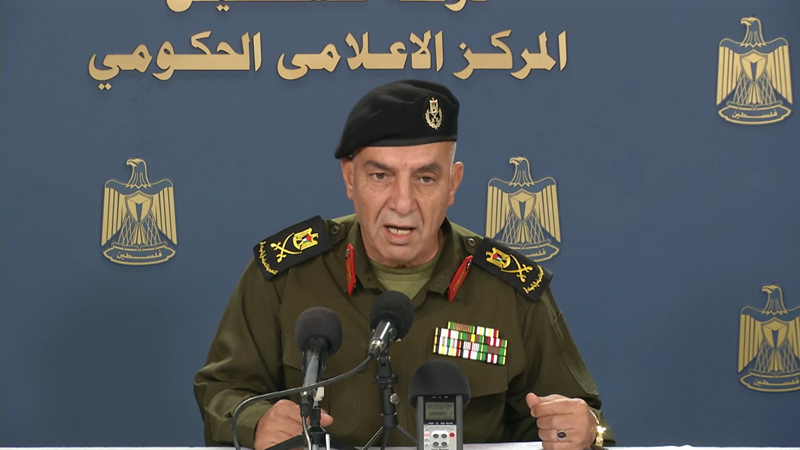
Many high-ranking PA security officials, such as Major-General Adnan Damiri, spokesman for the PA security forces, wear medals and decorations on their military uniforms even though they have not participated in any war. Damiri spent 10 years in Israeli prison for security-related offenses.

Many high-ranking Palestinian Authority (PA) security officials, such as Major-General Adnan Damiri, spokesman for the PA security forces, wear medals and decorations on their military uniforms even though they have not participated in any war. (Image source: PA video screenshot)

These are the leaders touted as role models to young Palestinians. No small number of Palestinian senior “officers” failed even to complete their high school education. But that should not bother any Palestinian who is dreaming of assuming a senior job in a Palestinian state.

On April 17, the Palestinians will again mark “Palestinian Prisoners’ Day” by holding as series of rallies in solidarity with prisoners who carried out terror attacks against Israel. This event is marked every year by Palestinians to honor the “heroes” who made “huge sacrifices” on behalf of the Palestinians.

These “sacrifices” include the maiming and murder of Jews. The annual event in the West Bank is sponsored and funded by Abbas’s Fatah, in turn funded by Europe and the West, in the context of glorifying terrorists and encouraging Palestinian youths to follow their presumably heroic example.

A Palestinian teenager who wishes to become a “general” under Abbas need not apply to any sort of academy. The shortest route to achieve rank is by carrying out a terror attack against Israel and doing time in Israeli prison. The longer the time spent in prison, the higher the military rank. Ten years will earn them the rank of Colonel. More than that will earn them General. The path to winning a job with a Palestinian Authority ministry also passes through Israeli prisons. Former prisoners are treated as the “good boys of the revolution” and granted the plum jobs. Meanwhile, those Palestinians who actually choose to become educated once again lose out.

It would be no surprise, then, if al-Maghari finds himself awarded the rank of General in Abbas’s Fatah-controlled security forces.

And so it continues: the unashamed glorification of murderers; terrorists paraded as role models and paragons of virtue to yet another generation of Palestinians. Under these conditions of unremitting incitement, no Palestinian can talk about peace with Israel.

When President Abbas visits the White House, it will be interesting to see if his “peace” stance includes a discussion of the Diploma for Terror.

Bassam Tawil is a scholar based in the Middle East.

Palestinians: The ‘Wall of Shame’ by Khaled Abu Toameh

  • “The equation facing the Palestinian factions is clear: Hand over the terrorists and there will be no wall. The Palestinians have proven that they are unable to take security matters into their own hands in this camp.” — Lebanese security official.

  • These anti-Palestinian practices are regularly ignored by the international community, including mainstream media and human rights organizations, whose obsession with Israel blinds them to Arab injustice. A story without an anti-Israel angle is not a story, as far as they are concerned
  • Typically, Western journalists and human rights activists do not even bother to report or document cases of Arab mistreatment of Arabs. This abandonment of professional standards is why apartheid laws targeting Palestinians in several Arab countries are still unknown to the international community.
  • The Lebanese authorities also say that they decided to build the wall after discovering several tunnels in the vicinity of Ain al-Hilweh, used to smuggle weapons and terrorists into and out of the camp.
  • The new wall will not solve the real problem — namely the failure to absorb the refugees and grant them citizenship. Palestinians living in Arab countries are denied citizenship (with the exception of Jordan) and a host of basic rights.
  • Now is the time for the international community to apply pressure to the Arab countries to start helping their Palestinian brothers by improving their living conditions and incorporating them into these countries.
  • The refugee problem will end the day their leaders stop lying to them and confront them with the truth, basically that there will be no “right of return” and that the time has come for them to move on with their lives.

It is no secret that Arab countries have long mistreated their Palestinian brothers and sisters, governing them with inhumane laws and imposing severe restrictions on their public freedoms and basic rights. Building a wall around a Palestinian community to prevent terrorists from entering or leaving, however, has raised the bar on such infringements.

This is precisely what is happening in Lebanon these days. The construction of a security wall around Ain al-Hilweh, the largest Palestinian refugee camp (with a population of nearly 120,000), has drawn sharp criticism from Palestinians and revived memories of the abuse they regularly receive at the hands of their Arab brethren.

The Lebanese authorities say the Palestinians have left them no choice but to build the controversial concrete wall. The Palestinians, they say, refuse to cooperate against terrorists who have established bases within their camps. Yet that problem raises the question: “What has Lebanon done in the past half-century or so to help the Palestinians who fled to that country?” The answer: “Nothing.”

In fact, among all Arab countries, Lebanon has been arguably the worst in its treatment of the Palestinians. Palestinian refugees in Lebanon are denied access to adequate housing and certain categories of employment. According to Amnesty International: “Over half of Palestinian refugees live in decaying and chronically overcrowded camps and discriminatory practices are permitted under personal status laws and nationality laws.”

These anti-Palestinian practices are regularly ignored by the international community, including the mainstream media and human rights organizations, whose obsession with Israel blinds them to Arab injustice. While, every now and then, an organization does publish a report on the misery endured by Palestinians in Arab countries, these bodies rarely follow up on their work, thus creating the impression that they are doing so only for the sake of protocol.

As such, the plight of the Palestinians in many Arab countries continues to be a taboo, as far as the international community is concerned. Typically, Western journalists and human rights activists do not even bother to report or document cases of Arab mistreatment of Arabs. This abandonment of professional standards is why apartheid laws targeting Palestinians in several Arab countries are still unknown to the international community. Even when Western journalists and human rights advocates do hear about these violations, they prefer to look the other way. A story without an anti-Israel angle is not a story, as far as they are concerned.

So what is going on in Lebanon, and why are so many Palestinians furious with the Lebanese authorities?

Until a few years ago, the population of Ain al-Hilweh camp was 70,000. But the influx of refugees fleeing the civil war in Syria, since 2011, has increased the camp population to nearly 120,000. It turns out that many of these new “refugees” are actually terrorists fleeing from Syria and Iraq.

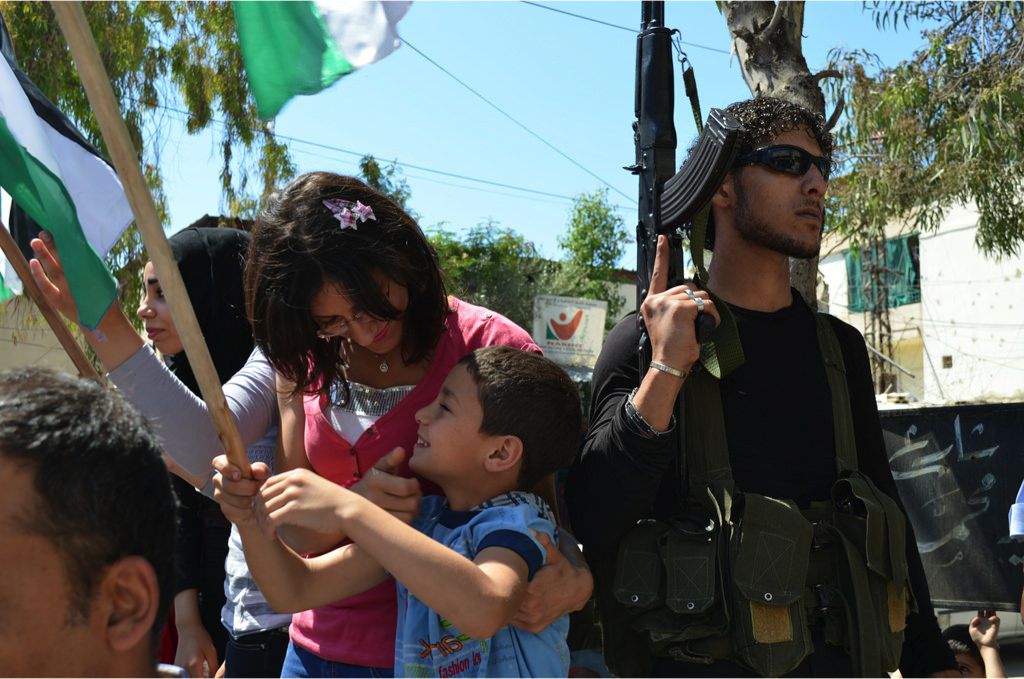
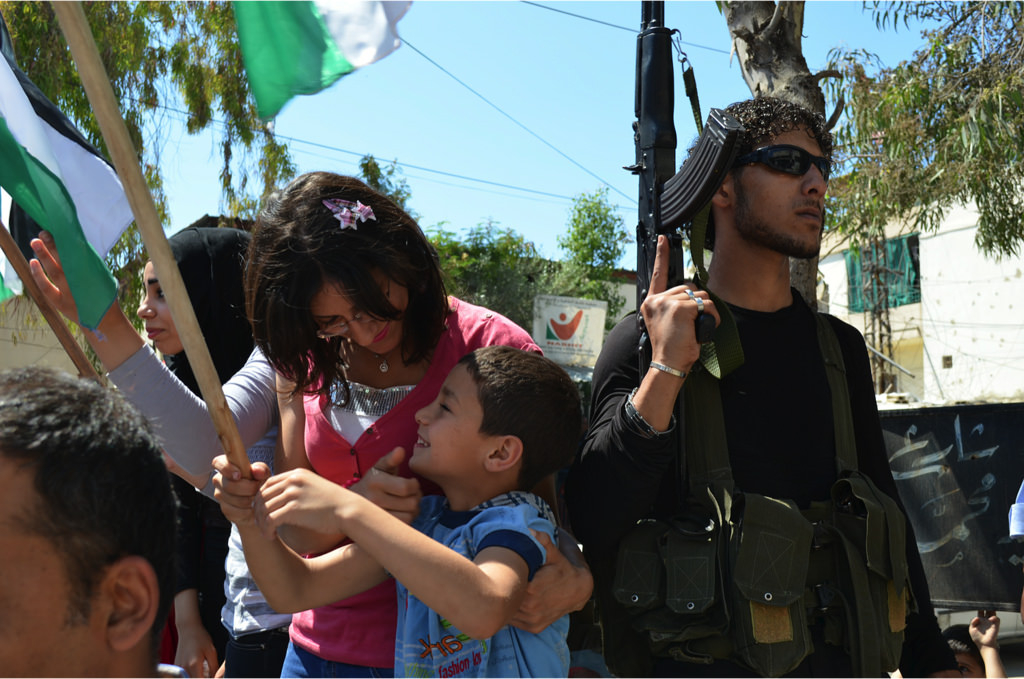
A street celebration in Lebanon’s Ain al-Hilweh camp, July 2015. (Image source: Geneva Call/Flickr)

Ain al-Hilweh, like most of the camps in Lebanon, has always been a major headache for the Lebanon. It seems, however, that the Lebanese government has had enough.

For years, the Lebanese authorities, for whom the camp is “off-limits,” have been trying, unsuccessfully, to clean the camp of its hundreds of terrorists.

Lebanese security forces steer clear of the refugee camps in an attempt to avoid friction with the Palestinians living there. This evasion has allowed the camps to become hotbeds for various jihadi groups and terrorists who pose a threat not only to the national security of Lebanon, but to Palestinians themselves and neighboring Arab countries such as Jordan, Egypt and Syria (not to mention Israel).

Alarmed by this heightened threat, the Lebanese authorities recently began building a concrete wall around Ain al-Hilweh, sparking a wave of denunciations from Palestinians. The Palestinians claim that the new wall, which will be completed in 15 months, will turn the camp into a big open-air prison. They refer to it as the “Wall of Shame.” Their main argument is that it is disgraceful that any Arab country would build a wall surrounding a refugee camp at a time when Palestinians are asking the world to condemn Israel for building a security fence to prevent terror attacks against Israelis from the West Bank.

Camp residents claim that the Lebanese authorities have misled them concerning the construction of the wall. According to the residents, the authorities led them to believe that it was to be a small fence on the outskirts of parts of the camp and not a massive concrete wall surrounding the camp.

The Lebanese security authorities have chosen to call the new barrier the “Wall of Protection” — stressing that it is mainly intended to prevent terror attacks against Lebanon and stop the camps from becoming bases for terrorists and criminals. The authorities say that if anyone is to blame for the construction of the wall, it is the Palestinians themselves, who have refused to cooperate with the Lebanese government against the terrorists. “The goal is to prevent terrorists from infiltrating the camp,” explained a Lebanese security official. “The equation facing the Palestinian factions is clear: Hand over the terrorists and there will be no wall. The Palestinians have proven that they are unable to take security matters into their own hands in this camp.”

The Lebanese authorities also say that they decided to build the wall after discovering several smuggling tunnels in the vicinity of Ain al-Hilweh. These tunnels, they say, are being used to smuggle weapons and terrorists into and out of the camp.

Representatives of Ain al-Hilweh and other Palestinians have been holding marathon meetings with Lebanese government officials in the past few weeks to persuade them to halt the construction of the wall. The Palestinians in Ain al-Hilweh are now threatening that if the Lebanese government does not cancel the project, they will seek the intervention of other Arab, and also Western, countries, as well as the United Nations.

Notably, the Palestinian Authority (PA) leadership in the West Bank has not joined in the efforts to persuade the Lebanese government to drop the idea of building a wall around the camp. This avoidance probably springs from the PA leadership and its president, Mahmoud Abbas, being well aware that Ain al-Hilweh and other refugee camps in Lebanon have fallen into the hands of their enemies, namely Hamas, Islamic Jihad, Islamic State and Al-Qaeda.

The “Wall of Shame” appears particularly to bother Hamas leader Khaled Mashaal. Last week, he telephoned a number of Lebanese officials, including Prime Minister Tammam Salam and Parliament Speaker Nabih Berri, to warn about the consequences of the construction of the wall. Mashaal, who is based in Qatar and enjoys a luxurious life most Palestinians can barely dream of, urged the Lebanese government to halt construction if the wall and said that the wall jeopardized the lives of Palestinian refugees and would have “negative repercussions.”

Hamas’s spokesman in Lebanon, Ra’fat Murra, dismissed Lebanon’s security concerns for building the wall. He warned that the wall would turn the camp into an isolated enclave and exacerbate tensions between Palestinians and Lebanese. Murra, however, expressed readiness to cooperate with the Lebanese authorities in apprehending and handing over wanted terrorists who had found shelter inside Ain al-Hilweh.

Protests against the wall reached their peak when hundreds of Palestinians (and some Lebanese) took to the streets of the nearby city Sidon, in southern Lebanon, calling on the government to stop construction immediately. The protesters warned that the wall would further increase tensions between Palestinians and Lebanese, and further reduce the quality of life for the camp residents.

Lebanon may be justified in building a security wall around the Palestinian refugee camp. Without a doubt, Ain al-Hilweh and other camps have become hubs for terror groups and criminals, and Lebanon has every right to combat terrorism. Yet, Lebanon needs to come up with ways to assimilate, rather than alienate, the Palestinians. Furthermore, this is a problem that extends beyond Lebanon’s borders. The same applies to the camps in the West Bank, Gaza Strip and Syria and Jordan.

The continued mistreatment of Palestinians at the hands of Lebanon and other Arab countries is totally unjustified. The new wall, complete with watchtowers, that is being erected around Ain al-Hilweh may stop some terrorists from infiltrating the camp, but it will not solve the real problem — namely the failure to absorb the refugees and grant them citizenship. In point of fact, Palestinians living in Arab countries are denied citizenship (with the exception of Jordan) and a host of basic rights.

Now is the time for the international community to apply pressure to the Arab countries to start helping their Palestinian brothers by improving their living conditions and incorporating them into these countries. Holding Palestinians in refugee camps for more than six decades is deadly counterproductive. The camps become sanctuaries for terrorists who pose a threat to the national security and stability in these Arab countries. There is no reason why a Palestinian living in Lebanon or Egypt or Kuwait should be banned from purchasing his or her own home.

Moreover, Arab states’ lies concerning the return of refugees to former homes inside of Israel, so long a staple fed to the refugees, have far outlived their usefulness. The refugee problem will end on the day their leaders stop lying to them and confront them with the truth, basically that there will be no “right of return” and that the time has come for them to move on with their lives.

If the lies do not end, the day will come when these countries will be forced to place all the refugees behind walls and fences — a move not likely to enhance stability in these countries. Ain al-Hilweh should serve as a wake-up call to all those Arabs who continue to subject Palestinians to apartheid laws and practices.

Khaled Abu Toameh, an award-winning journalist, is based in Jerusalem.

Palestinians: The “Battle for Succession” Who Will Succeed Mahmoud Abbas and Does It Really Matter? by Khaled Abu Toameh

  • Hamas is convinced that the Palestinian Authority (PA) will never allow elections to take place in the West Bank because of the likelihood that Hamas would win. The PA argues that Hamas will never allow a free election in the Gaza Strip because it does not tolerate any competition.

  • After Arafat died, Arafatism lived on. The same applies to Mahmoud Abbas. No real changes, if ever, should be expected in the Palestinian attitude towards the conflict with Israel after his departure.
  • In the Gaza Strip, the Palestinians will continue to be ruled by Hamas, an Islamist movement that has brought nothing but destruction and disaster to Palestinians.
  • The question of Abbas’s successor is thus rather unimportant. The Palestinians will continue to be ruled by dictatorships that do not give a damn about their people.

On his last visit to Cairo, Palestinian Authority (PA) President Mahmoud Abbas reportedly told Egyptian President Abdel Fattah el-Sisi that he does not intend to run in any future election.

Palestinian officials who accompanied Abbas to Cairo quoted him as saying that he does not want to be a “president for life” and that he is eager to see new presidential elections take place in the Palestinian territories as soon as possible.

“My age and health don’t allow me to remain in power,” the 81-year-old Abbas explained. “My term in office expired several years ago and I’m still in power only because of the Hamas, which staged a coup and is controlling the Gaza Strip and refusing to allow new elections.”

Abbas’s remarks came amid increased talk about a “battle for succession” that has been raging for weeks among the top brass of the Palestinian Authority leadership in the West Bank.

For now, it seems that there is no shortage of Palestinians who consider themselves “natural” and “worthy” successors to Abbas, who recently celebrated the 11th year of his four-year-term in office.

Abbas’s refusal to appoint a vice president, choose a possible successor, or share power, as well as his insistence on managing the PA as a one-man show, has left the door wide open for speculation as to what will happen the day he is gone.

Some Palestinians expect a smooth transition of power, while many fear that the “battle for succession” will lead to anarchy and violence.

Palestinian journalist Munir Abu Rizek recently sounded an alarm bell when he disclosed that some senior Palestinian officials and their supporters in the West Bank have been purchasing weapons in preparation for the post-Abbas era. He predicted that the anarchy that could erupt in the West Bank would be similar to what happened in the Gaza Strip before Hamas expelled the Palestinian Authority nearly a decade ago. Abu Rizek did not rule out the possibility that Palestinian cities in the West Bank would be turned into cantons ruled by rival Fatah officials and warlords.

However, the question is not which Palestinian official will succeed Abbas, so much as who will elect the next president and how? Besides, does it really matter who will be the next president?

Clearly, Abbas’s successor will not be elected through the ballot box. There are no free and democratic elections in the West Bank and the Gaza Strip. Hamas and the PA, however, disagree why this is so.

Hamas is convinced that the Palestinian Authority will never allow elections in the West Bank because of the likelihood that Hamas would win, as it did in the 2006 parliamentary elections.

The PA, for its part, argues that Hamas will never allow a free election in the Gaza Strip because it does not tolerate any competition.

In any event, since Hamas and the Palestinian Authority crack down on each other’s supporters in the Gaza Strip and West Bank, no free elections will emerge. So it is clear that an election to choose a successor for Abbas is off the table, at least for the foreseeable future. That is, of course, unless the PA leadership decides to hold separate elections for the West Bank — an option that seems to be highly unlikely. Holding a separate vote in the West Bank would result in Palestinians accusing the PA of “solidifying” the split between the Gaza Strip and West Bank, thus destroying the effort to establish a unified Palestinian state in these two areas.

Therefore, it is up to the ruling Fatah’s Central Committee to elect a new president. This body, established in 1963, is the most senior decision-making body of the PLO and consists of twenty-one Fatah officials, all known to be Abbas loyalists. But in recent years, the make-up of the Committee has changed a bit.

One of its members, Othman Abu Gharbiyeh, died a few weeks ago during open-heart surgery in an Indian hospital. Another member, Marwan Barghouti, is currently serving a prison term of five-life sentences for his role in terror attacks against Israelis during the Second Intifada. A third member, Mohamed Dahlan, was expelled from Fatah five years ago after falling out with Abbas and his sons.

Yet the Fatah leadership will not hand over the presidency to anyone who is not from its ranks, not even an independent and widely-respected figure such as former Palestinian Authority Prime Minister Salam Fayyad.

So the decision as to who will replace Abbas will be in the hands of 18 senior Fatah officials — all members of the faction’s Central Committee. The last time this committee held internal elections was in July 2009, when Abbas was elected as chairman.

More than half of the Committee members have announced their lack of interest in succeeding Abbas. But that may change the day after Abbas’s departure. Indeed, Abbas’s presence seems to discourage any such ambition. The PA president has expelled any Fatah official suspected of setting his eyes on the presidency. Mohamed Dahlan is the best example of how Abbas is quick to get rid of any official who may pose a threat to his throne. Since his expulsion from Fatah, Dahlan has been forced to relocate to the United Arab Emirates, after Abbas accused him of corruption and murder.

Six of the Committee members are over the age of 70, while most are in their 60s. Only two of them are in their 50s: Marwan Barghouti and Hussein Sheikh. But those two are not considered serious successors, although some public opinion polls have shown that many Palestinians would vote for Barghouti.

Today, Palestinians point to at least three candidates whose chances of succeeding Abbas are strong: Saeb Erekat, Mohammed Shtayyeh and Majed Faraj.

Erekat and Shtayyeh are members of the Fatah Central Committee, while Faraj, who is also a senior Fatah official, heads the Palestinian Authority’s General Intelligence Force in the West Bank.

Last year, Abbas promoted Erekat to the position of PLO Secretary-General, a move that was interpreted by many Palestinians as a sign that Abbas sees him as his successor. But Faraj is also very close to Abbas, who relies on him blindly when it comes to protecting the PA regime against Hamas and other political rivals.

Regarding Barghouti, Fatah officials said this week that it would make no sense to have a president who is in prison and thus not able to perform his duties.

Prime Minister Rami Hamdallah, who previously headed An-Najah University in Nablus, regards himself as a potential successor. One of his aides said that there is “no reason why such a widely-respected man should not become the next president.” Hamdallah, however, holds no official position in Fatah and has no power base there.

In this regard, Hamdallah is not different from his predecessor, Salam Fayyad. The two men do not have enough “credentials” among Palestinians, because they did not serve time in Israeli prisons and were never active members of the Palestinian “resistance.”

Because of the power struggle between members of the Fatah Central Committee, there is a chance that they could elect a veteran Fatah figure who is not a Committee member. Faraj is one of the “outsiders,” but there is no shortage of such people.

Another scenario that could take place, in wake of the internal squabbling and sharp differences within Fatah, sees its leaders forming a “collective leadership” to manage the affairs of the Palestinians. Tawfik Tirawi, a Fatah Central Committee member and a former head of the PA’s General Intelligence Force in the West Bank, lately hinted at this option when he said that, “President Abbas will be the last president of the Palestinians.”

Finally, a last question needs to be addressed: Does it really matter who replaces Abbas? In other words, will the next leader be able to deviate from the policies and strategy that have already been drawn by Abbas and his Fatah leadership? More importantly, will the next president be able to accept any peace deal with Israel that has already been rejected by Abbas and Yasser Arafat?

After Arafat died, Arafatism lived on. The same applies to Mahmoud Abbas. No real changes, if ever, should be expected in the Palestinian attitude towards the conflict with Israel after his departure.

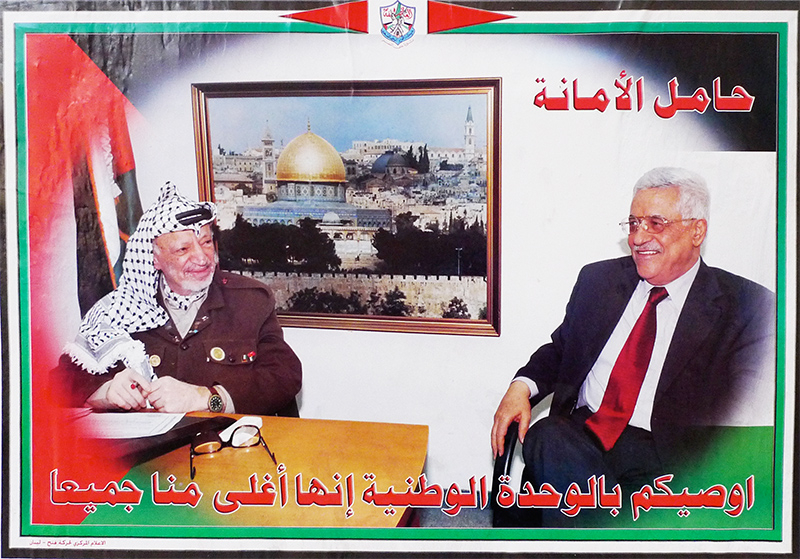
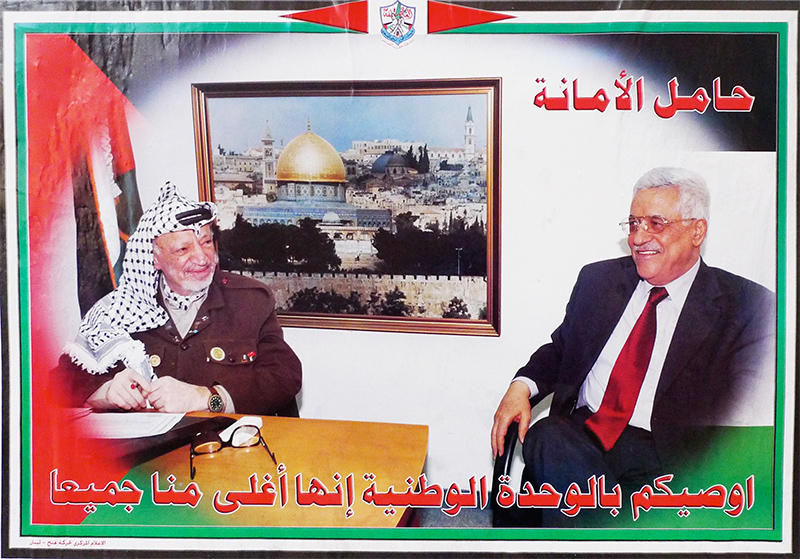
After Yasser Arafat died, Arafatism lived on. The same applies to Mahmoud Abbas. No real changes, if ever, should be expected in the Palestinian attitude towards the conflict with Israel after his departure. Pictured above: Yasser Arafat (L) and Mahmoud Abbas (R) in a Fatah propaganda poster.

Once again, the Palestinians will be the big losers. No one is going to ask their opinion about the next president and they will not be given the opportunity to cast their ballots in a presidential election.

Fatah’s Central Committee in the West Bank brings to mind the Politburo of a Communist Party, which made decisions on behalf of the people, though not with their best interests in mind. In the Gaza Strip, the Palestinians will continue to be ruled by Hamas, an Islamist movement that has brought nothing but destruction and disaster to Palestinians.

So, in the end, the question of Abbas’s successor is rather unimportant. The Palestinians will continue to be ruled by dictatorships that do not give a damn about their people.

Khaled Abu Toameh, an award-winning journalist is based in Jerusalem.

Translate »
Skip to toolbar