

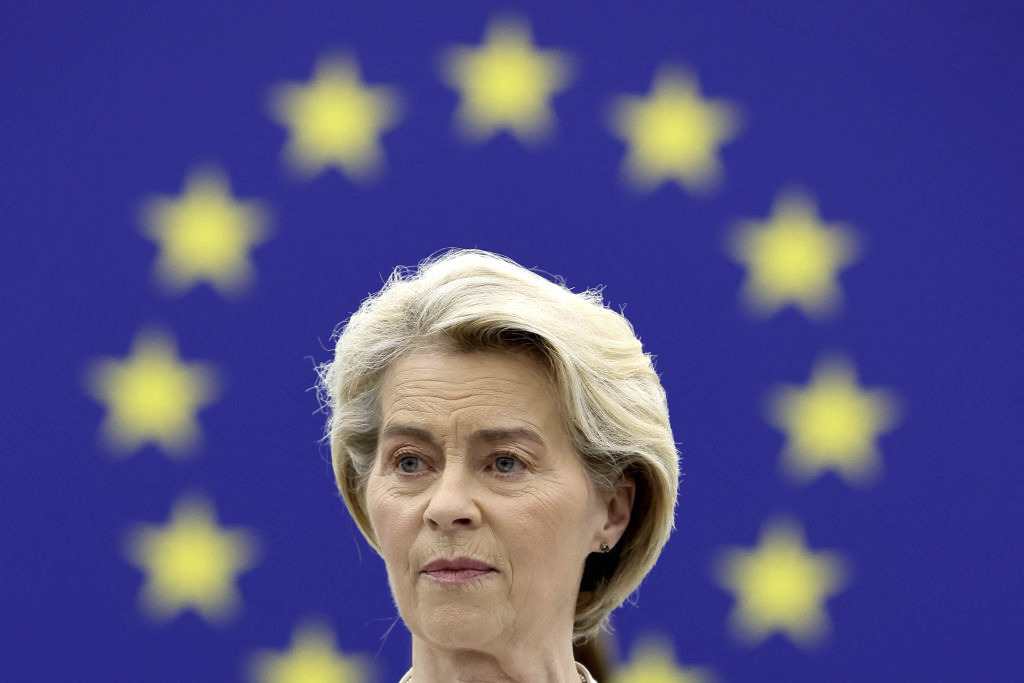
Even former high-ranking officials from the institutions of the European Union are beginning to speak out against the undemocratic regime of the unelected, untransparent, unaccountable European Commission — especially under its senior bureaucrat, European Commission President Ursula von der Leyen.
The European Commission was never meant to have any power beyond what its EU member states granted it.
“My concept of the mission was to establish a law enforcement authority to help nation state authorities protect their borders, not to be an NGO or a humanitarian agency.” — Fabrice Leggeri, former Executive Director of Frontex, the EU’s Border and Coast Guard Agency, The European Conservative, May 27, 2024.
Currently, [the EU unanimity rules] ensure that in sensitive policy areas… every EU member state has a veto right. Von der Leyen wants to change that to just a majority decision.
“In a normal parliamentary system, part of the MPs support the government and part support the opposition. In the European Parliament, this arrangement has been missing… Here, only one single alternative is being promoted, and those who dare think about a different option are labelled as enemies of European integration…. with no opposition, there is no freedom. That is why political alternatives must exist.” — Václav Klaus, former President and Prime Minister of the Czech Republic, February 19, 2009.
Even former high-ranking officials from the institutions of the European Union are beginning to speak out against the undemocratic regime of the unelected, untransparent, unaccountable European Commission — especially under its senior bureaucrat, European Commission President Ursula von der Leyen.
“Today, the Commission is trying to take control. That’s not in line with the [EU] treaty,” said Charles Michel, former president of the European Council and Belgium’s former prime minister, in a recent interview. “There is a super-authoritarian governance,” he added.
The European Commission was never meant to have any power beyond what its EU member states granted it. Michel, however, noted that the EU, by using the COVID-19 pandemic, the war in Ukraine, and other crises, has expanded its authority into areas that were always intended to remain in the hands of member states.
Fabrice Leggeri, who from 2015 to 2022 served as executive director of Frontex, the EU Border and Coast Guard Agency, has also become extremely critical of the EU, and the European Commission in particular. According to Leggeri, however, Sweden’s Ylva Johanssen, who served as European Commissioner for Home Affairs from 2019 to 2024, undermined the agency’s ability to fight illegal migration:
“The first time I met her [Johanssen] in October 2019, Frontex was preparing to equip itself with small arms and uniforms mandated by European lawmakers. When I explained to her that we needed more time to achieve our goal because of the legal problems regarding weapons and uniforms, she interrupted me and said, ‘Don’t worry. You don’t need guns and uniforms because migrants come in search of love. Europe is an ageing continent, so whether you like it or not, it is your job to welcome migrants.'”
Leggeri, after facing continued pushback from the Commission for doing the job that he was hired to do, resigned in 2022.
“I realised that… there was a huge political gap between me and the Commission. My concept of the mission was to establish a law enforcement authority to help nation state authorities protect their borders, not to be an NGO or a humanitarian agency.”
Today, Leggeri is a Member of the European Parliament for France’s Rassemblement Nationale party (RN), headed by Jordan Bardella. When Leggeri informed Bardella and former party leader Marine Le Pen about what really goes on inside the European Commission,
“Le Pen and Bardella told me that what I had told them was so serious and so bad that they could not even have imagined it. When you are outside… the system, you cannot even imagine what is going on inside.”
Von der Leyen — still under investigation for alleged wrongdoing in the acquisition of COVID-19 vaccines in the European Union, “Pfizergate” — would reportedly like even more power. She has been pushing to abolish EU unanimity rules. Currently, they ensure that in sensitive policy areas — such as questions of the EU’s Common Foreign and Security Policy, finances and taxation, EU membership eligibility and negotiations with potential member states, issues pertaining to justice and home affairs, citizenship and more — every EU member state has a veto right. Von der Leyen wants to change that to just a majority decision, and declared in her 2025 “state of the union” speech:
“It is time to break free from the shackles of unanimity. I believe we should move to qualified majority voting in certain areas, for example, in foreign policy.”
After the election defeat of Hungary’s Viktor Orbán in April, von der Leyen again pushed her agenda: “I think moving to qualified majority voting in foreign policy is an important way to avoid systemic blockages as we’ve seen in the past,” she said, referring to Orbán’s frequent use of Hungary’s veto when he was prime minister. “And we should use the momentum now really to move forward on that topic.”
The Middle East Forum’s Jose Lev Alvarez described how Orbán, one of Israel’s staunchest supporters in the EU, leveraged his country’s veto:
“Budapest used its veto power—enabled by the unanimity requirement in European Union foreign policy—to block joint statements condemning Israeli operations in Gaza, sanctions packages aimed at harming communities in the West Bank, and calls for unilateral ceasefires. Diplomatic records show Orbán’s government successfully intervened on at least six major Israel-related initiatives between late 2023 and early 2025.”
Former President and Prime Minister of the Czech Republic Václav Klaus — who suffered through decades of Soviet-imposed communism in Czechoslovakia and knows better than anyone what the dangers of totalitarianism are — warned in a 2009 address to the European Parliament about what others are discovering only now:
“The present decision-making system of the European Union is different from a classic parliamentary democracy, tested and proven by history. In a normal parliamentary system, part of the MPs support the government and part support the opposition. In the European Parliament, this arrangement has been missing… Here, only one single alternative is being promoted, and those who dare think about a different option are labelled as enemies of European integration. Not so long ago, in our part of Europe we lived in a political system that permitted no alternatives and therefore also no parliamentary opposition. It was through this experience that we learned the bitter lesson that with no opposition, there is no freedom. That is why political alternatives must exist.”
At the time, the Atlantic Council trashed Klaus’s sharp-eyed comparison of the EU to the Soviet Union as “truly bizarre.”
egretnewseditor@gmail.com