

The question before the US Congress is not whether the two regimes [Iran and Saudi Arabia] are morally equivalent. They are not. The question is whether uranium enrichment becomes inherently safe simply because today’s Saudi regime happens to be friendly. In Iran, what began as a civilian nuclear program of a trusted ally before 1979 became the longest-running nuclear proliferation crisis of the modern era.
The doctrine that emerged from that failure never rested on the assumption that allies cannot be trusted. It rested on the recognition that no one can predict who will govern a country 20 or 50 years after sensitive technology has been transferred. Nuclear infrastructure outlives the governments that acquire it and the administrations that approve it.
The agreement signed this week authorizes a uranium enrichment capability that will survive this and future governments in Riyadh, in a region where the durability of governments cannot be assured.
The UAE’s only nuclear power plant, Barakah, runs on imported fuel. Nothing in their reactors suffers from the absence of centrifuges.
Saudi Arabia declined those terms, and rather than hold the line, Washington moved it.
Within 18 months, Washington went to war over centrifuges in one country and signed a contract to build them in another. If President Donald Trump said it would be “unfair” for Iran to not have ballistic missiles since Saudi Arabia and Qatar have them, how is it not equally “unfair” for Saudi Arabia to conduct uranium enrichment but not all the other countries in the Middle East?
The precedent will not stop at the Saudi border. Turkey has expansionist ambitions its president has articulated with increasing candor.
“Jerusalem is our city,” Turkish President Recep Tayyip Erdogan has announced, and “We may come suddenly one night,” he has threatened Greece. “When you say ‘Tayfun’ [a Turkish ballistic missile],” he continued, “the Greek is scared. They say it will hit Athens. Of course it will hit it.” This, incidentally, is the leader to whom Trump wants to sell F-35 stealth fighter jets.
If enrichment is dangerous enough to justify war on one country because governments change and capabilities endure, those realities do not dissolve if the recipient should decide it is no longer a friend.
Benefits for friends cannot be retrieved if they are suddenly found in the hands of enemies.
At the moment, it looks as if Trump wants to arm his “friends,” Saudi Arabia and Turkey, with advanced American weapons systems such as the F-35 stealth fighter jet. When he leaves office, both countries will be perfectly positioned with those deadly weapons to attack an infidel West that they have never wanted and have never liked.
For more than two decades, the policy of the United States toward the Middle East, regardless of the party holding power in Washington, rested on the proposition that certain nuclear technologies are too dangerous to spread in an undemocratic region where regimes are overthrown and strategic realities change overnight. At the center of this policy sit centrifuges and uranium enrichment.
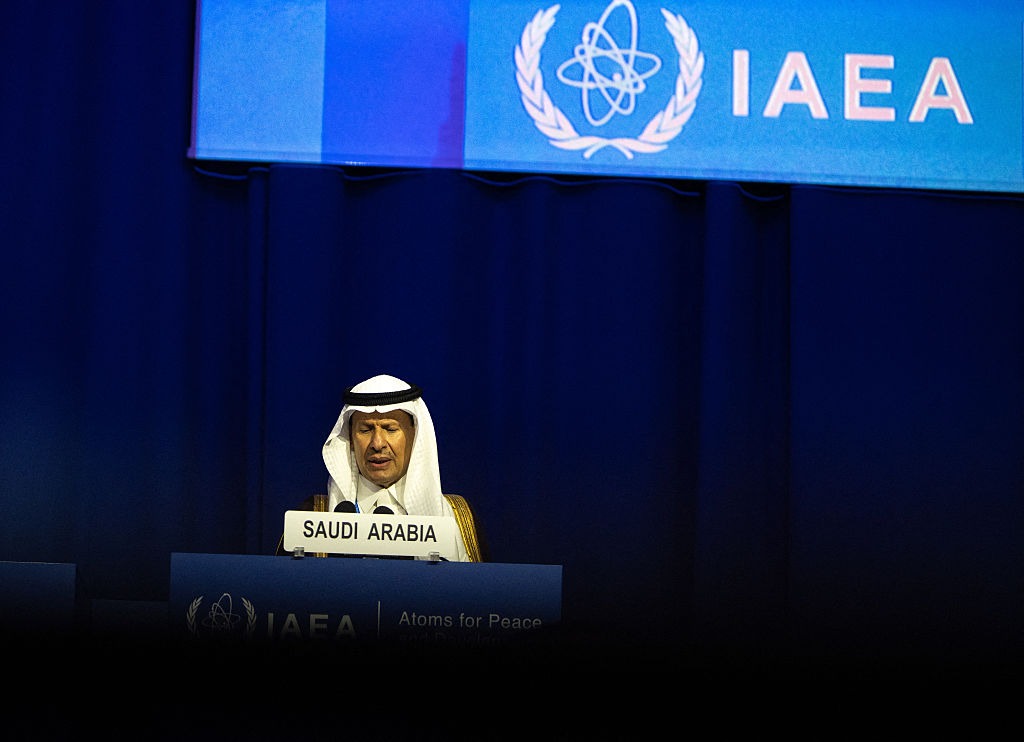
This week, the US signed a civilian nuclear cooperation agreement with Saudi Arabia that opens a path to both uranium enrichment and plutonium reprocessing on Saudi soil. US Energy Secretary Chris Wright and Saudi Energy Minister Prince Abdulaziz bin Salman signed the nuclear accord, in compliance with Section 123 of the Atomic Energy Act, alongside a bilateral safeguards agreement whose contents were not disclosed. The framework contemplates a uranium enrichment facility on Saudi territory, built by American firms, after a two-year joint study. Congress now has 90 days of continuous session to review it, and only a joint resolution of disapproval carried by a veto-proof majority in both chambers can stop it. No president has been overridden on one.
The Kingdom of Saudi Arabia cannot be exactly equated with the Islamic Republic of Iran. Saudi Arabia has been a sometimes strategic ally of the United States, apart from its involvement in the devastating 9/11 attacks, while Iran has spent decades financing terrorism and directly attacking American forces. The question before the US Congress is not whether the two regimes are morally equivalent. They are not. The question is whether uranium enrichment becomes inherently safe simply because today’s Saudi regime happens to be friendly.
Washington answered that question once, in the negative, on the basis of an experience it paid dearly to acquire. In the mid-1970s, few countries appeared more firmly anchored in the American camp than the Imperial State of Iran under Shah Mohammad Reza Pahlavi, who purchased advanced American weapons and was encouraged in his nuclear ambitions by US administrations that treated the alliance as a cornerstone of regional strategy. A few years later, the Shah was gone, and the alliance was gone with him, while the reactors built by the US and Germany, the trained nuclear physicists and the institutional appetite for a nuclear program stayed where they were. In Iran, what began as a civilian nuclear program of a trusted ally before 1979 became the longest-running nuclear proliferation crisis of the modern era.
The doctrine that emerged from that failure never rested on the assumption that allies cannot be trusted. It rested on the recognition that no one can predict who will govern a country 20 or 50 years after sensitive technology has been transferred. Nuclear infrastructure outlives the governments that acquire it and the administrations that approve it. Nuclear programs are measured in generations, political arrangements in years. The agreement signed this week authorizes a uranium enrichment capability that will survive this and future governments in Riyadh, in a region where the durability of governments cannot be assured.
Riyadh has never concealed how it thinks about this. Crown Prince Mohammed bin Salman said in 2018 that Saudi Arabia would pursue a nuclear weapon if Iran acquired one — a statement he has never retracted. Whether that day comes is beside the point. The declaration establishes that uranium enrichment is understood in Riyadh through the lens of regional deterrence as much as energy policy, an unusual foundation on which to build a fuel cycle in a country floating on oil and natural gas.
There was a standard for exactly this situation, and Washington wrote it. When the United Arab Emirates signed its own nuclear agreement with the US in 2009, Abu Dhabi renounced uranium enrichment and plutonium reprocessing outright and accepted the IAEA’s Additional Protocol. American officials spent 15 years citing it as proof that civilian nuclear power requires no domestic fuel cycle. The UAE’s only nuclear power plant, Barakah, runs on imported fuel. Nothing in their reactors suffers from the absence of centrifuges.
Saudi Arabia declined those terms, and rather than hold the line, Washington moved it. The agreement, as described by the administration, leaves enrichment open and drops the Additional Protocol, whose purpose is to give IAEA inspectors the ability to detect undeclared activity. The unpublished bilateral arrangement offered in its place is unlikely to be stricter than the regime Riyadh refused. Enrichment itself is deferred to a two-year study of “commercial viability,” though nobody expects Saudi centrifuges to undercut the global nuclear fuel market. A dozen Democrat lawmakers warned Secretary of State Marco Rubio in March that this was the direction of travel, and Rubio had himself co-sponsored legislation in 2018, with a Democrat colleague, requiring congressional approval of this kind of agreement.
The timing compounds the difficulty. American and Israeli aircraft struck Iranian nuclear facilities in June 2025 and again beginning in February, on the stated grounds that Iran’s uranium enrichment constituted an intolerable threat. IAEA inspectors have had no access to Iran’s declared enrichment sites for more than a year and cannot account for the 440.9 kilograms of uranium enriched to 60% — close to the level required for nuclear weapons. Most of it is believed to be sealed in tunnels at Isfahan. Within 18 months, Washington went to war over centrifuges in one country and signed a contract to build them in another. If President Donald Trump said it would be “unfair” for Iran to not have ballistic missiles since Saudi Arabia and Qatar have them, how is it not equally “unfair” for Saudi Arabia to conduct uranium enrichment but not all the other countries in the Middle East?
The precedent will not stop at the Saudi border. Turkey has expansionist ambitions its president has articulated with increasing candor.
“Jerusalem is our city,” Turkish President Recep Tayyip Erdogan has announced, and “We may come suddenly one night,” he has threatened Greece. “When you say ‘Tayfun’ [a Turkish ballistic missile],” he continued, “the Greek is scared. They say it will hit Athens. Of course it will hit it.” This, incidentally, is the leader to whom Trump wants to sell F-35 stealth fighter jets.
Egypt, meanwhile, has a civilian-use nuclear program and a long memory.
Neither Turkey nor Egypt will accept the restrictions Washington has waived for Saudi Arabia. The editorial board of the Wall Street Journal, which has backed the campaign against Iranian enrichment throughout, immediately called the Saudi deal a mistake:
“Why does Saudi Arabia need to enrich uranium on its home soil? The answer isn’t complicated: It doesn’t unless it would like to establish the rudiments of a nuclear-weapons program….”
It is unclear why the editorial board bothered with “rudiments.”
The WSJ noted that the UAE, a steadier ally through the Iran war, now has little reason to keep to rules binding no one else. The gold standard functioned because it was uniform. Applied selectively, it becomes a bargaining position — and bargaining positions can be bargained away.
For Israel, the consequences are more immediate. Nuclear cooperation had been the inducement for Saudi recognition of the Jewish state, the entire logic of the arrangement discussed before October 7, and the agreement signed Wednesday contained no such condition. Trump attached one the following day, writing that the nuclear deal’s approval depended on Saudi Arabia joining the Abraham Accords and insisting there would be no enrichment under the deal. Riyadh has not responded, the deal’s text remains unpublished, and the administration memo describing it permits the Saudis to enrich uranium supplied by third parties. Nothing in Trump’s Truth Social post amends a signed instrument, and the leverage the deal was meant to purchase had already been spent. Israeli officials across the political spectrum had already said so bluntly, warning of an arms race and a precedent leaving Israel to face nuclear weapons on two fronts rather than one. Jerusalem could live with Saudi reactors fueled with uranium enriched abroad. Uranium enrichment in Saudi Arabia is another matter — and Israel was not consulted.
When a country willingly joins the Abraham Accords, as did the UAE, Bahrain, Morocco and Kosovo, that is one thing; but when a country is coerced into joining to obtain a specific benefit, such as a nuclear enrichment program, the likelihood that it will stay in the Accords has to be open to question. It would be perfectly possible for Saudi Arabia to agree to join the accords for now; then, when Trump leaves office, and Saudi Arabia has its centrifuges comfortably enriching uranium, to bow out of the Abraham Accords — and perhaps also at a time when US oversight had become far less rigorous. Nuclear non-proliferation policy was not designed to judge the intentions of current leaders, but to limit the options available to their successors, whose intentions one cannot know.
The US Congress is therefore deciding something more consequential than whether Saudi Arabia is a reliable partner today. At stake is whether the principle that guided American policy toward Iran for decades still exists in any form applicable to a country Washington happens to like at this moment. If enrichment is dangerous enough to justify war on one country because governments change and capabilities endure, those realities do not dissolve if the recipient should decide it is no longer a friend.
Benefits for friends cannot be retrieved if they are suddenly found in the hands of enemies.
At the moment, it looks as if Trump wants to arm his “friends,” Saudi Arabia and Turkey, with advanced American weapons systems such as the F-35 stealth fighter jet. When he leaves office, both countries will be perfectly positioned with those deadly weapons to attack an infidel West that they have never wanted and have never liked.
egretnewseditor@gmail.com