

Europe is economically dependent on the United States, not on Russia. Russia, for its part, mainly sold hydrocarbons such as oil and gas — 85% of its oil exports to the EU before 2022 — and bought almost nothing from Europe. Europeans have therefore been in a position of unilateral dependence — not supposed “interdependence.”
Most European states possess no aircraft carriers, no missile defense, and no supply fleet. Europe seems only to have funds for endless welfare benefits handed out to migrants who seem committed to transforming Europe into the extremist, third-world countries that they left.
German industry is experiencing a severe depression…. The cause, however, is not the loss of Russian gas. It is 100% internal — and 100% ideological. It is Germany’s suicidal decision to phase out nuclear power in 2011, then coal in 2030, without a credible alternative.
The solution exists and is within reach….
Above all, stop believing that Germany’s €5 trillion economy can be “decarbonized” in ten years without causing an industrial, economic, and ultimately democratic collapse.
Russia is not the solution; it is part of Europe’s problem. Those in Paris, Berlin, or Brussels who continue dreaming of a “Brussels–Berlin–Moscow axis” are not realists. They are dreamers.
Some ideas refuse to die. One of these is the notion of a European “reversal of alliances” into the arms of Russia. The phrase refers to the unexpected decoupling from former allies, accompanied by an unexpected alliance with former enemies. In 1756, Austria, which had always been an ally of Great Britain, instead allied with its longtime foe, France. Meanwhile, Great Britain and its old enemy, Prussia, became allies — resulting in the Seven Years’ War.
You hear it in Europe from the “new right” and the far left — at conferences where people swoon over “multipolarity” and in the corridors of Germany’s Bundestag, where desperate industrialists plead for Russia’s Gazprom to reopen its taps.
If this reversal of alliances was possible in 1756, why not in 2026?
Europe is economically dependent on the United States, not on Russia
In 2024, bilateral trade between the European Union and the United States reached €1.68 trillion (exports plus imports). For 2025, goods trade rose modestly; services (which tend to grow steadily) likely pushed the combined total to a similar or slightly higher level, though exact 2025 services numbers are pending.
Trade between the EU and Russia was at €68 billion in 2023, then €67.5 billion in 2024. Full-year 2025 figures are not yet finalized, but trade continued to decline and hit record lows. In May 2025, EU News wrote, “EU-Russia trade at an all-time low, imports plummeted 86 per cent since the start of the war.”
Joel Hills, business and economics editor of ITV, has been asking for years, “Why Is Europe still buying Russian oil and gas?”
In other words, for the EU, the US alone represents 30 times Russia’s trade weight. Even these figures understate reality because they exclude direct US investment in Europe, the role of the dollar as a reserve currency, and financing Europe’s public debt.
Russia, for its part, mainly sold hydrocarbons such as oil and gas — 85% of its oil exports to the EU before 2022 — and bought almost nothing from Europe. Europeans have therefore been in a position of unilateral dependence — not supposed “interdependence.” Those in Europe who still lament the loss of “cheap Russian gas” conveniently forget that in 2021, Gazprom was charging more than $1,200 per 1,000 m³ at the peak of the crisis — three times the price of American liquefied natural gas today.
Russia never sought an “alliance” with Europe: It seeks Europe’s subjugation
People speak of an “alliance” as though Russian President Vladimir Putin were a potential partner. This is either childish or propaganda. Russia’s recent history is telling: In 2008, the invasion of Georgia; in 2014, the annexation of Crimea and the start of the Donbass war, and in 2022, an attempt to erase Ukraine as a sovereign state; bombing a Ukrainian nuclear power plant, deporting thousands of Ukrainian children to Russia, and repeated nuclear threats.
Russia is not looking for partners. It is looking for vassals.
Putin’s plan is clear: rebuild the old Soviet empire by force, piece by piece. Yesterday Georgia and Ukraine; tomorrow the Baltic States (constantly threatened); the day after tomorrow Moldova, Poland or Romania, and so forth.
Without NATO, Europe is defenseless — and will remain so
One may criticize NATO, its costs and its bureaucracy, or lament Trump asking for money, stationing troops or fly-over rights — but one cannot deny a few stark military realities:
France and the United Kingdom together have around 500 nuclear warheads — respectable, but insufficient as a deterrent to defend a continent of 500 million inhabitants against a Russia that possesses more than 6,000.
Conventional European armies are “display” armies: Germany struggles to field 180,000 soldiers; some lack even functional firearms. France can at best deploy 20,000 troops for a few months. Most European states possess no aircraft carriers, no missile defense, and no supply fleet. Europe seems only to have funds for endless welfare benefits handed out to migrants who seem committed to transforming Europe into the extremist, third-world countries that they left.
Faced by Russia — and also by Turkey (which has NATO’s second-largest army and pursues its own imperial ambitions), Algeria (which has just signed a strategic partnership with Moscow), Islamist militias in the Sahel, and weaponized migration flows — Europe without the US is an economic giant with feet of clay. It will take at least 10-15 years, even in the most optimistic scenario, before Europe could hope for true strategic autonomy.
Until then, those in Europe who advocate “leaving NATO” or “neutrality” are either reckless or delusional. At this point, Trump is mulling leaving it first.
Germany’s tragedy is real — and entirely self-inflicted
German industry is experiencing a severe depression: BASF is shutting factories, Volkswagen is eliminating tens of thousands of jobs, and the chemical and steel sectors are at the edge of collapse. The manufacturing giant Bosch just announced plans to cut 13,000 jobs in its mobility (auto) division in Germany by 2030 (on top of earlier cuts), representing about 10% of its German workforce. This aims to save €2.5 billion annually amid stagnating auto demand. Volkswagen plans to eliminate up to 50,000 jobs in Germany by 2030 (including ~35,000 at the core VW brand), following a sharp drop in profits (down ~44% in 2025 to the lowest level since 2016). The chemicals leader BASF is closing production facilities (e.g., a hydrosulfites plant in Ludwigshafen) and has already cut around 4,800 jobs as part of restructuring. The broader chemical industry faces its worst crisis in decades, with widespread plant downsizing and job losses in the tens of thousands.
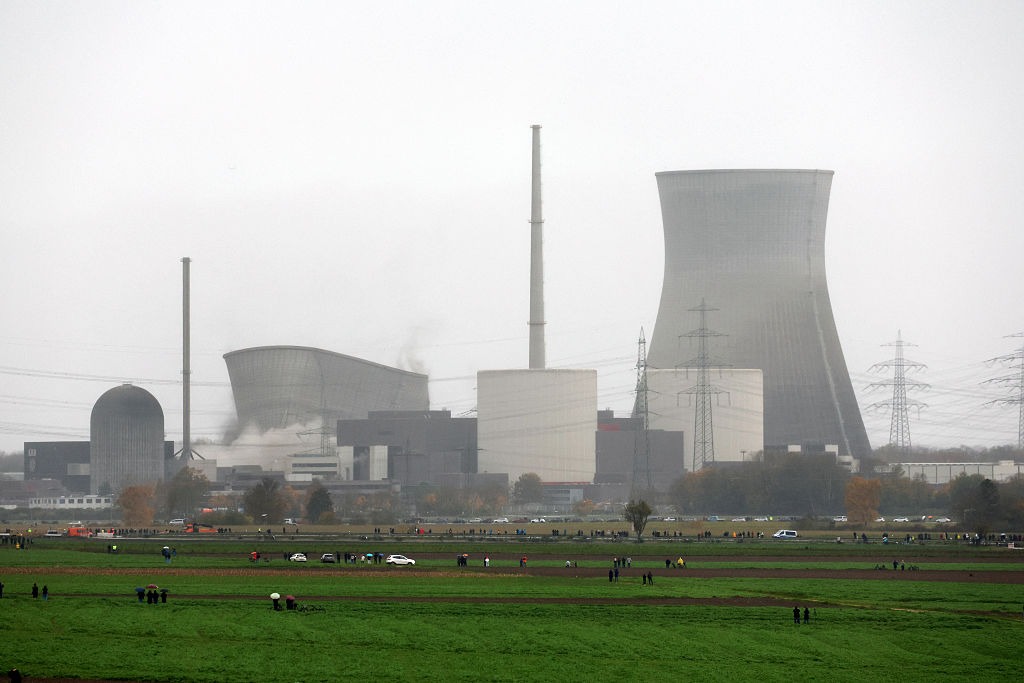
The cause, however, is not the loss of Russian gas. It is 100% internal — and 100% ideological. It is Germany’s suicidal decision to phase out nuclear power in 2011, then coal in 2030, without a credible alternative.
It is the dogma of forced “decarbonization,” which has sent electricity prices soaring (€40-€60/MWh in the United States, €300-€500/MWh in Germany on certain winter days).
It is the closure of Germany’s last nuclear plants in April 2023, just as France was expanding its nuclear power generation — and even as Swedish and Finnish Greens were applauding new reactors.
The solution exists and is within reach:
- Massively revive nuclear power. France is again proposing collaboration with Germany in the nuclear field, despite Germany’s refusals in the past on ideological grounds.
- Import American, Norwegian, and Australian natural gas, already much cheaper than in the past.
- Exploit vast shale gas reserves in Poland, Romania and Ukraine (once the war ends).
- Above all, stop believing that Germany’s €5 trillion economy can be “decarbonized” in ten years without causing an industrial, economic, and ultimately democratic collapse.
Russia is not the solution; it is part of Europe’s problem. Those in Paris, Berlin, or Brussels who continue dreaming of a “Brussels–Berlin–Moscow axis” are not realists. They are dreamers.
Europe really has only one option: to reinvest heavily in its defense, which means scaling back the welfare state and embracing nuclear and fossil fuels. Europe needs to salvage what it can of the transatlantic relationship by stopping its objections whenever our American allies ask for the right to use their own military bases in Europe. Europe would do well to step up to the plate. Everything else is nothing but a pipe dream — or completely self-defeating.
egretnewseditor@gmail.com