
Category Archives: Uncategorized

U.S. Prisoner Release Policy: Terrorists Yes, Americans and Human Rights Heroes No by George Phillips

  • When Carlos Manuel Figuerosa Alvarez climbed over the wall of the U.S. Embassy in Havana, U.S. officials turned him over to Cuban police, who, according to reports, detained him and immediately began to beat him. Did U.S. officials assess if Figuerosa’s safety was in jeopardy? Did they ignore their own policy that a Cuban may be eligible for refugee status in the U.S. if they are a human rights activist or former political prisoner?


  • A recent report by the Director of National Intelligence showed that of those so far released from Guantanamo Bay, 116 have returned to terrorist or insurgent activities and another 69 are suspected of having done so. These figures represent nearly 30% of released detainees.

  • President Obama pledged, “We are not going to relent until we bring home Americans who are unjustly detained in Iran.” But “we” have relented. If not, what are “we” doing to secure the release of the four Americans unjustly in Iranian prison?

The Obama Administration, to the chagrin of opponents of rogue regimes and terrorism, has made generous deals with the autocratic governments of Cuba and Iran, and seems in the process of making the release of terrorist detainees in Guantanamo Bay a cornerstone of its foreign policy.

On Monday November 16 — two days after terrorists murdered 129 innocent people in Paris — five more terrorist detainees were released from Guantanamo Bay detention camp in Cuba.

All five were originally from Yemen and are being released to the United Arab Emirates, a central location in the Middle East from where they can easily return to a life of terrorism.

Of particular concern is the release of Ali al-Razihi, a bodyguard of Osama bin Laden; a review board initially turned down his release.

Declassified documents show that al-Razihi received advanced Al Qaeda training and served in Bin Laden’s 55th Arab Brigade.

report by the U.S. Director of National Intelligence (DNI) this spring showed that of those so far released from Guantanamo Bay, 116 have returned to terrorist or insurgent activities and another 69 are suspected of having done so.

If you combine these two figures, it represents nearly 30% of those who have been released from Guantanamo Bay.

How can we be sure that the five men released to the UAE will not follow the same path?

On the other side of Cuba, in Havana, at the U.S. Embassy — which should serve as a bastion of freedom in an oppressed nation — a troubling event occurred on September 30.

When Carlos Manuel Figuerosa Alvarez climbed over the wall of the U.S. Embassy and began shouting, “Down with Raul!” — meaning Cuban dictator Raul Castro — U.S. officials turned him over to Cuban police, who, according to reports, detained him and immediately began to beat him.

Figuerosa — who had originally been arrested at a Human Rights Day protest in 2013 — was one of the 53 Cuban political prisoners released after a year and half of negotiations that led up to the announcement that the Obama Administration would be opening an embassy in Havana and press for an end of the U.S. embargo on Cuba.

The U.S. State Department said it would not comment on Figuerosa’s case; it was a security issue.

Whose security was at risk? Was it the security of U.S. Embassy workers, because of Figuerosa’s protest, or was it Figuerosa’s himself because of the brutal regime he was protesting?

Did U.S. officials ask who Figuerosa was or assess if his safety was in jeopardy?

Did U.S. officials fail to neglect information on their own website — specifically for the U.S. Embassy in Havana – which mentions the policy that a Cuban national may be eligible for refugee status to the United States if they are a human rights activist or a former political prisoner?

When U.S. officials turned Figuerosa over to Cuban police, did they consider what might happen to him in the hands of Cuban authorities? Their own State Department Human RightsReport for Cuba states the protocols for “detainees and prisoners [who have] endured physical abuse” and “were subjected to extended solitary confinement, beatings, restrictions on family visits, and denial of medical care.”

Did U.S. officials know that he was one of the 53 political prisoners whose release the Administration had spent so much time and effort trying to secure?

When Cuban dissident and former political prisoner Carlos Manuel Figuerosa Alvarez climbed over the wall of the U.S. Embassy in Havana on September 30, U.S. officials turned him over to Cuban police.

When the Obama Administration negotiated the Iran nuclear deal, there were four American citizens unjustly imprisoned in Iran: Christian pastor Saeed Abedini, U.S. Marine Amir Hekmati, Washington Post reporter Jason Rezaian, and former FBI and DEA employee Robert Levinson.

When asked why the release of American hostages was not being advanced as part of the Iran nuclear deal, President Obama’s response was to warn about “the logic that that creates. Suddenly, Iran realizes, you know what, maybe we can get additional concessions out of the Americans by holding these individuals…”

With the final nuclear deal, the Iranian regime will be getting up to $150 billion in sanctions relief in exchange for dubious inspections of nuclear sites they can control by delaying.

After this incredible giveaway to a leading state sponsor of terrorism, what leverage does the U.S. now have to secure the release of these Americans unjustly in Iranian prison?

Shortly after the Iran nuclear deal was signed — by the P5+1 nations but not by Iran — President Obama pledged, “We are not going to relent until we bring home Americans who are unjustly detained in Iran.”

Then — nothing. It appears yet another deception of the “you can keep your doctor” ilk. “We” — by the way, who is included in that? — have relented. If not, what are “we” doing to secure the release of these four Americans unjustly in Iranian prison?

Five more suspected terrorists are released from Guantanamo Bay, while four Americans are languishing in Iranian prisons — and a brave voice of freedom in Cuba is turned away.

George Phillips served as an aide to Congressman Chris Smith of New Jersey, working on human rights issues.

U.S. Policy Made 2015 the Worst Persecution of Christians “in Modern History” by Raymond Ibrahim

  • In 35 nations Islamic extremism “has risen to a level akin to ethanic cleansing” of Christians.
  • Something else stands behind this rise of genocidal “Islamic extremism”: U.S. foreign policy. In every Muslim nation where the U.S. has intervened in the name of “freedom and democracy,” Christian life has exponentially worsened.

  • For years the Obama administration has refused to list Boko Haram as a terrorist organization, and has argued that its violence had nothing to do with Islam and was a result of poverty and grievances. Instead, the U.S. pressured the Nigerian government to make concessions, including by building more mosques—the very structures, as the Nigerian lawyer Emmanuel Ogebe said, where Muslims are radicalized and recruited for the jihad.
  • Globally empowering forces hostile to Christians is synonymous with globally empowering forces hostile to America.
  • The primary achievement of U.S. foreign policies, apart from wasted American blood and treasure—
  • is the unprecedented rise in Muslim nations of Islamic forces outspokenly bent on destroying America.

2015 was the “worst year in modern history for Christian persecution,” according to Open Doors, a human rights organization that has been documenting the persecution of Christians since 1955.

According to its latest data, more than 7,000 Christians were killed for their faith in 2015 — almost twice as many as in 2014. In addition, more than 2,400 churches were attacked, damaged or destroyed — again, more than double the number of the previous year.

In the words of Open Doors’ CEO, David Curry:

The 2016 World Watch List [which ranks the 50 nations where Christians are most persecuted] documents an unprecedented escalation of violence against Christians, making this past year the most violent and sustained attack on Christian faith in modern history. … This research has concluded that after the brutal persecution of Christians in 2014, 2015 proved to be even worse with the persecution continuing to increase, intensify and spread across the globe. … The level of exclusion, discrimination and violence against Christians is unprecedented, spreading and intensifying.

Who or what is behind these unprecedented levels of persecution? Some of it is related to the tendency of non-Western nations to associate Christianity with the “hated West.” Four are Communist nations — Vietnam (ranked #20), Laos (#29), China (#33), and North Korea (#1), where “Christianity is not only seen as ‘opium for the people,’ as is normal for all communist states, it is also seen as deeply Western and despicable,” notes the report. Three are reclaiming their religious heritage in contradistinction to what is portrayed as a depraved West — Hindu India (#17), Buddhist Bhutan (#38) and Myanmar (#23). And two — Mexico (#40) and Columbia (#46) — are fueled by organized crime and drug cartels.

“Islamic extremism” is cited as the source of persecution for the remaining 41 nations that make the list of 50 worst persecutors of Christians. North Korea aside, the rest of the eight nations where Christians experience the worst form of persecution (“extreme persecution”) are all Islamic. In 35 nations, Islamic extremism “has risen to a level akin to ethnic cleansing” of Christians.

A close examination of the report indicates that something else stands behind this rise of genocidal “Islamic extremism”: U.S. foreign policy. In every Muslim nation where the U.S. has intervened in the name of “freedom and democracy,” Christian life has exponentially worsened. Put differently, among those who most despise “freedom and democracy” — radical and jihadi Muslims — tend to be the ones most empowered by U.S. foreign policies.

Iraq today, according to the report, is the second worst nation in the world in which to be Christian. Afghanistan is fourth, Syria fifth, and Libya tenth. A decade ago, none of these countries even made the top 10 list. Syria and Libya — when they were ruled by secular autocrats who were eventually demonized by U.S. politicians and media, and then underwent U.S. intervention — did not even make the top 20.

In 2004, Saddam Hussein’s Iraq was ranked 32 and scored only 35.5 (out of 100). After a decade’s worth of American lives and treasure were wasted, Iraq is now scores 90 and is the worst Muslim nation in which to be Christian. The situation is the same in those other Muslim nations that the U.S. government brought “freedom and democracy” to — and with Syria, which it continues trying to bring “freedom and democracy” to:

  • Syria: A decade ago it was ranked #47 and scored only 24.5. A nation must score at least 50 to count as containing “sparse persecution.” Today it is ranked #5 and scores 87 , or “extreme persecution.”
  • Libya: A decade ago it was ranked #22 and scored 41; today it ranks #10 and scores 79.
  • Afghanistan: A decade ago it ranked #11 and scored 53; today — a decade after the U.S. declared “victory” over al-Qaeda and the Taliban — it is ranked #4 and scores 88.

Even in nations where U.S. intervention is not obvious, Christian persecution has reached unprecedented levels. In Nigeria, Boko Haram — an Islamic group possibly more savage than ISIS — slaughtered more Christians in 2015 than any other terrorist group. Yet for years the Obama administration has refused to list Boko Haram as a terrorist organization, and has argued that its violence had nothing to do with Islam and was a result of poverty and grievances. Instead, the U.S. pressured the Nigerian government to make concessions, including by building more mosques — the very structures, as the Nigerian lawyer Emmanuel Ogebe said, where Muslims are radicalized and recruited for the jihad.

In May 2013, soon after Nigerian forces killed 30 Boko Haram members in a particularly strong offensive, Reuters reported that U.S. Secretary of State John Kerry “issued a strongly worded statement” to the Nigerian president: “We are … deeply concerned by credible allegations that Nigerian security forces are committing gross human rights violations, which, in turn, only escalate the violence and fuel extremism” from Boko Haram.

Those many Americans indifferent to all this persecution “over there” would do well to connect the dots: Globally empowering forces hostile to Christians is synonymous with globally empowering forces hostile to America. Those Muslims who hate and persecute Christians also hate, and seek to persecute, Americans for exactly the same reason: Westerners all are hated non-Muslim infidels.

In short, the primary achievement of U.S. foreign policies, apart from wasted American blood and treasure.

is the unprecedented rise in Muslim nations of Islamic forces outspokenly bent on destroying America.

Raymond Ibrahim, author of Crucified Again: Exposing Islam’s New War in Christians (a Gatestone Publication, published by Regnery, April 2013), is a Shillman Fellow at the David Horowitz Freedom Center and Judith Friedman Rosen Writing Fellow at the Middle East Forum.
U.S. Intelligence-Gathering on ISIS Threatened in Africa by Con Coughlin

  • The increasingly erratic conduct of one of Africa’s more despotic rulers, as well as his tilt toward China, is raising serious concerns about the future of a vital American intelligence-gathering base that plays a central role in targeting al-Qaeda and Islamic State militants in countries such as Yemen and Syria.


  • It will be the first time a head of state has been ordered to appear before a British court since King Charles I of England in 1649, who was subsequently beheaded for treason.

The increasingly erratic conduct of one of Africa’s more despotic rulers is raising serious concerns about the future of a vital American intelligence-gathering base that plays a central role in targeting al-Qaeda and Islamic State (ISIS) militants in countries such as Yemen and Syria.

Since coming to power 1999, President Ismail Omar Guelleh of Djibouti, in the Horn of Africa, has emerged as a vital ally of the United States, in spite of his despotic style of government and mounting criticism over his country’s lamentable record on human rights.

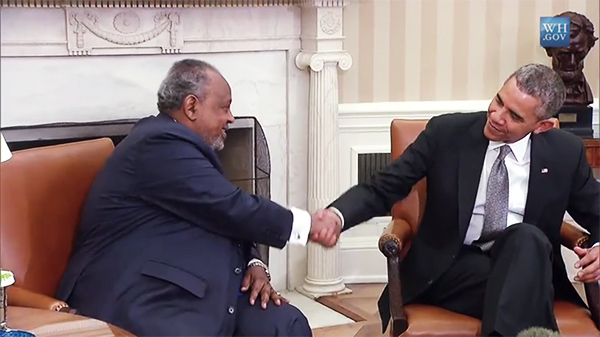
American officials fear that President Ismail Omar Guelleh of Djibouti (left) is turning away from his alliance with the U.S., jeopardizing one America’s key intelligence listening posts, which is located in Djibouti. (Image source: White House video screenshot)

Successive American administrations — including that of President Barack Obama, who claims to champion greater democracy in Africa — have willingly turned a blind eye to Mr. Guelleh’s dictatorial style, in return for being allowed to operate the Camp Lemonnier military base that is located in the strategically-important African state.

Sited at the junction between the Gulf of Aden and the Red Sea, the sprawling Camp Lemmonier complex, which houses 4,500 U.S. military personnel and is the only U.S. military based located in Africa, has developed into one of America’s key listening posts since the September 11, 2001 attacks. Apart from being a sophisticated communications centre for the Arab world and beyond, it also houses U.S. Special Forces, fighter planes and helicopters, as well as being a major operational center for drone operations in Africa and the Middle East.

But the unpredictable behaviour of Mr. Guelleh, who has been summoned to make an unprecedented appearance at a London court next month, has prompted senior counter-terrorism officials in Washington to question whether the U.S. can afford to maintain its decade-long alliance with the Djibouti strongman.

Mr. Guelleh will certainly find himself under intense scrutiny next week, after a judge at London’s Commercial Court, which is hearing fraud claims lodged by the Djibouti government, took the extraordinary decision to rule that Mr. Guelleh must appear in person, rather than via video link, when the court resumes its hearings on October 5. The judge made the order after Mr. Guelleh’s legal team were accused of deliberately misleading the court. It will be the first time a head of state has been ordered to appear before a British court since King Charles I of England in 1649, who was subsequently beheaded for treason.

But while this unique twist in the forthcoming legal proceedings is likely to dominate the headlines when the case resumes, it is the effect Mr. Guelleh’s erratic conduct is having on Djibouti’s political stability, as well as the country’s worrying tilt towards China, that is causing most concern for the Pentagon.

In recent months Mr. Guelleh has intensified his efforts to form a strategic partnership with China, which is keen to expand its military presence throughout the African continent. China, which is already contracted to build a railway linking Djibouti to Ethiopia, has negotiated a $400 million deal to develop Djibouti’s port facilities, a development Pentagon officials believe will lead to China establishing its own military presence just a few miles from the highly sensitive Camp Lemonnier complex.

China’s foothold in Djibouti, moreover, has raised fears in Washington that Mr. Guelleh is turning away from his erstwhile ally in the U.S., with all the implications that could have for the future operational security of Camp Lemmonier.

Consequently, senior policymakers in Washington are now hoping to prevent Mr. Guelleh from running for a fourth term in office when the next round of presidential elections are held next year. Certainly, if China continues with its plans to establish a military presence in the Horn of Africa, the Pentagon will have to give serious consideration to relocating some of Camp Lemonnier’s more sensitive operations elsewhere.

“The trade deal between Djibouti and China has raised serious concerns with regard to Camp Lemonnier,” commented a senior U.S. security official. “There are now genuine concerns that if President Guelleh gets too close to China, then he may be tempted to impose restrictions on U.S. access to the base, which would seriously impact on the West’s counter-terrorism operations against Islamic State and al-Qaeda.”

If Mr. Guelleh continues with his confrontational approach towards Washington, then Mr. Obama is likely to come under pressure to press for political reform in Djibouti, thereby ending the president’s long-running dictatorship. After all, it was only last July that Mr. Obama, in his keynote speech to the African Union, made a scathing attack on Africa’s culture of presidents-for-life, urging the continent’s leaders to follow the example of George Washington and Nelson Mandela by respecting term limits — a warning is particularly pertinent so far as Mr. Guelleh is concerned.

U.S. Bankrolling Hezbollah by Majid Rafizadeh

  • Hassan Nasrallah, Hezbollah’s leader, said that U.S. sanctions would have no impact on the organization, as it already obtains complete financial and weaponry assistance from the Islamic Republic of Iran.

  • After the flimsy and uncompleted nuclear agreement, the Obama Administration immediately began transferring billions of dollars to Iran’s Central Bank. One of the payments included $1.7 billion transferred in January 2016. $1.4 billion of this sum came from American taxpayers.
  • Thanks to President Obama and the continuing lifting of sanctions, the money that Iran is receiving from the U.S., from international trade, and from increased oil sales is most likely being directed toward Hezbollah and the Revolutionary Guards, Iran’s major beneficiaries, which keep attempting to scuttle U.S. foreign policy objectives in the region.

Nearly 34 years after its inception, Hezbollah, a Lebanese Shiite militant group, has publicly admitted that it is fully receiving its money and arms from the Iranian government.

Hassan Nasrallah, the leader of Hezbollah, ridiculed the recent U.S. sanctions targeting Hezbollah. His speech was broadcast by the Al-Manar, the Shiite party’s TV station, which is funded by the Iranian government. Nasrallah said that the U.S. sanctions would have no impact on the organization, as his group already obtains complete financial and weaponry assistance from the Islamic Republic of Iran.

The Shiite leader pointed out that “We do not have any business projects or investments via banks…” He added that Hezbollah’s survival depends on Iran: “We are open about the fact that Hezbollah’s budget, its income, its expenses, everything it eats and drinks, its weapons and rockets, come from the Islamic Republic of Iran,” he said, and pressed the notion that his group “will not be affected” by any type of sanctions.

Nasrallah’s recent speech was also part of a ceremony that marked 40 days after the death of a high level Hezbollah commander, Mustafah Bedreddine, in the Syrian capital of Damascus. Nasrallah has recently vowed to increase Hezbollah’s military presence in Syria, and assist Bashar Al Assad’s forces, although Hezbollah has suffered significant losses in the latest fighting in Aleppo, Syria.

Nasrallah stated on Al Manar television:

“We are facing a new wave… of projects in our war against Syria. They are being waged in northern Syria, particularly in the Aleppo region… The defense of Aleppo is the defense of the rest of Syria, it is the defense of Damascus, it is also the defense of Lebanon, and of Iraq….We will increase our presence in Aleppo. Retreat is not permissible.”

Iran maintains that Hezbollah is a legitimate social, political and religious organization. Iran fostered the birth of Hezbollah and transformed it into one of its militant proxies in the region. Iran also helped Hezbollah become part of Lebanon’s political system.

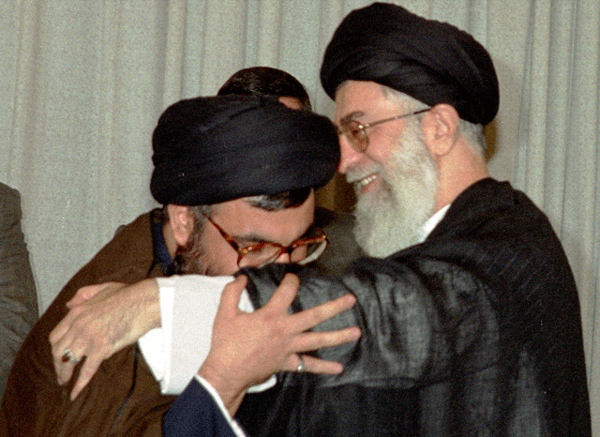
Hezbollah leader Hassan Nasrallah (left) hugs and kisses Iran’s Supreme Leader, Ayatollah Ali Khamenei.

The United States and several other countries, including Canada, France, Australia, the Netherlands, and even the Arab League and the Gulf Cooperation Council (GCC), have long listed Hezbollah as a global terrorist group.

Hezbollah has been accused of terrorist attacks, including the 1983 bombing of the U.S. Marines barracks in Beirut, in which 241 U.S. Marines were killed, the 1983 U.S. Embassy bombing in Beirut; the 2009 Hezbollah plot in Egypt; the 1984 United States Embassy annex bombing in Beirut; the 2012 bus bombing in Burgas, Bulgaria, as well as the 9/11 attacks in the United States, in which federal courts ordered Iran to pay $7.5 billion to the victims’ families. Hezbollah and Iran were also reportedly behind the 1992 attack on Israel’s Embassy in Buenos Aires in which 29 were killed.

U.S. President Barack Obama gave hope that the nuclear agreement (which is still unsigned by Iran), the lifting of sanctions against Iran, and engagement with Tehran will possibly help to change Iran’s behavior towards the moderates in Iran, and diminish Iran’s antagonistic, anti-Semitic stance towards Israel. He pointed out that as a result of the nuclear agreement,

“Iran being able to recognize that what’s happening in Syria for example is leading to extremism that threatens their own state and not just the United States; that some convergence of interests begins to lead to conversations between, for example, Saudi Arabia and Iran; that Iran starts making different decisions that are less offensive to its neighbors; that it tones down the rhetoric in terms of its virulent opposition to Israel. And, you know, that’s something that we should welcome.”

Instead, the rhetoric of Iran’s Supreme Leader, Ayatollah Ali Khamenei and his proxy, Hezbollah, appear to have grown harsher against Israel and the US. As Nasrallah emphasized, “As long as Iran has money, we have money… Just as we receive the rockets that we use to threaten Israel, we are receiving our money. No law will prevent us from receiving it…”

In December 2015, the U.S. Congress voted to impose fresh sanctions on Hezbollah, through the Hezbollah International Financing Prevention Act, by targeting those banks that are “knowingly facilitating a significant transaction or transactions for” Hezbollah and those financial institutions that “knowingly facilitating a significant transaction or transactions of a person identified on the List of Specially Designated Nationals and Blocked persons.”

Nasrallah lashed out at the U.S.: “We totally reject this law until the Day of Judgment. … Even if the law is applied, we as a party and an organizational and jihadi movement, will not be hurt or affected.” He added: “We have no money in Lebanese banks, either in the past or now. … We don’t transfer our money through the Lebanese banking system.”

The Congressional bill does pose some minor challenges to Hezbollah’s financial logistics, but it will not prevent its military operations, terrorist attacks and expansion in any significant way — due to the Obama administration’s grand policy towards Iran and Hezbollah.

After the flimsy and uncompleted nuclear agreement, the Obama Administration immediately began transferring billions of dollars to Iran’s Central Bank. One of the payments included $1.7 billion transferred in January 2016. $1.4 billion of this sum came from American taxpayers.

Iran immediately increased its military budget by $1.5 billion from $15.6 billion to $17.1 billion.

Iran also began witnessing the flow of money due to the lifting of international sanctions.

The major primary beneficiaries of the sanctions relief and flow of money are Hezbollah and the Islamic Revolutionary Guards Corps (IRGC). Previously, when sanctions were imposed on Iran, Tehran had to reduce funding to Hezbollah and the its television station, Al-Manar, from approximately $200 million a year. However, thanks to President Obama and the continuing lifting of sanctions, the money that Iran is receiving from the U.S., from international trade, and from increased oil sales is most likely being directed toward Hezbollah and IRGC, Iran’s major beneficiaries, which keep attempting to scuttle U.S. foreign policy objectives in the region.

Dr. Majid Rafizadeh, political scientists and Harvard University scholar is president of the International American Council on the Middle East. He can be reached at Dr.rafizadeh@post.harvard.edu

U.S. and West Victimize Christians Fleeing ISIS by Raymond Ibrahim

  • Western nations are not merely ignoring Muslim persecution of Christians in the Middle East, they are actively supporting it by sponsoring “moderate” rebels who in reality are as “radical” and anti-Western as the Islamic State.


  • “Why the federal government has failed to take steps to expedite such reunification in cases where family and religious leaders are willing to vouch for and help those seeking asylum here… remains an unfathomable mystery.” —East County Magazine, San Diego.

  • Such “unfathomable mysteries” are reminiscent of the U.S. State Department’s habit of inviting Muslim representatives but denying visas to Christian representatives. Since the start of 2015, 4,205 Muslims have been admitted into the U.S. from Iraq, but only 727 Christians. For every Christian granted asylum, the U.S. grants asylum to five or six Muslims — even though Christians, as persecuted “infidel” minorities, are in much greater need of sanctuary.

  • “Most European governments, especially those that are Christian explicitly or implicitly, are failing in their duty to look after their fellow Christians in their hour of need.” — Lord Weidenfeld.

  • When persecuted Christian minorities manage to flee the Islamic State and come to the West for asylum, they are imprisoned again. All the while, Muslims — in the Mideast and in the West — are being empowered and welcomed in the West with open arms.

Not only does the West facilitate the persecution of Christians in the Middle East, but in the West as well.

According to a recent NPR report, the U.S. supported “moderate” coalition fighting both Bashar Assad and the Islamic State in Syria “has extremists in its own ranks who have mistreated Christians and forced them out of their homes” — just as the Islamic State (IS) has done.

Christian minorities forced out of their homes who manage to reach Western nations — including the United States — sometimes encounter more trouble.

Despite having family members to sponsor them, a group of 20 Christians who fled the Islamic State in Iraq have been imprisoned indefinitely, some since February, at the Otay Detention Facility in San Diego, even though they have local family members and Christian leaders who vouch for them (a primary way that the majority of detained foreign nationals are released is to the supervision of American citizens who vouch for them).

Activists say that the men and women in detention have been held for too long, including by the U.S. government’s own standards. Some have been imprisoned for over seven months with no hearing date for release even set.

“They are being held without a real reason…. They’ve escaped hell. Let’s allow them to reunite with their families,” said Mark Arabo, a spokesman for the Chaldean community in San Diego.

The detainees include a woman who had escaped the clutches of IS, and who had pleaded to see her sickly mother. Her mother died before she could see her. “She had been begging to be let out to see her dying mother,” said a priest familiar with the case.

Discussing the ongoing plight of these Iraqi Christians, San Diego’s East County Magazineconcluded: “Why the federal government has failed to take steps to expedite such reunification in cases where family and religious leaders are willing to vouch for and help those seeking asylum here, then, remains an unfathomable mystery.”

Such “unfathomable mysteries” are reminiscent of the U.S. State Department’s habit of inviting Muslim representatives but denying visas to Christian representatives. Since the start of 2015,4,205 Muslims have been admitted into the U.S. from Iraq, but only 727 Christians. For every one Christian the U.S. grants asylum, it grants asylum to five or six Muslims — even though Christians, as persecuted “infidel” minorities, are in much greater need of sanctuary, not to mention more assimilating to American culture than Muslims.

Faith McDonnell, of the Institute on Religion & Democracy, said regarding the detainment of Iraqi Christians in San Diego:

This follows the disturbing pattern that we have seen from the State Department of ignoring the particular targeting of Christians by ISIS while giving preferential treatment for asylum to other groups with expedited processing — like Somalis, Iraqis, and Syrians, some of whom could very well be members of jihadist movements.

The same is happening in the United Kingdom. Church leaders accuse David Cameron of “turning his back” on Christians facing genocide in Syria and Iraq by failing to grant them refuge in the UK — even though thousands of Muslims have been allowed entry.

Lord Carey, the former Archbishop of Canterbury, signed a petition calling on the UK government to “welcome Christian refugees and give them priority as asylum seekers,” emphasizing that “Syrian and Iraqi Christians are being butchered, tortured and enslaved.”

Similarly, Lord Weidenfeld, 95, who fled Nazi-occupied Austria in 1938 with the help of British Quakers, said:

Why is it that the Poles and the Czechs are taking in Christian families and yet the British government stands idly by?

This mood of indifference is reminiscent of the worst phases of appeasement, and may have catastrophic consequences. Europe must awake and the Conservative British Government should be leading from the front.

Most European governments, especially those that are Christian explicitly or implicitly, are failing in their duty to look after their fellow Christians in their hour of need.

This is not necessarily true of east European nations. Along with countries like Poland and Czechoslovakia, Slovakia recently went so far as to say it will only accept Christians when it takes in Syrian refugees under an EU relocation scheme. The Slavic nation argues that “Muslims would not be accepted because they would not feel at home,” including because there are no mosques in Slovakia.

Meanwhile, many of those Christians who are granted asylum in Western countries arrive there only to be further persecuted by Muslim asylum seekers — indicating, once again, who does and who does not really need asylum; who does and who does not assimilate in Western culture.

Most recently in Sweden, two small families of Christian asylum seekers from Syria were recently harassed and abused by approximately 80 Muslim asylum seekers, also from Syria.

The Christians and Muslims — described by one Swedish newspaper as “fundamentalist Islamists” — resided in the same asylum house. Among other humiliations, the Muslims ordered the Christians not to wear their crosses around their necks and not to use the communal areas when in use by Muslims.

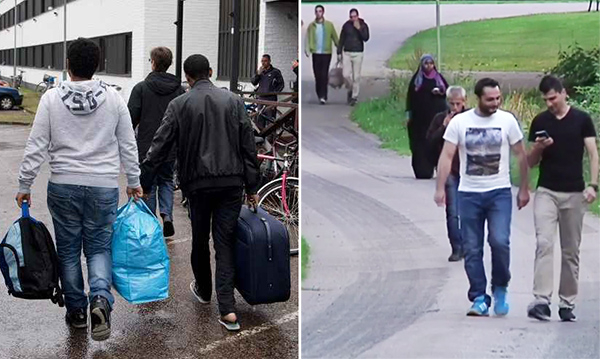
Asylum seekers in the Swedish city of Kalmar, where Christian refugees were forced to move out of public housing after being harassed and threatened by Muslims.

After continuous harassment and threats, these Christian refugees, who had managed to escape the Islamic State, left the Swedish asylum house “fearing for their own safety.” A spokesman for the government migration agency responsible for the center they had been staying in said:

“They dared not stay. The atmosphere became too intimidating. And they got no help… They chose themselves to organize new address and moved away without our participation because they felt a discomfort.”

Western nations are not merely ignoring Muslim persecution of Christians in the Middle East, they are actively supporting it by sponsoring “moderate” rebels who in reality are as “radical” and anti-Western as the Islamic State. And when these persecuted Christian minorities manage to flee the Islamic State and come to the West for asylum, they are imprisoned again. All the while, Muslims — in the Mideast and in the West — are being empowered and welcomed in the West with open arms.

Translate »
Skip to toolbar