Category Archives: Uncategorized

UK: The Lessons of Manchester by Robbie Travers

  • While Corbyn seems to be saying that Britain’s foreign policy is the reason the United Kingdom is being targeted by Islamists, this view seems to be at odds with what the Islamists themselves have said. The Islamic State’s propaganda magazine, Dabiq, explained perfectly clearly: “The fact is, even if you were to stop bombing us, imprisoning us, torturing us, vilifying us, and usurping our lands, we would continue to hate you because our primary reason for hating you will not cease to exist until you embrace Islam.”

  • Defending what we value would seem the better choice.

Here we are again. According to the analysis of the newly elected Mayor of Manchester, Andy Burnham, the Manchester suicide bomber “was a terrorist, not a Muslim” — despite all evidence to the contrary. After yet another mass casualty terrorist attack, elected leaders seems unable to attribute any of these attacks to the supremacist ideology that caused it: radical Islam.

At what point does an individual cease to be a Muslim and start to become a terrorist? Is there a definitive moment? Why can an individual not be a Muslim and a terrorist. Especially if that individual says he is?

Or is this just a racism of lowered expectations?

Refusing to name the problem also takes power away from Muslim reformers who are seeking to remove violence and bigotry from Islam, as well as other religious demands under which they would prefer not live — such as the lack of free speech, lack of separation of powers, subjugation of women and death penalty for apostasy.

Also, how come no one makes a distinction between religion and violence with any other faith? During the Inquisition, no one would ever claim that Torquemada was not a Christian. Why should this distinction apply only to radical Islam?

Perhaps it is just easier to put short-term political futures ahead of national security, and short term political gains ahead of addressing harsh political truths. That attitude only imperils the rights and Judeo-Christian values we may prefer to keep.

No one wants to blame the entire Islamic community for the actions of a few of its members — just as all Germans were not Nazis — but why can one not call Islamic terrorism exactly that and still emphasize that not all Muslims are terrorists?

Many would have it that in the wake of massive bombings and other terrorist attacks — from America’s 9/11, to London’s 7/7, multiple attacks in Paris, Nice, Toulouse, Berlin, Westminster, Copenhagen, Brussels, Orlando, Manchester, Jerusalem, Tel Aviv, and so on — that the major crime is “Islamophobia” and not the attacks themselves. Worse, the silence of so many Muslims in the wake of those attacks does not help to dispel an impression of indifference. “Qui tacet consentit“: He who is silent consents.

Britain’s leader of the Labour Party opposition, Jeremy Corbyn, stated the attacks were the fault of the West:

“Many experts… have pointed to the connections between wars our government has supported or fought in other countries and terrorism here at home. An informed understanding of the causes of terrorism is an essential part of an effective response that will protect the security of our people, that fights rather than fuels terrorism.”

So, the conquests of Persia, the Byzantine Empire, the Middle East, North Africa, Greece, northern Cyprus, Spain and most of Eastern Europe do not count? Only our wars count? Who is doing the counting?

What “foreign intervention” prompted the fatwa of a multi-million dollar bounty on the head of Salman Rushdie for writing a novel? What “foreign intervention” provoked bombings of U.S. embassies in Kenya and Tanzania before 9/11? What “foreign policy” prompted the bombing of a Yemeni hotel in 1992? What prompts Islamists to kill thousands of fellow Muslims and Yazidis — what offence did their foreign policy commit?

While Corbyn seems to be saying that Britain’s foreign policy is the reason the United Kingdom is being targeted by Islamists, this view seems to be at odds with what the Islamists themselves have said. The Islamic State’s propaganda magazine, Dabiq explained, perfectly clearly:

“The fact is, even if you were to stop bombing us, imprisoning us, torturing us, vilifying us, and usurping our lands, we would continue to hate you because our primary reason for hating you will not cease to exist until you embrace Islam.”

That is pretty succinct. Who might know better what Islamists think, Corbyn or Islamists? Our foreign policy is not the problem; our values are. We are seen, it seems, as degenerate, gender-unsegregated, music-loving, idolators. Western nations and their citizens refuse to become Muslim, accept Allah and bow to the demands of Islamic law, sharia. End of story.

As long as Western nations remain man-made democracies and not divinely-made Islamic States, these nations will be the major target for Islamists.

There seem to be two choices: either become more like Islamists, adopt sharia, and continue not to address the coercion out of fear that we might be further attacked — we will be anyway — or to confront the threat, now, before it becomes larger and costlier to contain, in lives and treasure.

Heavily-armed police patrol in Manchester, England, on May 27, 2017. (Photo by Anthony Devlin/Getty Images)

The entire aim of terrorism is to achieve political change by using violence to intimidate. Do we really want to change our way of life just to appease terrorists, allowing them to win?

Corbyn presents a choice of fighting against Islamism and thereby making ourselves into targets, or failing to do so in order to appease Islamists and thereby surrendering to a religious autocracy. As Islamists highlight that, regardless of our policies, they will attack us unless we embrace Islam, defending what we value would seem the better choice. It is time for Europe’s leaders to face up to the reality.

Robbie Travers, a political commentator and consultant, is Executive Director of Agora, former media manager at the Human Security Centre, and a law student at the University of Edinburgh.

UK: The Left’s Little Antisemitism Problem by Douglas Murray

  • Within a week, Britain’s Labour party leadership was forced to suspend one of its newest MPs and one of its oldest grandees — and both for the same reason.

  • Labour party leader Jeremy Corbyn and Ken Livingstone both say that they condemn anti-Semitism. They always tend to add that they also condemn “Islamophobia and all other forms of racism,” a disclaimer that always seems a deliberate attempt to hide a hatred of Jews under the skirts of any and all criticism of Islam. What is most fascinating is that all the while they are saying this, they stoke the very thing they claim to condemn.
  • They pretend that the Jewish state does such things for no reason. There is no mention of the thousands of rockets that Hamas and other Islamist groups rain down on Israel from the Gaza Strip. The comment turns a highly-targeted set of retaliatory strikes by Israel against Hamas in the Gaza Strip into a “brutal” attack “on the Palestinians” as a whole. While mentioning those death-tolls, Livingstone has no interest in explaining that the State of Israel builds bunkers for its citizens to shelter in, while Hamas uses Palestinians as human shields and useful dead bodies for the television cameras, to help Hamas appear as an aggrieved “victim.”
  • It is the narrative of the “left” on Israel that is causing the resurgence of anti-Semitism. It is not coming from nowhere. It is coming from them. If the left wants to deal with it, they first have to deal with themselves.

Every time anyone thinks Britain’s Labour party has reached a new low of anti-Semitism, entirely new depths seems to open. In September, I wrote here about how the election of Jeremy Corbyn to the leadership of the Labour party constituted a “mainstreaming” of racism in the UK. Although Mr. Corbyn claims he does not have any tolerance for any hatred of anyone, he is a man who has spent his political life cosying up to anti-Semites and terrorist groups that express genocidal intent against the Jewish people. He has worked closely with Holocaust deniers, praised anti-Semitic extremists and described Hamas and Hezbollah as his friends.

During his leadership so far, it is clear that the lead he is given is being followed farther down the party hierarchy. In March, I described how the party appeared to be rotting from the head down, with the discovery that the Labour Club at Oxford University had become an entity rife with anti-Semitic insults. Yet anyone who thought that the party could fall no farther had not imagined its turns of the past week.

In 2009, Jeremy Corbyn (left, posing before a Hezbollah flag) said: “It will be my pleasure and my honour to host an event in Parliament where our friends from Hezbollah will be speaking. I also invited friends from Hamas to come and speak as well.” Pictured in the middle is Hezbollah leader Hassan Nasrallah. Pictured at right is Hamas leader Ismail Haniyeh.

At the start of the week, the MP for Bradford West, Naz Shah, was found to have posted on Facebook threads such ideas as the deportation of all the Jews from Israel over to America; the caption read, “problem solved.” Elsewhere she wrote on a discussion thread, “The Jews are rallying.” Ms. Shah happens to be a Muslim and represents a constituency which, until the last election, was represented by George Galloway. Other luminaries of the area include the former Liberal Democrat MP and David Ward.

So it is fair to say that among her peers, what Ms. Shah said was not unusual. The posts are from 2014, a year before she became an MP, and during the latest of Israel’s engagements in Gaza. In her apology, once she was found out, Ms. Shah talked of the fact that it was period in which “feelings were running high.” Of course, not everyone during a period of heightened feelings calls for the destruction of a UN member state, but Ms. Shah did, and within a day of the exposé of these messages, and an appropriate political outcry, she was suspended from the Labour party, pending a full investigation.

Labour’s week had barely begun. Within hours, another Labour MP, Rupa Huq, tried to come to Ms. Shah’s rescue. In a BBC interview, Ms. Huq tried to compare calls to eradicate the State of Israel with any other “amusing” thing one might find on Twitter. After a swift U-turn, Ms. Huq managed to restrain herself and remained in the party.

Next, from stage far-left, the former Mayor of London, Ken Livingstone, currently on Labour’s National Executive Committee, made his intervention. Mr. Livingstone has been in the Labour party for almost five decades and in the same trenches as the party’s current leader all of his political life. They have marched together for many a terrible cause and stood shoulder-to-shoulder on many a forsaken platform. But as Ken Livingstone went on several BBC programs, he probably did not expect that within hours, his own Labour party membership would be suspended, as was Ms. Shah’s. Livingstone had used his media opportunities to start talking about Hitler — specifically to claim, that Zionism was an early policy of Hitler’s. Perhaps sensing that he had got himself onto unfortunate ground, Livingstone then stressed that this was all before Hitler “went mad” and killed six million Jews.

So within a week, the Labour party leadership was forced to suspend one of its newest MPs and one of its oldest grandees — and both for the same reason. Presently, Jeremy Corbyn and his spinners are desperately trying to pretend that they have cut out the problem and are dealing with it appropriately. But there are reasons why they cannot do this with the problem that the Labour party — and the wider left in Europe and America — now has when it comes to Jews and the State of Israel.

Both Jeremy Corbyn and Ken Livingstone say that they condemn anti-Semitism. They always tend to add that they also condemn “Islamophobia and all other forms of racism,” a disclaimer that always seems a deliberate attempt to hide a hatred of Jews under the skirts of any and all criticism of Islam. But doubtless on one level they believe it. What is most fascinating is that all the while they are saying this, they stoke the very thing they claim to condemn.

There was much outcry to one answer Ken Livingstone gave this week when he tried to excuse Naz Shah’s original comments by saying that they were “over the top and rude.” But it was what he said earlier and has so far gone uncommented upon that was far more revealing and points to the left’s central problem here. In an earlier interview that morning with BBC London, Livingstone had said:

“The simple fact in all of this is that Naz made these comments at a time when there was another brutal Israeli attack on the Palestinians.

“And there’s one stark fact that virtually no one in the British media ever reports, in almost all these conflicts the death toll is usually between 60 and 100 Palestinians killed for every Israeli. Now, any other country doing that would be accused of war crimes but it’s like we have a double standard about the policies of the Israeli government.”

That right there is what is at the centre of Labour’s anti-Semitism problem. It pretends that the Jewish state does such things for no reason. There is no mention of the thousands of rockets that Hamas and other Islamist groups rain down on Israel from the Gaza Strip. The comment turns a highly-targeted set of retaliatory strikes by Israel against Hamas in the Gaza Strip into a “brutal” attack “on the Palestinians” as a whole. While mentioning those death-tolls, Livingstone has no interest in explaining that the State of Israel builds bunkers for its citizens to shelter in, while Hamas uses Palestinians as human shields and useful dead bodies for the television cameras, to help Hamas appear as an aggrieved “victim.”

In pretending that a state, Israel, in protecting itself from a rain of rockets, stabbings and car-rammings in the best way it possibly can, is, instead, committing war-crimes, not only is there a perpetuation of one lie; there is the subtle placing of a kernel of a thought. Why, a naïf might wonder, do these double-standards exist only in regard to Israel, and not to, say, Iran, China, Sudan, North Korea or Russia? Might it be because some people just hate Jews?

Such a comment is also the reason why even if the party pretends to “root it out,” it no longer can. What Livingstone said there passed without comment because it is the sort of thing which many MPs in the party and countless members of the party believe. Yet every time they say it, they are propagating a lie. Excusing Naz Shah’s comments by saying that they came “at a time when there was another brutal Israeli attack on the Palestinians” parcels a whole pack of lies into one.

That is the problem. It is the narrative of the “left” on Israel that is causing the resurgence of anti-Semitism. It is not coming from nowhere. It is coming from them. If the left wants to deal with it, they first have to deal with themselves.

Douglas Murray is a current events analyst and commentator based in London.

UK: It Wasn’t a Gaffe by Shoshana Bryen

  • Such was the desire of the European parliamentarians to protect Mahmoud Abbas that his blood libel was erased from all official documents.

  • Unable to countenance even the mildest criticism, and unwilling or unable to engage in serious conversation, even with European interlocutors much less with Israel, Abbas may finally have made the Palestinian cause too difficult for the Europeans.

The naming of Boris Johnson as Britain’s Foreign Minister set off in his home country a storm of name-calling and hand-wringing that approximates the Democrat reaction to Donald Trump. Without wading into British politics, there is one specific incident that the Daily Mail called an impolitic “gaffe” that should be assessed at greater length — and from a different angle:

Last November local [Palestinian] officials called off a visit to Palestine on safety grounds after the then-London mayor told an audience in Tel Aviv that a trade boycott of Israeli goods was “completely crazy” and supported by “corduroy- jacketed, snaggletoothed, lefty academics in the UK.”

Palestinian officials accused him of adopting a “misinformed and disrespectful” pro-Israel stance and said he risked creating protests if he visited the West Bank.

Johnson was right on the merits: The Boycott, Divestment and Sanctions (BDS) movement is largely a function of university campuses and has little to do with Israel-UK trade, which is robust and growing. But the incident should be understood as a window into Palestinian strategy, and as such should not be overlooked.

Palestinian Authority (PA) President Mahmoud Abbas did not use the opportunity presented by Mr. Johnson’s visit to offer his view, to explain why Johnson was wrong, to promote UK-Palestinian trade, or even to argue for BDS. He reflexively threatened a prominent European guest with violence. It surely would have erupted on schedule if Johnson had continued his visit. The Palestinians are no longer interested in discussing their interests/demands/wishes. They have entered a period of ultimatum: one-hundred percent or nothing; my way or violence even with their friends.

It was in the atmosphere of “no criticism/no negotiation” that Abbas went to a European Parliament meeting in Brussels in June, following an inconclusive French-sponsored “peace process” meeting that included neither Israelis nor Palestinians — a mechanism Abbas assumed would result in French demands on Israel. It did not — putting Abbas in a foul mood for the European Parliament meeting that was prelude to the release of the Middle East Quartet report on prospects for Israeli-Palestinian peace. Again, Abbas expected to hear only criticism of Israel.

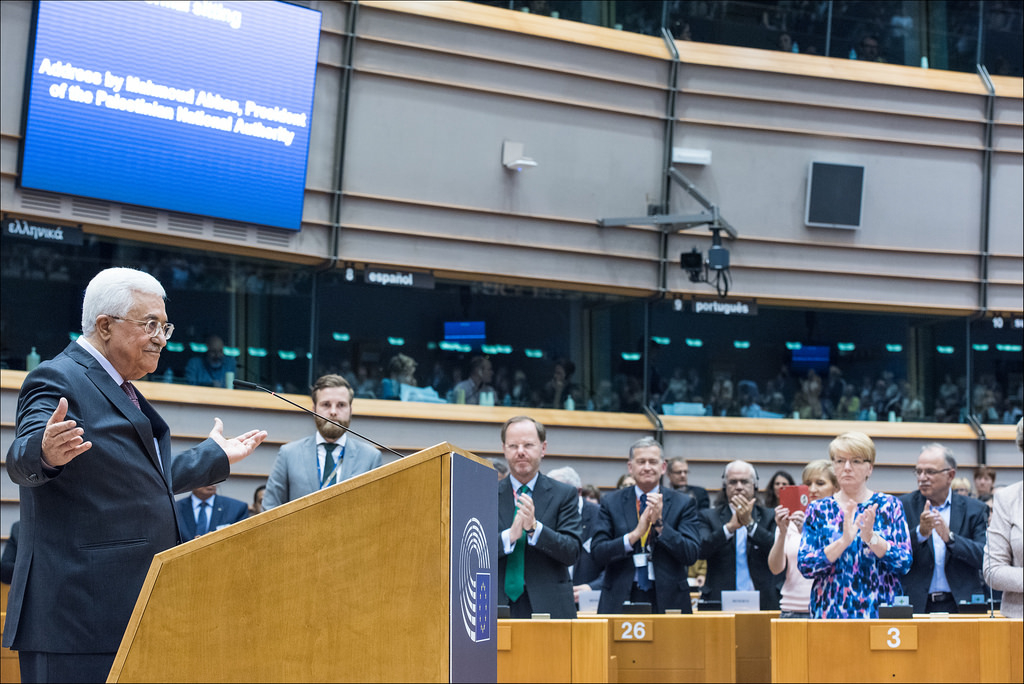
Then, European Parliament President Martin Shulz tried to arrange a meeting between Abbas and Israeli President Reuven Rivlin. Rivlin agreed, Abbas declined — and it was later revealed that Abbas even changed hotels when he discovered he and Rivlin were sharing a roof. It was in Brussels where Abbas claimed that some Israeli rabbis were calling for Israel to poison Palestinian water — an echo of Suha Arafat’s claim in 1999 that Israelis were poisoning Palestinian air and water. Abbas received a standing ovation at the end of his remarks; Suha received a kiss from then-First Lady Hillary Clinton.
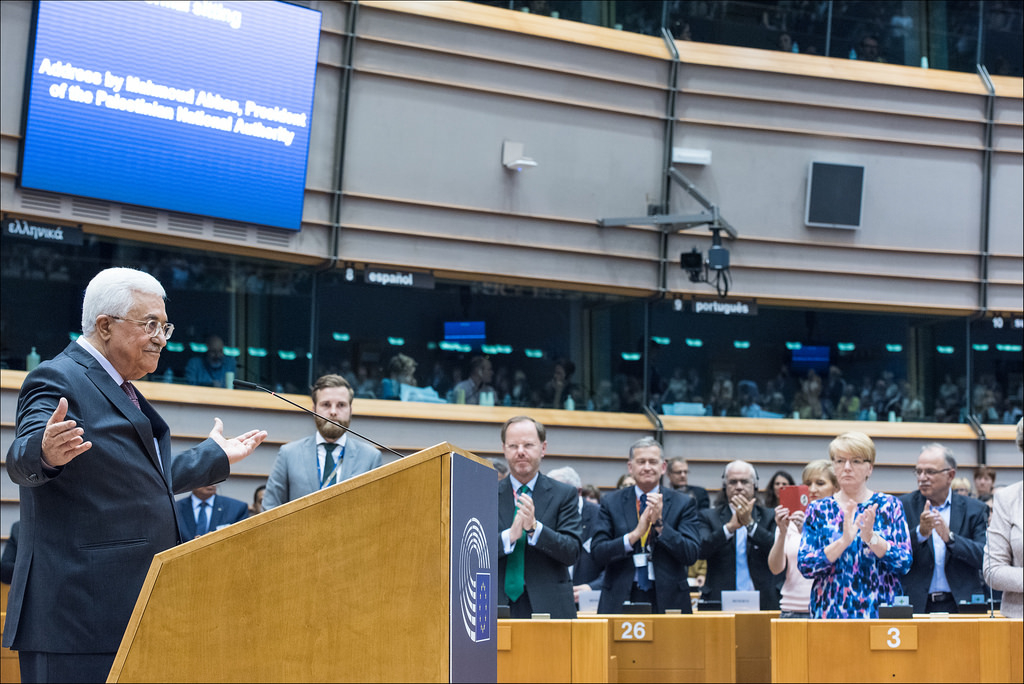
Palestinian Authority President Mahmoud Abbas receives a standing ovation at the European Parliament in Brussels, after falsely claiming in his speech that Israeli rabbis were calling to poison Palestinian water. Abbas later recanted and admitted that his claim had been false. (Image source: European Parliament)

Under pressure from people who recognized a centuries-old debunked piece of anti-Semitism, Abbas recanted and admitted that his claim had been false. But such was the desire of the European parliamentarians to protect him that his blood libel was erased from all official documents. Which makes his next move even less understandable.

After much wrangling, the Middle East Quartet report on the future of Israeli-Palestinian negotiations and the “two state solution” was released on 1 July. Before the release, leaks to the press strongly suggested that

“The focus on Israel will be its most contentious aspect.” [Ha’aretz] quoted a senior Israeli government official as stating: “The main question is how harsh criticism of the settlements will be. All the members of the Quartet can rally around this issue without a problem.”

Calling it an “eagerly awaited report,” Reuters said it would demand that “Israel should stop building settlements, denying Palestinian development and designating land for exclusive Israeli use that Palestinians seek for a future state.”

And it did, as reported here, here, here, and even here. The Quartet said that Israeli building policies raise

“legitimate questions about Israel’s long-term intentions, which are compounded by the statements of some Israeli ministers that there should never be a Palestinian state… Israel should cease the policy of settlement construction and expansion…”

But that wasn’t enough for Abbas, because even Quartet members found it impossible to ignore the seven-month-long so-called “stabbing intifada” and the drumbeat of incitement from the Palestinian Authority that encourages and honors the murderers of Israeli civilians. Nor could members ignore definitive evidence of Hamas rebuilding the Gaza tunnel infrastructure to attack Israel. In a relatively mild section, the Quartet criticized Palestinian leaders for “not consistently and clearly” condemning terrorist attacks and, for the first time, said the arms buildup and military activities in Gaza must stop.

Nabil Abu Rudainah, spokesman for Mahmoud Abbas, was furious, saying:

“Any report that does not include the full withdrawal to the 1967 borders, including occupied Jerusalem, and does not include a recognition of the illegality of settlement will not lead to real and lasting peace and will lead to more tension and more instability in the region.”

In other words, more Palestinian-incited violence.

The fit of pique continued as Abbas announced that the PA would boycott the Quartet — its best friends in Europe plus Russia and the U.S. — and attempt to block consideration of the report in the UN.

Unable to countenance even mild criticism, and unwilling or unable to engage in serious conversation even with European interlocutors, much less with Israel, Abbas may finally have made the Palestinian cause too difficult for the Europeans, bring the circle back around to Boris Johnson. Not only did he criticize BDS (in which he clearly criticized British academics more than Palestinians), he continued, “I cannot think of anything more foolish” than to boycott “a country that when all is said and done is the only democracy in the region, the only place that has in my view, a pluralist, open society.”

If there was a gaffe, it wasn’t by Johnson.

Shoshana Bryen is Senior Director of the Jewish Policy Center.
UK: Free Speech for Dictators Only by Robbie Travers

  • How come, then, that John Bercow did not think it advisable to oppose the Emir of Kuwait’s visit due to its “sexism” and “immigration ban”? No, Bercow granted the Emir a speech in the Queen’s Robing Room.It is evidently acceptable to be a representative of some of the world’s most repressive dictatorships, with policies far worse than President Trump’s, and yet visit Parliament, but a democratically-elected leader in the free world and a key ally, who may hold some views with which Bercow disagrees, makes him unacceptable.

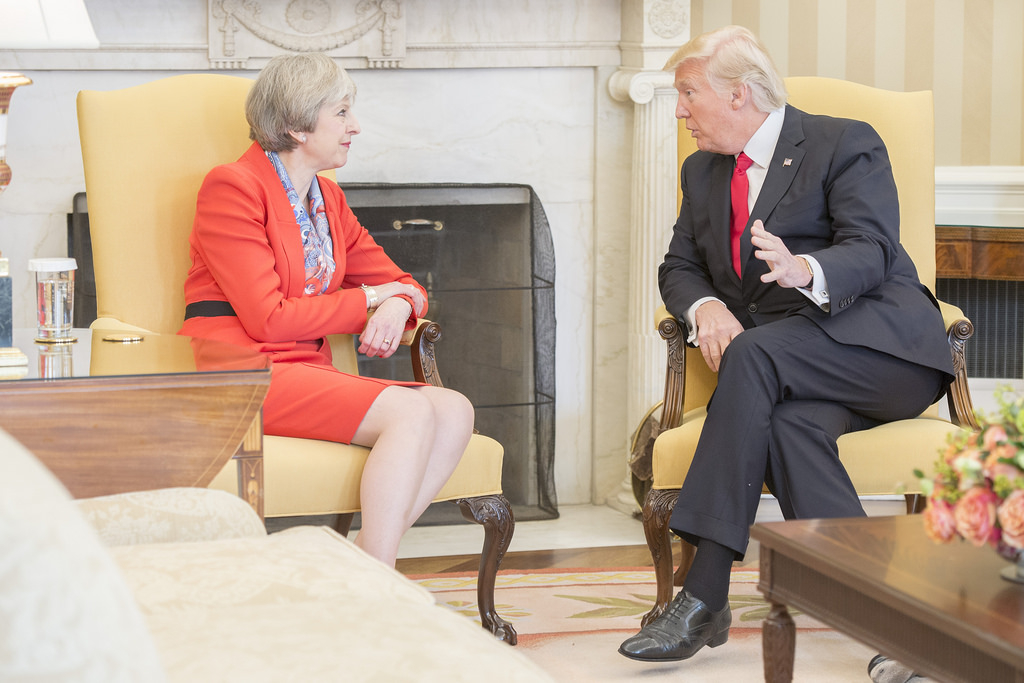
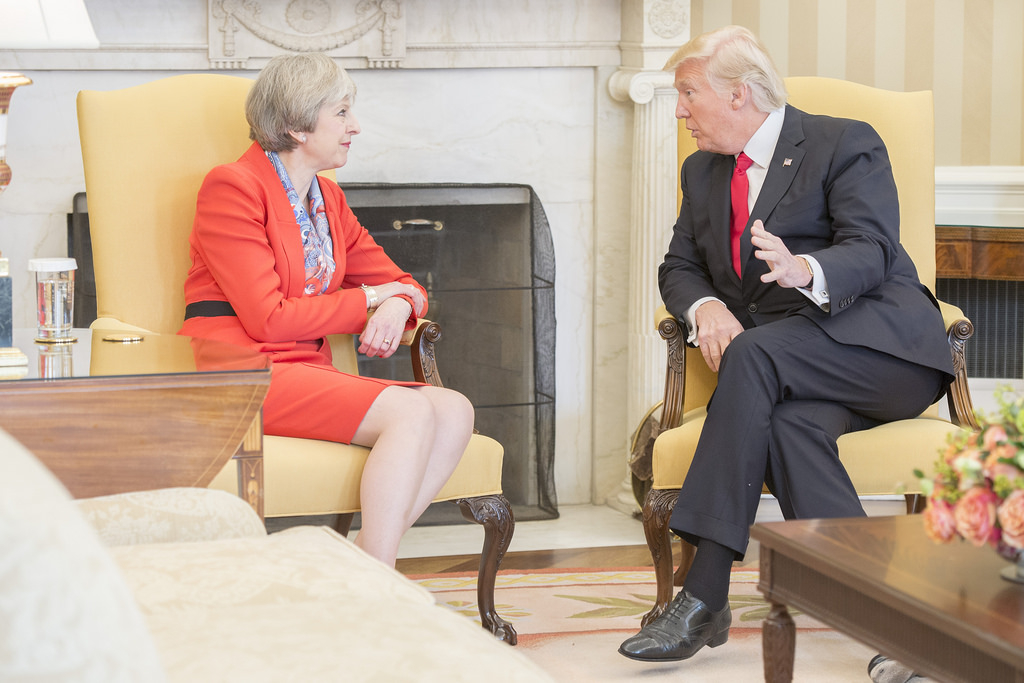
  • What is it that the people trying to keep Trump from speaking are afraid others might hear?When Theresa May announced, to the gathered press at the White House, an invitation for Donald Trump to make an official state visit to the United Kingdom, there were some in Britain who apparently oppose his views — and, in a democratic and free society, express their opposition. There also were, however, concerns that these critics may have been acting hypocritically, as well as without considering due process.

UK Prime Minister Theresa May meets with US President Donald Trump at the White House, January 27, 2017. (Image source: UK Prime Minister’s Office)

House of Commons Speaker John Bercow declared that he would not invite Trump to make a speech before Parliament due to the president’s alleged “sexism” and “racism,” and the British Parliament’s opposition to those stances, as well as, further, due to Trump’s temporary restrictions on immigration until better procedures for vetting applicants can be put in place .

Bercow, however, never adhered to due process: he should first have consulted the Speaker of the House of Lords or the Lord Chamberlain.

If Bercow thought that a ban from addressing Parliament would stop Trump from addressing the British people, he seems to have been wrong. Press reports suggest that Trump is planning massive stadium events. Perhaps that is the repeated failure of Trump’s opposition: to see his appeal to the masses.

Furthermore, where was Bercow when Emir of Kuwait visited? Kuwait has a poor record on women’s rights, and refuses entry to those with Israeli passports. Kuwait Airways and even dropped its flights between New York and London not to “break the law” by possibly carrying Israeli passengers.

How come, then, that Bercow did not think it advisable to oppose the Emir of Kuwait’s visit due to its “sexism” and “immigration ban”? No, Bercow granted the Emir a speech in the Queen’s Robing Room.

Bercow also granted a speech in Westminster Hall to the President of Indonesia — a country that canes women for “standing too close to their boyfriends”; that has applied sharia law and that has put the homosexual community under “unprecedented attack”.

In addition to these seeming slip-ups, Bercow also received a representative of the North Korean regime for afternoon tea in Parliament, and received representatives from the Communist single-party state of Vietnam.

So, it is evidently acceptable to be a representative of some of the world’s most repressive dictatorships, with policies far worse than Trump’s, and yet visit Parliament, but a democratically elected leader in the free world and a key ally, who may hold some views with which Bercow disagrees, makes him unacceptable.

Some MPs have rightly raised concerns that the Speaker is “using the Speaker’s chair to pontificate on international affairs.” The Speaker in Britain’s Parliament is supposed to be impartial; some MPs have alleged that Bercow has “broken his employment contract with members of parliament,” in which he is bound to remain impartial.

Others open to allegations of hypocrisy include Sadiq Khan, the Mayor of London, who demanded that Donald Trump not to be allowed a state visit or even to enter the UK for his incorrectly-named “Muslim ban” — actually, only a temporary ban on people from seven countries, designated by former President Barack Obama, and over which Congress gave the president the power to restrict people who might be security risks.

On the same day in which Sadiq Khan made these comments, he then hosted a party to which he invited the ambassadors of Bangladesh, Brunei, Iran, Iraq, Kuwait, Lebanon, Libya, Pakistan, Sudan, the United Arab Emirates and Yemen – all of which ban Israelis, and some of which even ban peopled holding passports stamped by Israel. Where was the outrage then, the mass protests, the marches against Khan for welcoming them?

Jeremy Corbyn, leader of the Labour Party, also made it clear that he would not welcome Trump addressing Parliament and that he opposed a state visit. How ironic from someone who has welcomed former members of the IRA to Parliament, shortly after the IRA bombed the Conservative Party conference. He also welcomed Hezbollah and Hamas, and called them his “friends”. Hamas is a genocidal organisation that remains dedicated to killing Jews and destroying Israel, and Hezbollah is dedicated to the obliteration of Israel.

It seems that there is a double standard here: Trump may have previously made tasteless remarks, but are his policies really worse than those of the Iran or North Korea?

As the British author George Orwell is alleged to have said, “Freedom is the right to tell people what they do not want to hear.”

What is it that the people trying to keep Trump from speaking are afraid others might hear?

Robbie Travers, a political commentator and consultant, is Executive Director of Agora, former media manager at the Human Security Centre, and a law student at the University of Edinburgh.

UK: Clerics Who Threaten Reformers and Praise Murderers by Douglas Murray

  • Anjem Choudary has gone to jail. He was the most visible part of the problem. But he was not the greatest or deepest problem in this area. That problem is shown when two extremist clerics with pre-medieval views come to Britain they are welcomed by an ignorant British establishment.

  • “These people teach murder and hate. For me personally I find it sad that a country like England would allow cowards like these men in. Why are they allowing people [in] that give fuel to the fire they are fighting against?” — Shahbaz Taseer, the son of Punjab Governor Salman Taseer, who was murdered for opposing Pakistan’s blasphemy laws.
  • “They have got hundreds of thousands of followers in the UK,” the imam of the Madina Mosque and Islamic Centre in Oldham, Zahoor Chishti, said of the two clerics.

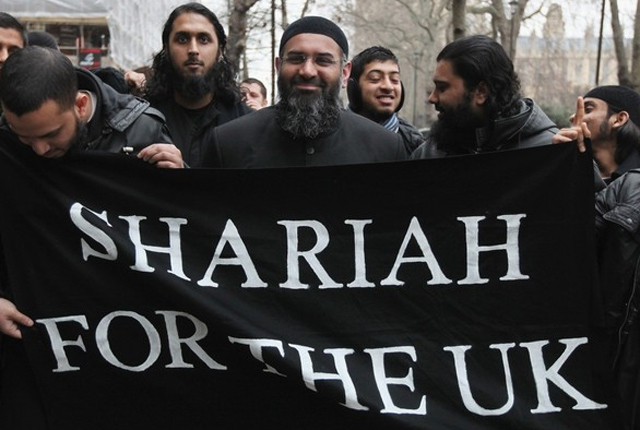
The conviction of radical Islamic preacher Anjem Choudary — the most prominent extremist in Britain — has been widely welcomed in the UK. For years his followers and he have infuriated the vast majority of the British public (including most British Muslims) with their inflammatory and hate-filled rhetoric. They have also provided a constant stream of people willing to follow through the words with actions. More people around Choudary have been convicted of terrorism offences in the UK than any other Islamist group — including al-Qaeda.

But Choudary’s conviction for encouraging people to join ISIS should not be greeted as though that is the end of a matter.

The conviction of radical Islamic preacher Anjem Choudary (centre) — the most prominent extremist in Britain — has been widely welcomed in the UK.

Last week we noted here how, after the murder of an Ahmadiyya Muslim in the UK at the hands of another Muslim, some Muslims are “more Muslim than others” and that those outside a particular theological group can be killed is not an idea held only by the murderer. It is an idea with a significant following in the UK Muslim community, as well as among Muslims worldwide. A recent test of this issue was the execution in January this year in Pakistan of Mumtaz Qadri. This was the man who murdered Salman Taseer, the governor of Punjab province in Pakistan. Taseer had opposed the strict blasphemy laws which operate in his country. In Qadri’s eyes, Taseer was an apostate for even thinking of watering down the blasphemy laws that jihadists and Islamists such as the Taliban wish to preserve. And so Qadri killed the governor.

Of course one would like to think that everyone could unite in condemning the actions of a man such as Mumtaz Qadri. What is striking is how many people fail to do so, and how many Muslim clerics and religious leaders — even in the West — not only fail to do so but have been open in their praise of Qadri and their condemnation of Pakistan for putting him to death. Prominent among the latter group is the imam of the largest mosque in Scotland — the Glasgow central mosque.

This past month, however, an even more significant event occurred. In July, two Pakistani clerics started a tour of the UK. Their seven-week expedition, called “Sacred Journey,” goes on until September 4, and includes appearances in Oldham, Rochdale, Rotherham and the Prime Minister’s own constituency of Maidenhead. One of the first things that Muhammad Naqib ur Rehman and Hassan Haseeb ur Rehman did when they arrived in the UK was to meet with the Archbishop of Canterbury. The Archbishop welcomed them in Lambeth Palace and claimed that the meeting would strengthen “interfaith relations,” as well as address “the narrative of extremism and terrorism.” One wonders how far the Archbishop got in this task?

If there is a “narrative of extremism and terrorism,” Muhammad Naqib ur Rehman and Hassan Haseeb ur Rehman can take some serious credit for the fact. Both men took an enthusiastic stand in Pakistan in support of Mumtaz Qadri. That is, they supported the murderer of a progressive Pakistani official. Listen here, for instance, to Hassan Haseeb ur Rehman delivering a hysterical speech in support of Mumtaz Qadri while his fellow cleric, Muhammad Naqib ur Rehman, looks on approvingly from the platform.

Here is Hassan Haseeb ur Rehman whipping up the vast crowd of mourners after the funeral of Mumtaz Qadri in Rawalpindi, Pakistan. During his speech he repeatedly refers to Qadri as a shaheed [martyr]. Tens of thousands of people attended the funeral, and afterwards rioted, chanting slogans such as “Qadri, your blood will bring the revolution” and “the punishment for a blasphemer is beheading.”

After Qadri’s execution, Haseeb ur Rehman said on social media “Every person who loves Islam and Prophet is in grief for the martyrdom of Mumtaz Qadri.”

So what are two clerics who approve of murdering reformers and mourn the death of fanatics and assassins doing touring the UK? Shahbaz Taseer, the son of the Salman Taseer, is among those who has criticised the UK authorities for allowing the two men into the country. “These people teach murder and hate,” he has said.

“For me personally I find it sad that a country like England would allow cowards like these men in. It’s countries like the UK and the US that claim they are leading the way in the war against terror [and] setting a standard. Why are they allowing people [in] that give fuel to the fire they are fighting against?”

“They have got hundreds of thousands of followers in the UK,” the imam of the Madina Mosque and Islamic Centre in Oldham, Zahoor Chishti, said of the two clerics. Chishti denied that the event was organised by his mosque and said that he was not aware of the views of the speakers. “When I found out I was upset. I think it was really upsetting and wrong. They come to the UK every year and give messages of love, so that’s why they’re booked on that basis.’

Elsewhere, the “Sacred Journey” tour has already thrown up another interesting connection. Mohammed Shafiq runs a one-man outfit called the “Ramadan Foundation” in the UK, and is regularly called upon by the British media. He appears to be viewed as a “moderate” Muslim because he has been outspoken in opposition to the mass rape of children by gangs of Muslim men. Despite this heroism, his own liberal credentials (not least as a member of the Liberal Democrat party) have often come into question. Several years ago, for instance, when the Liberal Democrat candidate and genuine anti-extremism campaigner Maajid Nawaz re-Tweeted an innocuous cartoon from the “Jesus and Mo” series, Shafiq was among those who tried to get up a lynch-mob against Nawaz. Shafiq wrote on social media that Nawaz was a “Ghustaki Rasool,” Urdu for “defamer of the prophet.” He warned that he would “notify Islamic countries.” Shafiq angrily denied that these and other messages constituted incitement against Nawaz.

But now, on the visit of two clerics to the UK who applaud and mourn Mumtaz Qadri, where is Mohammed Shafiq to be found? Why, warmly greeting the cleric who praises the murderers of reformers and glad-handing with the terrorist-apologists and blasphemy lynch-mob, of course.

Almost everyone in Britain is pleased that the loudmouth Anjem Choudary has gone to jail. Like the hook-handed cleric Abu Hamza before him, Choudary was — as a case — almost too easy. He was the most visible part of the problem. But he was not the greatest or deepest problem in this area. That problem is shown when two extremist clerics with pre-medieval views come to Britain, they are welcomed by an ignorant British establishment. The problem is shown when they tour mosques, they do so to packed houses because they have “hundreds of thousands” of followers of Pakistani origin in the UK. The problem is shown when you scratch the surface of one of the self-proclaimed “moderates” like Mohammed Shafiq and discover that he is happy to pal around with the people who threaten reformers and praise murderers.

That is the problem for British Islam in a nutshell. And that is a problem we still remain woefully unable to confront.

Douglas Murray, British author, commentator and public affairs analyst, is based in London, England.

Translate »
Skip to toolbar