Category Archives: Uncategorized

urkey: Victim of Its Own Enthusiasm for Jihad by Burak Bekdil

  • “Infidels who were enemies of Islam thought they buried Islam in the depths of history when they abolished the caliphate on March 3, 1924 … We are shouting out that we will re-establish the caliphate, here, right next to the parliament.” — Mahmut Kar, media bureau chief of Hizb ut-Tahrir Turkey.

  • “The magazine [Dabiq] creates propaganda for [ISIS]. It has an open address. Why does no one raid its offices?” — Opposition MP Turkey’s Parliament.

The government big guns in Ankara just shrugged it off when on June 5, 2015, only two days before general elections in the country, homegrown jihadist militants for the Islamic State of Iraq and Syia (ISIS, or ISIL or IS) detonated bombs, killing four people and injuring over 100, at a pro-Kurdish political rally.

Again, when IS, on July 20, 2015, bombed a meeting of pro-Kurdish peace activists in a small town on Turkey’s Syrian border, killing 33 people and injuring over 100, the government behaved as if it had never happened. After all, a bunch of “wild boys” from the ranks of jihad — which the ruling party in Ankara not-so-secretly aspires to — were killing the common enemy: Kurds.

Then when IS jihadists, in October, killed over 100 people in the heart of Ankara, while targeting, once again, a public rally of pro-peace activists (including many Kurds), the Turkish government put the blame on “a cocktail of terror groups” — meaning the attack may have been a product of Islamists, far-leftist and Kurdish militants. “IS, Kurdish or far-leftist militants could have carried out the bombing,” the prime minister at the time, Ahmet Davutoglu, said. It was the worst single terror attack in Turkey’s history, and the Ankara government was too demure even to name the perpetrators. An indictment against 36 suspects, completed nearly nine months after the attack, identified all defendants as Islamic State members. So there was no “cocktail of terror.” It was just the jihadists.

In the last year, there had been further jihadist acts of terror, targeting Turks and foreign tourists, but with relatively few casualties up to now. At an Istanbul airport, however, a mysterious explosion, which the authorities hastily attempted to cover up, was probably the precursor of the latest mega-attack in Istanbul. The management at Istanbul’s Sabiha Gokcen Airport said on Dec. 23, 2015 that: “There was an explosion at the apron and investigation regarding its cause is progressing … Fights have resumed.” That unidentified explosion consisted of three or four mortars fired at a passenger plane parked at the apron. The attack killed one unfortunate cleaner.

The incident was quickly “disappeared” from the public memory. One person dying in a mysterious explosion was too minor for a collective Turkish memory that had grown used to casualties coming in the dozens. It was, in fact, a powerful message from the terrorists: We will target your lifeline — air traffic.

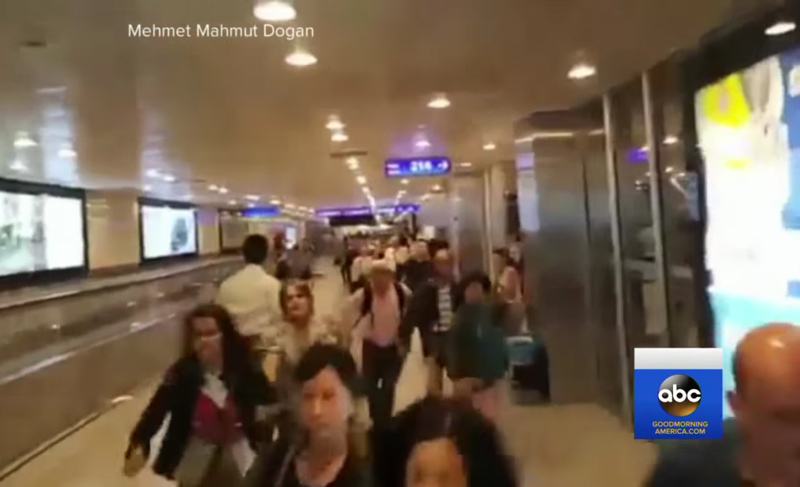
Every year about 60 million travelers pass through Istanbul’s main airport, Ataturk. Turkey is now building an even bigger airport that will host 150 million passengers a year. Completing the mission from December’s “minor and unresolved” attack at the Sabiha Gokcen Airport, the terrorists visited Ataturk Airport on June 28, killing at least 45 and injuring hundreds of people.

Travelers are shown fleeing, trying to escape the terrorists attacking Istanbul’s Ataturk Airport, June 28, 2016. (Image source: ABC video screenshot)

Turkish prime minister, Binali Yildirim, said that it was “probably” an attack by IS. Days later, the suicide bombers were identified as jihadists of Central Asian origin.

In a state of perpetual denial, Turkey’s Islamist rulers are still too bashful to admit any linkage between political Islam and violence. Ironically, their denial exposes their country to the risk of even more Islamic terror. Worse, the political Islam they fuel in their own country is growing millions of potential jihadists at home. In November, a Pew Research Center study found that 27% of Turks (more than 20 million) did not have an unfavorable opinion of IS — compared to, say, 16% in the Palestinian territories.

In March, only three months before the latest jihadist attack in Istanbul, thousands of supporters of Hizb ut-Tahrir — a global Islamist group, viewed by Russia and Kazakhstan as a terrorist group but that defines itself as a political organization aiming to “lead the ummah” [Islamic community] to the re-establishment of the caliphate and rule with sharia law — gathered at a public sports hall in Ankara, courtesy of the Turkish government, to discuss the re-establishment of the Islamic caliphate. In his speech, Mahmut Kar, the media bureau chief of Hizb-ut Tahrir Turkey said:

“Infidels who were enemies of Islam thought they buried Islam in the depths of history when they abolished the caliphate on March 3, 1924 … We are hopeful, enthusiastic and happy. Some 92 years later… we are shouting out that we will re-establish the caliphate, here, right next to the parliament.”

It was not a coincidence that an opposition MP on July 1 took the speaker’s point at the Turkish parliament, showed a copy of a magazine, Dabiq, largely viewed as IS’s press organ, to an audience and said: “This is [IS’s] official magazine. It is published in Turkey. Its fifth issue is out now. The magazine creates propaganda for [IS]. It has an open address. Why does no one raid its offices?”

That question will probably remain unanswered.

urkey: The Purges Continue by Burak Bekdil

  • What makes Turkey look more like North Korea than a European democracy is the legal authorities’ reflex to launch probes into anyone accused, without evidence, of terrorist activity or insulting the president.

Philipp Schwartz was a Hungarian-born neuropathologist who worked for the Goethe University in Frankfurt for 14 years until he was fired in 1933 for being Jewish. After his — and other scholars’ — dismissal, he convinced the then decade-old modern Turkish Republic to admit persecuted German professors to positions at Turkish universities. Mustafa Kemal Ataturk, the secular founder of the Turkish state, enthusiastically agreed to Schwartz’s proposal. Turkey quickly admitted 150 German Jewish professors. Schwartz was appointed as director of the Department of Pathology at the University of Istanbul. More than seven decades after, a German initiative that bears Schwartz’s name is returning the favor.

In the first week of 2017, another 631 Turkish researchers and professors were dismissed from their universities, adding to thousands who were purged during the second half of 2016. Several Turkish scholars are now reversing Schwartz’s path: In the fall of 2016, the Philipp Schwartz Initiative received more applications from Turkey than war-torn Syria or any other country. Turks now account for 46% of all applicants worldwide. As the Brussels-based European affairs weekly newspaper Politico put it: “Turkey loses its brains.”

Turkey’s problem is bigger than just literally losing its brains. The country apparently is also figuratively losing its brains. News headlines are so confusing that often one cannot decide whether he is reading a real newspaper or the Turkish version of The Onion, reflecting a collective, socio-pathological frenzy — ironically Schwartz’s work of science.

An Islamist and militantly pro-Erdogan newspaper, Yeni Akit, ran the photo of what looks like a main battle tank, claiming that this weapons system had been developed by Aselsan, a state-controlled defense company, and was capable of “even stopping an atomic bomb.” Yeni Akit belongs to an “elite” group of media outlets whose editors often find a seat aboard Erdogan’s private jet when he travels abroad for state visits. What is more worrying than the absurdity of Yeni Akit’s claim is that few Turks would question the story’s authenticity.

Erdogan-mania can take other weird forms, too. Another news story recently revealed that a legal investigation has been launched into 18 residents of a small village in southern Turkey, after the village headman informed authorities that the men engaged in “terrorist activity” and insulted President Recep Tayyip Erdogan. It became clear that the 18 suspects were merely the village headman’s election rival and his relatives and friends. The village headman’s behavior can be explained by “human psychology and political greed.” What makes Turkey look more like North Korea than a European democracy is the legal authorities’ reflex to launch probes into anyone accused, without evidence, of terrorist activity or insulting the president.

In Turkey, village headmen, like most villagers in Anatolia, are generally known to be Erdogan loyalists. After the Turkish lira’s unprecedented depreciation against major currencies since the beginning of 2017, the president blamed the slide on “manipulators and terrorists” who keep foreign currency portfolios. “There is no difference between a terrorist who has a weapon or bomb in his hand and a terrorist who has dollars, euros and interest rates in terms of aim,” Erdogan said on January 12. In a show of support for Erdogan, a group of village headmen in Turkey’s southeastern city of Adiyaman burned stacks of one dollar bills, protesting the U.S. currency’s sharp rise against the lira. Nice show. But the angry village chiefs were not generous enough in expressing their wrath for the dollar: During their show, they burned fake dollar bills.

Elsewhere, the headline “Top press rights defender in Turkish court for terror propaganda” was another Turkish peculiarity. Erol Onderoglu, the Turkey representative for Reporters Without Borders, along with rights activist Sebnem Fincanci and journalist Ahmet Nesin, has been charged with “making pro-Kurdish terror propaganda and aiding terrorists,” risking years in prison. The indictment proposes as evidence only the fact that the suspects had guest-edited a pro-Kurdish newspaper after its editors were put in prison.

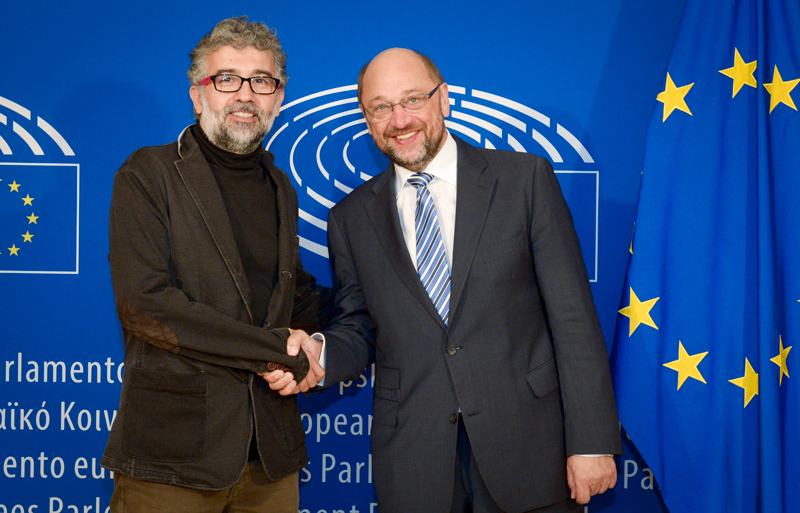
Erol Onderoglu (left, meeting with European Parliament President Martin Schulz), is the Turkey representative for Reporters Without Borders. He was recently arrested in Turkey, with rights activist Sebnem Fincanci and journalist Ahmet Nesin. They are charged with “making pro-Kurdish terror propaganda and aiding terrorists,” because they guest-edited a pro-Kurdish newspaper after its editors were jailed. (Image source: European Parliament)

On January 16, Turks sighed with relief when, after a 16-day manhunt, Turkish police caught the jihadi terrorist who gunned down and killed 39 people at an upscale nightclub in Istanbul shortly after midnight on New Year’s Eve. The man was caught alive in a special-forces operation, together with an Iraqi man and three women from Somalia, Senegal and Egypt — all believed to be members or supporters of the Islamic State of Iraq and Syria (ISIS). He confessed to the attack, and his fingerprints matched with those at the scene of crime. His four-year-old son was missing from the safe-house where he and others were caught. The poor toddler is believed to have been sent to another safe-house in Istanbul. Wherever he is being kept, he will never have a safe life in Turkey despite his innocence. The Turks treat him as a terrorist in absentia. Cemil Barlas, a pro-Erdogan journalist, tweeted that “… in whatever way he should be used [implying torture], that child should be used to make the killer talk. There is no moral harm in that.”

Burak Bekdil, one of Turkey’s leading journalists, was just fired from Turkey’s leading newspaper after 29 years, for writing what was taking place in Turkey for Gatestone. He is a Fellow at the Middle East Forum.

urkey: Is It Religiously All Right to Lust for My Daughter? by Burak Bekdil

  • The Directorate for Religious Affairs, or Diyanet in Turkish, enjoys an annual budget bigger than those of more than 10 other ministries combined — and its president, a government-appointed cleric, enjoys a $400,000 chauffeur-driven car.
  • Turkey accuses those who protest lusting for one’s daughter of hating religiosity.

  • “[G]ossip and holding hands, not allowed in Islam.” — Fatwa from Turkey’s Directorate of Religious Affairs.

Turkey has a government agency that regulates “religious affairs” [read: Sunni Muslim Affairs]. It is run by the country’s top Muslim cleric and reports to the prime minister. The Directorate for Religious Affairs, or Diyanet in Turkish, enjoys an annual budget bigger than those of more than 10 other ministries combined – and its president, a government-appointed cleric, enjoys a $400,000 chauffeur-driven car.

Among its duties is to issue “fatwas,” or to tell Muslim Turks what is religiously permissible and what is not. Its current president, the top cleric, also enjoys making long, doctrinaire speeches. Sometimes they sound reasonable, sometimes not.

When, a year ago, Islamist extremists in Paris were putting the final touches on their gruesome plan to kill a dozen cartoonists and attack the Charlie Hebdo magazine, Diyanet was busy issuing fatwas and publishing a religious calendar for three million or so desks and walls in offices and homes. Diyanet, at that time, also issued a fatwa that urged Muslims who have tattoos to repent if unable to erase them. Another fatwa in Diyanet’s 2015 calendar said: “Do not keep pet dogs at home … Prophet Mohammed once said: ‘Angels do not visit homes where there are dogs and paintings.'”

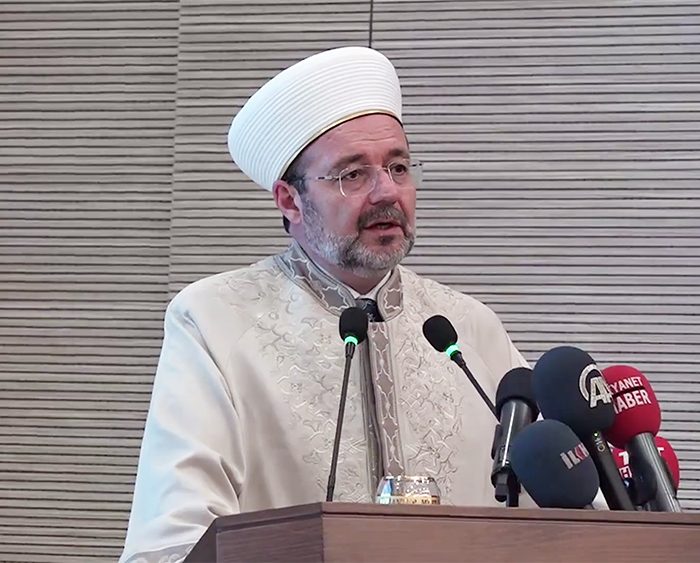
In those days of Parisian chaos — even before the jihadists killed over 130 people in November — Diyanet’s president and Turkey’s top cleric, Professor Mehmet Gormez “did not believe” jihadists could kill innocent people. Speaking to a press conference in the aftermath of the Paris attacks, Gormez said that the use of Islamic symbols by the perpetrators of the attack was a sign of “manipulation.” In other words, Professor Gormez was telling the world that someone else was carrying out the attacks and putting the blame on Muslims.

Mehmet Gormez, President of Turkey’s Directorate of Religious Affairs. (Image source: İlke Haber video screenshot)

Diyanet, generously funded by the Turkish taxpayer — Sunni, non-Sunni and non-Muslim — hit the headlines recently with two fatwas that both irked and amused secular people around the world, not just in Turkey.

In the first fatwa, Diyanet said that engaged couples should not hold hands or spend time alone together during their engagement. The fatwa read: “In this period, it is not inconvenient for couples to meet and talk to get to know each other, if their privacy is considered. However, there could be undesired incidents with or without their families’ knowledge … such as flirting, cohabitating or being alone. This encourages gossip and holding hands, not allowed in Islam.”

Now think about that. The top clergyman in a NATO member and EU candidate, Turkey, rules that: Flirting, cohabitating or being alone for engaged couples are ‘undesired incidents;’ and Islam does not allow gossiping and ‘holding hands.’

That’s fine. Every monotheistic clergy could be equally conservative – one could presume. But the second fatwa of the week — which Diyanet, under fire now, denies — caused a stir.

Diyanet’s second fatwa, appeared briefly on the fatwa section of its website (until it was deleted), in answer to readers’ questions. An anonymous user asked whether, from a religious perspective, a father having sexual desire for his daughter should result in the cancellation of his marriage.

The ulama [scholars] answered that, “There is a difference of opinion on the matter among Islam’s different schools of thought.” The fatwa read: “For some, a father kissing his daughter with lust or caressing her with desire has no effect on the man’s marriage.”

The response continued by saying that in one Islamic school of thought, Hanafi, the mother would be “forbidden” to such a man. “Moreover,” the fatwa went on, “The girl would be over nine years of age.”

Possibly too embarrassed by its own fatwa, Diyanet first deleted its ulama‘s answer to the query and claimed that its answer was deliberately “distorted” through “tricks, wiliness and wordplay” aiming to discredit the institution. It then closed its “queries” section and posted a warning saying the page in question was “under repair.”

As thousands of Turks decried Diyanet’s scandalous fatwa and accused the ulama of encouraging child abuse, a helping hand to Diyanet came from Justice Minister Bekir Bozdag. In his twitter account, he called the accusations a “character assassination” against the religious body. The “assassins,” according to Bozdag, “were those miserably types who are annoyed by religion and the pious.”

Turkey, once a secular Muslim country and the world’s only hope for interfaith dialogue, has reached a point where the justice minister defends a fatwa that says some Islamic schools of thought would NOT command divorce if a father had lust for his own daughter [but if she is over nine?]. Turkey also accuses those who protest such a thing as lusting for one’s daughter of hating religiosity. One can only wonder what will be the next insanity.

Burak Bekdil, based in Ankara, is a Turkish columnist for the Hürriyet Daily and a Fellow at the Middle East Forum.

urkey: Erdogan’s Galloping Despotism by Burak Bekdil

  • Before Turks could digest so many undemocratic practices they had to face in one week, they woke up only to learn that scores of journalists at a newspaper critical of Erdogan had been detained. On October 31, police raided the homes of 11 people, including executives and journalists of Cumhuriyet newspaper, after prosecutors initiated a probe against them on “terrorism” charges.

  • “This is about … abolishing all universal values… The most explicit indications of it are the growing pressure against the Turkish press and the policies to destroy it. This is the process of the destruction of free thought.” — The Contemporary Journalists Association.

Both fascism and communism exercised a large influence on the Arab “Baathist” ideology — “resurrection” in Arabic, and which started as a nationalist, Sunni Arab movement to combat Western colonial rule and to promote modernization. In Iraq, the despotic Baathist regime survived 35 years, largely under the leadership of Saddam Hussein. In Syria, it is still struggling under the tyranny of President Bashar al-Assad. These days a non-Arab, but Islamist version of the Baathist ideology is flourishing in an otherwise unlikely country: candidate for membership in the European Union (EU), Turkey.

President Recep Tayyip Erdogan’s increasing authoritarianism is killing Turkey’s already slim chances of finding itself a place in the world’s more civilized clubs and turning the country more and more into a “Baathist” regime.

In 2004 Erdogan’s government abolished the death penalty as part of his ambitions at the time to join the EU. Twelve years later, on Oct. 29, 2016, Erdogan addressed fans of his party, and said he would ratify a bill reinstating capital punishment once it passed in parliament despite objections it might spark in the West. He said: “Soon, our government will bring (the bill) to parliament … It’s what the people say that matters, not what the West thinks”.

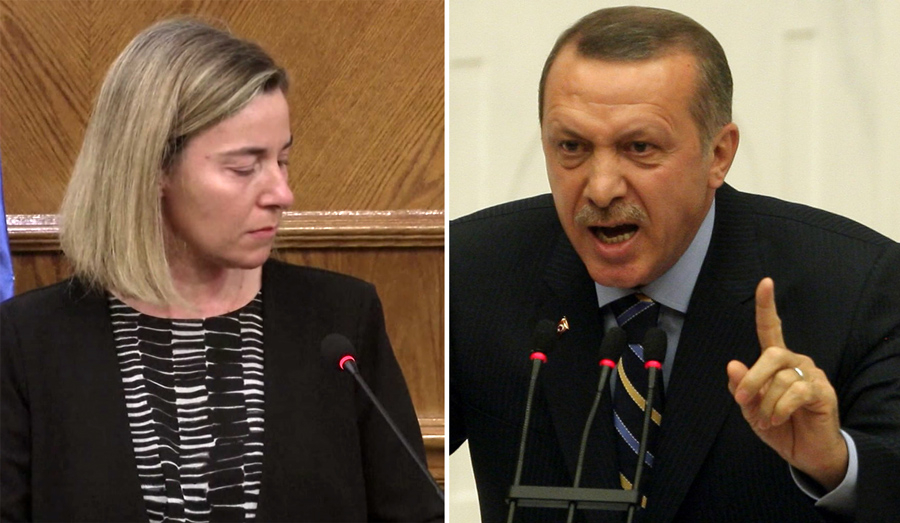
EU officials had warned in July that such a move would kill Turkey’s accession process. If Turkey reintroduces the death penalty, said Federica Mogherini, the EU’s foreign policy chief, it will not be joining the European Union. “Let me be very clear on one thing,” she said, “… No country can become an EU member state if it introduces [the] death penalty.”

On October 30, Europe once again warned Turkey. “Executing the death penalty is incompatible with membership of the Council of Europe,” the 47-member organization, which includes Turkey, tweeted.

Turkey’s President Recep Tayyip Erdogan (right) wants to reintroduce the death penalty to Turkey. Federica Mogherini (left), the European Union foreign policy chief, says that will disqualify Turkey from joining the EU.

The potential re-introduction of the death penalty is not the only “Baathist” signal Erdogan’s Turkey is making. A court in the predominantly Kurdish province of Diyarbakir arrested Gulten Kisanak and Firat Anli, the Kurdish co-mayors, following their detention, in the latest blow to political opposition in Turkey.

The co-mayors are being charged with “being a member of an armed terrorist group,” while Anli is also charged with “trying to separate land under the state’s sovereignty.”

“Arrest is a legal term, but [in Turkey] there is no law,” said Selahattin Demirtas, co-chairman of a pro-Kurdish opposition party. “This is abduction and kidnapping.”

Erdogan could not care less. He is busy strengthening his one-man rule. A governmental state of emergency decree on October 29 gave Erdogan powers directly to appoint presidents to nearly 200 universities in the country. Before that decree, he had to choose from three candidates offered by a central board that oversees higher education, based on free elections at universities.

Before the Turks could digest so many undemocratic practices they had to face in one week, they woke up only to learn that scores of journalists at a newspaper critical of Erdogan had been detained. On October 31, police raided the homes of 11 people, including executives and journalists of Cumhuriyet newspaper, after prosecutors initiated a probe against them on “terrorism” charges. Cumhuriyet said detention warrants were issued for 15 journalists. The prosecutor’s office said the operation was based on accusations that the suspects were “committing crimes on behalf of two terror organizations.”

Large crowds gathered outside the Cumhuriyet office in Istanbul to protest the detention of journalists, while leading press organizations also slammed the raids. The Contemporary Journalists Association released a written statement, saying:

“This is about … abolishing all universal values including the right to live and social rights. The most explicit indications of it are the growing pressure against the Turkish press and the policies to destroy it. This is the process of the destruction of free thought.”

Precisely. “Universal liberties” and “Turkey” have already become a very unpleasant oxymoron. Erdogan’s populism, based on religious conservatism and ethnic nationalism, are fast driving Turkey toward Arab Baathism instead of Western democratic culture.

Burak Bekdil, based in Ankara, is a Turkish columnist for the Hürriyet Daily and a Fellow at the Middle East Forum.

urkey’s Murderous Assault on Kurds by Uzay Bulut

  • The curfews are accompanied by military assaults against civilian populations — their homes, businesses, offices, historical monuments, reservoirs and infrastructure are being bombed and destroyed.

  • “No one can go outside. Our water is running out. The food at homes is running out. The telephone lines have been cut. The situation here is terrible. … After declaring the curfew, they [the Turks] deploy soldiers, police and snipers in the evacuated schools. They have piled up their ammunition inside the schools.” — Osman Tetik, a representative in Cizre of the Education and Science Workers’ Union.
  • “They are shooting bullets at hospitals and ambulances. The Ministry of Health is standing by as hospitals are turned into military quarters and as health institutions and employees become targets.” — Gonul Erden, co-President of the Trade Union of Public Employees in Health and Social Services.
  • “All those towns will be cleansed of terror elements. If necessary, neighborhood by neighborhood, house by house, street by street.” — Turkish Prime Minister Ahmet Davutoglu, December 15.
  • The curfews and military assaults against Kurdish civilians have reportedly forced at least 200,000 Kurds to flee.
  • “This reminds me of the Bosnian genocide, the mass graves where I worked, and the 1994 genocide in Rwanda. People did not speak up against those mass murders, too. Later, in the face of those massacres, the state authorities were found guilty of staying silent, of looking the other way.” — Prof. Sebnem Korur Fincanci, President of the Human Rights Foundation of Turkey.

The Turks have begun another massacre in Kurdistan, this time bigger than before, and imposing curfews to pin down their victims. It is the latest demonstration of Turkey’s 90-year-old extermination campaign against the Kurdish population.

In Turkey’s Kurdistan, since August 16, there have been 52 open-ended, round-the-clock curfews affecting 17 towns, in which approximately 1,299,061 people reside (2014 population census), according to the Human Rights Foundation of Turkey (TIHV). Those are predominantly Kurdish towns.

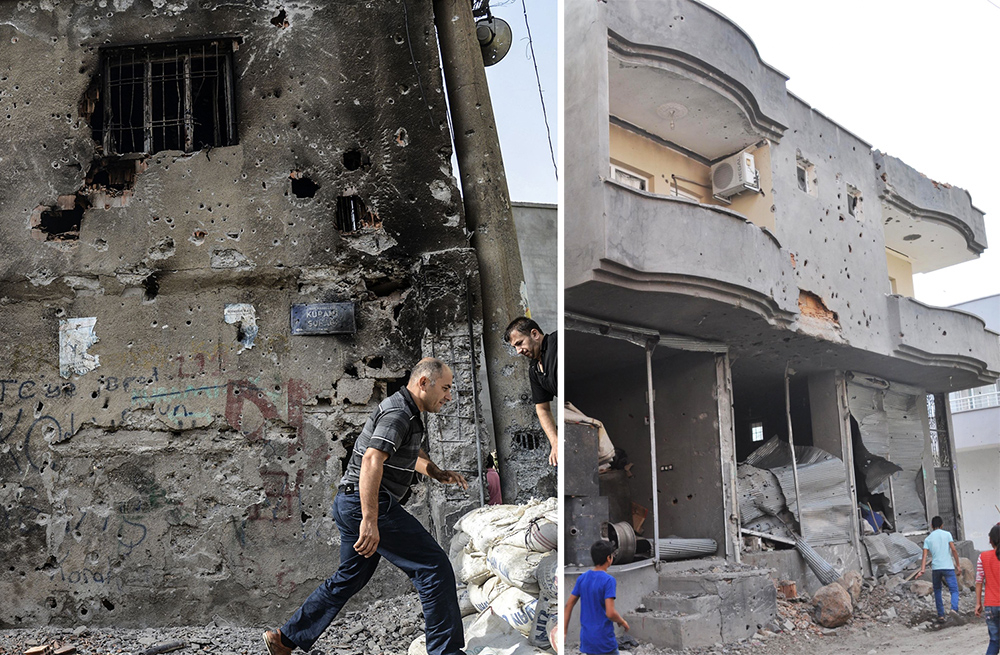
During these curfews, the Turkish military and police have targeted, terrorized and demolished entire Kurdish neighborhoods. The curfews are accompanied by military assaults against civilian populations – their homes, businesses, offices, historical monuments, reservoirs and infrastructure, are being bombed and destroyed. As Ziya Pir, a deputy of the pro-Kurdish Peoples’ Democratic Party (HDP) said: “The soldiers, police or some unregistered people that I call ‘head hunters’ rake through everything from top to bottom wherever they see life.”

The Turks are using aerial bombardment, sniper fire, artillery fire, tanks, helicopters and thousands of soldiers. When someone is wounded or gets seriously sick, and their family members need to take them to hospital, they are shot by snipers, or sometimes they are shot just at the windows of their homes.

In the Kurdish town of Silopi, police vehicles broadcast announcements that it is forbidden to look out of the windows.

The latest victims of the curfews and assaults are the Kurdish districts of Sur in Diyarbakir, Nusaybin in Mardin and Cizre and Silopi in Sirnak.
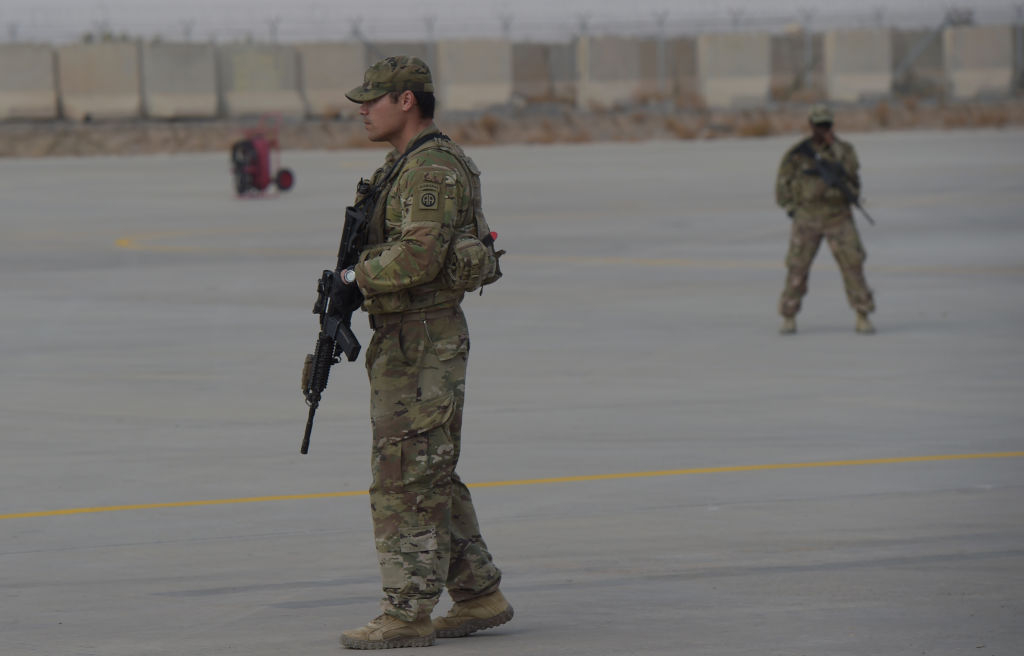
The Kurdish town of Cizre in Turkey has been indiscriminately bombarded by Turkish security forces. Many homes have been heavily damaged or destroyed. Photographic evidence from an earlier assault in September shows many buildings and vehicles in the town riddled with bullet holes.

On December 14, 3,000 teachers working in Silopi and Cizre left the towns after they received an SMS message from Turkey’s ministry of national education. Teachers were told in the message that they would be included in an in-service training program, and that they could receive this training in their hometowns.

Most of these teachers are Turks whom the government sent to teach the children of the Kurdish towns. After the departure of the teachers, the towns were attacked by Turkish army units. Now the homes of Kurdish children in these towns are bombed and devastated.

On December 21, 11-year old Mehmet Mete was murdered in his home by tank fire. “He was heavily wounded in his head with a shrapnel piece. But as ambulances could not go there and take him to hospital, he lost his life,” said Kurdish MP Aycan Irmez.

“After declaring the curfew, they [the Turks] deploy soldiers, police and snipers in the evacuated schools,” Osman Tetik, a Cizre representative of the Education and Science Workers’ Union (Egitim-Sen) told the daily Evrensel. “They have piled up their ammunition inside the schools. The state uses schools as arsenals.”

“The teachers from Cizre are still here. That means this state only values the lives of teachers that come from western Turkey. And it sees no harm in murdering the Kurdish citizens and Kurdish teachers here.

“They are shooting the interior of the city with tanks. They are raking through the neighborhoods from their armored vehicles. Everyone who goes out to the streets or even to their balconies is targeted. Hediye Sen was murdered by police when she went to the garden of her house, which is very close to where we are. We can contact some of our friends. No one can go outside.

“The electricity has been out since yesterday. Our phones will be dead. We have started to run out of our basic needs. Our water is running out. The food at homes is running out. We have been having lots of problems with the internet connection. The telephone lines have been cut. The situation here is terrible.”

Turkey’s Prime Minister Ahmet Davutoglu said on December 15 that, “all those towns will be cleansed of terror elements. If necessary, neighborhood by neighborhood, house by house, street by street.”

After his statement, the towns of Cizre and Silopi in Sirnak came under major military attacks. “The Turkish military is out in full force in Sirnak,” an MP from the Kurdish HDP party, Ferhat Encu, told Gatestone Institute. “This is an offensive to destroy a whole city. The attacks come with tanks, helicopters, heavy artillery and go on non-stop. There are sharpshooters on every roof: houses, the municipal building, the hospital. No one can go out.”

Since July, 44 Kurdish children have been murdered and 52 wounded, all due to state violence, according to a report entitled, “We do not want War! We do not want you to Kill Children!” The youngest was three and a half months old.

During operations in Silopi, the Turkish “security” forces were heard playing songs of Ottoman military bands through the loudspeakers of their vehicles.

The Turkish military are not only bombing Kurdish civilian areas but also breaking down the doors of homes with sledgehammers. One was the house of the Kurdish MP, Ferhat Encu. “Even though I told them I am a parliamentary deputy, they entered the house and pointed a gun at me,” Encu said. “They tried to arrest me. When I asked them the reason, they did not say anything. They told me to ask the governor. But we cannot contact the governor.”

Videos and photographs coming from the region show that the Turkish military are attacking the towns with tanks from the hills and in every street.

People cannot even bury their dead.

On December 18, while returning home from a neighbor’s home, Taybet Inan, 57, a mother of 11, was murdered by sharpshooters in Silopi. Her family started its struggle, trying to take her body from the street. Her brother-in-law, Yusuf Inan, tried to help; sharpshooters killed him in the garden of his house. When Inan’s husband also tried, he too was shot. Her son, Mehmet Inan, said the family was keeping the body of Yusuf Inan in the basement.

“The prosecutor and the police told us we could get my mother’s body from the street if we held a white flag,” said Mehmet Ianan “but when we went outside, there were bullets fired even at that.”

On December 25 — seven days after Taybet Inan was murdered — her family was finally able to retrieve her body, and put it, with their uncle’s, in the morgue of the hospital.

The families of Resit Eren, 17, and Axîn Kant, 16, murdered in Silopi, are keeping their bodies, with some ice beside them, at a local mosque.

Seyfettin Aydemir, the co-mayor of Silopi, told Gatestone Institute that in Silopi a group of 60 people — mostly children — have had to hide, with little water and food, in the basement of a house. “Since the curfew started, many people have been murdered. When the electricity is cut, there is no ice; the bodies start to rot.”

Health employees have to work under conditions in which they have no safety, said Gonul Erden, the co-President of the Trade Union of Public Employees in Health and Social Services. “At the entrances of hospitals, instead of ambulances, water cannon vehicles and armored police vehicles are waiting. They are shooting bullets at hospitals and ambulances,” she said. “The Ministry of Health is standing by as hospitals are turned into military quarters and as health institutions and employees become targets.”

The death toll is rising every day. In Silopi, Ayse Buruntekin, 40, a mother of 9, were shot dead by special operations police when she went to the roof of her house.

In Cizre, Zeynep Yilmaz, 45, and Hediye Cete, a mother of 3, were murdered.

Guler Yamalak, 8 months pregnant, was shot by Turkish armed forces as she tried to take her son, who had broken his wrist after a fall, for treatment. She has lost her baby.

Meanwhile, JINHA news agency reported that the special operations police are seizing the property of residents. Sait Uzen, a hotel owner, for instance, said that his hotel in Cizre has been seized by police and he and his family evacuated. “They swore at me and insulted me. They told me that ‘if you don’t leave, and if you create problems, we will destroy here with tanks.” The hotel has been turned into military quarters.

The curfews and military assaults against Kurdish civilians have reportedly forced at least 200,000 Kurds to flee.

The family of Derya T. from the Kurdish district of Nusaybin, has been exposed to five curfews since August 6. Once the curfew was lifted, she went to Uludere in Sirnak where her relatives reside. “We were left without water,” she told Today’s Zaman. “All of the power transformers exploded. I have seven children. They cannot go to school. They are now in a severe depression. They had to drink water we generally use for the toilets. All of them got sick. We could not take them to the hospital because of the curfew. I sent my children to different relatives. My house is full of bullet holes. There is virtually no house without bullet holes in the district. Everyone there lives in fear.”

In the Sur district of Diyarbakir, Hasret Sen, the 11-year-old daughter of Ekrem Sen, was shot dead while going to the bakery to buy some bread. Sen said that no one could dare take the dead body from the street for 15 minutes.

The Kurdish press is another target of the military siege. Kurdish journalist Beritan Canozer, who works for the JINHA (Women’ News Agency) for instance, was first taken into custody while following up news in Diyarbakir because “she looked nervous.” Then she was jailed due to “her social media posts.”

Until recently, the government said that the curfews were imposed to “remove ditches and barricades erected by terrorists.” But on December 19, Prime Minister Davutoglu changed his mind. “Even if the ditches and barricades are removed, we will not withdraw; we will stay there,” he said.

The Turkish military may now be destroying the Kurdish homeland because Kurdish mayors and politicians in some Kurdish towns recently announced that they would like to exercise their right to self-rule.

In late August — as a response to the brutal state violence in Kurdish towns — Kurds started announcing self-governance in those districts where the municipalities are already administered by democratically-elected Kurdish mayors. Kurds have been asking for their own free autonomous administration in Turkey’s Kurdistan. They have been asking for schools where they will be taught in the Kurdish language — without the language prohibitions, terror and murders of the Turkish state authorities.

Turkish prosecutors, meanwhile, have opened investigations against Kurdish MPs or officials of the pro-Kurdish Democratic Peoples’ Party (HDP) and Democratic Regions Party (DBP).

Many Kurdish mayors have been removed from their posts by Turkey’s Ministry of Interior or arrested by police. Ruken Yetiskin and Tacettin Safali, co-mayors of the Kurdish town of Yuksekova, were removed from their posts for participating in a statement to the press in which the Kurds’ decision of self-rule was declared on August 13. Seyid Narin, and Fatma Şık Barut, co-mayors of Sur, Yuksel Bodakci, co-mayor of Silvan, and Ali Riza Cicek, co-president of the Sur district of the pro-Kurdish Democratic Regions Party (DBP), among others, were arrested on August 19, after making declarations on self-rule, for “disrupting the unity and integrity of the state.”

Turkish authorities have apparently been deeply disturbed by the success of the pro-Kurdish HDP party in the June and November elections, in which they got 10.76% of votes and prevented the ruling AKP Party from reaching a super-majority.

The towns and cities under attack are predominantly Kurdish. Turkey, history shows, is not happy that the Kurds exist — just like it has not been happy with the existence of other non-Turkish communities.

Meanwhile, on December 18, the HDP leader, Selahattin Demirtas, commented at a press conference on the military operations against Kurdish towns:

“The Prime Minister and President, who after challenging Putin for just one or two days have turned into pipsqueaks… The President, who challenged the world by sending soldiers to Mosul, then withdrew his soldiers like a jellyfish… The President first said ‘One minute!’ to Israel and then made a 20-million-dollar deal with it…. Do you become tough guys only when it comes to Kurdish people?

“You are blowing up houses and mosques with your tanks. Even that is not enough for you. You say to your media outlets that people here (in Diyarbakir) burned a mosque. But the mosque in Diyarbakir was not burned by us, it was burned by the state’s forces.

“Nothing the government does has a legal basis. What can people do in the face of a state that does not recognize the law? The state itself is acting illegally.

“If the President and the Prime Minister are doing illegal things, then where can we go for help? To the prosecutors? They are in prison. The government even arrests writers and members of the press. So the youths are digging ditches? The people are setting up barricades? Show them another way and they will do that instead.”

Hulusi Akar, the Turkish chief of general staff, has also gone to Sirnak and is reportedly leading the operation there.

The goal of such ethnic cleansing, it seems, as in all such ethnic cleansings here, is to further someone’s dreams of “Turkification” and Islamization.

Prof. Sebnem Korur Fincanci, President of the Human Rights Foundation of Turkey (TIHV), recently said,

“Curfews are a form of torture which we define as the exposure of people to heavy physical and psychological violence due to discriminatory reasons. These are not limited to curfews. The snipers shoot at water reservoirs. They cut off electricity. The shoot at people directly. It reminds me of the Bosnian genocide, the mass graves where I worked, and the 1994 genocide in Rwanda. People did not speak up against those mass murders, too. Later, in the face of those massacres, the state authorities were found guilty of staying silent, of looking the other way.

“Before there is another affront to humanity in Kurdistan, we are making a call to Turkey and the international community. Everyone needs to speak up immediately, in the loudest way. Please struggle against this violence; it is getting so late.”

Uzay Bulut, born and raised a Muslim, is a Turkish journalist based in Ankara.

Translate »
Skip to toolbar