

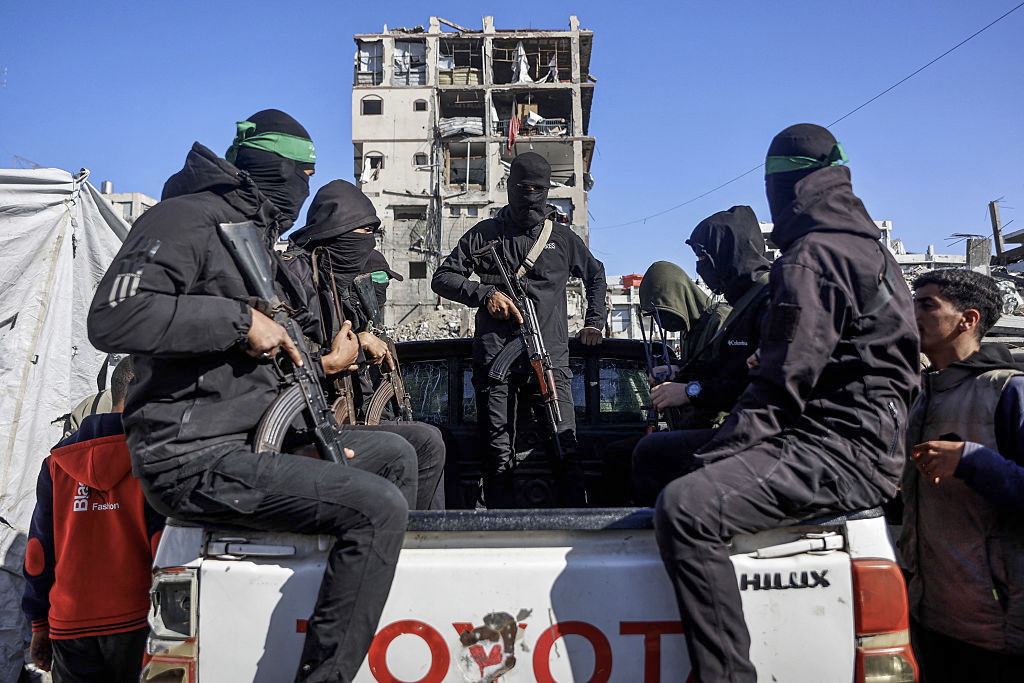
Six months after the ceasefire went into effect in the Gaza Strip, Hamas remains firmly in power. Despite international promises, diplomatic initiatives, and the much-publicized “Board of Peace,” the Iran-backed Islamist group has not disarmed, relinquished control, or moderated its behavior. Instead, it appears to be using the ceasefire as an opportunity to entrench its rule, regroup militarily, and tighten its grip on the Palestinian population.
The persistence of Hamas rule also raises serious questions about the Trump administration’s policy. Why is Hamas still in power six months after the ceasefire? Why has Trump’s “Board of Peace” failed to achieve its most basic objective: forcing Hamas to hand over its weapons and relinquish control over the Gaza Strip? If anything, the ceasefire has strengthened Hamas, giving it time to rearm, reorganize, and reassert control over the population.
Why is there insufficient pressure on key mediators such as Egypt and Qatar to hold Hamas accountable? What concrete steps will the Trump Administration take to ensure that Hamas does not remain the de facto ruler of the Gaza Strip?
Without decisive action, the current approach is legitimizing an Islamist terror regime, Hamas, committed to Israel’s destruction, engaged in the systematic abuse of its own people, and, as the Trump Administration has seen with Iran, no intention whatever of giving up its rule.
So long as Hamas remains in power, there can be no positive future for the Gaza Strip.
While much of the world’s attention remains fixed on Iran and the broader regional conflict, a darker and largely ignored reality is unfolding inside the Gaza Strip: credible and deeply disturbing reports of sexual exploitation, abuse, and coercion carried out under Hamas rule.
New testimonies emerging from the Gaza Strip reveal that Hamas terrorists are systematically sexually exploiting vulnerable Palestinian women — demanding sex in exchange for basic aid, food, and shelter. The accounts describe a predatory system targeting widows, displaced mothers, and divorcees without male breadwinners, with victims threatened into silence by Hamas operatives.
Six months after the ceasefire went into effect in the Gaza Strip, Hamas remains firmly in power. Despite international promises, diplomatic initiatives, and the much-publicized “Board of Peace,” the Iran-backed Islamist group has not disarmed, relinquished control, or moderated its behavior. Instead, it appears to be using the ceasefire as an opportunity to entrench its rule, regroup militarily, and tighten its grip on the Palestinian population.
According to an investigative report in Britain’s Daily Mail, Palestinian women are being sexually abused by Hamas terrorists and forced to have sex in return for food aid. Human rights organizations in the Gaza Strip told the newspaper that up to 60,000 women are vulnerable, with reports also indicating a rise in child marriages and pregnancies.
The report quotes a Gazan man, whose identity was not released for security reasons, describing “how he found a widow displaced in the war being molested inside a tent by ‘a bunch of’ Hamas members and was warned to stay silent”:
“We were contacted by the wife of a friend. She had asked a [Hamas military wing] Qassam Brigades commander to help her, but he took advantage of her. His behavior is disgraceful. We investigated the matter and found her in a tent in the Gharabli area where a bunch of Qassam members were taking advantage of her. We informed the leadership but were told we had to keep silent about it.”
The report added:
“Another Gazan man confirmed that a similar episode had happened with one of his female neighbours, who was blackmailed by ‘one of Hamas’s charity organisations… they wanted her to wh*** herself in exchange for a food parcel, or an aid voucher, or 100 shekels.'”
Noor (not her real name), a divorced mother of four, recounted:
“I am a mother of four children. I am displaced because of the war and I do not belong to a recognised displacement camp, so I did not receive any aid. I went to an Islamic charity that distributes aid to displaced and needy people in Gaza. I was welcomed by a man who looked religious, like a sheikh. He said he would stand by me and help me. I told him I was separated from my husband. He said: ‘Oh, separated? A woman as beautiful as you?'”
She said the man took her phone number under the pretext that he wanted to help her.
“From the beginning, the way he spoke to me felt like harassment. I am much younger than him. I trusted him because he was an older man; I saw him like a father. He is the age of my father, but he harassed me directly. I was afraid, of course. He was pursuing me. I told him I would expose him. He said: ‘You cannot expose me, I am the government here.'”
Noor added, “They exploit women’s need for help. But the women are too scared to speak up.”
Even more disturbing are allegations involving children. A separate report by the Daily Mail tells of minors who have been sexually abused by Hamas-affiliated clerics and then blackmailed into silence. Families, according to testimonies, are threatened with severe consequences, including accusations of collaborating with Israel, if they dare to speak out. In Palestinian society, an accusation of collaboration with Israel can amount to a death sentence.
A nine-year-old Palestinian boy said he was sexually assaulted by a sheikh inside a mosque:
“I went to pray at the mosque that day, it was before the ‘asr prayer, I was studying the Quran,’ says the nine-year-old before naming the Sheikh that was there. We were studying the Qur’an together. He said to me, ‘come with me, I want to give you something nice.’ He took me to the restrooms and undressed me, took off my pants and had his way with me. I started to scream and then I cried.”
The report relates the experiences of other victims:
“[A] ten-year-old described how he used to be the first child to arrive at the mosque until one day a Sheikh asked to follow him upstairs. ‘So I went upstairs, he pulled down my pants and started to do filthy things to me,’ the boy said.
“A 42-year-old father of a third victim who was raped in a Mosque in Khan Younes, recalls how his hysterical wife called him at work to say: ‘Your son is bleeding and has bruises all over his body.'”
These accounts are not isolated. In fact, they point to a broader pattern.
The use of sexual violence by Hamas did not begin in the Gaza Strip during the recent war, which erupted with the October 7, 2023, Hamas-led invasion of Israel. On that day, Hamas terrorists carried out widespread acts of rape and sexual abuse against Israeli girls and women. Israeli hostages – both male and female – who were held by Hamas have since reported sexual harassment and abuse while in captivity.
What is now emerging from the Gaza Strip suggests that such brutality is not only directed outward, against Israelis, but also inward, against Palestinians themselves.
Yet the response from the international community has been conspicuously muted.
Where are the global human rights organizations? Where are the international women’s groups that are usually quick to condemn sexual violence in conflict zones? Why has there been no urgent investigation by the United Nations into Hamas’s crimes against Palestinian women and children? Why has UN Women failed to respond meaningfully to these allegations?
The silence is beyond offensive. One possible explanation is fear – both among local NGOs operating under Hamas rule and among international organizations wary of confronting the Islamist terror group. Another is political bias: a reluctance to highlight abuses that complicate the prevailing narrative that views Israel as the only villain.
Whatever the reason, the failure to address these allegations amounts to a betrayal of the very people these organizations claim to defend.
The persistence of Hamas rule also raises serious questions about the Trump administration’s policy. Why is Hamas still in power six months after the ceasefire? Why has Trump’s “Board of Peace” failed to achieve its most basic objective: forcing Hamas to hand over its weapons and relinquish control over the Gaza Strip? If anything, the ceasefire has strengthened Hamas, giving it time to rearm, reorganize, and reassert control over the population.
The Trump Administration, which has championed the ceasefire deal, now faces a critical test. Why is there insufficient pressure on key mediators such as Egypt and Qatar to hold Hamas accountable? What concrete steps will the Trump Administration take to ensure that Hamas does not remain the de facto ruler of the Gaza Strip?
Without decisive action, the current approach is legitimizing an Islamist terror regime, Hamas, committed to Israel’s destruction, engaged in the systematic abuse of its own people, and, as the Trump Administration has seen with Iran, no intention whatever of giving up its rule.
So long as Hamas remains in power, there can be no positive future for the Gaza Strip.
egretnewseditor@gmail.com