Statement on the Ongoing Uprising in Iran
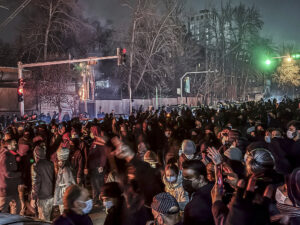
The Iranian people are once again engaged in sustained, nationwide resistance against the Islamic Republic of Iran, a regime that for more than four decades has relied on systematic repression, ideological coercion, and violence to maintain power. This uprising is not an isolated episode, but the continuation of a long struggle for national sovereignty, and democratic self-determination.
Since the murder of Mahsa Jina Amini in September 2022, Iranian citizens from all regions have demonstrated extraordinary courage in confronting a state apparatus that employs arbitrary detention, torture, executions, and mass surveillance to suppress peaceful dissent. The persistence of these protests, despite brutal crackdowns, reflects a profound and irreversible rupture between the Iranian population and the ruling regime.
Central to this movement is the visible re-emergence of national symbols and unifying figures that transcend factionalism. The widespread invocation of Iran’s pre-revolutionary national identity and the public support expressed for Crown Prince Reza Pahlavi reflect a popular demand for continuity, legitimacy, and unity – rather than ideological experimentation or externally imposed alternatives. These expressions should be understood not as nostalgia, but as a rejection of the Islamic Republic’s claim to represent Iran’s history, culture, or future.
Crown Prince Reza Pahlavi has articulated a clear commitment to a peaceful transition, national reconciliation, territorial integrity, secular governance, and the principle that the Iranian people alone must determine their system of government through a free and democratic process. His role as a unifying national figure – without seeking power by force or faction – stands in contrast to the fragmentation and coercion that have defined Iran’s political landscape since 1979.
We therefore affirm:
- The legitimacy of the Iranian people’s uprising against totalitarian rule.
- The right of Iranians to rally behind a nationally unifying leader, Crown Prince Reza Pahlavi, whose position has emerged through popular support rather than factional appointment.
- The responsibility of democratic governments to support the Iranian people through diplomatic pressure, targeted sanctions against regime institutions, and the protection of activists.
- The need to reject false equivalence between a brutal theocratic state, the Islamic Republic, and a population demanding freedom, the Iranian people.
The responsibility of the international community is to support, by all appropriate means, the Iranian people’s struggle for democracy and self-determination. This requires attentiveness to the voices expressed across Iran’s streets, including the leader whose name is repeatedly invoked by the protesters themselves.
egretnewseditor@gmail.com