Yearly Archives: 2017

Israel and “Palestine”: What International Law Requires by Louis René Beres

  • Under relevant international law, a true state must always possess the following specific qualifications: (1) a permanent population; (2) a defined territory; (3) a government; and (4) the capacity to enter into relations with other states.

  • While this contingent condition of prior demilitarization of a Palestinian state may at first sound reassuring, it represents little more than a impotent legal expectation.
  • For one thing, no new state is ever under any obligation to remain “demilitarized,” whatever else it may have actually agreed to during its particular pre-state incarnation.
  • “The legality of the presence of Israel’s communities the area (Judea and Samaria) stems from the historic, indigenous, and legal rights of the Jewish people to settle in the area, granted pursuant to valid and binding international legal instruments, recognized and accepted by the international community. These rights cannot be denied or placed in question.” — Ambassador Alan Baker, Israeli legal expert.

International law has one overarching debility. No matter how complex the issues, virtually everyone able to read feels competent to offer an authoritative legal opinion. While, for example, no sane person would ever explain or perform cardio-thoracic surgery without first undergoing rigorous medical training, nearly everyone feels competent to interpret complex meanings of the law.

This debility needs to be countered, at least on a case by case basis. In the enduring controversy over Palestinian statehood, there are significant rules to be considered. For a start, on November 29, 2012, the General Assembly voted to upgrade the Palestinian Authority (PA) to the status of a “Nonmember Observer State.”

Although it is widely believed by many self-defined “experts” that this elevation by United Nations has already represented a formal bestowal of legal personality, that belief is incorrect. Under law, at least, “Palestine” – whatever else one might happen to think of “fairness” – remains outside the community of sovereign states.

This juridical exclusion of “Palestine,” whether welcome or not, on selective political grounds, is evident “beyond a reasonable doubt.” The authoritative criteria of statehood that express this particular exclusion are long-standing and without ambiguity. Under relevant international law, a true state must always possess the following specific qualifications: (1) a permanent population; (2) a defined territory; (3) a government; and (4) the capacity to enter into relations with other states.

Moreover, the formal existence of a state is always independent of recognition by other states. According to the 1934 Convention on the Rights and Duties of States (the Montevideo Convention):

“Even before recognition, the state has the right to defend its integrity and independence, to provide for its conservation and prosperity, and consequently to organize itself as it sees fit….”

It follows that even a Palestinian state that would fail to meet codified Montevideo expectations could simply declare otherwise, and then act accordingly, “to defend its integrity and independence….”

More than likely, any such “defending” would subsequently involve incessant war and terror against “Occupied Palestine,” also known as Israel. The Palestine Liberation Organization (PLO) was formed in 1964, three years before there supposedly were any “Israeli Occupied Territories.” What, then, exactly, was the PLO trying to “liberate?”

Whenever the PA finally decides it is time openly to declare statehood, certain explicit Montevideo standards and corollary criteria of statehood will need to be invoked.

Much as the Government of Israel, seeking to challenge any such adversarial PA declaration, will then cite correctly multiple Oslo Agreement violations. The PA will counter-argue that its particular right to declare an independent state of Palestine is nonetheless fundamental, or “peremptory.” The PA will surely add as a footnote that its right of statehood according to jus cogens (“certain fundamental, overriding principles of international law, from which no derogation is ever permitted”) simply overrides all previously-existing expectations of a just peace with Israel.
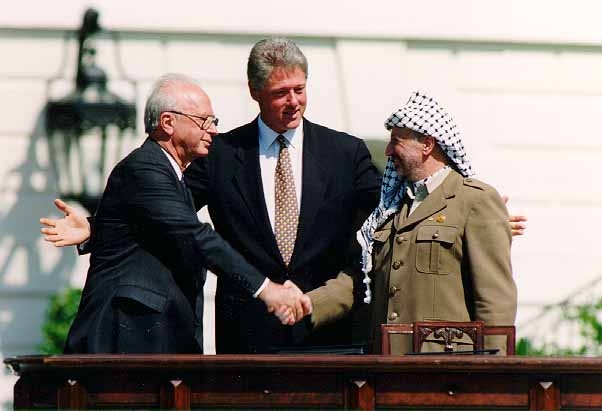
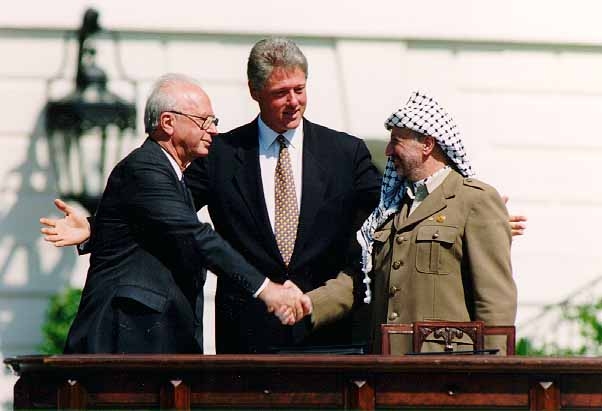
Israeli Prime Minister Yitzhak Rabin, U.S. President Bill Clinton, and PLO chairman Yasser Arafat at the Oslo Accords signing ceremony on September 13, 1993. (Image source: Vince Musi / The White House)

Undoubtedly, among other matters, the PA will cite (1) the plainly non-treaty quality of the Oslo Agreements (per definitions of “treaty” at the 1969 Vienna Convention on the Law of Treaties), and to (2) those basic and allegedly immutable human rights under international law that concern “self‑determination” and “national liberation.”

Now, of course, Prime Minister Netanyahu seems to have acknowledged the eventual creation of Palestine, but, among other things, only on the seemingly prudent condition of antecedent Palestinian “demilitarization.”

While this contingent condition may at first sound reassuring, it effectively represents little more than a contrived and ultimately impotent legal expectation. For one thing, no new state is ever under any obligation to remain “demilitarized,” whatever else it may have actually agreed to during its particular pre-state incarnation. For another, there is no discernible reason to believe that “Palestine” would ever make good on any of its pre-independence promises to Israel to support the Jewish State’s equally basic right to “peace and security.”

For “Palestine,” following formal statehood, the struggle with Israel would continue to be conceptualized as zero-sum; that is, on the corrosive assumption that absolutely any gain for Israel would represent a corresponding loss for Palestine. It could claim it was defending itself against anyone, including terrorist groups, and remain within its rights.[1]

Under the Montevideo Convention, all states are legally equal, enjoy the same rights, and have equal capacity in their exercise. The moment that the PA should proceed to declare a State of Palestine, the new country could become the effective juridical equal of Israel. To best maintain its indispensable national interests in such circumstances, Israel should insist that Palestine’s borders never be based upon pre-1967 lines.

A perfect core summation of such insistence is provided in the February 10, 2013 words of Israeli legal expert, Ambassador Alan Baker:

“The legality of the presence of Israel’s communities in the area (Judea and Samaria) stems from the historic, indigenous, and legal rights of the Jewish people to settle in the area, granted pursuant to valid and binding international legal instruments, recognized and accepted by the international community. These rights cannot be denied or placed in question.”

Accordingly, Israel should clearly affirm that Israeli “settlement activity” is in fact fully consistent with binding international law. Any contrary affirmation by a still-aspiring “Palestine” would be founded upon specious misrepresentations of this critical law.

Louis René Beres is Emeritus Professor of International Law at Purdue University. His just-published new book is titled Surviving Amid Chaos: Israel’s Nuclear Strategy. lberes@purdue.edu


[1] Over the years, a number of cases in United States federal courts have rejected the idea that the PLO, as “parent” of the PA, is in any way recognizable as the legitimate core of an independent Palestinian state. Earlier, perhaps, capable Israeli lawyers and policymakers might have been able to refer to such American case law in compelling support of an argument against Palestinian statehood. Today, however, after Oslo, and after so many years of incremental Israeli recognition of PLO/PA authority as legitimate, Israel will have to base its well-founded opposition to “Palestine” on other grounds.
Islamists Won: Charlie Hebdo Disappears by Giulio Meotti

“The newspaper is no longer the same, Charlie is now under artistic and editorial suffocation.” — Zineb el Rhazoui, French-Tunisian intellectual and journalist, author of Destroying Islamic Fascism. “We must continue to portray Muhammad and Charlie; not to do that means there is no more Charlie.” — Patrick Pelloux, another cartoonist who left the magazine. “If our colleagues in the public debate do not share part of the risk, then the barbarians have won.” — Elisabeth Badinter, philosopher, who testified in court for the cartoonists in the documentary, “Je suis Charlie.” After the Kouachi brothers slaughtered Charlie Hebdo’s journalists, they ran out into the street and cried: “We have avenged Muhammad. We killed Charlie Hebdo.” Two years later, it appears that they won. They succeeded in silencing the last European magazine still ready to defend freedom of expression from Islamism. Over twenty years, fear has already devoured important pieces of Western culture and journalism. They all disappeared in a ghastly act of self-censorship: the cartoons of a Danish newspaper, a “South Park” episode, paintings in London’s Tate Gallery, a book published by the Yale University Press; Mozart’s Idomeneo, the Dutch film “Submission”, the name and face of the US cartoonist Molly Norris, a book cover by Art Spiegelman and Sherry Jones’s novel, “Jewel of Medina”, to name just a few. Most of them have become ghosts living in hiding, hidden in some country house, or retired to private life, victims of an understandable but tragic self-censorship. Only the French satirical magazine Charlie Hebdo was missing from this sad, long list. Until now. The disappointment with what Charlie Hebdo has become is reflected in the words of the French journalist, Marika Bret: “From Italy we receive many threats.” The reference is not to some Italian jihadist cell, but to a September Charlie Hebdo cover that mocked victims of the earthquake in Italy. It seems that the satirical weekly, almost destroyed by French Islamists two years ago, has been “normalized”. Take Charlie’s recent covers. Against terrorists? No. Against those who called them “racists”? No. It was against Éric Zemmour, the brave French journalist at Le Figaro who has led a public debate about French identity. “Islam is incompatible with secularism, incompatible with democracy, and incompatible with republican government,” Zemmour wrote. Laurent Sourisseau, aka “Riss,” now the publishing director and majority owner of Charlie, was shot during the 2015 attack on the magazine, and lives under police protection. He depicted Zemmour on the cover with an explosive vest, effectively comparing him to a terrorist. Charlie Hebdo also recently satirized Nadine Morano, a critic of Islam, depicting her as a baby with Down Syndrome. Riss also recently published a comic book attacking another easy target of submissive conformists, entitled “The Dark Side of Marine Le Pen.” Le Pen leads France’s National Front party, with a platform fighting for national sovereignty and Europe’s Judeo-Christian identity. In Charlie, the political leader of the French “right” is dressed as Marilyn Monroe. For the first anniversary of the massacre at Charlie Hebdo’s office, Riss released a cover not with Mohammed, but depicting a murderous Judeo-Christian God, as if Riss’s colleagues had not been butchered by Islamists but by Catholics. Riss had, in fact, announced earlier that the magazine would “no longer draw Mohammed”. The first person at Charlie to capitulate was “Luz”, a well-known cartoonist. He surrendered, saying: “I will no longer draw Muhammad”. Charlie Hebdo, after Islamist terrorists murdered much of its staff in 2015, announced it would “no longer draw Mohammed.” Instead, the magazine now focuses on attacking critics of Islamism, and mocking the Judeo-Christian God. “The transplant that works worst,” said Jeannette Bougrab, the companion of Charlie’s late editor Stéphane Charbonnier, “is the transplant of balls.” Bougrab charged the attack’s survivors with bowing to terrorism and threats by betraying the legacy of free speech for which these truthful men were murdered. After the massacre of January 7, 2015, the cartoonist “Luz” cried in front of the cameras after presenting a cover depicting the survivors, in which Muhammad was portrayed as saying, “All is forgiven”. Luz then appeared in Le Grand Journal along with Madonna, and in a gesture of sad voyeurism, displayed his genitals, covered by the logo “Je suis Charlie”. Charlie’s “normalization” was also reflected in the recent dramatic decision to terminate the magazine’s relationship with another survivor, the French-Tunisian intellectual and journalist Zineb el Rhazoui, who also now has to live under police protection for her criticism of Islamic extremists. “The newspaper is no longer the same, Charlie is now under artistic and editorial suffocation,” she told Le Monde. Rhazoui is the author of a new book, “Détruire le Fascisme Islamique” (“Destroying Islamic Fascism”). “We must continue to portray Muhammad and Charlie; not to do that means there is no more Charlie”, said Patrick Pelloux, another cartoonist who left the magazine. There were seven cartoonists at Charlie Hebdo. Five were killed on January 7, 2015: Charb, Cabu, Honoré, Tignous and Wolinski. The other two, Luz and Pelloux, resigned after the massacre. The headline of the monthly Causeur captured the atmosphere: “Charlie Hebdo Commits Hara-Kiri,” playing with the Japanese form suicide and the previous name of Charlie (which was “Hara-Kiri”). Between murders, desertions and self-censorship, Charlie’s story is almost over. What is happening? Sadly, the Islamists’ threats and attacks are working. A similar crisis affected the Jyllands-Posten, the Danish newspaper that first published the 12 cartoons of Muhammad, which Charlie Hebdo immediately, to show solidarity, reproduced. “The honor of France was saved by Charlie Hebdo,” wrote Bernard-Henri Lévy when the magazine republished the Danish cartoons, while many “right thinking” media blasted the “Islamophobia” of those caricatures. “The truth is that for us it would be totally irresponsible to publish the cartoons today,” the director of Jyllands-Posten, Jorn Mikkelsen says to justify his self-censorship. “Jyllands-Posten has a responsibility to itself and its employees.” Such as Kurt Westergaard, author of the caricature of Mohammed with a bomb in his turban, who now lives in a house-fortress, with cameras and security windows and machine-gun toting guards outside. An ideological clash inside Charlie Hebdo developed well before the terror attack. Zineb el Rhazoui arrived at the weekly magazine through editor Stéphane Charbonnier, “Charb”, the brave journalist who lead the battle against Islamist intimidation in Europe. Even from his grave, he penned an “Open Letter to the Fraudsters of Islamophobia Who Play Into Racists’ Hands.” But, as Libération writes, “Riss opposed Charb; he is less politically identified, more introverted than him.” Charbonnier belonged to the generation of Philippe Val and Caroline Fourest, the libertarian journalists determined to criticize Islam, who, from 1992 to 2009, shaped the weekly magazine. “Charb? Where is Charb?”, shouted the terrorists in Charlie Hebdo’s office, to make sure they found the journalist they considered responsible for the Mohammed cartoons controversy. Philippe Val, who as a former Charlie Hebdo editor, was put on trial in Paris for printing those cartoons, published a book “Malaise dans l’inculture” (“Sickness in the Lack of Culture”), which attacks “the ideological Berlin Wall” that has been raised by the Left. In 2011, after a firebombing that destroyed Charlie’s offices, an appeal by frightened, intimidated journalists announced their refusal to support the magazine’s stance on Islam. Two years later, one of the signatories, Olivier Cyran, a former editor of Charlie Hebdo, charged the magazine with being “obsessive about the Muslims.” So did a former Charlie journalist, Philippe Corcuff, who accused his colleagues at the magazine of fomenting “a clash of civilizations.” The attacks continued with another former cartoonist at Charlie Hebdo, Delfeil de Ton, who, in Le Nouvel Observateur, after the 2015 massacre, shamefully accused Charb of “dragging” the staff into the slaughter by continuing to satirize Mohammed. After the Kouachi brothers slaughtered Charlie Hebdo’s staff, they ran out into the street and cried: “We have avenged Mohammed. We killed Charlie Hebdo.” Two years later, it appears that they won. They succeeded in silencing the last European magazine still ready to defend freedom of expression from Islamism. And they sent a special warning to all the others. Because after Charlie Hebdo, writing articles critical of Islam, or penning a cartoon, make them a target for assassination attempts and intimidation campaigns. The feminist and philosopher Elisabeth Badinter, who testified in court for the French cartoonists in the documentary, “Je suis Charlie,” said: “If our colleagues in the public debate do not share part of the risk, then the barbarians have won.” The magazine Paris Match asked Philippe Val if he could imagine the disappearance of Charlie Hebdo. Val replied: “This would be the end of a world and the beginning of Michel Houellebecq’s ‘Submission'”. After attacks comes self-censorship: submission. If Charlie Hebdo is tired and fleeing from responsibilities, who can blame it? But the others, the rest?

Islamists Infiltrate the Swedish Government One Month of Islam and Multiculturalism in Sweden: April 2016 by Ingrid Carlqvist

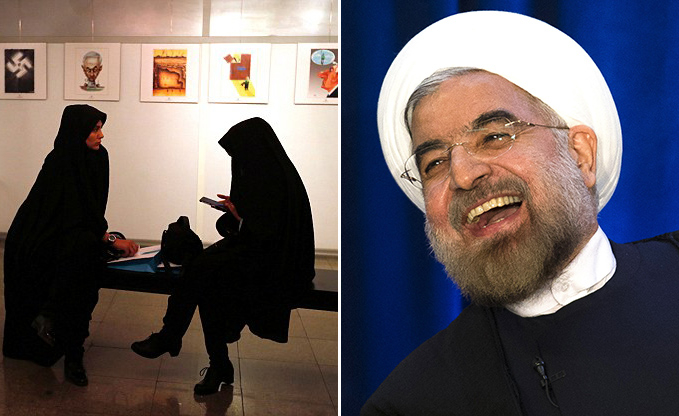
  • Thanks to the lifting of sanctions, the prize for best Holocaust cartoon was lifted as well. Iran is now offering $50,000 for the best Holocaust cartoon, more than quadruple last year’s prize, which was $12,000.

  • The competition is expected to draw participants from more than 50 countries. It is sponsored by two organizations which are directly or indirectly linked to the Iranian regime: the Owj Media and Cultural Institute, funded by the Islamic Revolutionary Guard Corps, and the Sarsheshmeh Cultural Center, which is supported by the Islamic Development Organization (IDO). The Iranian parliament provides the IDO’s budget.
  • These kinds of Holocaust events and conferences in Iran are based on the notion that Holocaust did not occur.

This week, Iran is hosting its second annual Holocaust Cartoon Competition, even as some politicians and world leaders continue to argue that Iran is becoming a stabilizing force because it is re-joining the international community, by implementing the nuclear agreement and integrating into the global financial system.

The exhibition of Holocaust cartoons will open on May 14. Iran’s Holocaust Cartoon Competition reflects the Iranian regimes’ attempts to expand its efforts to promote anti-Semitism beyond the borders of its nation.

As Iran’s revenues are rising, thanks to the lifting of sanctions, the prize for the best Holocaust cartoon was lifted, as well. Iran is now offering $50,000 for the best Holocaust cartoon, more than quadruple last year’s prize, which was $12,000. According to Iran’s semi-official IRNA news agency, the conference is expected to draw participants from more than 50 countries.

The Iranian regime seems to be using global legitimacy, granted to its leaders by many Western politicians through the nuclear agreement and business deals, to promote the core pillars of its Islamic revolution, opposing the US and rejecting Israel’s right to exist, as well as its fundamental ideals.

In addition, it is worth noting that these kinds of global conferences, which work to deny the historical fact of the Holocaust, are aimed at undermining Israel’s legitimacy, as well as its right to exist. One of Iran’s major foreign policy and ideological objectives, which rests on the religious teachings of Ayatollahs Khomeini and Khamenei, is the struggle against Israel.

For more than 35 years, the Iranian regime has been trying to delegitimize Israel through both soft and hard power. Iran promotes its anti-Semitic and anti-Israel narrative through schools, social media, television, and non-stop political rhetoric. Its narrative has attracted an audience in the Middle East, as well as in the West.

The Iranian government claims that it has nothing to do with sponsoring such a conference and that it does not endorse such an event. Iranian Foreign Minister Mohammed Javad Zarif explained last week to the New Yorker, in response to this news: “It is not Iran. It is an NGO that is not controlled by the Iranian government. Nor is it endorsed by the Iranian government.”

Zarif added that Iran “does not support, nor does it organize, any cartoon festival of the nature that you’re talking about.”

Mr. Zarif is being disingenuous. The competition is sponsored by two organizations which are directly or indirectly linked to the Iranian regime: the Owj Media and Cultural Institute and the Sarsheshmeh Cultural Center, which is supported by the Islamic Development Organization (IDO). The Iranian parliament provides the IDO’s budget.

In Iran, governmental or non-governmental organizations (NGOs), groups, or institutions cannot hold events — whether cultural, economic or political — without the explicit or implicit approval of Iran’s officials. The approval normally comes from the Ministry of Culture, the Islamic Revolutionary Guard Corps (IRGC), Basij, intelligence agencies, Etela’at, Tehran Municipality or the Ministry of Islamic Guidance.

If the government is not involved in these kinds of events and NGO activities, why do no events exist that criticize the Supreme Leader or the ideological principles of Iran? Why are there only events that promote Ayatollah Khamenei and the revolutionary principles of the IRGC?

In short, it is impossible to hold such a large and global conference without the sponsorship and approval of the government.

The U.S. Holocaust Memorial Museum accurately pointed out in a statement that in Iran, “Previous [Holocaust cartoon] contests in 2006 and 2015 have had the endorsement and support of government officials and agencies.” The museum added that, “There are reports in the Iranian press that the Ministry of Culture is asserting its support for the upcoming contest.”

By denying any involvement in such conferences, Rouhani, Zarif and their team are playing the tactical shift that Supreme Leader Ali Khamenei and a senior cadre of IRGC designed long time ago. The tactical shift is to feign a softer tone on the international stage through the president and the foreign minister, while keeping the fundamentals of Khamenei and the IRGC’s policy intact.

By denying the Iranian regime’s official involvement in the Holocaust cartoon contest, President Rouhani (right) and FM Zarif are feigning a softer tone on the international stage, while keeping the fundamentals of Ayatollah Khamenei and the Revolutionary Guards’s policy intact.

To gain more wealth through business deals and the lifting of sanctions, Rouhani and Zarif are faking a nicer façade and illusion on the international stage, while Khamenei and the IRGC continue with their longstanding objectives of opposing the US and Israel, and preserving Iran’s Islamic and revolutionary norms. Anti-Zionism and Anti-Semitism are two of the core values of Iran’s Islamic revolutionary principles. Khamenei and the IRGC leaders derive legitimacy from these revolutionary and ideological values.

These kinds of Holocaust events and conferences are not linked to “understanding” the Holocaust, as the Iranian leaders disingenuously argue. The conference premise is based on the notion that Holocaust did not occur.

Iran’s propaganda can normally turn this anti-Semitism into a motivation for violence and more terrorist acts.

Western powers are aware of the fact that the improving ties and rapprochement between Tehran and the West, particularly Washington, are contributing to legitimizing the Iranian regime. Nevertheless, it is incumbent on the international community to strongly condemn these hatred-driven moves by Iran’s regime.

Dr. Majid Rafizadeh is an Iranian-American political scientist, Harvard scholar, and president of the International American Council on the Middle East. He can be reached at Dr.rafizadeh@post.harvard.edu and followed at @Dr_Rafizadeh

Islamists Attack Christmas, but Europeans Abolish It by Giulio Meotti

  • A statue of the Virgin Mary was ordered taken away by a court in the French municipality of Publier. Senator Nathalie Goulet slammed the judges as “ayatollahs of secularism”.

  • A German school in Turkey just banned Christmas celebrations: the school, Istanbul Lisesi, funded by the German government, decided that Christmas traditions and carol-singing would no longer be allowed. A Woolworth’s store in Germany scrapped Christmas decorations telling customers that the shop “is now Muslim”.
  • Europe is already mutilating her own traditions “to avoid offending Muslims”. We have become our own biggest enemy.
  • Muslims are also reclaiming “the mosque of Cordoba”. Authorities in the southern Spanish city recently dealt a blow to the Catholic Church’s claim of ownership of the cathedral. Now Islamists want it back.
  • The final result of Europe’s self-destructive secularism could seriously be a Caliphate.

“Everything is Christian”, Jean-Paul Sartre wrote after the war. Two thousand years of Christianity have left a deep mark on the French language, landscape and culture. But not according to France’s Minister of Education, Najat Vallaud-Belkacem. She just announced that instead of saying “Merry Christmas”, state officials should use “Happy Holidays” — clearly a deliberate intent to erase from discourse and the public space any reference to the Christian culture in which France is rooted.

Jean-François Chemain called it the “eradication of any Christian sign in the public landscape”. A year ago, the controversy was ignited in the French town of Ploermel, where a court decided that the statue of Pope John Paul II, erected in a square, had to be removed for violating “secularism”.

Then, a statue of the Virgin Mary was ordered taken away by a court in the municipality of Publier. Senator Nathalie Goulet slammed the judges as “ayatollahs of secularism“.

The newspapers of the French “left”, outraged by the “right’s” ban on burkinis on the French Riviera, have been endorsing this anti-Christian policy.

France’s Council of State has just ruled that “the temporary installation of cribs [nativity scenes] in a public place is legal if it has a cultural, artistic or festive value, but not if it expresses the recognition of a cult or a religious preference”. What precautions to justify a millenary tradition!

In the town of Scaer, a nursing home has been the subject of a similar secularist complaint, for the presence of a fresco of the Virgin Mary. Then, it was the turn of the manger in the train station of Villefranche-de-Rouergue, in Aveyron. In the town of Boissettes, the church bells have been muted by court decision.

Fortunately, some ideas from the Observatory of Secularism — the organ established by President François Hollande to coordinate his neo-secularist policies — have not been implemented. One proposed even to eliminate some Christian national holidays to make room for the Islamic, Jewish and secular holidays.

President Hollande, on the occasion of Easter, “forgot” to express holiday wishes to the Christians of France. But a few months before, Hollande had extended his best wishes to the Muslims during the feast of Eid, which closes Ramadan. “Hollande’s greeting to Muslims is opportunistic and political. For the Socialist Party, it is a crucial electoral clientele”, said the French philosopher Gerard Leclerc in the newspaper, Le Figaro.

This Christianophobia is the Trojan Horse of Islam. As Charles Consigny writes in the weekly Le Point, “Through this tabula rasa of the past, France will make a clean sweep of its future”. Unfortunately, France is not an isolated case. Everywhere in Europe, a weary, secularist absence of purpose and confused values damns Christianity in favor of Islam.

A jihadist terrorist, targeting a symbol of Christian tradition, last week slaughtered 12 people at a Christmas market in Berlin. But Europe is already mutilating her own traditions “to avoid offending Muslims”. We have become our own biggest enemy.

The annual candlelit Saint Lucia (“Sankta Lucia“) procession, a Swedish Christian tradition celebrated for hundreds of years, is “dying” out. Uddevalla, Södertälje, Koping, Umeå, and Ystad are among the growing numbers of cities no longer holding this lovely cultural event. According to Jonas Engman, an ethnologist at the Nordic Museum, the declining interest in the St. Lucia procession accompanies a more general alienation from the culture of Christian Sweden. A study conducted by Gallup International reveals that in observing the Christian religion, Sweden is “the least religious in the West“. In the meantime, with a young, strong, driven sense of purpose and a set of sharia values, Islam is growing.

A German school in Turkey just banned Christmas celebrations. The school, Istanbul Lisesi, funded by the German government, decided that Christmas traditions and carol-singing would no longer be permitted. The Washington Post summarized the decision: “No teaching of Christmas customs, no celebrations and no Christmas caroling”. It is not an isolated incident. A Woolworth’s store in Germany also scrapped Christmas decorations, telling customers that the shop “is now Muslim”.

In Britain, David Isaac, the new head of the Equalities and Human Rights Commission (EHRC), told employers that they should not suppress Christian tradition out of fear of offending anyone. Previously, Dame Louise Casey, the British government’s integration “tsar”, warned that “traditions such as Christmas celebrations will die out unless people stand up for British values”.

In many Spanish towns, such as Cenicientos, the municipality of this Autonomous Community of Madrid removed the Christian Stations of the Cross. Then, Madrid’s mayor, Manuela Carmena, decided to remove the city’s traditional Nativity display at the Puerta de Alcalá.

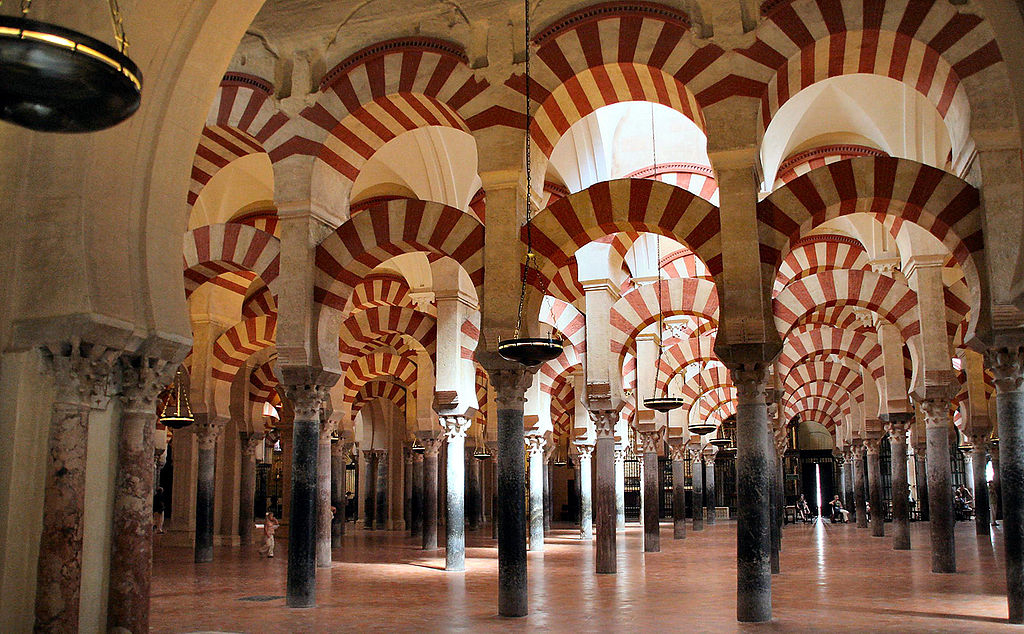
Muslims are also reclaiming “the mosque of Cordoba“. Authorities in the southern Spanish city recently dealt a blow to the claim of ownership of the cathedral by the Catholic Church. Built on the site of Saint Vincent’s church, it then served as a mosque for over 400 years when Islamic Spain was part of a caliphate, before the Christian kingdom of Castile conquered the city and converted it again into a church. Now Islamists want it back.

Muslims are also reclaiming “the mosque of Cordoba”. Authorities in the southern Spanish city recently dealt a blow to the claim of ownership of the cathedral by the Catholic Church. Built on the site of Saint Vincent’s church, it then served as a mosque for over 400 years when Islamic Spain was part of a caliphate, before the Christian kingdom of Castile conquered the city and converted it again into a church. (Image source: James Gordon/Wikimedia Commons)

Belgium, the most Islamized democracy in Europe, is also purging its Christian heritage. The Nativity, the traditional manger scene, has not been put up in the Belgian town of Holsbeek, just outside Brussels. Claims were scenes it was scrapped to “avoid offending Muslims”.

As reported by the newspaper La Libre, school calendars within Belgium’s French speaking community are also using a new secularized terminology: All Saints Day (Congés de Toussaint) is now be referred to as Autumn Leave (Congé d’automne); Christmas Vacation (Vacances de Noël) is now Winter Vacation (Vacances d’hiver); Lenten Vacation (Congés de Carnaval) is now Rest and Relaxation Leave (Congé de détente); and Easter (Vacances de Pâques) is now Spring Vacation (Vacances de Printemps). Then Belgium installed an abstract, de-Christianized Christmas tree in the capital, Brussels.

In the Netherlands, the Christian tradition of Black Pete is under attack and it will soon be abolished. In Italy, Catholic priests this year canceled Christmas to “avoid offending Muslims”.

The final result of Europe’s self-destructive secularism could seriously be a Caliphate, in which the fate of its ancient and beautiful churches recapitulates those in Constantinople, where the Hagia Sophia, for thousand years Christianity’s greatest cathedral, was recently turned into a mosque. The muezzin’s call now reverberates inside this Christian landmark for the first time in 85 years.

Islamic terrorists targeted Christmas in Berlin, but it is the Christian secularists who are abolishing it all over Europe.

Giulio Meotti, Cultural Editor for Il Foglio, is an Italian journalist and author.

Islamist Terrorism, European Denial by Yves Mamou

  • Europeans have delegated to the State the exclusive right to use violence against criminals. But Europeans, especially in France and Germany, are discovering that some kind of “misunderstanding” seems actually to be at work. Their State, the one that has the monopoly on violence, does not want to be at war with its Islamist citizens and residents. Worse, the State gives off the feeling that it is afraid of its Muslim citizens.

  • “The concept of the rule of law means that the citizen is protected from the arbitrariness of the State. Currently, the rule of law protects the attackers above all”. — Yves Michaud, French author and philosopher.

If a group of Jewish or Christian terrorists in Algeria, Egypt or Saudi Arabia had committed the same kind of stabbings, car-rammings, throat-slittings and shootings that France and Germany are suffering now, they would have provoked an immediate reaction. Tens of thousands — maybe hundreds of thousands — of enraged Muslims would have rushed into the streets to kill, stab or eviscerate the first group of Jews or Christians they met. Within 24 hours, no church or synagogue would be able to open its doors: all of them would have been burned to cinders.

These words are not to stigmatize anyone; they are meant to explain what terrorists want. According to Gilles Kepel, professor at the Paris Institute of Political Studies and a specialist of Islam, “ISIS calls for stabbing dirty and evil French people… because they want to trigger a civil war.” Muslim terrorists behind the wave of terrorist attacks apparently assume that thousands of French, Germans or Belgians will rush out into the streets, as they would do themselves, to kill, stab or eviscerate Muslims. Muslim sponsors of terrorism may not even be able to imagine that Europeans may not wish to participate in the pleasure of bloodthirsty riots.

The fact is that even if millions of Arabs and Muslims live in Europe today, Europeans are not Arabs and do not act as Arabs do. Westerners in Europe have delegated the “legitimate use of physical force” — commonly, if controversially, known as the “monopoly on violence” — to the State.

Max Weber, in his 1919 essay, “Politics as a Vocation”, claims that the State is any “human community that claims the monopoly of the legitimate use of physical force within a given territory.” In other words, Weber describes the State as any organization that succeeds in having the exclusive right to use, threaten, or authorize physical force against residents of its territory (“Gewaltmonopol des Staates“).

For French and Germans citizens, the mission of the State is to fight Islamist terrorists — harshly if necessary. But today, instead of the “legitimate violence” of the State, German and French citizens are encountering only denial. The State keeps denying that Islamist crimes are being openly committed in its territory. This denial comes in different forms:

1. The Real Victim is the Terrorist.

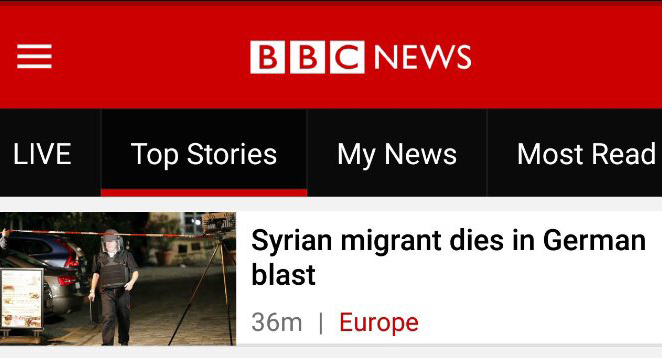
  • From Britain’s BBC: “Syrian Migrant Dies in German Blast.”
  • From Le Monde: “Germany: A Syrian Refugee Dies While Causing an Explosion in Front of a Restaurant in Bavaria” (Allemagne : un réfugié syrien meurt en provoquant une explosion devant un restaurant en Bavière). The headline (which has since been changed) is not about the diners in the restaurant who were targeted by the suicide bomber. The headline is about a victim, who is “the author of the explosion”. This “victim” — apparently only incidentally an Islamist criminal, according to this narrative — may have had a good reason to seek revenge! He was, after all, “a Syrian refugee whose entry into Germany was denied by the administration.” He was not deported for humanitarian reasons. The journalist barely mentions the 15 victims wounded, some severely, in the explosion. There is only one victim, the author of the suicide attack, which some journalists implied was not really a suicide attack, but maybe only a suicide. The man had history of psychiatric problems, after all.
  • According to the Wall Street Journal: “He was known to police and had been treated twice after trying to take his own life, Mr. Herrmann [the Bavarian Interior Minister] said. He was also known because of a previous drug misdemeanor, a police spokeswoman said.”

In short, the killer is not a killer but a poor, sick, young man.

After a Muslim suicide bomber injured 15 people on July 24 in Germany, many media outlets rushed to portray the terrorist as the victim.

2. He Was Not an Islamist, Just a Lunatic. Ali Sonboly, the 18-year-old German-Iranian gunman who murdered nine people at a Munich shopping mall on July 25 may be an Islamist killer, but he was more surely psychotic. According to Reuters:

“Materials found at the gunman’s home also showed he had been hospitalized for psychiatric care for three months around the same time, and was an avid player of violent video games, the officials told a news conference”.

Immediately after the attack, officials said the murderer was not an Arab but an Iranian — but that would simply make him a Shi’ite Muslim. According to Walid Shoebat, a Palestinian-American who converted to Christianity from Islam, “Sonboly is no Iranian. He is Syrian. His Facebook page showed that he is pro-Turkey’s Islamists”. However, even more bizarrely, some officials and media outlets said that Sonboly was inspired by the far-right Norwegian terrorist, Anders Breivik.

3. The Problem Is Not Islam or Islamism, but Too Many Guns on the Black Market. “German politicians have signaled that they will review the country’s gun laws, after a troubled 18-year-old was able to use a 9mm handgun and amass 300 rounds of ammunition in a shooting that left nine dead in Munich,” according to The Guardian.

4. The Victims Are Responsible for Their Own Murders. In Nice, France, after Mohamed Lahouaiej Bouhlel murdered more than 80 people by driving a 19-ton truck into a crowd celebrating Bastille Day, Julien Dray, a Socialist MP, said,

“The fireworks… It is a popular festival, there are families, children; it is often the only party that these children have, and so people are eager to go, and often checkpoints are removed to help the flow, because people do not want to wait, they want to leave, and that is unfortunately, is the time there may be a problem. “

5. The Attacker “Self-Radicalized” Rapidly. Even if the State is at fault, it found a good excuse to explain incompetence and lack of foresight: the terrorist “self-radicalized” so quickly that he was undetectable. The daily Le Figaro reported:

It seems that the perpetrator of the Nice attack “radicalized very quickly.” Interior Minister Bernard Cazeneuve called it “a new type of attack” that “demonstrates the extreme difficulty of combating terrorism.”

Cazeneuve added that Bouhlel, the Tunisian attacker, “was not known to the intelligence services.”

6. ISIS Is Not Islamist; It Is a Right-Wing Organization. We can sleep soundly, we are advised. The terrorists, we are told, are not Islamists but Fascists. “In claiming to be part of Daesh [ISIS], the two assassins show once again the bloody nature of this right-wing sect with policies that are racist, anti-Semitic, sexist and homophobic,” wrote SOS Racisme, an NGO financed by France’s Socialist government in a bid to seduce Muslim voters.

No doubt the next attacks will produce new and interesting explanations of this type whose aim is to reassure people.

Europeans have delegated to the State the exclusive right to use violence against criminals. But Europeans, especially in France and Germany, are discovering that some kind of “misunderstanding” seems actually to be at work. Their State, the one that has the monopoly on violence, does not want to be at war with its Islamist citizens or residents. Worse, the State gives off the feeling that it is afraid of its Muslim citizens.

The question now is: if the State does not want to fight Islamists murderers; if the State does not want to shut down Salafist mosques, deport hate preachers, and break the alliance between Islamists and organized criminals in the no-go zones of France and Germany; if the only solution proposed by President François Hollande is to “remain united”, unfortunately it will not work. “They attacked democracy,” Hollande said, “democracy will be our shield.”

But “national unity has no meaning when no serious measure is taken,” wrote Yves Michaud, the French author and philosopher, on his Facebook page:

“The concept of the rule of law means that the citizen is protected from the arbitrariness of the State. The same legal barriers cannot be used to protect those who want to kill citizens and destroy the res publica [republic]. … Currently, the rule of law protects the attackers above all”.

Yves Mamou, based in France, worked for two decades as a journalist for Le Monde.

Translate »
Skip to toolbar