Yearly Archives: 2017

Palestinians’ Biggest Tragedy: Failed Leadership by Khaled Abu Toameh

  • It was recently reported that the commander of the Islamic State (ISIS) branch in Sinai held talks in the Gaza Strip with leaders of Hamas’s armed wing, the Ezaddin al-Qassam Brigades, about expanding their cooperation.


  • President Abbas does not seem to care whether the Palestinians of Gaza are turned into hostages and prisoners. He is probably hoping that the crisis will drive Palestinians to revolt against the Hamas regime, paving the way for his PA to return to the Gaza Strip.

  • Instead of trying to solve the Gaza crisis, Abbas is too busy waging a diplomatic war against Israel. He wants to file “war crimes” charges against Israel with the International Criminal Court — ignoring the fact that he and Hamas are responsible for the suffering of the Palestinians in Gaza.

  • The Palestinians ignore the fact that their biggest tragedy over the past few decades has been (and remains) their failed and corrupt leadership that is willing to sacrifice them for its own interests.

Since June 2013, the Rafah border crossing, the sole crossing point between the Gaza Strip and Egypt, has been closed for most of the time.

Since the beginning of 2015, the Egyptian authorities have opened the Rafah terminal for a total of only 21 days.

Last week, the Egyptians opened the border crossing for two days, allowing a few hundred Palestinians to cross in both directions.

Last year, by contrast, the terminal was open for a total of 123 days, and in 2013 for 263 days.

These figures indicate that the Egyptians have stepped up security measures along their shared border with the Gaza Strip over the past few years.

In addition to the continued closure of the Rafah terminal, the Egyptian army continues to destroy dozens of smuggling tunnels between the Gaza Strip and Egypt. In recent weeks, the Egyptians have been pumping seawater into the tunnels, causing most of them to collapse.

The Egyptians have good reason to be concerned about the smuggling tunnels — especially in light of increased Islamist terror attacks against Egyptian soldiers and civilians in the Sinai Peninsula. Reports about cooperation between Hamas, which rules the Gaza Strip, and the Islamist terror groups in Sinai, have also prompted the Egyptians to keep the Rafah terminal shut for most of the time.

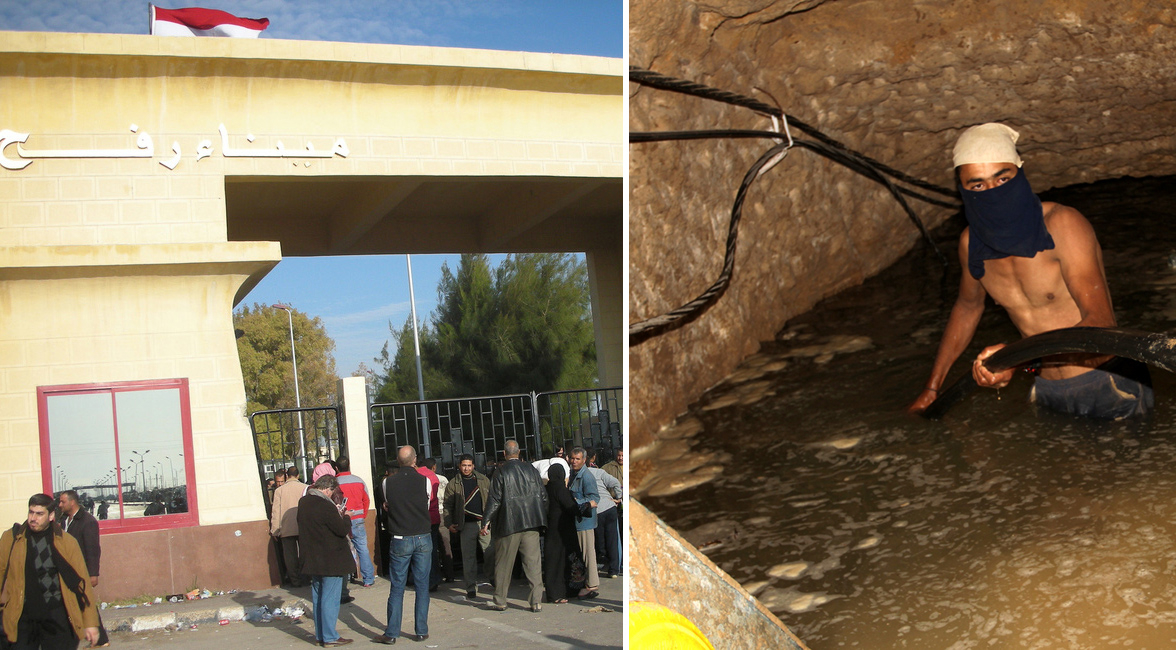
Left: The Rafah border crossing between Egypt and the Gaza Strip. Right: A Gazan man works in a smuggling tunnel under the Gaza-Egypt border, which was flooded by the Egyptian army.

A report on Israel’s Channel 2 last week revealed that Shadi al-Munei, commander of the Islamic State (ISIS) branch in Sinai, recently visited the Gaza Strip for secret talks with Hamas leaders.

According to the report, the ISIS commander held talks with leaders of Hamas’s armed wing, the Ezaddin al-Qassam Brigades, about expanding the cooperation between the two groups.

But there is another reason the Egyptians insist on keeping the Rafah terminal shut, leaving thousands of Palestinians stranded on both sides of the border: the ongoing power struggle between Hamas and Fatah.

Before blaming the Egyptians for the predicament of the residents of the Gaza Strip, Palestinians need, for a change, to hold their leaders responsible for their continued suffering.

In recent weeks, it has become evident that the Hamas-Fatah dispute is the main reason behind the continued closure of the Rafah border crossing.

Egyptian President Abdel Fattah el-Sisi does not trust Hamas; that is the reason he is not prepared to reopen the terminal on a permanent basis.

Sisi recently told Palestinian Authority (PA) President Mahmoud Abbas that Egypt would be prepared to reopen the terminal permanently only if Hamas relinquishes control over the Palestinian side of the border and allows PA forces to take control of it, as was the situation before the summer of 2007, when the Islamist movement seized control over the entire Gaza Strip.

While Sisi does not trust Hamas, it is worth noting that Hamas does not trust the PA and Abbas. Hamas does not want to see Abbas’s security forces return to the Gaza Strip in any way, even if that means keeping thousands of Palestinians stranded on both sides of the border and living in an open-air prison.

“Hamas will never hand control over the terminal to the filthy hands that betrayed the Palestinians,”explained Salah Bardaweel, a senior Hamas official in the Gaza Strip. “Hamas can’t sell its people to these hands, regardless of the price.” He also claimed that Palestinians from the Gaza Strip have been paying bribes to PA officials in the West Bank to obtain permission from the Egyptian authorities to cross through the Rafah terminal.

By refusing to cede control over the border crossing with Egypt, Hamas is in fact holding the entire population of the Gaza Strip as hostages. Hamas is saying, “We either continue to manage the Rafah terminal, or no one leaves or enters the Gaza Strip.” The most Hamas is prepared to accept is an arrangement that allows it to manage the terminal in partnership with the PA — an idea to which Abbas remains strongly opposed.

According to the Hamas-controlled Interior Ministry, about 25,000 Palestinians need to leave the Gaza Strip through the Rafah terminal for “humanitarian reasons.” Still, Hamas is not prepared to make any concessions to alleviate the suffering of its people.

Abbas, for his part, does not really seem to care whether the Palestinians of the Gaza Strip are turned into hostages and prisoners. In fact, he is probably hoping that the crisis will drive Palestinians to revolt against the Hamas regime, paving the way for his PA to return to the Gaza Strip.

Instead of trying to solve the crisis in the Gaza Strip, Abbas is too busy waging a diplomatic war against Israel in the international arena. He wants to file “war crimes” charges against Israel with the International Criminal Court, while ignoring the fact that he and Hamas are responsible for the suffering of tens of thousands of Palestinians in the Gaza Strip.

The Hamas-Fatah dispute has turned the Palestinians of the Gaza Strip into hostages and prisoners. The Palestinians will never be able to solve their problems as long as they continue to ignore the fact that their biggest tragedy over the past few decades has been (and remains) their failed and corrupt leadership that is willing to sacrifice them for its own interests.

Palestinians Praise Terror Attack by Bassam Tawil

  • President Mahmoud Abbas’s Palestinian Authority (PA), which is funded by Americans and Europeans, has once again chosen to maintain silence following a terror attack perpetrated by Palestinians. This silence of Abbas and his PA leadership, specifically their refusal to condemn the terror attack, can only be interpreted as an endorsement of the killing of Jews.
  • This is the twisted logic of Abbas and his people: How dare Israeli police officers shoot terrorists armed with knives and a submachine gun and prevent them from killing more Jews?
  • One wonders: how does this public endorsement of the Jerusalem terror attack and the terrorists stand up to Abbas’s promise to President Trump to stop anti-Israel incitement and “promote a culture of peace” among Palestinians?

For many Palestinians, the stabbing murder of a 23-year-old Israeli Border Police officer in Jerusalem on June 16 is an act of “heroism” that proves that the “revolution against the Zionist entity will continue until the liberation of Palestine, from the (Mediterranean) sea to the (Jordan) river.”

For many Palestinians, the three terrorists who murdered the young woman, Hadas Malka, are “heroes” and “martyrs” who will be rewarded by Allah in Paradise.

President Mahmoud Abbas’s Palestinian Authority (PA), which is funded by Americans and Europeans, has once again chosen to maintain silence following a terror attack perpetrated by Palestinians. This silence of Abbas and his PA leadership, specifically their refusal to condemn the terror attack, can only be interpreted as an endorsement of the killing of Jews.

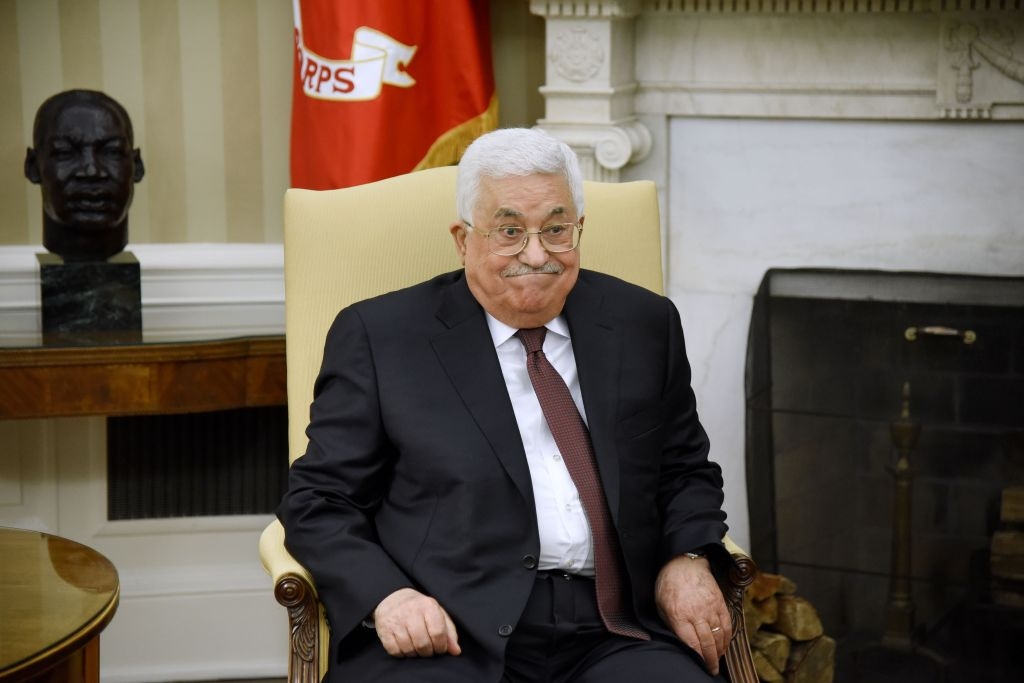
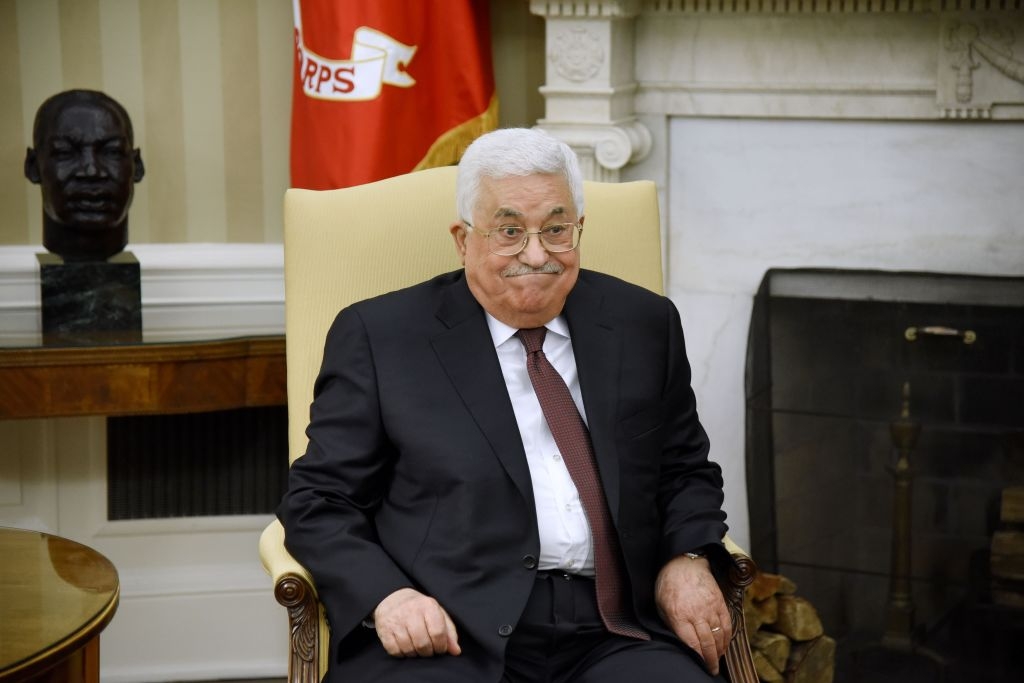
The silence of Mahmoud Abbas following the Jerusalem terror attack, specifically his refusal to condemn the attack, can only be interpreted as an endorsement of the killing of Jews. (Photo by Olivier Douliery-Pool/Getty Images)

Moreover, in a move reminiscent of a demented Alice in Wonderland, Abbas’s ruling Fatah faction, which is often described by Westerners as “moderate” and “pragmatic,” publicly blasted Israel for killing the three terrorists who murdered the policewoman and wounded several others.

In a statement published in Ramallah shortly after the terror attack, Fatah “condemned the Israeli occupation forces for killing three young Palestinian men in East Jerusalem.” It said that the killing of the three terrorists “proves that the Israeli government is pursuing its policy of escalation.” Fatah called on the international community to “seriously look into providing protection for the defenseless Palestinian people.”

The Fatah statement failed to mention that the three Palestinian “young men” were armed with knives and a homemade submachine gun. Nor did Fatah mention a word about the Border Police officer who was stabbed to death in the terror attack.

Such a statement could never have been published without the approval of Abbas and his top cronies in Ramallah. They even seem to have endorsed the Fatah communiqué by publishing it on the website of the PA’s official news agency, Wafa. This agency is managed and funded by the PA, which also appoints the editors and journalists working there.

This is the twisted logic of Abbas and his people: How dare Israeli police officers shoot terrorists armed with knives and a machinegun and prevent them from killing more Jews?

Fatah spokesperson Osama Qawassmeh went as far as accusing Israel of committing a “war crime” by killing the terrorists and thwarting a bigger attack. He called on the international community to condemn Israel for the “cold-blooded” killing of the three terrorists in Jerusalem, dubbing it a “cruel crime.” Qawassmeh, who is considered a trusted advisor and confidant of Abbas, seized the opportunity to heap praise on the terrorists, describing them as “martyrs.” Palestinians, he added, should remain faithful to the “blood of the martyrs” by “holding on to their lands and holy sites and defending them.”

One wonders: how does this public endorsement of the Jerusalem terror attack and the terrorists stand up to Abbas’s promise to US President Donald Trump to stop anti-Israel incitement and “promote a culture of peace” among Palestinians?

This is but further proof in an endless string of damning evidence concerning the ‘peace lies’ spouted by Abbas and his PA. The PA president is always among the first to denounce terror attacks around the world, including Britain, France and Germany. Yet when Palestinians murder Israelis, they suddenly become “heroes” and “martyrs.”

How would the British government and public have reacted had someone condemned the British police for killing the three terrorists who carried out the recent London Bridge attack?

How would the British government and public have reacted had the international media run headlines such as, “British policemen kill three Muslim men in London attack?” This is precisely how Abbas’s media outlets — and the BBC — reported on the Jerusalem terror attack: “Israeli policemen shoot dead three Palestinians in Jerusalem” and “Three Palestinian youth martyred at the hands of Israeli occupation policemen.”

It is no wonder, then, that many Palestinians have been celebrating the terror attack in Jerusalem. If these are the messages Abbas and his PA and Fatah cronies are sending to their people, why should it come as a surprise that many Palestinians have been glorifying the terrorists and calling for more attacks against Jews?

Hamas, notably, was the first party to applaud the Jerusalem terror attack, saying it proves that the Palestinian intifada was continuing and would escalate.

The Popular Front for the Liberation of Palestine (PFLP), a Marxist Palestinian terror group, also joined the chorus of those heaping praise on the terrorists for murdering the Israeli policewoman. Hamas and the PFLP have claimed responsibility for the “heroic operation” and dismissed as “false” a statement by ISIS taking credit for the attack.

To be clear: the two terror groups are furious with ISIS for attempting to rob them of the “honor” of murdering a young policewoman on the streets of Jerusalem. This is the surreal reality in the Middle East today.

Not to be left behind in the promotion of Jew-killing, Palestinians across the political spectrum took to social media to applaud the latest terror attack and express their jubilation over the murder of the policewoman.

In innumerable postings on Facebook and Twitter, dozens, if not hundreds, of Palestinians praised the terrorists, describing them as “heroes” and “martyrs.” They particularly expressed excitement over the use of a homemade submachine gun (often referred to as a “Carl Gustav“). This type of weapon is often produced in workshops in various parts of the PA-controlled territories in the West Bank.

The Palestinians also expressed deep satisfaction that the terrorists chose to carry out their attack during the holy month of Ramadan. They pointed out that the three terrorists, who were fasting, had chosen to carry out their attack during Ramadan because this was the surest and fastest path to Paradise. “There is nothing more pure and sacred than killing the infidels and Jews than when one is fasting during Ramadan,” remarked some of the Palestinians.

There is documented, widespread jubilation in the Muslim world about this and other terror attacks perpetrated not only by Palestinians against Israelis, but — contrary to the statements of many in the West — by many Muslims against all “unbelievers”: if “infidels” are murdered during Ramadan, their killers expect to be “doubly rewarded in Paradise.”

In Israel, this joy over Jew-killing does not emerge from nothing. It can be traced directly to the Palestinian leadership, beginning with President Abbas and his Palestinian Authority friends. When he and the PA leadership next mouth their lies about a “culture of peace,” perhaps the world will pause for a moment, not just to think of a murdered young woman, Hadas Malka, but also of what the Palestinian leadership really wants.

Bassam Tawil is a Muslim based in the Middle East.
Palestinians of Syria: A Year of Killings and Torture by Khaled Abu Toameh

  • According to the reports, Syrian authorities are withholding the bodies of more than 456 Palestinians who died under torture in prison. No one knows exactly where the bodies are being held or why the Syrian authorities are refusing to hand them over to the relatives.

  • Mainstream media outlets seem to prefer turning a blind eye to the plight of Palestinians living in Arab countries. This evasion harms first and foremost the Palestinians themselves and allows Arab governments to continue their policies of persecution and repression.
  • It remains to be seen whether the UN Security Council will get its priorities straight and hold an emergency session to discuss the murderous campaign against Palestinians in Syria. Perhaps, somehow, this will overtake “settlement construction” as a topic worthy of world condemnation.

2016 was a tough year for the Palestinians. It was tough not only for those Palestinians living in the West Bank under the Palestinian Authority (PA) regime, or the Gaza Strip under Hamas. When Westerners hear about the “plight” and “suffering” of Palestinians, they instantly assume that the talk is about those living in the West Bank or Gaza Strip. Rarely does the international community hear about what is happening to Palestinians in the Arab countries. This lapse doubtless exists because the misery of Palestinians in the Arab countries is difficult to pin on Israel.

The international community and mainstream journalists only know of those Palestinians living in the West Bank or the Gaza Strip. Of course, life under the Palestinian Authority and Hamas is no box of dates, although this inconvenient fact might be rather unpleasant to the ears of Western journalists and human rights organizations.

In any event, mainstream media outlets seem to prefer turning a blind eye to the plight of Palestinians living in Arab countries. This evasion harms first and foremost the Palestinians themselves and allows Arab governments to continue their policies of persecution and repression.

The past few years have seen horror stories about the conditions of Palestinians in Syria. Where is the media attention for the Palestinians in this war-stricken country? Palestinians in Syria are being murdered, tortured, imprisoned and displaced. The West yawns.

Foreign journalists covering the Middle East swarm by the hundreds throughout Jerusalem and Tel Aviv. Yet they act as if Palestinians can only be found in the West Bank and the Gaza Strip. These journalists have no desire to go to Syria or other Arab countries to report about the mistreatment and trespasses perpetrated by Arabs against their Palestinian brothers. For these journalists, Arabs killing and torturing other Arabs is not news. But when Israeli policemen shoot and kill a Palestinian terrorist who rams his truck into a group of soldiers and kills and wounds them, Western reporters rush to visit his family’s home to interview them and provide them with a platform to express their thoughts.

Palestinians living in Syria, however, are less fortunate. No one is asking how they feel about the devastation of their families, communities and lives. Especially not the hundreds of Middle East correspondents working in the region.

“The year 2016 was full of all forms of killings, torture and displacement of Palestinians in Syria,” according to recent reports published in a number of Arab media outlets.

“The last year was hell for these Palestinians and its harsh consequences will not be erased for many years to come. During 2016, Palestinians in Syria were subjected to the cruelest forms of torture and deprivation at the hands armed gangs and the ruling Syrian regime. It is hard to find one Palestinian family in Syria that has not been affected.”

According to the reports, Syrian authorities are withholding the bodies of more than 456 Palestinians who died under torture in prison. No one knows exactly where the bodies are being held or why the Syrian authorities are refusing to hand them over to the relatives.

Even more disturbing are reports suggesting that Syrian authorities have been harvesting the organs of dead Palestinians. Testimonies collected by some Palestinians point to a Syrian government-linked gang that has been trading in the organs of the victims, who include women and children. Another 1,100 Palestinians have been languishing in Syrian prisons since the beginning of the war, more than five years ago. The Syrian authorities do not provide any statistics about the number of prisoners and detainees; nor do they allow human rights groups or the International Committee of the Red Cross to visit prisons and detention centers.

The most recent report about the plight of Palestinians in Syria states that 3,420 Palestinians (455 of them females) have been killed since the beginning of the war. The report, published by the Action Group For Palestinians of Syria, also reveals that nearly 80,000 Palestinians have fled to Europe, while 31,000 fled to Lebanon, 17,000 to Jordan, 6,000 to Egypt, 8,000 to Turkey and 1,000 to the Gaza Strip. The report also mentions that 190 Palestinians died as a result of malnutrition and lack of medical care because their refugee camps and villages are under siege by the Syrian army and armed groups.

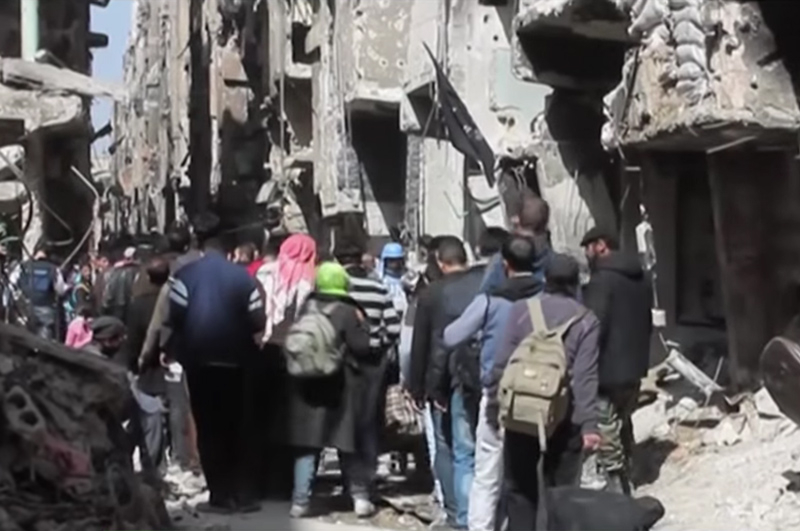
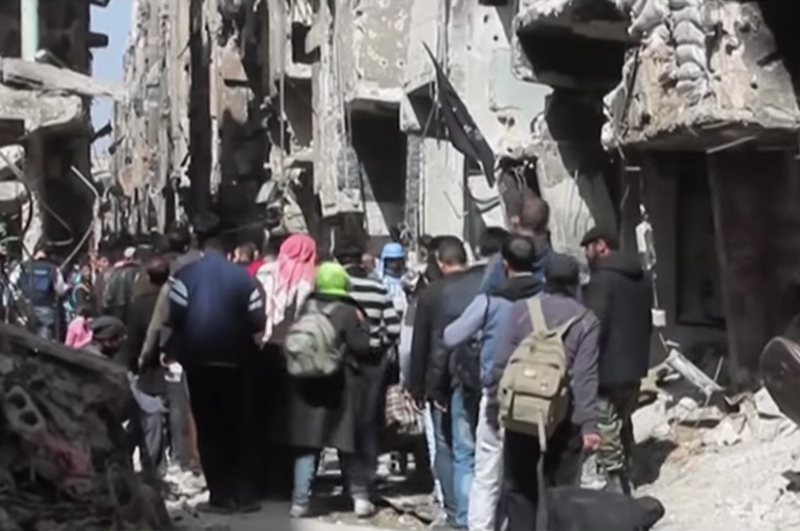
Palestinians flee Yarmouk refugee camp, near Damascus, after fierce fighting in September 2015. (Image source: RT video screenshot)

Alarmed by the indifference of the international community to their plight, Palestinians in Syria have resorted to social media to be heard in the hope that decision-makers in the West or the UN Security Council, obsessed as they are with Israeli settlements, might pay attention to their suffering. The latest campaign on social media, entitled, “Where are the detainees?” refers to the unknown fate of those Palestinians who have gone missing after being taken into custody by Syrian authorities. The organizers of the campaign revealed that in the past few years, 54 Palestinian minors have died under torture in Syrian prisons. The organizers noted that hundreds of prisoners and detainees, after they were apprehended by the Syrian authorities, remain unaccounted for.

Another report revealed that more than 80% of the Palestinians living in Syria have lost their jobs and businesses since the beginning of the civil war. The report added that to support their families, many Palestinian children have been forced to quit school and search for work.

Yet to the international community and Western media, these figures and reports about the Palestinians in Syria are ho-hum at best. The Arab countries care nothing about the Palestinians in Syria who are being killed, tortured and starved to death. In the Arab world, human rights violations are not news. When human rights are respected in an Arab country, that is news.

The Palestinian leadership in the West Bank and Gaza Strip are also blind to the suffering of their people in the Arab world, specifically in Syria. These so-called leaders are too busy ripping out each other’s political throats to be bothered with the welfare of their people, being smothered under the undemocratic and repressive regimes of the Palestinian Authority and Hamas. Such leaders are more concerned about President Donald Trump’s intention to the move the US embassy to Jerusalem than about their own people. In the past two weeks, Mahmoud Abbas and his officials have not missed an opportunity to warn that moving the US embassy to Jerusalem would spark unrest in the Middle East. The killing, torture and displacement of Palestinians in an Arab country seem not to be on their radar.

It remains to be seen whether the UN Security Council will get its priorities straight and hold an emergency session to discuss the murderous campaign against Palestinians in Syria. Perhaps, somehow, this will overtake “settlement construction” as a topic worthy of world condemnation.

Khaled Abu Toameh, an award-winning journalist, is based in Jerusalem.

Palestinians and Jordan: Will a Confederation Work? by Khaled Abu Toameh

  • In a rare moment of truth, former Jordanian Prime Minister Abdel Salam Majali admitted that the Palestinians were not “fully qualified to assume their responsibilities, especially in the financial field…”

  • According to the study, the Jordanian public is totally opposed to the idea of confederation, even after the establishment of an independent Palestinian state. They fear the confederation would lead to the “dilution” of the Jordanian identity, create instability and undermine security.
  • The reality is that the two-state solution has already been fulfilled: the Palestinians got two mini-states of their own — one governed by the Palestinian Authority and the second by Hamas in the Gaza Strip.
  • Today, there is only one solution: maintain the status quo until Palestinian leaders wake up and start working to improve the living conditions of their people and prepare them for peace with Israel.

Talk about a confederation between the Palestinians and Jordan has once again resurfaced, this time after a series of unofficial meetings in Amman and the West Bank in the past few weeks. Jordan, fearing that such confederation would end up with the Hashemite kingdom transformed into a Palestinian state, is not currently keen on the idea.

Many Palestinians have also expressed reservations about the idea. They argue that a confederation could harm their effort to establish an independent Palestinian state in the West Bank, East Jerusalem and the Gaza Strip.

The confederation talk returned during a recent high-profile visit to the West Bank by former Jordanian Prime Minister Abdel Salam Majali. During a meeting with representatives of large Palestinian clans in Nablus, Majali voiced his support for the confederation idea, saying it was the “best solution for both Palestinians and Jordanians.”

The former Jordanian prime minister told some 100 Palestinians who gathered to greet him in Nablus, the largest Palestinian city in the West Bank: “Jordan cannot live without Palestine and Palestine cannot live without Jordan.” Stressing that such a confederation should be created after the establishment of an independent Palestinian state, Majali said that the confederation would mean that Palestinians and Jordanians would have a joint government and parliament.

In a rare moment of truth, Majali admitted that the Palestinians were not “fully qualified to assume their responsibilities, especially in the financial field, in wake of the failure of the Arab countries to support them.” So Majali is basically telling the Palestinians: “You can’t rely on your Arab brothers to help you build a state. Jordan is the only Arab country that cares about you.”

Some Jordanians said this week that Majali was speaking only on his behalf and that his views did not represent those of Jordan’s King Abdullah or the government. They pointed out that the last time Majali met with the monarch was four months ago, when King Abdullah visited him in the hospital where Majali was being treated.

Still, it is hard to believe that such a senior figure as Majali would have advocated the confederation plan without having first received some kind of green light from the royal palace in Amman.

Let us remember that Jordan has a history on this issue. In 1988, the late King Hussein “divorced” the West Bank, announcing that the kingdom was cutting its administrative and legal ties to the territory that had been under its control until 1967. Of course, the king had good reason to renounce any claim to the West Bank: the First Intifada had just begun and the Palestinians in the West Bank were considered “troublemakers” that he did not need in his Palestinian-majority kingdom.

Thus we see why many Jordanians remain opposed to the confederation idea. A study published in 2014 shows that the Jordanian public was against the idea.

According to the study, the Jordanian public is totally opposed to the idea, even after the establishment of an independent Palestinian state in the West Bank, Gaza Strip and east Jerusalem. The Jordanians fear, among other things, that the confederation would lead to the “dilution” of the Jordanian identity, create instability and undermine security in the kingdom.

Jordanian columnist and political analyst Fahd Khitan echoed this fear by declaring that the confederation idea “means suicide for the Hashemite kingdom.” Noting that many Palestinians were also opposed to the idea, even after the establishment of an independent Palestinian state, Khitan said that mutual confidence between the Palestinians and Jordanians has deteriorated, particularly in wake of the recent controversy over the installment of security cameras at the Temple Mount in Jerusalem.

Under a U.S.-brokered plan, the Jordanian government was supposed to install the cameras at the holy site as a way of easing tensions between Palestinians and Israel. The controversy had erupted over Jewish visits to the Temple Mount. However, the Jordanians were forced a few weeks ago to abandon the plan after Palestinian opposition and threats. The Palestinians claimed that Israel would use the cameras to arrest Palestinians who are stationed at the Temple Mount with the mission of harassing Jewish visitors.

“The Palestinians in the West Bank and Gaza Strip are not just residents who can be incorporated into this or that country,” Khitan explained in his rejection of the confederation idea. “The Palestinians are a people who have their own land and Jordan is a country that is now celebrating its 70th anniversary.” So this Jordanian analyst is telling the Palestinians: “We love you and you are wonderful people, but we prefer that you stay away from us.”

While most Jordanians seem to be strongly opposed to the idea of adding another three or four million Palestinians to the kingdom’s population, Palestinians in the West Bank and Gaza Strip appear to be divided over the idea.

The Palestinian Authority (PA) leadership, which by all accounts has failed to lead its people towards statehood because of its incompetence and corruption, has yet to spell out its position regarding the proposed confederation with Jordan.

There are, however, signs that a growing number of Palestinians are beginning to entertain the idea of being part of Jordan. A recent public opinion poll published by An-Najah University in Nablus found that 42% of Palestinians favor the confederation idea. The poll also found that 59% of Palestinians do not believe that a Palestinian state would be established within the pre-1967 lines.

This means that a majority of Palestinians have lost confidence in their leaders’ ability to achieve an independent Palestinian state. One of the main reasons is the ongoing power struggle between the PA and Hamas. It is a conflict that has divided the Palestinians into two separate cultural as well as geographic entities, in the West Bank and Gaza Strip. The reality on the ground is that the two-state solution has already been fulfilled: in the end, the Palestinians got two mini-states of their own — one governed by the Palestinian Authority and the second by Hamas in the Gaza Strip.

Another sign of growing Palestinian support for the idea can be found in the Hebron area, where leaders of large clans have also begun campaigning for the implementation of a confederation with Jordan. It is estimated that nearly one million Hebronites live in Jordan and the West Bank, and this statistic is also driving support for the idea.

In recent weeks, several Hebron clan leaders visited Jordan as part of an effort to muster popular support for the confederation idea. A prominent member of the Jordanian parliament, Dr. Mohammed al-Dawaymeh, lately visited Hebron, where he met with the heads of the city’s large clans to promote the idea. Again, it is unlikely that the member of parliament was acting without the backing of King Abdullah or the Jordanian government. But his visit to the West Bank, like that of Majali before him, has sparked a new wave of speculation among Palestinians that something is being “cooked up” to enable the confederation plan to take place.

What is notable is that the confederation idea seems to be gaining support among Palestinian clans in a society that is largely a tribal one. Both Hebron and Nablus consist of large clans, and it makes sense that the two senior Jordanian figures chose to concentrate their efforts there. If you manage to convince the clans to support the idea, that approval, they believe, would create pressure on the Palestinian leaders to follow suit.

Also intriguing is that some prominent Palestinians seem to have endorsed the confederation idea — again due to their having lost confidence in their leaders’ ability to move forward and bring them a better life.

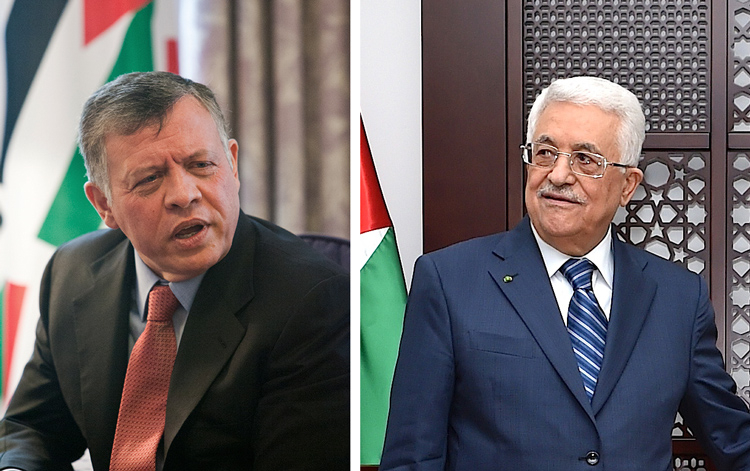
It is unlikely that prominent Jordanian politicians, who have recently talked about a confederation between the Palestinians and Jordan, are acting without the backing of King Abdullah (left). Meanwhile, a majority of Palestinians have seemingly lost confidence in the ability of their leaders, such as PA President Mahmoud Abbas (right), to achieve an independent Palestinian state. (Image source: Abdullah: World Bank / Abbas: US State Dept.)

Two of these Palestinians are Ghassan Shaka’ah, a former mayor of Nablus and a prominent PLO leader in the West Bank, and Professor Sari Nusseibeh, a respected pragmatic academic and former president of Al-Quds University.

The renewed talk about a confederation between the Palestinians and Jordan underscores the Palestinian leadership’s failure to convince many Palestinians of its ability to lead them towards statehood. It is also a sign of the revival of the role of Palestinians clans in the Palestinian political arena. For the past two decades, the power of the clans has been undermined, thanks to the presence of central governments — the Palestinian Authority in the West Bank and Hamas in the Gaza Strip. But the weakness of these two governments has prompted clan leaders to take matters into their hands and renew talk about a confederation with Jordan.

A confederation between the Palestinians and Jordan may seem to be a good idea in the long term. But for now, it is hard to see how Jordanian leader would agree to turn millions of Palestinians into citizens of the kingdom. It is also hard to see Jordanians agreeing to absorb either Hamas or the Palestinian Authority and share power with them. Still, the talk about a confederation between the Palestinians and Jordan shows that under the current circumstances, the two-state solution (a Palestinian state alongside Israel) is no longer being viewed by Palestinians as a realistic solution that will bring their people a better life.

Jordan is not the only Arab country that does not consider the Palestinians trustworthy partners. The Jordanians still have painful memories from the early 1970s, when the PLO and other Palestinian groups tried to establish a state within a state inside the kingdom, and thus threatened Jordan’s security and stability. Today, there is only one solution: maintain the status quo until Palestinian leaders wake up and start working to improve the living conditions of their people and prepare them for peace with Israel.

Khaled Abu Toameh, an award-winning journalist is based in Jerusalem.

Palestinian Terror Rages On with More 3 Attacks Today, 1 by Palestinian ‘Security Officer’

Three Palestinian terror attacks were carried out on Thursday, wounding three people in total, one seriously. One of the terrorists was a Palestinian Authority security officer.


On Thursday morning, an Arab terrorist shot and wounded an IDF soldier and an Arab Israeli at the entrance to the Palestinian village of Hizma, located about seven kilometers north of Jerusalem. While soldiers were checking the cars at the checkpoint, the terrorist shot at them.

Soldiers eliminated the terrorist, who was later identified as 37-year-old Mazen Hassan Orebeih from the Abu Dis neighborhood in Jerusalem. He was an intelligence officer in thePalestinian Authority preventative security service.

The soldier was lightly injured, while the civilian, a male in his late 40s, was seriously wounded in his upper body. He was evacuated to Hadassah Ein Kerem hospital in the capital.

In the early evening, a Palestinian terrorist stabbed and lightly wounded an officer in his mid-30s at the Damascus Gate in the Old City of Jerusalem. Border police officers shot and killed the terrorist.

The victim was treated by Magen David Adom (MDA) medics at the scene before taken to Shaare Zedek hospital in Jerusalem.

At around 8 pm the same day, a Palestinian terrorist opened fire at a car near the Jewish community of Psagot in Samaria, just north of Jerusalem. The driver, Rabbi Itay Halevi, escaped unharmed, but the car was damaged.

Ten Bullet Holes, but Driver Left Unharmed

“I was leaving Psagot to go back home to Migron. Right outside Psagot there’s a sharp bend in the road, and immediately after the bend, they opened fire on my car from the right side,” Halevi told Tazpit Press Service. He suspected more terrorists were laying in ambush close by.

He fled to a nearby gas station, waiting for soldiers to arrive. “More then 10 bullets actually penetrated my car, passing between me and the front windshield, meaning the bullets entered the car from the right window, and some exited from the left side, close to the driver’s seat. But I left without even a scratch,” Halevi told TPS.

“It ended in a miracle. I sped out of the danger zone as fast as I could while calling the security services on my phone even before stopping,” he added. “I am thankful to God for this miracle, and I am thankful to the IDF and Police for doing their job.”

IDF and police forces are searching for the terrorist.

By: United with Israel Staff
(With files from TPS)

Translate »
Skip to toolbar