Monthly Archives: June 2017

Why Won’t Abbas Accept “Two States for Two Peoples”? by Alan M. Dershowitz

  • Over the years, and to the current day, they continue to want no state for the Jewish people more than they want a state for Palestinian Arabs.The general idea of a two-state solution – which Abbas has nominally supported – does not specify that one state would be for the Jewish people and the other one for the Arabs.

  • When the Palestinian leadership and people want their own state more than they want there not to be a state for the Jewish people, the goal of the 1947 U.N. Resolution – two states for two peoples – will be achieved. A good beginning would be for Abbas finally to agree with the U.N. Resolution and say the following words: “I accept the 1947 U.N. Resolution that calls for two states for two peoples.” It’s not too much to ask from a leader seeking to establish a Palestinian Muslim state.

There is a widespread but false belief that Mahmoud Abbas is finally prepared to accept the two-state solution proposed by the U.N. in November 1947 when it divided mandatory Palestine into two areas: one for the Jewish People; the other for the Arab People. The Jews of Palestine accepted the compromise division and declared a nation state for the Jewish people to be called by its historic name: Israel. The Arabs of Palestine, on the other hand, rejected the division and declared that they would never accept a state for the Jewish people and statehood for the Palestinian people. They wanted for there not to be a state for the Jewish people more than for there to be a state for their own people. Accordingly, they joined the surrounding Arab armies in trying to destroy Israel and drive its Jewish residents into the sea. They failed back then, but over the years, and to the current day, they continue to want no state for the Jewish people more than they want a state for Palestinian Arabs. That is why Abbas refuses to say that he would ever accept the U.N. principle of two states for two peoples. I know, because I have personally asked him on several occasions.

In a few months, Israel will be celebrating the 70th anniversary of the historic U.N. compromise, but the leaders of the Palestinian Authority still refuse to accept the principle of that resolution: two states for two peoples.

President Trump, for his part, has expressed an eagerness to make “the ultimate deal” between the Israelis and the Palestinians. This has propelled discussions about the dormant peace-process back into the spotlight. Shortly before travelling to the Middle East – where he met with Prime Minister Netanyahu in Israel and President Abbas in Bethlehem – Trump invited the Palestinian leader to the White House. Abbas was last at the White House in March 2014 shortly before the Obama administration’s shuttle diplomacy efforts –led by Secretary of State John Kerry – fell apart.

Leading up to his meeting with President Trump in Washington, Abbas said to a German publication: “We’re ready to collaborate with him and meet the Israeli prime minister under his [Trump’s] auspices to build peace.” He then went on to voice his support for a two-state solution, saying, “It’s high time to work on the requirements for it.” This was interpreted as a willingness on Abbas’ part to accept the idea of a state for the Jewish people. Generally speaking, the international community supports the idea of resolving the Israeli-Palestinian conflict with two-states for two-peoples: a state for the Jewish people alongside a state for the Palestinians. Yet presenting Mahmoud Abbas as a supporter of the two-states for two people formulation is to deny truth. The general idea of a two-state solution – which Abbas has nominally supported – does not specify that one state would be for the Jewish people and the other one for the Arabs. Over the years President Abbas has expressed a commitment to a two-state solution – stating that he supports an Arab state along the 1967 borders with East Jerusalem as its capital – but has so far refused to accept the legitimacy of a nation state for the Jews existing by its side.

Consider President Abbas’ own words. In a 2003 interview he said: “I’ve said it before, and I’ll say it again: I will never recognize the Jewishness of the state, or a ‘Jewish state.'” When asked about Israel being the nation state of the Jewish people (in the context of Ehud Olmert’s generous peace proposal in 2008) the PA leader said: “From a historical perspective, there are two states: Israel and Palestine. In Israel, there are Jews and others living there. This we are willing to recognize, nothing else.” And in a later interview with the Al-Quds newspaper Abbas reiterated this refusal to recognize that Israel is the nation state of the Jewish people:

“We’re not talking about a Jewish state and we won’t talk about one. For us, there is the state of Israel and we won’t recognize Israel as a Jewish state. I told them that this is their business and that they are free to call themselves whatever they want. But [I told them] you can’t expect us to accept this.”

The list of such pronouncements from the man at the head of the Palestinian Authority goes on and on. Not only has Abbas refused to accept the formulation “Jewish state,” he adamantly refuses to accept the more descriptive formulation “nation state of the Jewish people.”

Abbas is of course committed to Palestine being a Muslim state under Sharia Law, despite the reality that Christian Palestinians constitute a significant (if forcibly shrinking) percentage of Palestinian Arabs. Article 4 of the Palestinian Basic Law states that:

1. Islam is the official religion in Palestine. Respect and sanctity of all other heavenly religions shall be maintained.

2. The principles of Islamic Shari’a shall be the main source of legislation.

Writing for the New York Times on the advent of the 50th anniversary of the Six Day War, Israel’s former Ambassador to Israel, Michael Oren said: “The conflict is not about the territory Israel captured in 1967. It is about whether a Jewish state has a right to exist in the Middle East in the first place. As Mr. Abbas has publicly stated, ‘I will never accept a Jewish state.'”

Oren argues that until Abbas and other Palestinian leaders can say the words “two states for two peoples,” no reasonable resolution will be reached.
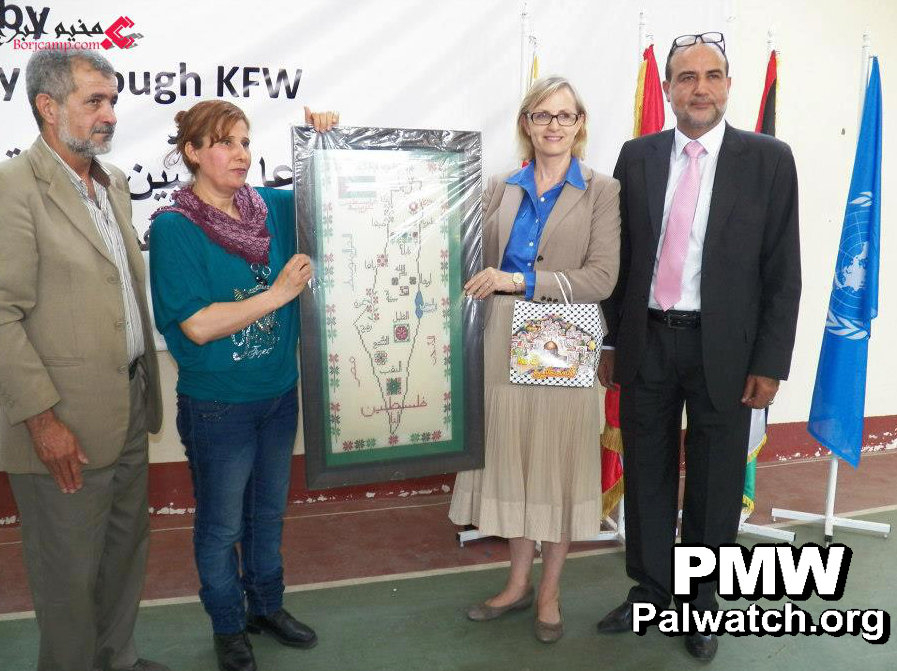
The Director of the United Nations Relief and Works Agency [UNRWA] in Lebanon, Ann Dismorr, poses with a map devoid of any trace of the State of Israel, instead presenting it as a map of “Palestine,” May, 2013. (Image source: Palestinian Media Watch)

The Palestinian leader’s conditional support for a peaceful resolution is also undermined by his own actions. For years, the Palestinian Authority– first under the leadership of Yasser Arafat and now under the 82-year-old Abbas – has perpetuated a vile policy of making payments to terrorists and their families.

According to the official PA budget, in 2016 the Palestinian Authority directed $174 million of its total budget in payments to families of so-called “martyrs,” and an additional $128 million for security prisoners — terrorists in Israeli prisons.

Abbas claims to be a man of peace yet in reality he incentivizes, rewards and incites terrorism.

It must also be remembered that Israel has offered to end the occupation and settlements in 2000-2001. These generous peace initiatives would have established a demilitarized Palestinian state. In 2008, Prime Minister Ehud Olmert made an even more generous proposal by offering the Palestinians 97% of the West Bank but Mahmoud Abbas did not respond. For the past several years, the current Israeli government has offered to sit down and negotiate a two-state solution with no pre-conditions — not even advanced recognition of Israel as the nation state of the Jewish people. Yet no substantive negotiations have taken place.

Some of the blame rests on the shoulders of Barack Obama. By applying pressure only to the Israeli side, not to the Palestinians, Obama consistently disincentivized Abbas from embracing the two-states for two-peoples paradigm. This came to a head in December when Obama allowed the U.S. not to veto the inane U.N. Resolution, under which the Western Wall and other historically Jewish sites are not recognized as part of Israel. (Recall that U.N. Resolution 181 mandated a “special international regime for the city of Jerusalem,” and Jordan captured it illegally. Israel liberated Jerusalem in 1967, and allowed everybody to go to the Western Wall.)

It is a tragedy that the international community – headed by the U.N. – encourages the Palestinian Authority’s rejectionism, rather than pushing it to make the painful compromises that will be needed from both sides in reaching a negotiated two-state outcome. Indeed, just a few days ago the U.N. once again demonstrated that it is a barrier to the peace-process. In his address at the U.N. General Assembly marking the 50th anniversary of the Six Day War and Israel’s “occupation” of the West Bank, U.N. Secretary General, Antonio Guterres said:

“In 1947, on the basis of United Nations General Assembly resolution 181, the world recognized the two-state solution and called for the emergence of ‘independent Arab and Jewish states.’ On 14 May 1948, the State of Israel was born. Almost seven decades later, the world still awaits the birth of an independent Palestinian state.”

Guterres failed to acknowledge that “the reason the world still awaits the birth of an independent Palestinian state” is because the Arabs rejected the U.N. partition plan, which would have given them their own state, committing instead to seven decades of undermining Israel’s legitimacy.

When the Palestinian leadership and people want their own state more than they want there not to be a state for the Jewish people, the goal of the 1947 U.N. Resolution – two states for two peoples – will be achieved. A good beginning would be for Abbas finally to agree with the U.N. Resolution and say the following words: “I accept the 1947 U.N. Resolution that calls for two states for two peoples.” It’s not too much to ask from a leader seeking to establish a Palestinian Muslim state.

Alan M. Dershowitz is the Felix Frankfurter Professor of Law, Emeritus, at Harvard Law School and author of “Taking the Stand: My Life in the Law” and “Electile Dysfunction: A Guide for the Unaroused Voter.”
Why the Palestinians Are Calling to Overthrow Abbas by Khaled Abu Toameh

  • Abbas has used the dirtiest words: Peace with Israel. Abbas, of course, was speaking to the Israeli public, and not to his own people. He has always sent a conciliatory message to Israelis, but this is the same Abbas who whips his people into a frenzy by telling them that Jews are “defiling the Aqsa Mosque with their filthy feet,” and the same Abbas whose media and officials glorify Palestinians who murder Israelis.

  • Abbas has only himself to blame for this morass. Like other Palestinian leaders, Abbas has become hostage to his own anti-Israel poison.
  • Perhaps this time, the international community can hear the truth: the Palestinian leadership does not educate the Palestinian people for peace with Israel. That is the real obstacle to peace.

Palestinian Authority (PA) President Mahmoud Abbas is reaping what he has sown. He is facing a firestorm calling for his resignation or overthrow.

The Palestinians are not up in arms about Abbas’s eleventh year of a four-year term in office. They really do not seem to care about that, especially as long as he is paying salaries.

Most Palestinians are not objecting to his dictatorial rule, or staunch refusal to bring democracy and public freedoms to the Palestinians. Nor is he under attack for failing to implement reforms in the Palestinian Authority, or to combat financial and administrative corruption.

No, the trouble stems from a different corner entirely. Abbas has used the dirtiest words: Peace with Israel.

Let us put things into perspective. This is the same Abbas who over the past six months has remained silent in the face of the new “knife intifada”; the same Abbas who whips his people into a frenzy by telling them that Jews are “defiling the Aqsa Mosque with their filthy feet,” and the same Abbas whose media and officials glorify Palestinians who murder Israelis.

The whole problem exploded when Abbas told Israel’s Channel 2 TV station that his security forces in the West Bank have been entering schools and searching students’ bags for knives. “In one school, we found 70 students with knives, and we told them that this was wrong,” Abbas said. “I told them I do not want to kill someone or die; I want you to live, and for others to live too.” He went on to say that he wants peace with Israel and is ready to meet with Prime Minister Binyamin Netanyahu.

Abbas, of course, was speaking to the Israeli public, and not to his own people. He has always sent a conciliatory message to Israelis — leaving the truth with blood on it for his Arabic-speaking audiences.

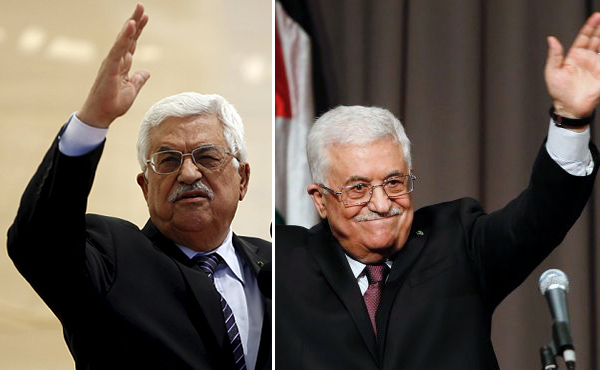
The two faces of Mahmoud Abbas: The Palestinian Authority president speaks to Israelis about peace, while he whips his own people into a frenzy by telling them that Jews are “defiling the Aqsa Mosque with their filthy feet,” and his media and officials glorify Palestinians who murder Israelis.

A few days earlier, Abbas seemed to have committed another “crime” when he told Druze leaders who visited him in his office in Ramallah that his hand would continue to be extended for peace with Israel. He even went as far as declaring that that he “rejected violence and terrorism.”

In yet a further “provocative” move on the part of Abbas, he received in his office a delegation representing the World Federation of Moroccan Jews. At the meeting, Abbas once again discussed his desire for peace, saying he was seeking to “end hostility and bloodshed between us.”

By granting an interview to an Israeli TV station, Abbas was defying instructions from his loyalists in the Palestinian Journalists Syndicate. In February, the syndicate decided to boycott any Palestinian official who gives an interview to Israeli reporters or media organizations.

The Palestinian Journalists Syndicate, which is dominated by members of Abbas’s ruling Fatah faction, did not publicly condemn the interview with the Israeli TV station. They have better judgment than that. Privately, however, Palestinian journalists and political activists in Ramallah expressed outrage over their president’s “collaboration” with Israeli media in defiance of the ban.

The meeting with the Moroccan Jews also infuriated some Palestinians, who rushed to accuse Abbas of acting against the instructions of the “anti-normalization” movement in the Palestinian territories. This movement has long worked to foil meetings between Israelis and Palestinians; its supporters have not hesitated to use violence to stop such encounters from taking place. Even soccer matches between Israeli and Palestinian children are considered unacceptable by this extremist movement, which, ironically, also consists of Abbas loyalists.

Yet what really caused the outcry was the talk of peace. Without it, the interview and the meeting with the Moroccans might have been quietly condemned. Apparently, discussing searching schoolchildren’s bags for knives was considered “over the top.”

Verbal attacks against Abbas are not only coming from his political enemies, such as Hamas and Islamic Jihad. Some are coming from his own supporters in Fatah and the PLO.

The Popular Front for the Liberation of Palestine (PFLP), the second largest faction of the PLO after Fatah, has called for Abbas’s immediate resignation.

Accusing him of having “crossed all red lines,” the PFLP said that Abbas’s remarks to the “enemy’s TV station” prove that the Palestinian Authority continues to conduct security coordination with Israel.

The PFLP, which denounced Abbas’s remarks as “despicable,” said that if Abbas does not step down, then the PLO leadership should hold a meeting to remove him from power and hold him accountable for his statements and actions.

Palestinians also took to social media to denounce their president for his remarks, with some joking that it could have been because of April Fool’s Day. Abbas was mocked as a liar and a hypocrite.

Abbas has only himself to blame for this morass. In the last months, he and the PA leadership have been inciting their people against Israel through the media and public rhetoric. Forget what they say in English: in Arabic, many of the Palestinian leaders talk of death to the Israelis.

Like other Palestinian leaders, Abbas has become hostage to his own anti-Israel poison. He has now had some feedback from his people on how well he has taught them. The answer: very well indeed.

Perhaps this time, the international community will hear the truth: the Palestinian leadership does not educate the Palestinian people for peace with Israel. That is the real obstacle to peace.

Khaled Abu Toameh, an award-winning journalist, is based in Jerusalem

Why Terrorism Thrives in West Africa by Nuhu Othman

  • In the mid-20th century, the Western powers partitioned West Africa, and other parts of the African continent, into nation-states that had nothing in common with each other apart from geographical proximity. The general consensus among the Muslims in fragmented West Africa was that the West won over the vast Caliphate not by the superiority of its idea or civilization but by its sheer superiority in organized violence. This reasoning plays into the hands of extremist Islamic groups today.

  • There has been no way for people to reject the past Empire and Caliphate in West Africa as failed systems because they were not replaced by better systems.
  • Whatever democratic values were handed to these newly independent states were short-lived, trampled by military incursions. Military leadership suppressed freedoms in every aspect. This in itself served as a gag to protest the rule of any aspiring terror group. Now Africa, especially West Africa, would like to democratize. Amid the madness of terrorism, it is calling for freedom. But is anyone listening?

Great civilizations existed in northern Nigeria before the West ever set foot there. The Kanem Bornu Empire (700-1900) stretched to present-day Chad, Libya, Niger and Cameroon, and was bound by trade and ethnic similarities and religion.

Present day Northern Nigeria is home to the large Hausa ethnic group. The Hausa language is spoken by more than 50 million people across the present-day Sahel (north Central Africa, spanning much of Niger, Nigeria, Cameroon, Ivory Coast, Togo, Chad, and Sudan). Hausa is still the region’s second language of trade; the primary languages come from the region’s colonizers: English, French and to a degree, Arabic.

In the early 19th century, a towering Islamic figure, Sheikh Uthman ibn Fodio (1754-1817), emerged in what is now northwest Nigeria. Although of ethnic Fulani extraction, he galvanized support across the Hausa-dominated regions and parts of the old Kanem Bornu Empire. In this multi-ethnic region, he had a uni-directional purpose: Islamic evangelism, imperialism and dominance. He ended up creating an Islamic Caliphate.

In the mid-20th century, the Western powers partitioned West Africa, and other parts of the African continent, into nation-states that had nothing in common with each other apart from geographical proximity. The ethnic groups that made up the old order still consider themselves as distinctive nations, regardless of the fragmentation of the Caliphate into multiple nation-states. Under such splintering, it was easy for the ideas of Islamists Sayyid Qutb or Osama Bin Laden violently to re-order the region through Jihad to reverberate and gain a following.

Although shattering the Caliphate succeeded in collapsing it geographically, the general consensus among the Muslims in the now-fragmented Caliphate was that the West won not by the superiority of its ideas or civilization, but by its sheer superiority in organized violence. This reasoning has played into the hands of extremist Islamic groups such as Boko Haram and Al-Qaeda, as they galvanize support across the region. These new groups also exploit thorny and delicate issues such as casting a negative obsession with Israel and its sovereignty as a way to unite Muslims, as many Islamic groups have been doing for decades.

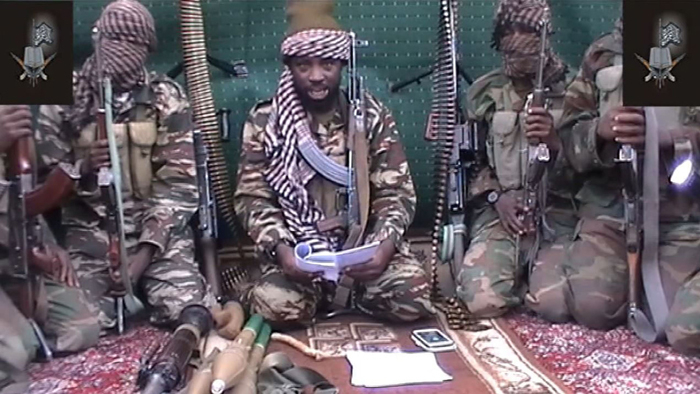
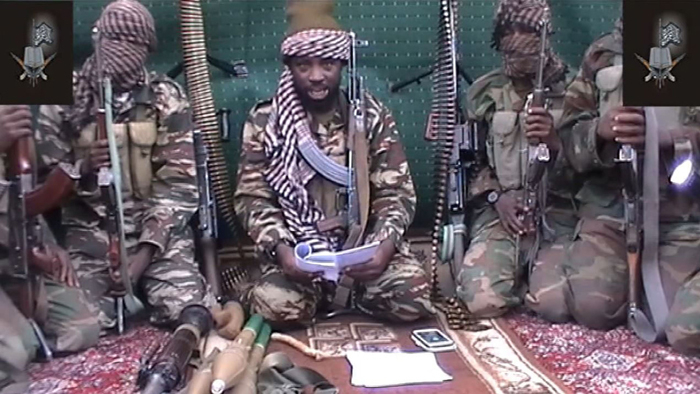
Boko Haram leader Abubakar Shekau (center) in one of the group’s propaganda videos.

Above all, there has been no way for people to reject the past Empire and Caliphate in West Africa as failed systems because they were not replaced by better systems.

In the mid-20th century, most of the West African colonies were given independence. Whatever democratic values were handed to these newly independent states, however, were short-lived, trampled by military incursions. Military leadership suppressed freedoms in every aspect. This in itself served as a gag to protest the rule of any aspiring terror group. Now Africa, especially West Africa, would like to democratize; amid the madness of terrorism, it is calling for freedom. But is anyone listening?

Expectedly, the violent idea of jihad has taken on a regional dimension and therefore should necessitate a regional solution. Nigeria has played a leading role, based on the platform of the Economic Community of West African States (ECOWAS), in peace-keeping missions and restoring democratic rule in many West African countries. ECOWAS should be the linchpin for greater integration and the possible eradication of terror. The following, in no particular order, can help to root out those elements of terror and foster greater cooperation among states in West Africa:

  • The worsening of environmental conditions in West Africa have increased the rate of violent crimes. Desertification and the shrinking of the Chad Basin have significantly affected the means of livelihood of tens of millions of people in this region. There is simply less arable land and grazing land. This has immensely contributed to the increasing number of unemployed youths. As a result, many have turned to joining various terror groups. Others go into cattle rustling. ECOWAS member states should encourage the spread of modern agricultural methods that work with limited supplies of water — a specialty of Israelis — and revive the Chad Basin so as to boost trade. That would deplete the pool of people from which terror groups get easy and unquestioning recruits.
  • Each country in West Africa should strengthen their various “transitional justice mechanisms.” This is paramount for Ivory Coast and the Central African Republic, which recently experienced violent civil strife with religious undertones. Such upheavals are created and exploited by various terror groups. Committees and courts of law should be put in place to handle matters of genocide, secular education, rule of law, equal justice under law, property rights, freedom of expression, separation of religion and state, and also establish “truth and reconciliation” commissions to heal past wounds. Taking a cue from the Gacaca Court in Rwanda would be helpful.
  • Islamic clerics should be included in this exercise. It will be an adventure in futility if this critical group is neglected, because a single sermon from a revered preacher could roll back whatever gains are achieved. Some clerics may see any improvement in the economy as a threat to their hegemony, and any democratic values as a threat to their power, but many moderate clerics have been killed by Boko Haram, as well. In essence, there should be room for reward and sanction. A preacher is responsible for any incitement they engage in — on or off the pulpit. Kaduna State in northern Nigeria is proposing a bill to license preachers.
  • A highly motivated joint military task force comprising all member states should be established to patrol the porous regional borders — especially the borders between Mali and Libya.
  • The ECOWAS Community Court should be empowered to deal with cross-border crimes and the prosecution of terrorists. So far, this court is merely an expression on paper.
  • Financial institutions. After the 9/11 attacks, there were calls in banking institutions for “due diligence” and “know your customer” in opening accounts. This forced terrorists to go underground and use the informal system of hawala. One can bring cash to a hawala broker in Lagos, and a designated person can collect the same amount from a money broker in Jos. Terror groups still use this medium to fund their operations.

David C. Faith at Global Security Studies estimates that over $7 billion enters Pakistan through the hawala system every year. The true number is likely higher. And because of hawala‘s unregulated nature, it is impossible to verify the amounts used to finance terrorism.

Worries about terror financing led the Central Bank of Nigeria to strengthen its anti-money laundering laws. Transactions above the threshold of $5,000 for individuals and corporations are flagged, and details sent to Nigerian security services on a weekly basis.

Democracy is gradually becoming rooted in West Africa, especially in Nigeria, Senegal and Ghana. Demands for transparency and accountability are growing with visible positive results. The ECOWAS Commission has a robust strategy on counter-terrorism and anti-money laundering. The Institute for Security Studies West Africa explained that the ECOWAS Commission has identified three pillars of counter-terrorism:

PILLAR ONE — PREVENT: It constitutes the central pillar of the strategy. Its main goal is to prevent terrorism before it occurs based on the concept of “DID” -Detect, Intercept and Deter.

PILLAR TWO — PURSUE: The second phase of actions seeks to ensure timely and effective responses to terrorist acts. It is anchored on military and non-military approaches to terrorism, as well as the criminal justice system. One of the key objectives of this pillar is to eliminate impunity and ensure that all those who participate, support, finance and facilitate terrorists acts, whether directly or indirectly, are investigated, prosecuted and punished to the limit allowed by the law.

PILLAR THREE — REBUILD: seeks to restore society and re-assert the authority of the state after terrorist attacks. This strategy is based on regional and international cooperation including mutual legal assistance to meet the shortfalls and disparities in states’ capabilities. Above all, it requires cooperation in the areas of intelligence, investigation, prosecution and counter-terrorism.

The success of the Nigerian military in recent months is an indication that a coherent and enduring policy can see the end of these terror groups.

In the late 1970s and early 1980s, a Cameroonian Muslim clergyman emerged in the northeast of Nigeria: Muhammad Marwa, popularly known as Maitatsine, Hausa for “the one who damns.” He, like Boko Haram, also rejected Western education. He and his movement were crushed by military firepower. Nigeria’s current President, General Muhammadu Buhari, was appointed at that time to neutralize Maitatsine. Nigeria’s military captured Maitatsine, and his movement collapsed. This feat endeared Buhari to the people of northeast Nigeria, who had suffered greatly under Maitatsine. Not surprisingly, Boko Haram emerged in the same place 30 years later with the same ideology,

In 2015, Muhammadu Buhari was elected president in the hope that he could repeat his success.

Unfortunately, Iran’s nuclear deal has emboldened the terrorists, and the Kingdom of Saudi Arabia has also been increasing its presence in Nigeria by sponsoring Sunni clergymen in their institutions of learning.

Military campaigns alone cannot bring a lasting solution to terrorism in the West African sub-region. The political will seriously to address the issues above will make joining these criminal and heartless groups far less desirable.

Nuhu Othman is a senior consultant at Atta Zubairu & Associates, in Abuja, Nigeria. He can be reached at nuhuothman@gmail.com

Why Palestinians Love Baby-Killers

Samir Kuntar murdered four Israelis. One of his victims was a four-year-old girl, Einat Haran. Kuntar smashed her skull. Kuntar was killed this week in Syria while helping President Bashar Assad commit war crimes against his own citizens.


  • Senior Palestinian official Sultan Abu Al-Einein evidently believes that murdering Jews is not a “despicable crime,” but killing an arch-terrorist such as Kuntar is a “despicable crime.”
  • When the Western-backed Palestinian Authority openly endorses terrorists and names streets, squares and schools after them, Palestinian leaders are sending a message to their people that murdering Jews is a noble and dignified act. This show of solidarity with a baby-killer is the direct result of ongoing incitement against Israel and Jews in mosques, the press and social media in the West Bank and Gaza Strip.
  • In this sick, twisted society that the Europeans have bought and paid for, anyone who murders Jews is considered a role model. Anyone who supports peace with Israel is denounced as a “traitor.”

Samir Kuntar was a terrorist who committed one of the most brutal terrorist attacks one can imagine. On April 22, 1979, Kuntar, who was then 16 years old, murdered four Israelis in the Israeli city of Nahariya. One of his victims was a four-year-old girl, Einat Haran. Kuntar smashed her skull after murdering her 31-year-old father, Danny.

This week, Kuntar was killed in an explosion that destroyed his apartment south of the Syrian capital, Damascus. He had been in Syria helping President Bashar Assad commit war crimes against his own Syrian citizens. Kuntar had been sent to Syria also as part of the Iranian-backed Lebanese Hezbollah terror group, to plan major terror attacks against Israel from Syria.

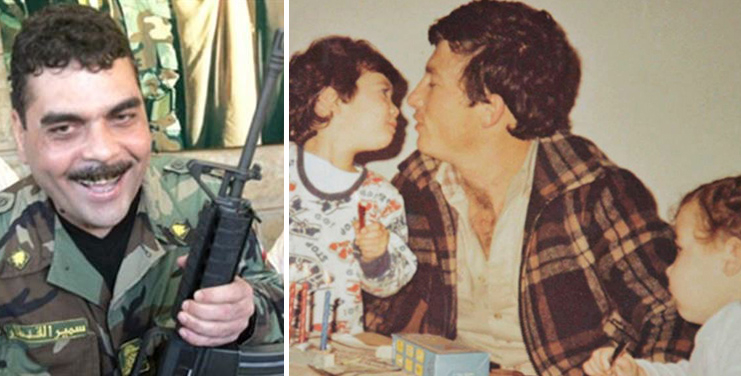
Lebanese terrorist Samir Kuntar (left) was killed this week in Syria. Kuntar murdered four Israelis in 1979, including Einat, Danny and Yael Haran (right). Kuntar’s murderous résumé turned him into a hero in the eyes of many prominent Palestinians.

Kuntar was not a Palestinian. He was Lebanese Druze. This irregularity still has not stopped Palestinians from adoring him for murdering Jews. Palestinians will worship anyone who carries out a terror attack against Israel or Jews — such as the Japanese terrorist, Kozo Okamoto, who led the 1972 massacre at Israel’s Lod Airport, in which 24 people were murdered and more than 70 wounded.

In the eyes of many Palestinians, Kuntar’s murderous résumé, like Okamoto’s, has turned him into a “martyr” and a “hero.” The arch-terrorist is now being mourned in the West Bank and Gaza Strip as a “national hero and fighter” who sacrificed his life for the sake of the Palestinians. This is who many Palestinians consider their role model: the only requirement is that they try to destroy Israel and murder Jews. It is as if all the Muslims in France idolized the men who committed the November 13 massacres at Paris’s football stadium and the Bataclan Theater, and committed themselves to being just like them.

The love affair between Kuntar and the Palestinians began many years ago, while the terrorist was serving time in Israeli prison. Palestinian prisoners such as Fatah’s Marwan Barghouti and Ahmed Sa’dat, Secretary-General of the Popular Front for the Liberation of Palestine (PFLP), proudly posted photos of themselves posing with Kuntar. Barghouti is now serving five life sentences for his role in deadly terror attacks against Jews between 2000 and 2006. Sa’dat is in prison for his role in gunning down Israel’s Minister of Tourism, Rehavam Ze’evi, in a hotel in 2001.

Upon learning of Kuntar’s death, Barghouti, who is a senior official with the “moderate” and Western-backed Fatah faction, published the following eulogy: “One thousand greetings to your soul. We shall meet.”

Although the Fatah-dominated Palestinian Authority has so far refrained from commenting on the assassination of the Lebanese Druze terrorist, Fatah websites have been mourning and praising Kuntar as a “hero” and “martyr.”

Sultan Abu Al-Einein, a senior Fatah official who is close to President Mahmoud Abbas, and apparently does not favor terrorists being killed, denounced the assassination as a “despicable Israeli crime.” Abu Al-Einein went on to praise Kuntar as a “martyr” who had contributed to the Palestinian cause from the age of 16. Not surprisingly, the Fatah official failed to mention that Kuntar had brutally murdered four Israelis, including a little girl. Evidently, Abu Al-Einein believes that murdering Jews is not a “despicable crime,” but killing an arch-terrorist is a “despicable crime” — one that requires the entire international community to punish those responsible!

In the Gaza Strip, only hours after the terrorist was killed in Syria, a Palestinian father, Maher Huthut, announced that he has named his newborn baby after Samir Kuntar. The announcement was presumably meant to express Palestinian “gratitude” for Kuntar’s “sacrifices” on behalf of the Palestinians. In yet another sign of affection for Kuntar, various Palestinian factions in the Gaza Strip set up a large tent to receive condolences over his death. Hundreds of Palestinians visited the tent to express their deep condolences over his death, and many pledged to follow in Kuntar’s footsteps.

Palestinian factions are now planning a similar move in Ramallah, only a few hundred meters away from the office and residence of President Mahmoud Abbas.

This outpouring of sympathy and affection from the Palestinians for Kuntar should not surprise anyone. Palestinians have long been glorifying terrorists and jihadis who attack and kill any Jew, whether soldier or civilian. When Palestinian leaders — the Western-backed Palestinian Authority, not even Hamas — openly endorse terrorists and name streets, squares and schools after them, they are sending a message to their people that murdering Jews is a noble and dignified undertaking, and that it is virtuous to do more of it!

It is frankly disgusting, even as a Palestinian, to see so many of my countrymen mourning and heaping praise on a man who murders babies. This show of solidarity with a baby-killer and arch-terrorist is the direct result of the ongoing incitement against Israel and Jews that takes place each day in mosques, the press and social media in the West Bank and Gaza Strip. It is precisely this non-stop incitement and indoctrination that is driving young Palestinians to take knives, run out, and stab the first Jew they meet.

Despite what the European politicians funding them wish to think, Palestinian leaders are not educating their people for tolerance, non-violence and peace. Instead, with the money they are given by these dreamy northerners who seem to imagine the world is one big loving day-care center, they continue to poison the hearts and minds of their people through incendiary lies and the most bigoted rhetoric.

The Europeans, who are largely bankrolling this venom, should be made to know that this is what their generosity is used for. And that this is precisely why no peace process with Israel will ever work. Thanks mainly to the largesse of European funding that keeps most Palestinians from thinking of other ways to earn a living, Palestinian terrorism is now a big business! The gullible Europeans have enabled an entire generation to be raised on the glorification of terrorists such as Kuntar. I do hope this makes the Europeans feel very good about themselves.

In this sick, twisted society that the Europeans have bought and paid for, anyone who murders Jews is considered a role model. But anyone who supports peace with Israel is instantly denounced as a “traitor.” It is high time for the Europeans and others in the West to wake up.

Bassam Tawil is a scholar based in the Middle East.

Why Palestinians Do Not Want Cameras on the Temple Mount by Khaled Abu Toameh

  • The Palestinian Authority (PA) will continue to work against having cameras in the hope of preventing the world from seeing what is really happening at the site and undermining Jordan’s “custodianship” over Islamic holy sites in Jerusalem.


  • Another reason the Palestinians oppose King Abdullah’s idea is their fear that cameras would expose that Palestinians have been smuggling stones, firebombs and pipe bombs into the Al-Aqsa Mosque for the past two years.

  • The cameras are also likely to refute the claim that Jews are “violently invading” Al-Aqsa Mosque and holding prayers on the Temple Mount. The cameras will show that Jews do not enter Al-Aqsa Mosque, as Palestinians have been claiming. Needless to say, no Jewish visitors have been caught trying to smuggle weapons into the holy site.

  • It remains to be seen how Secretary Kerry, who brokered the camera deal between Israel and Jordan, will react to the latest Palestinian Authority escalation of tensions. If Kerry fails to pressure the PA to stop its incitement and attempts to exclude the Jordanians from playing any positive role, the current wave of knife attacks against Jews will continue.

Why is the Palestinian Authority (PA) opposed to Jordan’s proposal to install surveillance cameras at Jerusalem’s Haram al-Sharif (Temple Mount), sacred to Christians, Muslims and Jews?

This is the question that many in Jordan have been asking in light of the recent agreement between Israel and Jordan that was reached under the auspices of US Secretary of State John Kerry. The idea was first raised by Jordan’s King Abdullah in a bid to ease tensions at the holy site in the Old City of Jerusalem.

Shortly after Israel accepted the idea, the Palestinian Authority rushed to denounce it as a “new trap.” PA Foreign Minister Riad al-Malki and other officials in Ramallah expressed concern that Israel would use the cameras to “arrest Palestinians under the pretext of incitement.”

During the past two years, the Palestinian Authority and other parties, including Hamas and the Islamic Movement (Northern Branch) in Israel, have been waging a campaign of incitement against Jewish visits to the Haram al-Sharif. The campaign claimed that Jews were planning to destroy Al-Aqsa Mosque.

In an attempt to prevent Jews from entering the approximately 37-acre (150,000 m2) site, the Palestinian Authority and the Islamic Movement in Israel hired scores of Muslim men and women to harass the Jewish visitors and the police officers escorting them. The men are referred to as Murabitoun, while the women are called Murabitat (defenders or guardians of the faith).

These men and women have since been filmed shouting and trying to assault Jews and policemen at the Haram al-Sharif. This type of video evidence is something that the Palestinian Authority is trying to avoid. The PA, together with the Islamic Movement, wants the men and women to continue harassing the Jews under the pretext of “defending” the Al-Aqsa Mosque from “destruction” and “contamination.”

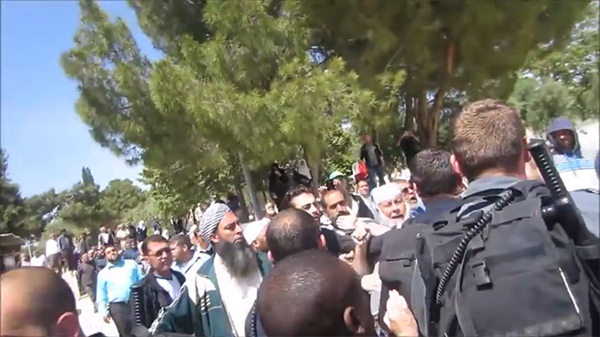
Hundreds of Muslims on the Temple Mount, yelling and throwing objects, surround three Jewish men and their children, as about a dozen police officers try to hold back the angry crowd and evacuate the Jews.

The installation of surveillance cameras at the site will expose the aggressive behavior of theMurabitoun and Murabitat, and show the world who is really “desecrating” the Islamic holy sites and turning them into a base for assaulting and abusing Jewish visitors and policemen.

The cameras are also likely to refute the claim that Jews are “violently invading” Al-Aqsa Mosque and holding prayers at the Temple Mount. The Palestinian Authority, Hamas and the Islamic Movement have long been describing the Jewish visits as a “provocative and violent incursion” into Al-Aqsa Mosque. But now the cameras will show that Jews do not enter Al-Aqsa Mosque, as the Palestinians have been claiming.

Another reason the Palestinians are opposed to King Abdullah’s idea is their fear that the cameras would expose that Palestinians have been smuggling stones, firebombs and pipe bombs into Al-Aqsa Mosque for the past two years. These are scenes at the PA, Hamas and the Islamic Movement do not want the world to see: they show who is really “contaminating” the Haram al-Sharif. Needless to say, no Jewish visitors have thus far been caught trying to smuggle such weapons into the holy site.

Palestinian Arab young men with masks, inside Al-Aqsa Mosque (some wearing shoes), stockpile rocks to use for throwing at Jews who visit the Temple Mount, September 27, 2015.

By rejecting the idea of setting up 24-hour surveillance cameras at the Haram al-Sharif, the Palestinian Authority has found itself on a course of collision with Jordan. Jordanian politicians and columnists have voiced outrage over the stance of the PA, and have dubbed it harmful to Palestinian and Islamic interests.

The Jordanian newspaper Al-Ghad, which is close to the government, quoted Jordanian politicians as denouncing the opposition of the Palestinian Authority to the cameras as “inappropriate, clumsy, tasteless and unfair.”

Sources in Ramallah explained this week that the PA’s opposition to cameras should also be seen in the context of the power struggle between the Palestinians and Jordan over control of the Islamic holy sites in Jerusalem. The Jordanians have long been seeking to preserve their status as “custodians” of Al-Aqsa Mosque and other Islamic holy sites in Jerusalem. This is a status that some Palestinians and the Islamic Movement in Israel have been trying to change during the past two decades, especially after the signing of the Oslo Accords between the PLO and Israel in 1993.

The Palestinian Authority’s opposition to the installation of cameras is seen as an attempt to undermine Jordan’s status at the Islamic holy sites. Many Palestinians argue that they, and not the Jordanians, should be in charge of the Haram al-Sharif. Members of the PA are opposed to the cameras because it is a Jordanian proposal and reinforces Jordan’s role at the holy site.

As such, the Palestinian Authority’s position could be seen as an attempt to change the status quo at the holy site by driving the Jordanians out of the area. King Abdullah is obviously aware of the Palestinian attempt to prevent him from playing any role at the holy site; that is why he was quick to reach a deal with Israel about the installation of cameras. The PA, meanwhile, will continue to work against having cameras in the hope of preventing the world from seeing what is really happening at the site and undermining Jordan’s “custodianship” over Islamic holy sites in Jerusalem.

It now remains to be seen how Secretary Kerry, who brokered the camera deal between Israel and Jordan, will react, if at all, to the latest Palestinian Authority attempt to continue escalating tensions at the holy site. If Kerry fails to pressure the PA to stop its incitement and repeated attempts to exclude the Jordanians from playing any positive role at the Haram al-Sharif, the current wave of knife attacks against Jews will continue.

Translate »
Skip to toolbar