Monthly Archives: June 2017

Turkey’s “Fall and Fall” by Burak Bekdil

  • In reality, Turkey’s “post-modern Islamist” leaders were just Islamists gift-wrapped in a nicer package.
  • In a span of only seven months, more than 170 people have lost their lives in bomb attacks in Turkey. This number excludes more than 300 security officials killed by Kurdish militants, and more than 1000 Kurdish militants killed by Turkish security forces.

  • Russia is in the process of encircling Turkey militarily — in Syria, the Crimea, Ukraine and Armenia.
  • Russia’s fight is not about defeating the Islamic State, but about expanding its sphere of influence in the eastern Mediterranean, including the mouth of the Suez Canal. In a way, Russia is challenging NATO through Syria — the same way Turkey is challenging the Shiites through Syria, or Iran is challenging the Sunnis through Syria.

Less than a decade ago, many Western statesmen and pundits were racing ahead to praise Turkey’s Islamist leaders as “post-modern, democratic, reformist, pro-European Union Islamists” who could play the role model for less democratic Muslim nations in the Middle East. It was “The Rise and Rise of Turkey,” as Patrick Seale put it in the New York Times in 2009.

In reality, the “post-modern Islamists” were just Islamists gift-wrapped in a nicer package. Today, Turks are paying a heavy price for the neo-Ottoman, revisionist, miscalculated strategic vision of their leaders.

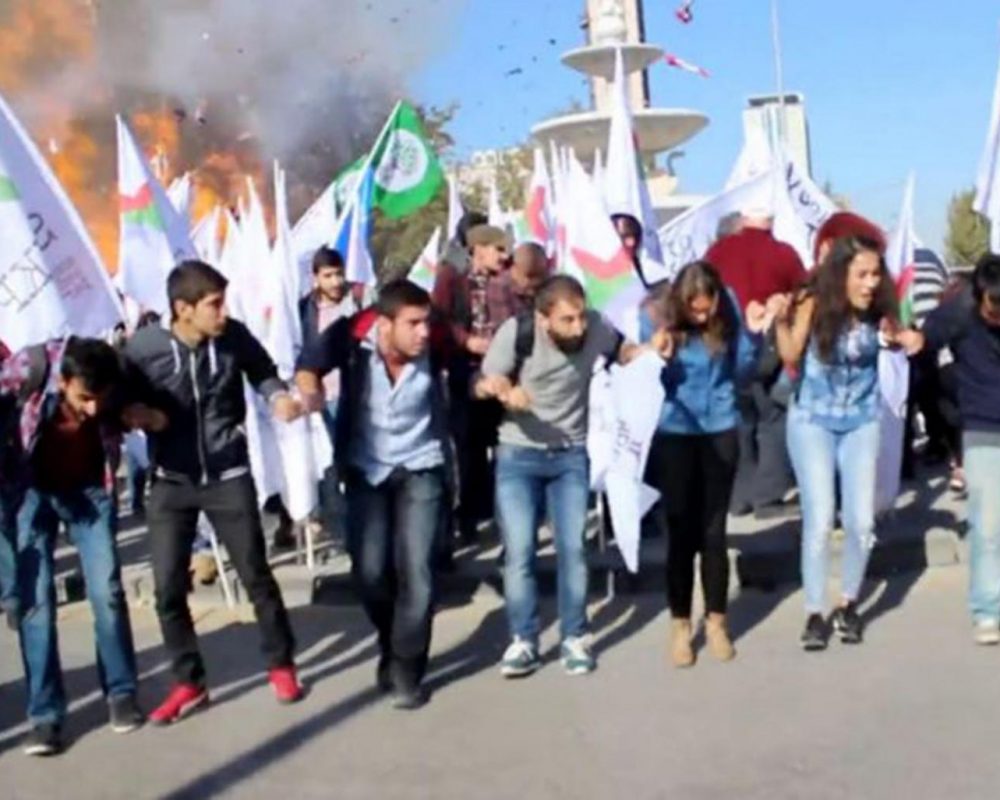
In July, a Turkish-Kurdish suicide bomber murdered more than 30 pro-Kurdish activists in a small town along Turkey’s border with Syria. Three months later, jihadist suicide bombers murdered more than 100 pro-peace activists in the heart of Ankara, in the worst single act of terror in Turkish history. The Turkish government manipulatively put the blame on a “cocktail” group of terrorists, including Kurds. In January, jihadists murdered 10 German tourists in Istanbul in another suicide bomb attack.

On October 10, 2015, jihadist suicide bombers murdered more than 100 pro-peace activists in the heart of Ankara, in the worst single act of terror in Turkish history. Pictured above, one of the bombs explodes in the background.

Most recently, on February 17, a Kurdish militant murdered nearly 30 people, including military personnel, just a few hundred meters away from the Turkish parliament in Ankara.

In a span of only seven months, more than 170 people have lost their lives in bomb attacks. This number excludes the more than 300 security officials killed by Kurdish militants, and more than a thousand Kurdish militants killed by Turkish security forces since a Turkish-Kurdish ceasefire ended last July.

Outside its borders, Turkey is floating on a sea of chaos too. The country is in an increasingly dangerous proxy war against a bloc of Shiite and Shiite-dominated governments in Damascus, Baghdad and Tehran, plus their Russian supporters. In addition, for Turkey’s neo-Ottomans, Lebanon, Libya, Israel and Egypt are all “hostile lands.”

Government officials privately claim that Turkey’s enemies were using terror groups to launch attacks on Turkish targets. “It’s like you know well who is behind the attacks but cannot prove it … The masterminds can be one or more of the countries we have locked horns with,” a senior security official told this author recently. Not a nice feeling to be the common target of a number of thuggish-to-rogue states with the capability of manipulating terrorists.

The players in the eastern Mediterranean theater, including Turkey, are running after a bigger slice of a smaller pie. Turkey’s sectarian ambitions are no secret. Nor are Iran’s. Today there are nearly 50,000 Shiite militiamen fighting in Syria, where a majority of the population is Sunni (as in Turkey).

Russia, on the other hand, since September 30 has been bombing targets hostile to the regime of Syrian President Bashar al-Assad. Russian aircraft have carried out about 7,500 sorties, 89% of which have hit Assad’s opponents from groups other than the Islamic State (IS). Only 11% have targeted IS, which is everyone’s common enemy.

Russia has also piled up a very serious military inventory around the Caspian Sea and the eastern Mediterranean. Russia is in the process of encircling Turkey militarily — in Syria, the Crimea, Ukraine and Armenia. Most recently, Moscow announced the deployment of a new batch of fighter aircraft and attack helicopters to an air base outside the Armenian capital, Yerevan, 25 miles from the Turkish border.

Turkey looks helpless. Even its NATO allies look deeply reserved over any help they would be prepared to extend to Ankara in case of a conflict with Russia. Recently, Luxembourg’s foreign minister, Jean Asselborn, warned the Turkish government that it cannot count on NATO’s support if its tensions with Russia escalated into an armed conflict.

Russia’s fight is not about defeating the Islamic State, but about expanding its sphere of influence in the eastern Mediterranean, including the mouth of the Suez Canal. In a way, Russia is challenging NATO through Syria — the same way Turkey is challenging the Shiites through Syria, or Iran is challenging the Sunnis through Syria.

There are a number of questions concerning the possibility of peace returning to this part of the world.

  1. Will the Muslims ever stop hating and killing each other, including bombing their mosques, along sectarian lines and end their 14-century-long war?
  2. Will there be functional governments in Damascus and Baghdad any time soon?
  3. Will the Sunni world ever stop its own radicalization without peace being imposed upon it from the non-Muslim world?
  4. Will the Shiite world ever control its own sectarian expansionist ambitions?
  5. Will the Sunni and Shiite worlds ever stop hating Jews and committing themselves to annihilating the State of Israel?
  6. Will Turkey’s Islamists ever realize that their neo-Ottoman ambitions are too disproportionate to their power and regional clout?
  7. Will the Western world be prepared to challenge Russia, the new thuggish kid on the block called the eastern Mediterranean? If yes, how?
  8. Will the players in the eastern Mediterranean ever be happy with a bigger pie and their slices not necessarily getting smaller?

The answers of this author to those questions are negative.

Burak Bekdil, based in Ankara, is a Turkish columnist for the Hürriyet Daily and a Fellow at the Middle East Forum.

Turkey vs. Free Press by Uzay Bulut

  • “What I’m going through can face all journalists out there. They can use laws to put you in prison just for mentioning the word ‘PKK’ in your news story. They take this as ‘praising the terrorist organization.'” — Ocak Isik Yurtcu, former editor of Ozgur Gundem. He was sentenced to 15 years in prison.

  • “We expose their war crimes; and they respond by blocking us.” — Ramazan Pekgoz, editor, Dicle News Agency.

  • Of the 580 issues of Ozgur Gundem, criminal cases were opened in relation to 486 of them. Its editors-in-chief were sentenced to a total of 147 years in prison.

  • One cannot help asking: Why does Turkey try to destroy free speech that much? What is it that all those Turkish governments have been trying to hide?

  • “These bans take place because the state does not want the incidents in Kurdistan to be exposed.” — Eren Keskin, editor-in-chief and lawyer for Ozgur Gundem.

  • In 103 years in Turkey, 112 journalists and writers have been murdered, mostly Armenians and Kurds. — The Platform of Solidarity with Arrested Journalists (TGDP)

Ever since clashes between the Turkish army and the Kurdish PKK (Kurdistan Workers’ Party) intensified in late July, the pressure of the government against the Kurdish media, including bans on Kurdish news outlets as well as psychical violence against journalists, have become increasingly widespread.

On October 4, for instance, Turkish police in the Kurdish province of Diyarbakir detained two Kurdish journalists: Murat Demir of Ozgur Gun TV (Free Day TV) and Serhat Yuce of Dicle News Agency. The police seized their cameras and equipment. A police officer put a gun to Yuce’s head and took both into custody. The journalists were released after five hours, but fined for “violating the curfew” imposed on the town.

On October 6, Turkish police abducted Filiz Zeyrek, a female journalist working for the Kurdish JINHA (Women’s News Agency), in the southern province of Adana and drove her around for half an hour while interrogating and photographing her. The police then released her at a park.

Earlier, on September 28, Turkish police armed with assault rifles raided the offices of the Dicle News Agency (DIHA), the newspaper Azadiya Welat (Freedom of the Country), Aram Publishing House and the Kurdi-Der (Kurdish Language Association) in Diyarbakir, andarrested 32 journalists. The police seized their ID cards and phones, and eventually took the journalists to police headquarters. One of the reporters, Dicle Muftuoglu, said the police broke down the door, did not show a search warrant and did not allow the journalists to call their lawyers. The journalists were released late at night.

In the meantime, since late July, more than 100 pro-Kurdish websites have been totally blocked— including Dicle News Agency, Ozgur Gundem newspaper, Firat News Agency, Hawar News Agency and RojNews.

This month, the website of another Kurdish news agency, JINHA (Women’s News Agency), which focuses on women’s rights issues in Kurdistan and the Middle East, has also beenblocked by Turkey’s Presidency of Telecommunication (TIB).

Turkish authorities claim that most of the sites have been banned because “they are close to the PKK or support terror acts,” according to the newspaper Hurriyet.

“Security institutions make demands. And action is taken according to these demands. … The bans start at the direction of the security institutions. These institutions report the sites they have chosen to the Presidency of Telecommunication (TIB). First, a decision of administrative closure of those sites is made; then, in 24 hours, the decision is presented to the court for its approval.”

The authorities say that, “the security institutions specify the sites used by terror organizations and the sites that praise or propagate terror acts. Then based upon this specification, the administrative process gets started.”

Last month, the Radio and Television Supreme Council (RTUK) ceased broadcasting all of the TV channels on Digi Medya 1 and 2, as well as Guc Medya 1 and 2 satellite providers.

Fourteen of these are pro-Kurdish TV channels – including Ozgur Gun TV (Free Day TV.)

RTUK claims that it has ceased broadcasting the channels because “they have not complied with the right of publication.” However, the editors of some of the blocked Kurdish sites told Gatestone Institute that they do not agree with the excuses of the state authorities.

Faysal Dagli, chief editor of BasNews, said:

“The banned outlets are either Kurdish language sites that have ties with Kurdistan, or that are dissident, and might cover incidents the government does not want the public to hear about. In this current phase, when a cycle of violence has been restarted, these kinds of operations by the state are a familiar method of dimming facts that refer to the state. The government controls such phases through its own media. What matters to them is to restrict the influence of the dissident or ‘uncontrollable media’ at times when unexpected events are taking place, or else to prevent news from coming out of Kurdistan. The Turkish army’srecent bombardment of the Kurdish village of Zargala in Qandil reveals this purpose.”[1]

Ramazan Pekgoz, editor of Dicle News Agency, said:

“Since July 24, our four web addresses have been blocked. When we expose what is really going on, we are subjected to attacks and censorship. Before the ban, we covered an incident in which Kurdish workers were tortured by a Turkish police officer in Yuksekova. In 2011, our reporters were the first to cover the Roboski massacre. We also covered the Kurdish extrajudicial murders and massacres in 1990s. But every time the war in the region intensifies, they ban us…This has been the state mentality for years. In 1990s, they murdered our colleagues. They bombed our offices, and closed down the papers that worked with us. Today, they block our web content. We expose their war crimes; and they respond by blocking us.”

Erkan Capraz, chief editor of Yuksekova News, said:

“Whatever happens in Kurdish cities, we report them in accordance with journalistic ethics. So we are shocked that we are faced with such a censorship. We already knew that journalists in Turkey are not free and there are restrictions to the freedom of expression. We have been brought to court several times. We somewhat understand these trials and investigations. Sometimes a prosecutor or a citizen is disturbed by some news reports and makes a complaint about that outlet and an investigation is opened against the reporter or the editor. But before that ban, there have been no complaints or complainants against us. The Turkish prime ministry has sent a list to the Presidency of Telecommunication (TIB) based on an intelligence report and wanted it to close down the websites in that list. I do not think there could be such a practice in any country other than Iran.

“But it is so wrong to deprive our hundreds of thousands readers from our outlet. This is a disgrace to the freedom of expression and of the press. Our readers ask us why we have been blocked. There is only one explanation we can make to them: ‘We have exposed the truth.’ Turkey is committing a huge crime by blocking our outlet now. We will continue our legal struggle. If necessary, we will take the case to the European Court of Human Rights. This lawlessness should be exposed to the entire world.”

The ban on the Yuksekova News website was removed on October 20 — after 87 days.

Mehmet Oguz, chief editor of the Turkish page of Rudaw, noted:

“In recent weeks, there have been new events in Turkey such as the war between the PKK and the Turkish army and Turkey’s participation in the global coalition against ISIS. And after these developments, house raids and arrests of Kurds are on the rise. What attracts my attention is that the ‘new Turkey’ (the term Erdogan uses to define Turkey under his rule) is acting with its old reflexes. In times of crises, censorship is the first thing they think of. They did so in 1990s as well.

“The Turkish mainstream media outlets use the same language against Kurds and have taken the stance of a Turkish ‘commando’…

“As the Kurdish media has been banned, all these incidents make us ask: Is there something that is going on secretly?”

Apparently, pressures, prohibitions against media and even murders of journalists have been a state tradition.

The Platform of Solidarity with Arrested Journalists (TGDP) reported that in 103 years in Turkey, 112 journalists and writers have been murdered. The TGDP notes that most of the murdered journalists were Armenians or Kurds.

The Armenian journalists were massacred mostly during the 1915 Armenian Genocide; Kurdish journalists were massacred mostly between 1990 and 1994. (See the list of TGDP.)

Armenian intellectuals — including journalists, editors, writers or publicists — were also slain during the deportation campaign of the Armenian Genocide. On April 24, 1915, they were arrested in Constantinople (Istanbul). Some of them died on the way to their exile, others died after reaching it.

The last Armenian journalist murdered in Turkey was Hrant Dink, known for his advocacy of human rights and minority rights in Turkey. As editor-in-chief of the bilingual Turkish-Armenian newspaper Agos, Dink had written and spoken about the Armenian Genocide and had been under prosecution for violating Article 301 of the Turkish Penal Code — making it illegal to insult Turkey or Turkish government institutions — and “denigrating Turkishness.” Dink was shot dead outside his newspaper’s office in Istanbul on January 19, 2007.

One of the main targets of the Turkish state has been Ozgur Gundem, particularly known for its extensive coverage of Kurdish matters and the conflicts between the Turkish army and the Kurdish PKK (Kurdistan Workers’ Party).

Since Ozgur Gundem was founded on May 30, 1992, “authorities led a concerted campaign of arrests, bans and trials against Ozgur Gundem, eventually forcing the paper to close in April 1994,” according to the Committee to Protect Journalists. “In addition to the legal harassment, journalists at the paper were frequent targets of violent reprisal by unidentified assailants.”

During that period, Turkey held more journalists in prison than any other country. In 1992, 14 journalists and two newspaper distributors were murdered.

And in 1993, nine journalists and 13 distributors were murdered.

In 1994, seven journalists and two distributors were murdered.

Of Ozgur Gundem‘s 580 issues, criminal cases were opened in relation to 486 of them, and its editors in chief were sentenced to a total of 147 years in prison.

Ocak Isik Yurtcu, one of the former editors-in-chief of the paper, became the symbol of the pressures against the Kurdish press. The sentence against Yurtcu amounted to 15 years’ imprisonment.

While serving his sentence in prison, Yurtcu said in an interview:

“My problem is not unique. … What I’m going through can face all journalists out there. They can use laws to put you in prison just for mentioning the word ‘PKK’ in your news story. They take this as ‘praising the terrorist organization.’ How can you write about the Southeast without mentioning the PKK?”

After Ozgur Gundem was banned, the paper often changed its name in order to be able to continue the publication, but courts kept on issuing bans on publishing papers that followed the same line as Ozgur Gundem.

The successors of Ozgur Gundem were also victims of attacks: On 3 December 3, 1994, three bombs hit the printing facilities of Ozgur Ulke, one of the successors of the paper, and its offices in Istanbul and Ankara. One member of staff was killed and 23 injured.

Today, the website of Ozgur Gundem has been blocked in Turkey.

Eren Keskin, one of the chief editors of Ozgur Gundem and a human rights lawyer, told Gatestone Institute:

“I oppose it when these pressures against the Kurdish media are [depicted as being] restricted to the rule of Tayyip Erdogan. This did not start with Erdogan or the AKP. Ever since the Turkish Republic was established, the Kurdish media has been under pressure. I was the lawyer of Ozgur Gundem for years. So these unjust practices should not be evaluated by just looking at what is happening today. The state ideology towards the Kurdish people, Kurdish political movement and Kurdish media has never changed. And these bans take place because the state does not want the incidents in Kurdistan to be exposed. This has been the state policy for decades; it is nothing new.”
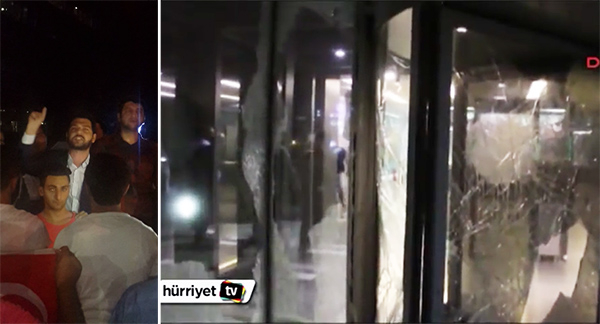
Abdurrahim Boynukalin (center of left image), a Turkish Member of Parliament from the ruling AKP Party, leads a mob in front of the offices of Hurriyet newspaper, September 6, 2015. At right, the shattered windows of the building’s lobby, after the mob hurled stones.

Ever since the Turkish state was founded in 1923, Turkey has never had freedom of the press.

The first government ruled by the Republican People’s Party (CHP) — through its Law on the Maintenance of Order enacted in 1925 and the Press Law in 1931 — closed down or censored many newspapers with various political inclinations, arrested many journalists and banned many foreign newspapers and magazines from entering Turkey. The Law on the Maintenance of Order gave the government the “right” to close down newspapers.

The minister of interior then, Sukru Kaya, described the “press policy” of the government: “The press is to comply with the political regime of the place where it is based. Just as every regime seeks for a type of citizen suitable for itself; it also seeks for a type of press suitable for itself.”

During the rule of Mustafa Kemal Ataturk, Turkey’s first president, at least 130 newspapers, magazines and books were banned. During the rule of Prime Minister Adnan Menderes (1950-1960, from the Democrat Party), 161 were banned.[2]

“It is not enough to say that there was no freedom of the press in that [one-party] era,” wrote the historian, Professor Mete Tuncay. “In the Ottoman autocracy, too, the press was not able to write what the government did not want. In the one party era [during the CHP administration of republican Turkey], however, the press could write only what the government wanted it to write.”[3]

The Greek-language media has also become almost extinct in Turkey.

During the government-instigated attacks against the Greek Christians of Istanbul in 1955, Muslim Turks in the city attacked everything owned by Greeks — their homes, offices, businesses, cemeteries, churches, and schools, among other things. And the Greek-language press of Istanbul was no exception.

“The offices and printing presses of eight newspapers were destroyed,” wrote the author Speros Vryonis Jr. “All three principal dailies, the Apoyevmatini, the Tachydromos, and theEmbros suffered heavy losses. The first two had both their offices and printing establishments completely wrecked. In the case of the Embros only its offices were destroyed since it had no printing press of its own.”

Due to many aggressive and discriminatory state policies against Greek Christians — including the 1955 attacks and the 1964 expulsions of Greeks from Turkey, the Greek population of Istanbul and Anatolia has dropped tremendously.

Today, Apoyevmatini, Turkey’s only Greek-language newspaper, faces closure. Mihail Vasiliadis, its editor-in-chief, said there were about 120,000 Greeks in Istanbul during the 1930s and 1940s, at which time the newspaper had a circulation of 35,000. But today, there are only 605 Greek families in the city, and 600 of those are Apoyevmatini subscribers. The offices of the paper, which was established in 1925, were closed down in October 2014 due to economic difficulties. Ever since, Vasiliadis has been trying to put the paper together from his home. Vasiliadis explained that he has had difficulty even covering rent payments.

For decades, it seems that Turkish state authorities have tried to silence all dissident voices in the media — particularly Kurdish, Greek and Armenian journalists. One cannot help asking: Why does Turkey try so hard to destroy free speech? What is it that all those Turkish governments have been trying to hide?

Uzay Bulut, is a Turkish journalist, born and raised a Muslim, and based in Ankara.

Turkey Sets Ultimatum for EU Migrant Deal “Erdoğan is openly pursuing the Islamization of Europe” by Soeren Kern

  • Turkey has threatened to back out of an agreement to stem the flow of migrants to the European Union if Turkish nationals are not granted visa-free travel to the bloc by October.Europe is trapped in a no-win situation. European officials say that although Turkey has fulfilled most of their conditions, it has failed to relax its stringent anti-terrorism laws, which are being used to silence critics of President Erdoğan, especially since Turkey’s failed coup on July 15.

  • The German newspaper Bild recently reported a confidential plan to house all migrants arriving from Turkey on Greek islands. Public transportation between those islands and the Greek mainland would be cut off to prevent migrants from moving into other parts of the EU.
  • “No matter how uncouth, how merciless, how unscrupulous Western countries act, they have no chance of keeping the migration flows under control.” — Turkish President Recep Tayyip Erdoğan, quoted by German journalist Wolfram Weimer.

Turkey has threatened to back out of an agreement to stem the flow of migrants to the European Union if Turkish nationals are not granted visa-free travel to the bloc by October.

Although Turkish officials have repeatedly threatened to renege on the March 18 EU-Turkey deal, this is the first time they have set a deadline.

If the EU approves the visa waiver, tens of millions of Turks will gain immediate and unimpeded access to 26 European countries. If the EU rejects the visa waiver, and Turkey retaliates by reopening the migration floodgates, potentially millions of migrants from Africa, Asia and the Middle East could begin flowing into Greece this fall. Europe is trapped in a no-win situation.

The migration deal, which entered into force on June 1, was hastily negotiated by European leaders desperate to gain control over a crisis in which more than one million migrants poured into Europe in 2015.

Under the agreement, the EU pledged to pay Turkey €3 billion ($3.4 billion), grant visa-free travel to Europe for Turkey’s 78 million citizens, and restart accession talks for Turkey to join the bloc. In exchange, Turkey agreed to take back all migrants and refugees who reach Greece via Turkey.

Turkish officials have repeatedly accused the EU of failing to keep its end of the bargain.

In a July 25 interview with the German television broadcaster ARD, Turkish President Recep Tayyip Erdoğan said that Turkey had so far received only €2 million of the promised €3 billion: “European leaders are dishonest,” he said. “We have stood by our promise. But have the Europeans kept theirs?”

The EU insists that the €3 billion must be transferred through the United Nations and other international aid agencies in accordance with strict rules on how the money can be spent: “Funding under the Facility for Refugees in Turkey supports refugees in the country,” the EU said in a statement. “It is funding for refugees and not funding for Turkey.”

In a July 31 interview with the Frankfurter Allgemeine Zeitung, Turkish Foreign Minister Mevlüt Cavusoglu stressed that the Turkish government wants the EU to set a “specific deadline” for lifting the visa requirements: “It can be early or mid-October but we are waiting for an exact date,” he said.

Cavusoglu said that his words are “not a threat,” but added that “if there is no lifting of the visa restrictions, we will be forced to abandon the agreement struck on March 18.”

Under the agreement, European officials promised to fast-track visa-free access for Turkish nationals to the Schengen (open-bordered) passport-free zone by June 30, and to restart Turkey’s stalled EU membership talks by the end of July 2016.

To qualify for the visa waiver, Turkey had until April 30 to meet 72 conditions. These include: bringing the security features of Turkish passports up to EU standards; sharing information on forged and fraudulent documents used to travel to the EU and granting work permits to non-Syrian migrants in Turkey.

European officials say that although Turkey has fulfilled most of their conditions, it has failed to comply with the most important one: relaxing its stringent anti-terrorism laws, which are being used to silence critics of Erdoğan, especially since Turkey’s failed coup on July 15.

European Commissioner Günther Oettinger recently said he did not believe the European Union would grant visa-free travel for Turkish citizens this year due to Erdoğan’s post-coup crackdown.

Turkish authorities have arrested more than 15,000 people in connection with the coup attempt, and at least 60,000 civil servants, teachers, journalists, police officers and soldiers have been fired or suspended from various state-run institutions.

Turkey’s EU accession talks also have run aground after Erdoğan threatened to reinstate the death penalty in Turkey. Oettinger said: “The death penalty is irreconcilable with our order of values and our treaties. No country can become a member state of the EU if it introduces the death penalty.”

Erdoğan has indicated he is no longer interested in EU membership: “We’ll go our way, you go yours,” he said.

Meanwhile, Greek officials report a significant increase in the number of migrants arriving in Greece from Turkey since the coup attempt. Observers say Erdoğan is using the migrant flows to pressure Greece to extradite eight Turkish officers who participated in the coup and fled across the border to Greece. Athens has refused to hand them back.

As the migrant deal unravels, European officials are discussing a “Plan B.” The German newspaper Bild recently reported a confidential plan to house all migrants arriving from Turkey on Greek islands in the Aegean Sea. Public transportation between those islands and the Greek mainland would be cut off to prevent migrants from moving into other parts of the European Union.

The plan, which Bild says is being discussed at the highest echelons of European power, would effectively turn parts of Greece into massive refugee camps for many years to come. It remains unclear whether Greek leaders will have any say in the matter.

The European Union now finds itself in a Catch-22 situation. Large numbers of Muslim migrants will flow to Europe regardless of whether or not the EU approves the visa waiver.

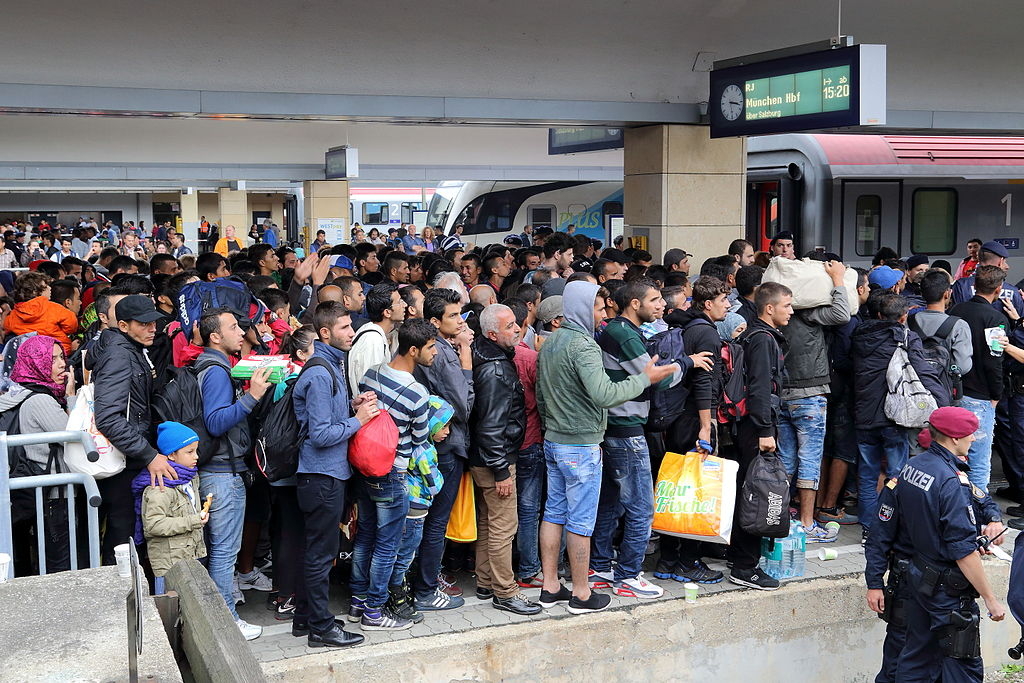
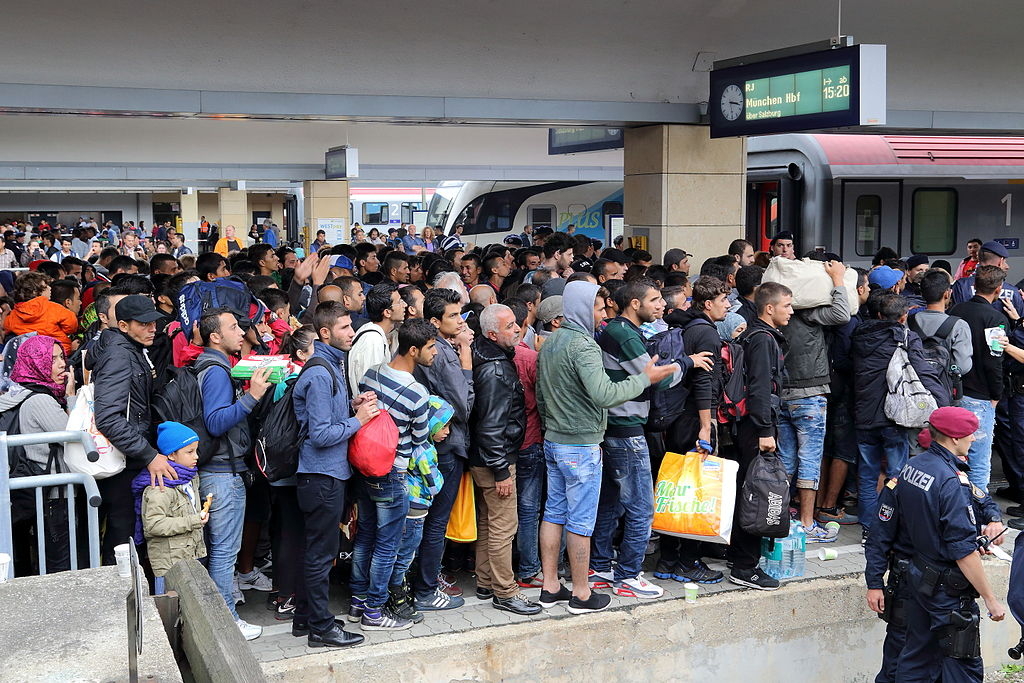
Thousands of newly arrived migrants, the vast majority of whom are men, crowd the platforms at Vienna West Railway Station on August 15, 2015 — a common scene in the summer and fall of 2015. (Image source: Bwag/Wikimedia Commons)

Critics of visa liberalization fear that millions of Turkish nationals may end up migrating to Europe. The Austrian newsmagazine, Wochenblick, recently reported that 11 million Turks are living in poverty and “many of them are dreaming of moving to central Europe.”

Other analysts believe Erdoğan views the visa waiver as an opportunity to “export” Turkey’s “Kurdish Problem” to Germany. According to Bavarian Finance Minister Markus Söder, millions of Kurds are poised to take advantage of the visa waiver to flee to Germany to escape persecution at the hands of Erdoğan: “We are importing an internal Turkish conflict,” he warned. “In the end, fewer migrants may arrive by boat, but more will arrive by airplane.”

In a refreshingly perceptive essay, Wolfram Weimer, a well-known German journalist, wrote that Erdoğan is exploiting Europe’s strategic weaknesses to advance Turkish imperialism and his goal of Islamizing the continent:

“A few days ago Erdoğan said: ‘No matter how uncouth, how merciless, how unscrupulous Western countries act, they have no chance of keeping the migration flows under control.’ In short, he sees mass migration as a political weapon to put Europe under pressure. In diplomatic and military circles, the word that has been circulating for months is ‘migration weapon’ because the Turkish secret service has been deliberately and massively promoting the migration of Muslims to Europe.

“Turkey now earns tremendous amounts of money on all sorts of migration services and has allowed the refugee industry to blossom. At the same time Erdoğan is openly pursuing the Islamization of Europe. With its religious authority Diyanet [a branch of the Turkish government’s Directorate for Religious Affairs that runs hundreds of mosques in Europe], Europe (and especially Germany) are being Islamized in a planned manner; the refugees play a key role, as do mosques, to give a ‘home’ to the faithful in a foreign land.

“Erdoğan’s favorite quote comes from a poem by Ziya Gökalp [1876-1924, a father of Turkish nationalism]: ‘The mosques are our barracks, the minarets are our bayonets.’ Erdoğan sees himself both domestically and internationally as a religious cultural warrior — as the patron saint of Islamist expansion.”

Soeren Kern is a Senior Fellow at the New York-based Gatestone Institute. He is also Senior Fellow for European Politics at the Madrid-based Grupo de Estudios Estratégicos / Strategic Studies Group. Follow him on Facebook and on Twitter. His first book, Global Fire, will be out in 2016.

Turkey Needs to Practice in Turkey What It Preaches in Cyprus by Kyriacos Kyriakides

Turkey has claimed all along that it stays in Cyprus to “protect” the Turkish Cypriot minority. Since Turkey has “protected” them, almost half of Turkish Cypriots have abandoned Cyprus. They have been conveniently replaced by Anatolian Turks whose Islamic orientation and ethos could not be more foreign to Cyprus. If Turks are so keen on “saving” minorities, why have they not applied the same principles in Turkey to save their own Kurds? With these circumstances in mind, it might be helpful to summarize the demands of the Turkish Cypriot minority and their patron, Turkey. The Turkish Cypriots are sort of like the “Kurds” of Cyprus — with the emphasis on the sort of. Like the Kurds in Turkey, the Turkish Cypriots are a sizeable minority in Cyprus — and that may be just about where the similarity ends. The Greek Cypriots, the original Cypriots, like the Kurds in Turkey, have a provenance that is deeply rooted in history. They happen to have, in fact, an uninterrupted, well-documented Greek and Christian cultural footprint that dates back over three millennia. Modern Cyprus was born in 1960 out of geostrategic concerns after an anti-colonial struggle, the aim of which was union with Greece. In Turkey, similarly to the Greeks in Cyprus, the Kurds who have lived mostly in north Kurdistan, the eastern part of the country, have a history as its indigenous people of over a thousand years. The Turkish minority in Cyprus emerged only during the Ottoman occupation of Cyprus, between the late 16th and late 19th centuries. Since that time, the Turkish Cypriots lived scattered around the island. At present, the Turkish Cypriots form an 18% minority in Cyprus[1], roughly the same percentage as the Kurds’ population in Turkey, estimated at 20%. The democratic right of self-determination for Greek Cypriots was denied by the United Kingdom, the colonial power in Cyprus since the late 19th century. The UK, by pursuing a policy of “divide and conquer,” brought Turkey into the picture as the “patron” of the minority. Then, in 1974, Turkey invaded Cyprus. Since that invasion, the Turkish Cypriots live in the illegally occupied north of Cyprus, often in the homes left behind by the Greek Cypriots who fled to safety. (Image source: Wikimedia Commons) In 1960, two powerful NATO allies, the UK and Turkey, presented the Greek Cypriot majority with a charter on ‘take-it-or-else’ basis. This crippled independence “offer” provided for three foreign guarantors of Cyprus’s territorial integrity: the UK, Greece and Turkey. There would also be two sovereign military bases for the UK, as well as a constitution laden with innumerable, apartheid-like, bi-communal characteristics. These consisted of extraordinary privileges for the Turkish Cypriot minority, such as, for example, ethnically-based separate elections and a Turkish Cypriot legislative veto system that would enable a lock-down in communal and state politics by either a simple veto from the Turkish Cypriot vice-president or simple majority of the Turkish Cypriot representatives. In other words, a mere eight MPs out of a parliament of 50, with a 70%-30% Greek Cypriot -Turkish Cypriot makeup[2] could block any legislation. And they did. Although the Turkish Cypriots used to be called Muslim Cypriots, they are mostly secular and would identify themselves as Cypriot first. Many of them are Christian converts to Islam, due to the Ottoman era’s tax system that favored Muslims. Most of them also spoke Greek, but that changed with the 1960 constitution, which separated the Greek and the Turkish communities by offering education exclusively in Greek and Turkish for each community. The problem is that in Turkey, the Turks apparently want to prevent the minority of Kurds from having any rights at all, but in Cyprus, the Turks want the Greek majority to submit to be ruled by the Turkish minority. While Turkey continues to demand full political and cultural rights and privileges for the Turkish Cypriot minority on Cyprus, when it comes to its own Kurdish population inside Turkey, the Turks continue to bomb, gag, imprison, and culturally suppress the Kurds in every way for asking for even a fraction of those rights. “Turkey is loudly championing the rights of Turkish Cypriots in the EU,” Kirsty Hughes wrote in the New York Times back in 2006[3]. “But anyone who champions Kurdish rights in Turkey risks being accused of separatism and even terrorism.” Nothing has changed. In Cyprus, according to a recent article[4] in the Turkish daily, Hürriyet, before 1974, over 80% of the land occupied by Turkey in northern Cyprus was Greek property. Greek Cypriot refugees, with their 19th century land registry property titles in hand, are still waiting to return to their literally within-sight, but inaccessible, ancestral towns and tracts of land. Despite Turkey’s efforts to encourage the Greek Cypriots to sell, so far very few have done so. According to the Republic of Cyprus’s land registry, only around 15% of all private property in Cyprus belongs to Turkish Cypriots. In Turkey, there are no official records of property ownership or other statistics by ethnicity, so there is no way of knowing what percentage belongs to Kurds. When the Republic of Turkey came into existence in 1923, after the dissolution of the Ottoman Empire, the Turks and Kurds, both Sunni Muslims, had fought side-by-side, shedding blood for independence. The Kurds had evidently expected a joint state to be formed and equally shared. The Turks, however, took control of the entire state and began to pursue policies that would force assimilation. These included, among other things, a ban of the Kurdish language, the forced relocation of Kurds to non-Kurdish areas of Turkey, the banning of any opposing organizations, and the violent repression of any Kurdish resistance. The Kurds aptly refer to these practices as “cultural genocide”. During the past 90 years, tens of thousands of Kurds have died struggling for more rights, to no avail. In the Turkish school system, for instance, even the teaching of Kurdish is forbidden. The Turkish researcher Fuat Dündar details the tactics of the Ankara governments to achieve the Kemalist goal of “one nation, one language, one country” in his 2000 book “Minorities in the Turkish Census”[5]. In Cyprus, many would agree that the historic, 82% Christian majority population should have had the right to chart its own future. The goals of the compromise solution, the Cyprus constitution, should have been two-fold: first, to secure Western geostrategic interests in the eastern Mediterranean; and second, to strike the right balance between majority and minority. Sadly, it achieved only the former, with the British military bases being the only part of the 1960 deal that to this day maintain both their sovereignty and territorial integrity. In the words of constitutional law expert, Alexander Stanley de Smith[6][7], the Cyprus charter was “unique in its tortuous complexity, and in the multiplicity of the safeguards that it provides for the principal minority … [it] stands alone among the constitutions of the world.” Unsurprisingly it did not take long for the new constitution to prove unworkable. Unable to approve state budgets three years in a row, and faced with a plethora of religion-based segregationist demands, the Cypriot president — with British encouragement , albeit duplicitous — presented proposals for a constitutional overhaul. Sir Arthur Clark, the British High Commissioner in Cyprus in 1963, was directly involved with the modifications. He was ordered by London to overlook those amendments, in order that they “would affect as little as possible the Turkish interests.” In different reports and discussions in London, Sir Arthur Clark regarded the most unworkable points of the constitution as totally logical and justified. London’s deepest worry was, and still is, the status of the British bases in Cyprus. Clark and the British Government were fully aware of the Turkish plans and intentions, long before the December 1963. Turkish attacks. He had calculated accurately, however, that the Turkish Cypriots would use the Cypriot president’s proposal as a pretext to proceed with their long-organized plan for partition.[8] Nevertheless, London never gave official approval to the final version of the “13 amendments”[9]. Indeed, the proposals did spark island-wide violence, which prompted the United Nations to send peacekeeping forces in 1964[10] . It also produced a policy of self-segregation[11], as UN Secretary General U Thant described it. The Turkish Cypriot community leaders committed themselves to physical and geographical separation of their community, and abstention from all political offices in an apparent attempt to undermine the new state. The uneasy peace this produced was ended in 1974 by a brief failed coup instigated by Greece. Greece at the time was run by a military junta, since 1967. The Greek generals attempted to overthrow the elected Cypriot government and some Greek Cypriots in the paramilitary sided with the Greek military. Dozens of Greek Cypriots died in defending the president and the Republic, almost 100 in total. No Turkish Cypriots were involved or harmed. The junta fell a day after the Turkish invasion of July 20, 1974 (five days after the coup) and democracy was restored in Greece as a result. This attempted coup offered Turkey the perfect pretext to execute a plan of “taksim”, geographic division based on ethnic and religious lines. The sole legal premise for the invasion was to restore the constitutional order and the territorial integrity of the Republic of Cyprus. Although not a single Turkish Cypriot was harmed as a consequence of the coup, Turkey launched a massive military invasion, the repercussions of which were, to say the least, devastating. More than 1% of the population, or 6000 people, lost their lives, and for the first time in Cypriot history a purely ethnic-based geographic division was established. The northern part of the island was ethnically cleansed of almost its entire population; all surviving Greek Christians fled south. In the subsequent months, the Turkish Cypriots living in the free southern part were encouraged to abandon their homes for a new life in the north. This organized “temporary” transfer was facilitated by the British and completed by 1975. Despite the Turkish Cypriot policy of self-segregation in the 1960s and the 1974 invasion by Turkey, the Republic of Cyprus survived as the sole legitimate state, sovereign over the entire island, today a member not just of the United Nations but the European Union and the eurozone as well. The status quo in the north of Cyprus is a self-declared state called the “Turkish Republic of Northern Cyprus” (or “TRNC”), recognized only by Turkey, which maintains 40,000 troops there. The European Union considers the entire island as part of its own territory. However, as the Republic of Cyprus authorities have no control over the Turkish-occupied northern part, the “acquis communautaire,” or EU law, cannot be enforced pending a final resolution to the problem. The UK, in violation of its own legal obligations, remained on the sidelines, enabling the Turkish invasion and throwing its full diplomatic support behind the legitimization of the “facts on the ground” ever since. From its perspective, any solution that preserves the vital military bases and entrenches the status quo is an acceptable solution. Turkey remains involved in its ostensibly noble “protective” pursuits in Cyprus. Turkey has claimed all along that it is there to protect and save the Turkish Cypriot minority. This claim has been refuted by facts and experts alike. Since Turkey “saved” them, almost half of Turkish Cypriots have abandoned Cyprus and have been conveniently replaced by Anatolian Turks, whose Islamic orientation and ethos could not be more foreign to Cyprus. Since the Turkish invasion of 1974, Turkey has implemented a systematic policy of colonization, in direct violation of the Geneva Conventions. It has been condemned by various international bodies, including twice by the Council of Europe. In 2003, the Council of Europe revisited the issue of settlers. The report produced by Jaakko Laakso was approved by an overwhelming majority. It stated that “it is a well-established fact that the demographic structure of the island has been continuously modified since the de facto partition of the island in 1974 as a result of the deliberate policies of the Turkish Cypriot administration and Turkey.”[12] As a matter of fact, colonists today constitute more than half of the population in the occupied north.[13] Turkey’s objectives are obvious. It aims to change the demographic character and to distort the population balance on the island between Turks and Greeks, in the hope of gains at the bargaining table. It also shifts the balance of political power in the occupied part of Cyprus and influences the elections, since colonists are a different “breed” than the Turkish Cypriots and easily controlled. To that effect, the colonists have been given “citizenship”, Greek Cypriot properties, “voting rights” and work permits. In an interview[14], former Turkish Cypriot leader Mehmet Ali Talat admitted the policy of colonization. He said that, “there were times when ‘citizenship of the TRNC’ had been given in restaurants. There are people who never came to Cyprus, yet they were given ‘citizenship’.” But if Turks are so keen on “saving” minorities, why have they not applied the same principles in Turkey itself to save their own Kurds? To agree to reunification, Turkey and the Turkish Cypriots base their demands on two historical occurrences: the “rights” they legally secured in Cyprus’s imposed charter of 1960, and the geographic division they secured via the unprecedented Turkish military invasion of 1974. Under the United Nations and with European Union support, negotiations between Greek and Turkish Cypriots are once again in full swing. They aim to produce a plan, by early 2016 preferably, to reintegrate Turkish Cypriots back into the international community under a Cyprus bi-zonal federal structure. With these circumstances in mind, it might be helpful to summarize the demands of the Turkish Cypriot minority and their patron, Turkey. They demand: The end of the Republic of Cyprus as a legal entity and its replacement with a brand new federal state based on a 50-50% partnership between the Greek Cypriot majority and Turkish Cypriot minority An autonomous zone/state on stolen Greek Christian land A guaranteed Muslim majority in the “Turkish Cypriot state” Recognition of the “Turkish Cypriot state” under international law, much like in a confederation arrangement, making secession easier if/when warranted Universal veto rights for all federal decisions, implying that Turkish Cypriots would have to approve every decision the federation makes 50-50% representation in the upper house of the federation Over-representation in federal state positions up to two and a half times their population numbers Full exclusive education in Turkish for their community, without learning Greek, the majority’s language Half of all hydrocarbons and natural resources of Cyprus, the only finds of which have been in the southern waters controlled by the legitimate government of the Republic of Cyprus The naturalization of all illegal Turkish settlers who have been granted the pseudo-state’s “citizenship” Automatic accession of the “Turkish Cypriot state” to the EU, which the Republic of Cyprus secured in 2004. Eternal say by proxy, and presence of “Turkey” in Cypriot affairs, and by extension in those of the European Union These would seem to be extraordinary demands indeed for any ethnic minority anywhere. Many would agree that it is one thing to stand for the respect of the human, political and cultural rights of people and communities, but it is totally another to allow a minority to dictate the fate of an entire nation. Since 1960, the majority Greek Cypriots have felt hostage to what they regard a sort of tyranny by an 18% minority. What if the 20% Kurds of Turkey were to follow the Turkish Cypriot example and demand for themselves “rights” commensurate to those demanded by the Turks in Cyprus? What if Turkey’s Kurds, as preconditions to lay down their arms and drop all talk of an independent Kurdistan, applied the same Turkish logic to Turkey’s majority-minority dispute? Kurds, after all, fought alongside the Turkish majority for independence, and they have a historic claim as the native people of the entire east of the country. Turkish Cypriots can make no such claims. This might be a hypothetical list of the Kurds’ demands: The end of the Republic of Turkey as a legal entity and its replacement with a brand new federal state based on a 50-50% partnership between the Turkish majority and Kurdish minority An autonomous state in the east on what historically constitutes Kurdish land as well as autonomous zones in every major district in Turkey that has a sizable Kurdish population, with forced relocations of ethnic Turks where necessary Safeguards that their autonomous state/zones shall have guaranteed Kurdish majority Recognition of the “Kurdish state” under international law, much like in a confederation arrangement, enabling it to secede if/when warranted Universal veto rights for all federal decisions, implying that Kurds would have to approve every decision the federation makes 50-50% representation in the upper house of the federation Over-representation in state apparatus up to two and a half times Kurds’ actual numerical numbers; in other words, that Kurds would have guaranteed representation in state positions well above their population proportion Full exclusive education in Kurdish, which would become an official language of the new federation, along with Turkish; in other words, Kurds would be educated exclusively in Kurdish and Turks exclusively in Turkish, without either learning the other’s language The right to half of all hydrocarbons and natural resources of the country The naturalization of millions of Kurds from other parts of Kurdistan Eternal say and presence by outsiders, NATO perhaps, in Turkish affairs to ensure that the state would not recede to methods of the past of cultural assimilation and physical extermination Would Turks regard such demands as logical and acceptable? How would the average Turk feel if the HDP, the Kurdish party that in the recent general elections in Turkey entered parliament by surpassing for the first time the 10% threshold[15], explicitly stated these demands from the Turkish state? The truth is Turkey has always considered notions of political and cultural equality a threat to its indivisibility as a nation. Throughout Turkey’s existence, even more so perhaps today, most, if not all, ethnic Turkish politicians deny Kurds not just political status and autonomy in Kurdish majority areas but even their human rights, in a manner that bears the hallmarks of systematic persecution intent on destroying the Kurdish identity, all on the basis of the need to preserve the nation’s unity. The Kurd in Turkey cannot be educated in Kurdish, cannot learn it in public schools, cannot make use of it in an official capacity and cannot even find government websites in Kurdish. The Kurd in Turkey faces torture, repression, denial of freedom of expression and association and discrimination. The Kurd in Turkey cannot even grant her child a Kurdish name if such name entails a letter that does not exist in the Turkish alphabet. As a result, three letters, ‘Q’, ‘W’ and ‘X’ have become a symbol for the uniqueness of Kurdish identity. The Turks see one people and one nation in Turkey, but they see two in Cyprus; they see one language in Turkey, but they see two in Cyprus; they see one indivisible land in ‘bizonal-by-history’ Turkey, but they see two states in ‘bizonal-by-ethnic-cleansing’ Cyprus; they see a minority in Turkey, but they see two equal communities in Cyprus. Turkey has insisted, since the 1920s, on a policy of forced assimilation for the Kurds and other smaller minorities, but they regard as anathema any proposition for Turkish Cypriot integration. They see majoritarian democracy as the only solution in Turkey, but they cannot contemplate anything different than political equality in Cyprus, which they interpret as a 50-50 share of everything, from power, to property, to political and cultural rights. Both the Turkish Cypriots in Cyprus and the Kurds in Turkey want, at a minimum, respect for their legitimate rights as large ethnic communities within the borders where they live and share. Finding a fair and reasonable way to balance the rights of a large ethnic minority community with the rights of the majority should be the goal in both countries. Equally puzzling to Turkish double standards is the Turkish Cypriots’ silence with respect to the Kurdish struggle for political status, autonomy and cultural equality — the very rights they consider “sacred” for themselves. It is as if there is a sort of Turkish omertà (code of silence) in exchange for the military and financial support they receive. With one Turkish soldier for every two Turkish Cypriots stationed in occupied Cyprus, and at a subsidy of a billion Turkish liras a year[16], that is the way it looks. It would be sensible if the same universally accepted principles were employed to address what is essentially the same political problem, for the sake of all peoples concerned. Regrettably, we can be optimistic neither about the future of the Kurds in Turkey nor for a successful conclusion to the latest round of the Cyprus negotiations for a truly just and viable settlement. It feels as if the largest nation in the region is abusing its only indisputable Western credential, that of NATO membership, to apply a contradictory set of principles to the rights of two large ethnic minorities. Conversely, the most powerful alliance in the world, NATO, conveniently looks the other way, like a modern Pontius Pilate, while its third most powerful member abuses its military might to enforce an illicit nationalist agenda. Turkey, however, may not manage much longer to keep this split in its values regarding sizable ethnic minorities at home and abroad out of the public debate. Kyriacos Kyriakides is a political activist, current events expert and blogger based in Limassol, Cyprus. He hopes that by juxtaposing the Cyprus and Kurdish issues, a common understanding can be reached to solve both on the basis of universally accepted principles. He blogs in English and Greek. Follow him on Twitter and Facebook. [1] The 82% Greek Cypriot majority also includes three other small Greek-educated minorities that the constitution recognizes: the Armenians, the Latins and the Maronites, which altogether count for close to 4%. [2] 15 Turkish Cypriot MPs, 35 Greek Cypriots in a 50-member parliament [3] “The Cypriots and the Kurds,” by Kirsty Hughes, International Herald Tribune, November 14, 2006. [4] “KKTC’de mülkiyet kaosu,” Ömer BİLGE / LEFKOŞA, 31 Temmuz 2015 [5] Fuat Dündar, “Türkiye Nüfus Sayimlarinda Azinliklar” (Minorities in the Turkish Census), Istanbul: Çivi, 2000. (Translated in Greek in 2003 by Infognomon). [6] Republic of Cyprus: Core document on Cyprus drawn up in accordance with General Assembly resolution 45/85 and the consolidated guidelines for the initial part of the reports of States parties (document HRI/991/1) – May 2008 [7] Cyprus: Sui Generis, The New Commonwealth and its Constitutions, 1964, Pages: 282-296, Publisher: Stevens & Sons, Authors De Smith, Alexander Stanley [8] Bloody Truth, C6: “The 13 Points”, page 326 [9] Suggested measures for facilitating the smooth functioning of the state and for the removal of certain causes of inter-communal friction (1963), President of the Republic of Cyprus, Archbishop Makarios, 30 November 1963. [10] These forces are still in place today. UNFICYP, as they are called, is one of the longest-running UN peacekeeping missions. [11] “Turkish Cypriot leadership is committed to physical and geographical separation of the communities as a political goal, it is not likely to encourage activities by Turkish Cypriots which may be interpreted as demonstrating the merits of an alternative policy. The result has been a seemingly deliberate policy of self-segregation by the Turkish Cypriots (S/6426, Report of 10.6.1965, p. 271)”. [12] “Colonisation by Turkish settlers of the occupied part of Cyprus,” Doc. 9799, 2 May 2003, Report Committee on Migration, Refugees and Demography, Rapporteur: Jaakko Laakso, Finland, Group of the Unified Left. [13] “In 2011, the resident population was reported at 286,257 (excluding the Turkish army), of which ‘TRNC’ citizens amounted to 190,494 (66.5% of the resident population) [with] what might be termed the indigenous Turkish Cypriot population around 136,000 people, or 47.6% of the total resident population.”, in-cyprus.com, ‘Northern Cyprus demographics: who is voting?’ by Fiona Mullen — 25/04/2015. [14] Interview to the Turkish Cypriot daily “VATAN” (24/10/05). [15] HDP scored 13.1% in the 2015 general elections, which made it the 4th party to enter parliament with 80 deputies, the same as MHP nationalist party. [16] Roughly 350 million US dollars at today’s exchange rate, or 500 million less than a year ago.

Turkey Jails American Pastor by Uzay Bulut

  • “[T]he charging documents do not present any evidence against him…. He is being held simply because of his Christian beliefs and is facing grave danger in a Turkish prison.” — Gene Kapp, American Center for Law and Justice.

  • “The government of Turkey — led by an Islamic party — has begun increased crackdowns on Christians, and Pastor Andrew, if convicted, may face years in prison based on extremely serious — and false — charges,” wrote Jordan Sekulow, Executive Director, American Center for Law and Justice.
  • “A Turkish judge had the option to deport Pastor Andrew, release him on weekly sign-ins at the local police station, or imprison him. The judge chose to remand Pastor Andrew to prison.” — American Center for Law and Justice.
  • The global “human rights community” has done nothing to help him. One hopes that the incoming Trump administration will stand up for his freedom.

American Pastor Andrew Brunson has been jailed in the city of Izmir, in western Turkey, on charges of “being a member of an armed terrorist organization”.

Brunson — a U.S. citizen from Black Mountain, North Carolina — has led Protestant churches in Turkey for over 23 years with the knowledge of local authorities, and has raised his family there.

Brunson and his wife, Norine, were summoned to the local police station in Izmir on October 7, 2016 to discuss their application to renew their visas. They thought they would be receiving a long-awaited permanent residence card; instead, they were detained by Turkish police.

While Norine was released 13 days later, Pastor Brunson was informed he would be detained until deportation, based on being a “threat to national security”.

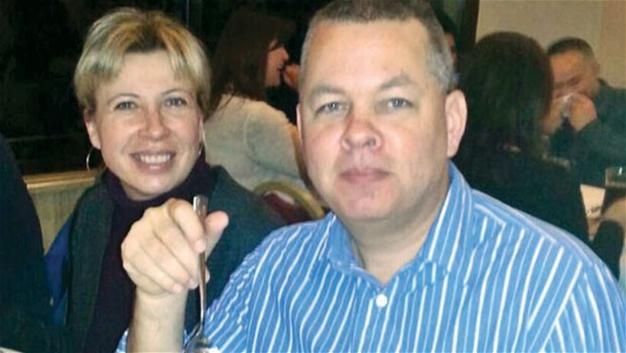
American Pastor Andrew Brunson, pictured with his wife Norine, has been jailed in Turkey on spurious charges of “being a member of an armed terrorist organization”. “He is being held simply because of his Christian beliefs and is facing grave danger in a Turkish prison,” according to the American Center for Law and Justice.

During his 63-day confinement, he was denied access to his Turkish attorney and for part of this time placed in solitary confinement. His belongings, including his glasses, phone, pen and watch, were confiscated. He was also denied a Bible.

On December 8, he was taken to a counter-terrorism center in Izmir; then to court. He was questioned, then on December 9 imprisoned after being charged with “membership in an armed terrorist organization.”

Pastor Brunson is now in the Sakran 3 Nolu T Tipi Prison near Izmir. The authorities there declined Gatestone Institute’s requests for comment.

The American Center for Law and Justice (ACLJ), which represents the Brunson family, is working to secure his freedom. “He faces a serious, yet completely unfounded, charge — ‘membership in an armed terrorist organization.’ In fact, the charging documents do not present any evidence against him,” the ACLJ’s Gene Kapp told Gatestone.

“He is being held simply because of his Christian beliefs and is facing grave danger in a Turkish prison,” the ACLJ reported.

“A Turkish judge had the option to deport Pastor Andrew, release him on weekly sign-ins at the local police station, or imprison him. The judge chose to remand Pastor Andrew to prison.”

Brunson is now allowed visits with his Turkish attorney, said Kapp.

“However, due to an emergency decree in Turkey, those visits are recorded and any notes taken by his attorney are copied. Thus, Pastor Andrew has no attorney-client privilege.”

Earlier reports that claimed that Brunson is held in the same cell as Islamic State terrorists were denied by his wife, Norine.

Brunson’s future seems uncertain. “No trial date has been set. In recent days, the court has denied an appeal,” Kapp said.

Gatestone asked the ACLJ for an interview with Brunson’s Turkish lawyer, but Kapp said:

“As this case continues, we are not at liberty to put our representatives in Turkey on the phone with reporters. I am sure you can understand the sensitivity to this case and the nature of the serious charges.”

More than 99% of Turkey’s population is Muslim; there are about 10,000 Protestant Christians in the country.

According to the Association of Protestant Churches in Turkey, 100 expatriate Protestants have been prevented from serving in Turkey during the past four years: their visas or residence permits were not extended.

“The government of Turkey — led by an Islamic party — has begun increased crackdowns on Christians, and Pastor Andrew, if convicted, may face years in prison based on extremely serious — and false — charges,” wrote Jordan Sekulow, executive director of the ACLJ.

An American, Brunson, has been stripped of all of his basic rights and is being held in a Turkish prison despite there being no evidence against him. The global “human rights community” has done nothing to help him. One hopes that the incoming Trump administration will stand up for his freedom.

Uzay Bulut, a journalist born and raised a Muslim in Turkey, is currently based in Washington D.C.

Translate »
Skip to toolbar