Monthly Archives: June 2017

Turkey’s Oppression Machine by Burak Bekdil

  • The law stated that the homes and workplaces of those non-Muslims who could not afford the tax would be sequestered.


  • Under the AKP rule, Turkey’s dwindling Jewish community, now at around a mere 17,000, as well as other non-Muslims, have come under systematic intimidation from government politicians and bureaucrats. These non-Muslim minorities are also often the targets of racist attacks.

It was 1942 when, one day, Hayim Alaton, a Jewish yarn importer in Istanbul, received two payment notices from the tax office: He was asked to pay 80,000 liras in total — a fortune at that time. He ran to the tax office to object, but was told to pay the whole amount within 15 days. It was the infamous Wealth Tax, passed on Nov. 11, 1942 and it remained in effect for a year and a half until it was repealed on March 14, 1944.

The Wealth Tax exclusively targeted Turkey’s non-Muslims at a time when 300,000 Orthodox Greeks and 100,000 Jews were living in Istanbul (where total population was one million). The law stated that the homes and workplaces of those non-Muslims who could not afford the tax would be sequestered. Alaton was able to pay no more than 11,000 liras. That was the start of “black years,” as Alaton’s son, 15 years old at that time, would later recall.

Before long, the Alaton’s home and store were sequestered. The merchandise in the store and the goods in stock were sold at auction. Every item in the Alaton home, including kitchen utensils, bed frames and lamps were seized and sold too. The family of six was left only with mattresses. In later days, Alaton was taken from his home and sent to a tent camp in Istanbul where he was kept for two months. There were no meals, so his children would bring him whatever food they could find. One day the 15-year-old Ishak went to the camp and saw his father’s tent empty. The Turkish authorities had put Alaton, along with many others, on a train bound for the town of Askale, in eastern Turkey, where the non-Muslims would be forced to perform physical labor, in this instance, cutting stones on a hill. Alaton would stay in the forced-labor camp for two hard winters and one summer.

The family would not hear from him for a year. During that time, the bodies of 20 laborers at Askale were sent home. Ishak recalls his father’s return: “One evening, there was a knock on our door and an aged, wretched beggar stepped in. We wondered who he was and looked at him with curiosity. When he started to speak, we knew from his voice that he was my father.”

By that time, the family business had gone bankrupt and Alaton, in the grip of a crippling depression, could not leave home. He died running a small store where he sold a small inventory of imported goods.

In a 2011 interview, Hayim Alaton’s son, Ishak, who, after turbulent years in his youth, would found one of Turkey’s most successful industrial conglomerates, would praise Turkey’s ruling Islamists, the Justice and Development Party (AKP) by saying “the AKP has taken many positive steps to improve the situation of non-Muslim minorities.”

Unfortunately, that was a premature conclusion, as the younger Alaton would learn four years later.

Under the AKP rule, Turkey’s dwindling Jewish community, now at around a mere 17,000, as well as other non-Muslims, have come under systematic intimidation from government politicians and bureaucrats. These non-Muslim minorities are also often the targets of racist attacks.

Now 90, Ishak Alaton, although widely respected as “a man of wisdom” by the Turks — Jews, Christians and Muslims alike — is under scrutiny on charges of supporting terror.

An Ankara prosecutor is inspecting claims that Alaton has provided financial and moral support to what the state bureaucracy calls “the parallel structure” — a movement led by an influential U.S.-based Muslim cleric, Fethullah Gulen. Gulen and his movement were staunch AKP allies until the end of 2013, when the two engaged in an all-out war. The Gulenists accuse Turkey’s President Recep Tayyip Erdogan and the AKP of autocratic rule and corruption, and the Turkish government has declared the Gulenists a terror organization that aims to topple the government.

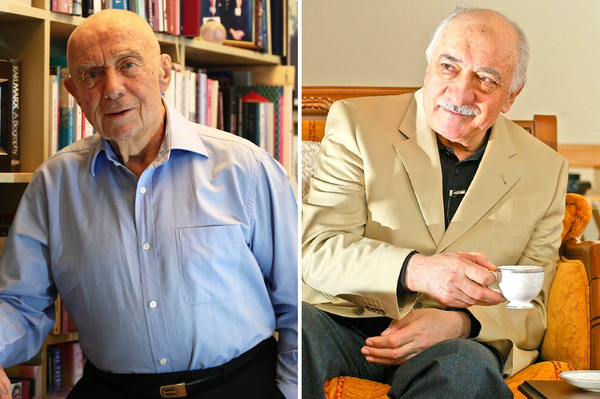
Ishak Alaton (left), a 90-year-old Turkish Jewish industrialist, is being investigated on charges of “supporting terror,” for providing financial and moral support to Fethullah Gulen (right), a U.S.-based Muslim cleric who is a political rival of Turkey’s president.

The charges against Alaton are based on his 2013 biography, “Unnecessary Man,” and were leveled after a former colleague of Alaton’s filed a criminal complaint against him. Some passages in the book refer to Alaton’s support for the Gulen movement schools outside Turkey, particularly one in Moscow. The probe has been ongoing for about a year.

This is the passage from the biography that the prosecutors may be thinking is an evidence of the 90-year-old man’s support for terror:

“This [Gulen] movement is a great educational movement. It educates people. It changes people’s outlook on life and makes them into better equipped, worldly people. The Gulen movement is involved in educational efforts. I’ve seen the outcome of such efforts with my own eyes. Once in Moscow we, as a company, participated in the establishment of such a school. We managed to acquire the land from the Moscow municipality and the school began there. The Russian officials asked us, ‘What are they trying to do? We don’t know them, what do you say?’ [My business partner] Uzeyir Garih and I vouched for them, we told them [the Russians], ‘Don’t worry, let them build the school.'”

When it comes to persecution Turkey’s state machinery never changes.

Burak Bekdil, based in Ankara, is a Turkish columnist for the Hürriyet Daily and a Fellow at the Middle East Forum.

Turkey’s Official “Cocktail Terror” by Burak Bekdil

  • In its latest attack in Turkey, ISIS used a child suicide bomber to attack a wedding ceremony. More than 50 victims were killed, of whom 26 were less than 18 years old.

  • This is premeditated, officially-tolerated murder. Evidence? Two opposition parties appealed to parliament five times asking for a parliamentary investigation into ISIS and its activities in Turkey. All five requests were rejected by the votes of the ruling AKP Party, Erdogan’s powerful political machine.
  • The opposition claims SADAT International Defense Consultancy, which was established by soldiers dismissed from the military due to Islamist activities, offers ISIS operatives training in “intelligence, psychological warfare, sabotage, raiding, ambushing and assassination.” Erdogan this month appointed the owner of SADAT, retired Brigadier General Adnan Tanriverdi, as his chief presidential advisor.

Failing to name Islamic terror has cost Turkey hundreds of lives and will likely cost it hundreds more, as the country’s leaders — and many others, especially in the West — are still too demure to call Islamic terror by its name. Without a realistic diagnosis, the chances of a successful treatment are always close to nil, and Turkey’s leaders stubbornly remain on the wrong side of the right diagnosis.

President Recep Tayyip Erdogan’s theory that “there is no Islamic terror,” coupled with his persistent arguments that Islamist radicals hit Europe because of Islamophobia in the Western world, are not only too remote from reality but have now become a curse in his own country.

As early as 2014, cars began to be seen in the streets of Istanbul sporting the black flag of the Islamic State of Iraq and Syria (ISIS). The same year, Islamists opened a shop selling T-shirts featuring the same flag. ISIS-related magazines went ahead with open hate content even though, in March 2014, ISIS spilled its first blood in Turkey when an ISIS team ambushed a police checkpoint and killed one police officer, one soldier and one civilian.

In its first suicide attack on June 5, 2015, ISIS targeted a pro-Kurdish rally in Diyarbakir, killed four people and injured 279. It targeted, once again, a pro-Kurdish gathering in July 2015 in Suruc, a small town bordering Syria, killed more than 30 people and injured more than 100.

When, in October 2015, Islamists attacked the main train station in Ankara and killed more than 100 civilians in the worst terror attack in Turkey’s history, Turkish officials were once again too demure to blame it on radical Islamists. Instead, they invented an unconvincing concept, “cocktail terror,” putting the blame on a mixture of various terror groups.

In a span of just one year, starting with the Suruc suicide bomb attack in July 2015, ISIS terror attacks in Turkish soil have killed 265 people and injured 1,256.

In its latest attack in Turkey on August 21, ISIS did something it had not done before: it used a child suicide bomber with explosives detonated by a remote controller. The target was a wedding ceremony in the southern city of Gaziantep; most of the victims were children, like the suicide bomber himself. More than 50 victims were killed, of whom 26 were less than 18 years old. Two of the victims had just turned four.

On August 21, ISIS terrorists used a child suicide bomber to kill more than 50 people, mostly children, at a wedding in Gaziantep. (Image source: ABC News video screenshot)

This is premeditated, officially-tolerated murder. Evidence? Between Aug. 14, 2014 and June 29, 2016, two opposition parties, the social democrat Republican People’s Party (CHP) and the pro-Kurdish People’s Democratic Party (HDP), appealed to parliament five times asking for a parliamentary investigation into ISIS and its activities in Turkey. All five requests were rejected by the votes of the ruling Justice and Development Party (AKP), Erdogan’s powerful political machine. Why would a ruling party vote down an investigation request into a barbaric terror group that has killed hundreds of people in its own country? But there is more.

In July, slightly more than a month before the ISIS’s child bomber was blown up along with more than 50 others in Gaziantep, a court in the same city reduced the jail sentence of an ISIS militant due to “good conduct.” Good conduct?! The man did not even stand before the court, as the police were unable to apprehend him.

At the end of June, the main opposition party, CHP, made a parliamentary inquiry into the activities of an Istanbul-based defense company accused of having links to ISIS. The opposition claims the SADAT International Defense Consultancy, established in the early 2000s by soldiers dismissed from the military due to Islamist activities, offers “irregular warfare training” in various fields including “intelligence, psychological warfare, sabotage, raiding, ambushing and assassination.” The inquiry said: “…that special commissioned and non-commissioned officers have begun working at this company with high salaries, and that in camps irregular warfare training has been given to ISIS and its derivatives.”

SADAT’s owner and chief official is retired Brigadier General Adnan Tanriverdi widely known for his close relations with Erdogan and the AKP.

Since the opposition made the parliamentary inquiry, it has not heard from the government benches about its request for an investigation into SADAT. But, after the inquiry, the government made a move. In August Erdogan appointed Tanriverdi as his chief presidential advisor.

Turkey’s war with radical jihadists is a too demure and reluctant one — if not fake altogether.

Burak Bekdil, based in Ankara, is a Turkish columnist for the Hürriyet Daily and a Fellow at the Middle East Forum.

Turkey’s Islamist Factory Settings by Burak Bekdil

  • Normalization of relations with Israel could bolster efforts to balance Iran’s growing regional clout.

  • “In the Middle East, everyone at some point realizes that there is a bigger enemy than the big enemy.” – Israeli official.

  • But in the Middle East, reason does not always overcome holiness.


Israel-bashing and the systematic fueling of anti-Semitic behavior have become a Turkish political pastime since Turkey downgraded its diplomatic ties with Israel in 2010. There has been, though, relative tranquility and reports of a potential thaw since June 7, when Turkey’s Islamist government lost its parliamentary majority for the first time since it rose to power in 2002.

In August, a senior Hamas official, apparently hosted for some time by an all-too affectionate Turkish government, vanished into thin air. Saleh al-Arouri, a veteran Hamas official and one of the founders of its military wing, the Izz ad-Din al-Qassam Brigades, was forced to leave Israel in 2010, after serving more than 15 years in prison. After his release, he was believed to be living in Istanbul. In August 2014, at a meeting of the International Union of Islamic Scholars in Istanbul, al-Arouri said that Hamas was behind the kidnapping of three Israeli teenagers in the West Bank, an incident that triggered a spiral of violence in Gaza and Israel that summer.

A year later, Turkish diplomatic sources said that “Arouri was not in Turkey” although they did not confirm or deny earlier reports that Turkey had deported him.

Earlier than the news about Arouri, top diplomats from the two countries had secretly met in Rome. Dore Gold is Israel’s Foreign Ministry Director-General, and his Turkish counterpart was Feridun Sinirlioglu, then the Turkish Foreign Ministry’s undersecretary. Sinirlioglu is a career diplomat, not an Islamist political appointee. Between 2002 and 2007, he served as Turkey’s ambassador to Israel.

On June 24, Turkish Foreign Minister Mevlut Cavusoglu confirmed ongoing talks with Israel, aimed at reaching some form of rapprochement, while suggesting that undue emphasis should not be placed on the gatherings.

Fast-forward to August: Turkish Prime Minister Ahmet Davutoglu forms an interim cabinet to take the country to snap elections on Nov. 1, and Sinirlioglu becomes Turkey’s new Foreign Minister. One of the first to send his congratulations to Sinirlioglu was Dore Gold.

In early September, Gold, a long-time advisor to Israeli Prime Minister Benjamin Netanyahu,said: “I have to say that many people in different capitals asked about the Rome meeting and … I heard the highest praise whether I was in a European capital or speaking to American officials about his diplomatic skills …Turkey is very lucky to have him [Sinirlioglu] as foreign minister. He is a first-class diplomat.”

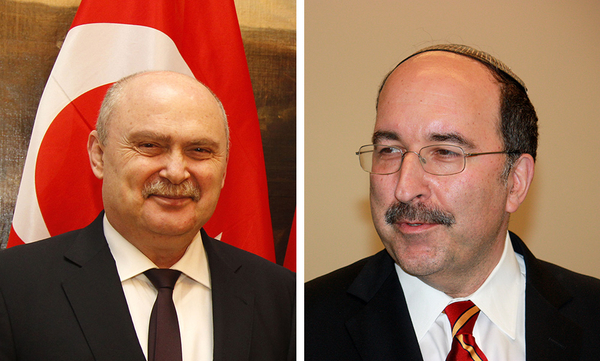
The Israeli press reported in June that Israel’s Foreign Ministry Director-General Dore Gold (R) held a secret meeting in Rome with Feridun Sinirlioglu (L) Turkey’s then Foreign Ministry Undersecretary (today Foreign Minister).

Apparently, reason had gained a bit of the upper hand after Turkey’s parliamentary elections in June. It is, no doubt, in the best national (and rational, too) interests of both countries, which once were best regional allies — before the Islamists rose to power in Turkey in 2002. A normalization of relations with Israel could bolster efforts to balance Iran’s growing regional clout. It could as well help keep Gaza relatively peaceful, stable and economically more viable.

But in the Middle East, reason does not always overcome holiness. Israel, Jews, Hamas and “our Palestinian brothers” remain a few of the most popular themes in Islamist election rallies — the best ones to exploit a Muslim voter base.

Things between the two countries look relatively calm these days, but a fresh round of attacks from Turkey’s Islamist politicians during election rallies are not unlikely.

An Israeli official was right when he told this author recently: “In the Middle East, everyone at some point realizes that there is a bigger enemy than the big enemy.”

Turkey and its best regional (Sunni) ally, Qatar, may have come to understand that they are paying a price for unconditionally supporting Hamas, and sometimes abusing this support. Apparently, there are some signs of a potential change in the Turkish-Qatari solidarity with Hamas. But caution is required. No one is sure yet if those signs indicate a medium-term policy change.

Jerusalem is not unaware of the risks of reaching premature conclusions about any normalization with Turkey. Prime Minister Netanyahu has every reason not to trust Turkey’s dominant pro-Sunni, pro-Hamas and anti-Israel Islamist polity. He knows that any normalization may collapse in a matter of months if the Turkish Islamists decide to start a new fight with Israel. Both countries would look ridiculous if they have to withdraw their ambassadors once again two months, say, after they were appointed. Turkish behavior in the event of normalization would be unpredictable. But it would also depend very much on the election results on November 1.

If, as in June’s elections, PM Davutoglu’s ruling Justice and Development Party (AKP) fails to win a parliamentary majority, it will be forced into a coalition government with one of the three opposition parties, with the social-democratic Republican People’s Party (CHP) appearing as a likely prospective partner. The AKP will have to compromise on its Islamist policies, including foreign policy — particularly in the Middle East. The AKP would be reluctant to surrender foreign policy entirely to any coalition partner but may be lured into a compromise in which someone such as Sinirlioglu (the experienced diplomat and presently interim foreign minister) may be the solution satisfying everyone.

But the opposite is also true. In case of a landslide AKP victory on November 1 and a single-party government, all Middle East policy, including relations with Israel, could have to be reset to the Islamist factory settings.

Perhaps the headline in Zaytung, an online humor magazine and a Turkish response to The Onion, explains it all: “The Foreign Ministry, which has neglected its routine work due to civil strife in the country, gave signs of a return to normality when it condemned Israel.”

Burak Bekdil, based in Ankara, is a Turkish columnist for the Hürriyet Daily and a Fellow at the Middle East Forum.


Turkey’s Islamic Supremacist Foreign Policy by Uzay Bulut

  • “We have never been involved in an attack against Turkey … we were never involved in such an action… Davutoglu wants to pave the way for an offensive on Syria and Rojava and cover up Turkey’s relations with the ISIS which is known to the whole world by now.” — YPG (Kurdish) General Command.
  • “Thousands of settlers from Anatolia were shipped in by the Turkish government to occupy former Greek villages and to change Cypriot demography — in the same manner the occupying Ottoman Empire once did in the 16th century.” — Victor Davis Hanson, historian.
  • Turkey, for more than 40 years, has been illegally occupying the northern part of the Republic of Cyprus, historically a Greek and Christian nation, which it invaded with a bloody military campaign in 1974.
  • What Turkey would call a crime if committed by a non-Turkish or a non-Sunni state, Turkey sees as legitimate if Turkey itself commits it.

Between March 29 and April 2, 2016, Turkey’s president, Recep Tayyip Erdogan, paid a visit to Washington D.C. to participate in the 4th Nuclear Security Summit hosted by U.S. President Barack Obama.

In an interview with CNN broadcast March 31, Erdogan said, “We will not allow an act such as giving northern Syria to a terrorist organization… We will never forgive such a wrong. We are determined about that.”

Asked which terror organization he was referring to, Erdogan said: “The YPG [Kurdish People’s Protection Units], the PYD [Democratic Union Party] … and if Daesh [ISIS] has an intention of that sort then it would also never be allowed.”

Erdogan was thereby once again attempting to equate Islamic State (ISIS), which has tortured, raped, sold or slaughtered so many innocent people in Syria and Iraq, with the Kurdish PYD, and its YPG militia, whose members have been fighting with their lives to defeat genocidal jihadist groups such as al-Nusra and ISIS.

The question is not why Erdogan or his government have such an intense hatred for Kurds. Turkey’s genocidal policies against the Kurds are not a secret. Turkey’s most recent deadly attacks are ongoing in Kurdish districts even now. The more important question is why Erdogan thinks that Turkey is the one to decide to whom the predominantly Kurdish north of Syria will belong — or who will not rule that part of Syria.

On February 17, Turkey’s capital, Ankara, was shaken by a car bomb that killed 28 people and wounded 61 others.

Turkey’s Prime Minister, Ahmet Davutoglu, immediately announced that the perpetrator was a Syrian national with links to the Syrian Kurdish People’s Protection Units (YPG).

“A direct link between the attack and the YPG has been established,” Davutoglu said. “The YPG attack was carried out with logistical support from the Kurdistan Workers’ Party (PKK) inside Turkey. Just as al-Qaeda or Daesh do not have seats at the table, the YPG, which is a terrorist organization, cannot have one.” He then once again refused to permit Kurdish YPG participation in U.N.-brokered Syria peace talks in Geneva.

Saleh Muslim, the head of Syria’s Kurdish Democratic Union Party (PYD), replied via Agence France-Presse: “We deny any involvement in this attack. These accusations are clearly related to Turkish attempts to intervene in Syria.”

The General Command of the YPG also denied any involvement in the attack:

“Under challenging conditions, we are protecting our people from barbaric gangs such as ISIS and Al-Nusra. Countless states and media outlets have repeatedly reported about the support Turkey has been providing to these terrorist groups. Apart from the terrorist groups attacking us, we as YPG have engaged in no military activity against the neighboring states or other forces.

“We would like to repeat our message to the people of Turkey and the world: We have no links to this incident… We have never been involved in an attack against Turkey. The Turkish state cannot possibly prove our engagement in any kind of attack on their side because we were never involved in such an action. Turkish Prime Minister Davutoglu’s remarks ‘Ankara attack was conducted by YPG’ is a lie and far away from the truth. With this statement, Davutoglu wants to pave the way for an offensive on Syria and Rojava and cover up Turkey’s relations with the ISIS which is known to the whole world by now.”

The Middle East is going through mass murders, kidnappings, rapes, the sexual slavery of women and other crimes. And Turkey’s aggressive and supremacist foreign policy, which does not respect the sovereignty of its neighbors, has played a large role in this situation.

Syria and Iraq, Turkey’s southern neighbors, are now the breeding ground of genocidal jihadist groups, foremost the Islamic State (ISIS). Many reporters, experts and eyewitnesses have revealed that Turkey has contributed to the rise of jihadist terrorists in the region — by letting ISIS members get in and out of Turkey and even by providing funds, logistics, and arms for ISIS.

Inside its own boundaries, Turkey has been engaged in an all-out war against its own Kurdish citizens since last August. Turkey has been murdering them indiscriminately and destroying their homes and neighborhoods.

Turkey’s hatred of Kurds is so intense that it also targets Kurdish defense forces in Syria.

On February 13, Davutoglu confirmed shelling the Kurdish YPG group in Syria, after the YPG advanced on the rebel-held town of Azaz in Syria. “We will retaliate against every step [by the YPG],” Davutoglu said. “The YPG will immediately withdraw from Azaz and the surrounding area and will not go close to it again.”

The rebels in Azaz and elsewhere in Syria are mostly Islamist jihadists. According to the scholar Aymenn Jawad Al-Tamimi, Azaz was mostly controlled in early 2015 by the group Liwa Asifat al-Shamal (“Northern Storm Brigade”), affiliated with the Islamic Front. Syria’s al-Qaeda affiliate Jabhat al-Nusra (“Al-Nusra Front”) also had a presence there.

“Azaz is a symbol for Turkey,” said Fabrice Balanche of the Washington Institute For Near East Policy. “Prime Minister Davutoglu fears that if the Kurds capture Azaz, they could start a big offensive from Kobane to the west and from Afrin to the east,” he told BBC.

As widely reported, the crisis in the region reached a peak when a Turkish Air Force F-16 fighter jet shot down a Russian Air Force Su-24 bomber along the Turkey-Syria border on November 24, killing the pilot, Lieutenant-Colonel Oleg Peshkov. The Turkish government tried to excuse the attack by claiming that the jet was downed after it had violated Turkish airspace for 17 seconds.

The Russia Defense Ministry, however, denied the aircraft ever left Syrian airspace, and released a video they claimed shows that the Su-24 was not in Turkish airspace when it was shot down.

Meanwhile, Turkey’s neighbor to its West, Greece, has long been a victim of Turkey’s violations of its sovereign airspace. According to data recorded by the Greek military, in 2014 alone, Turkish aircraft violated Greek airspace 2,244 times. On just one day, February 15, Turkish warplanes violated Greek airspace 22 times, according to Athens News Agency.

After Syria, Greece and Russia, Turkey’s next target was its other southern neighbor, Iraq. In December, Iraq’s President, Fuad Masum, said, “The presence of the Turkish Army Forces in Mosul Province without our permission violates international rules. I want Turkish officials to get its force out of Iraq’s territory immediately.”

Iraq’s Prime Minister Haider al-Abadi also condemned Turkey’s action: “We have not asked Turkey for any force and no one had informed us about the arrival of the force.”

Two neighbors of Turkey, Cyprus and Armenia, have also been victims of Turkish aggression — for an even longer time.

Turkey, for more than 40 years, has been illegally occupying the northern part of the Republic of Cyprus, which it invaded with a bloody military campaign in 1974. According to historian Victor Davis Hanson:

“Thousands of settlers from Anatolia were shipped in by the Turkish government to occupy former Greek villages and to change Cypriot demography — in the same manner the occupying Ottoman Empire once did in the 16th century. … The island remains conquered not because the Greeks have given up, but because their resistance is futile against a NATO power of some 70 million people. Greeks know that Turkey worries little about what world thinks of its occupation.”

Turkey has also been blockading yet another neighbor since 1993: “Turkey and Azerbaijan have effectively been exercising an illegal unilateral economic blockade against Armenia, which has hurt the latter economically,” wrote Armen V. Sahakyan, the executive director of the Eurasian Research and Analysis Institute. “Turkey and Azerbaijan are in clear violation of the Principle of Good Neighborliness, as well as all of the General Assembly resolutions condemning unilateral coercive measures.”

Turkey has been assaulting its neighbors in what appears as outbursts of Turkish Islamic supremacy. What Turkey would call a crime if committed by a non-Turkish or a non-Sunni state, Turkey sees as legitimate if Turkey itself commits it.

When Turkey invaded Cyprus, historically a Greek and Christian nation, it is not called an invasion. Turkey still refers to the 1974 military campaign as a “peace operation.” Senior politicians and military officials from Turkey also participate in the official ceremonies called “the Peace and Freedom Festival,” organized in occupied northern Cyprus on July 20 every year, to celebrate what they “achieved” more than 40 years ago — namely, an ethnic cleansing and colonization campaign that they conducted through many crimes, including mass murders, wholesale and repeated rapes, torture and inhuman treatment, plundering Cypriot cultural heritage and destroying churches, among others.
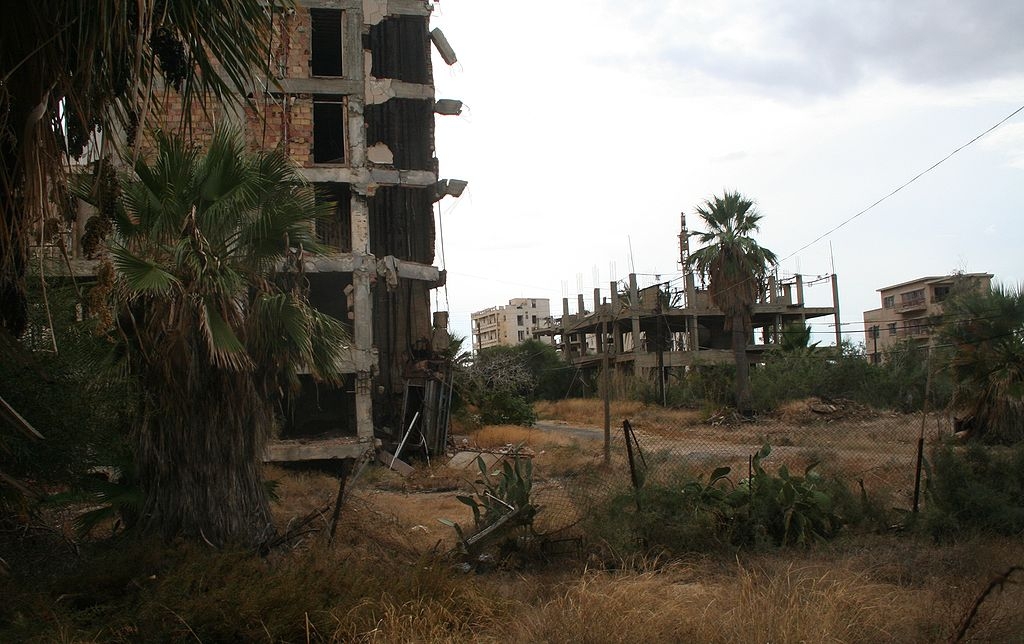
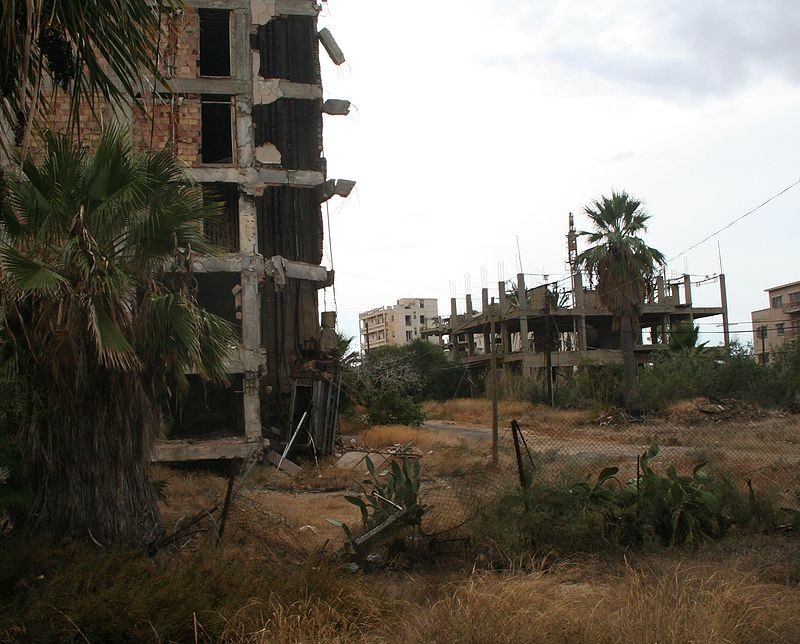
The crumbling buildings of the Varosha district of Famagusta, Cyprus, photographed in 2009. The area lies within Turkish-controlled northern Cyprus. The inhabitants fled during the 1974 Turkish invasion and the district has been abandoned since then. (Source: Wikimedia Commons)

If anyone blockaded another state, especially a Sunni state, Turkey would most certainly condemn it. But when Turkey itself blockades a Christian nation, it is always “justified” — most often as a response to some “unacceptable wrongdoing” by the other side.

If a non-Turkish, or non-Sunni state, treated a Turkish or Sunni minority brutally, Turkey would passionately condemn it. But Turkey sees no harm in slaughtering its own Kurdish citizens, and devastating their towns. Turkey claims this is a just way of “fighting against terrorism.”

Turkey can shoot down a Russian plane in the blink of an eye, because supposedly no one can violate Turkish airspace even for a few seconds — or even if no such violation takes place. But Turkey can violate the Greek sovereign airspace countless times as a national sport or hobby whenever it feels like it?

If Western authorities criticize Turkey for its policies, Turkey accuses them of “intervening in Turkey’s internal affairs.”

For instance, when a group of journalists close to the movement of the Islamic cleric Fethullah Gulen were detained in a mass arrest operation on December 14, 2014 in Turkey, the European Commission, in a joint statement, criticized the police raids and arrests of the media representatives.

EU foreign affairs chief Federica Mogherini and the commissioner heading EU enlargement talks also said the arrests went “against European values.”

Turkish President Recep Tayyip Erdogan responded in a public speech:

“When we take a step, someone in the European Union immediately comes up and makes a statement. According to what do you make this statement? What do you know?

“Those who have made this country wait at the gate of the European Union for 50 years, do you ever know what this [our] step is? The elements that threaten our national security — be they members of the press, or this or that — will get the required response. It is impossible for us to make them sovereign in this country.

“And when we take such a step, we do not think about ‘what will the European Union say?’ or ‘will the EU accept us [as a member]?’ We do not have such concerns. We will pull ourselves up by our own bootstraps. Please keep your intellect to yourselves.”

Erdogan also said that the detentions were not an “issue” of press freedom and claimed that the Fethullah Gulen movement was backed by Israel, which Erdogan referred to as “the country in the south that he [Gulen] loves.”

So, the European Union, of which Turkey is allegedly “striving” to be a member, cannot even issue a critical statement concerning Turkey’s policies because that would “intervene in Turkish steps for national security,” but Turkey can send jihadist fighters, arms or funds into Syria or Iraq and destroy lives and civilizations there?

Turkey seems to believe it always has to be strong and a leading force in the region. But if Kurds — an indigenous, stateless and persecuted people — are to gain a single right anywhere in the world, does Turkey find that unacceptable?

The entire history of Turkey as well as its current policies demonstrate that Turkey believes Kurds are inferior to Turks. Turkey does not even recognize the Kurds’ right to be educated in Kurdish, evidently in an attempt to separate them from their identity.

“The policy of Republican Turkey since its establishment in 1923,” wrote the author Amir Hassanpour, “is a typical case of what has been called ‘linguicide’ or ‘linguistic genocide.’ Forcing the Kurds to abandon their language and become native speakers of Turkish is the primary goal of the language policy.”Freedom and sovereignty are for Turks only. Kurds are just to be murdered or to be Turkey’s servants. This has been the state policy of Turkey ever since it was founded in 1923.


“The master in this country is the Turk,” said Mahmut Esat Bozkurt, Turkey’s first Minister of Justice, in 1930. “Those who are not genuine Turks can have only one right in the Turkish fatherland, and that is to be a servant, to be a slave. We are in the most free country of the world. They call this Turkey.”

Uzay Bulut, a Turkish journalist, is currently based in Washington DC.

Turkey’s Growing Influence over Islam in Austria by Soeren Kern

  • The Berlin-based expert on Turkey, Ralph Ghadban, warns that the Islam being preached in Turkish-controlled mosques in Europe is a “Sharia Islam with strong Turkish-nationalist overtones” that calls for a “strict separation from Western individualistic values.”

  • In February 2016, the University of Vienna published study which found that Islamic kindergartens in the capital are dominated by “intellectual Salafists and political Islamists” who are contributing to the “theologically-motivated isolation” of Muslim pupils. The report calls into question claims by the IGGiÖ that anti-Western textbooks have been removed from Austrian schools.
  • Muslim students now outnumber Roman Catholic students at middle and secondary schools in Vienna, according to official statistics, which show that Muslim students are also on the verge of overtaking Catholics in Viennese elementary schools. The data confirms a massive demographic and religious shift in Austria, traditionally a Roman Catholic country.

The selection of an ethnic Turk to lead the Islamic Religious Community in Austria (Islamischen Glaubensgemeinschaft in Österreich, IGGiÖ), the primary representative of Muslims in the country, is being challenged by Muslim groups opposed to Turkey’s growing influence over the practice of Islam in Austria.

Ibrahim Olgun, a 28-year-old Austrian-born Islamic theologian with ties to the Turkish state, was quietly named on June 19 to replace 62-yer-old Fuat Sanac, who stepped down after serving as IGGiÖ president for five years.

Sanac, also a Turk, was reviled by Turkish authorities for helping the Austrian government draft a new Islam Law (Islamgesetz) that aims to promote an “Islam with an Austrian character.” The law, which was promulgated in February 2015, seeks to reduce outside meddling by prohibiting foreign funding for mosques, imams and Muslim organizations in Austria. It also stresses that Austrian law must take precedence over Islamic Sharia law for Muslims living in the country.

Observers worry that Olgun — a member of the Turkey-financed Turkish-Islamic Union for Cultural and Social Cooperation in Austria (ATIB), an influential group that has vowed to challenge the Islam Law at Austria’s Constitutional Court — will use his new position both to undermine the Islam Law and to increase further Turkey’s influence over Muslims in Austria.

At least eight Austrian Muslim groups (representing Albanian, Arab, Bosnian and Sufi Muslims) are challenging Olgun, who was selected by the IGGiÖ’s Shura Council (Schurarat), a rules committee (Shura is an Arabic word for consultation) whose five members all happen to be ethnic Turks.

IGGiÖ statutes require a person to be at least 35 years old to head the group, but the Shura Council secretly annulled that stipulation last December, according to Hassan Mousa, head of the Arab Religious Community in Austria (Arabischen Kultusgemeinde in Österreich). He said that Olgun’s selection was “undemocratic” and “illegal” and added that his ties to ATIB would shift IGGiÖ’s balance of power further in Turkey’s direction.

ATIB, an umbrella group that operates more than 60 mosques in Austria, is directly managed by the religious affairs attaché at the Turkish embassy in Vienna, and the imams of these mosques are Turkish civil servants. ATIB and its German counterpart, the Turkish-Islamic Union for Religious Affairs (DITIB), are financed by the Turkish government’s Directorate for Religious Affairs, known in Turkish as Diyanet.

According to the Berlin-based expert on Turkey, Ralph Ghadban, the primary mission of ATIB and DITIB is to “install the Turkish government’s official version of Islam” in Austria and Germany. He says the two groups are the “extended arms” of Turkish President Recep Tayyip Erdogan, who uses them to promote Turkish nationalism as an antidote to integration among the Turkish diaspora.

Ghadban warns that the Islam being preached in Turkish-controlled mosques in Europe is a “Sharia Islam with strong Turkish-nationalist overtones” that calls for a “strict separation from Western individualistic values.” He also says that DITIB has been strengthening its ties to Milli Görüs (Turkish for “National Vision”), an influential Islamist movement strongly opposed to Muslim integration into European society.

Olgun, who studied Islamic theology at the University of Ankara, has vowed to represent all Muslims in Turkey:

“I myself have experienced what it is like to grow up in Austria and to question my own identity. What is religion and what is tradition? It is worthwhile to reflect on it and then do theological research. Today I feel at home as a Muslim in Austria, but I also do not forget my roots. Therefore I will build bridges.”

Olgun insists that he will not be Erdogan’s puppet and will not allow himself to be influenced by ATIB. Until recently, however, Olgun was ATIB’s point man for “interreligious dialogue,” a key method of spreading Islam in the West by portraying it as a religion of peace and tolerance.

In Austria, ATIB directly competes with the Vienna-based, Saudi-funded King Abdullah bin Abdulaziz International Centre for Interreligious and Intercultural Dialogue, which, according to critics, is a permanent “propaganda center” in central Europe from which to spread the conservative Wahhabi sect of Islam.

Olgun also was an “inspector for Islamic religious instruction” (Fachinspektor für islamischen Religionsunterricht) for the IGGiÖ in Vienna, where he worked to ensure that Muslim children are being taught a version of Islam that presumably complies with standards established by the Turkish government.

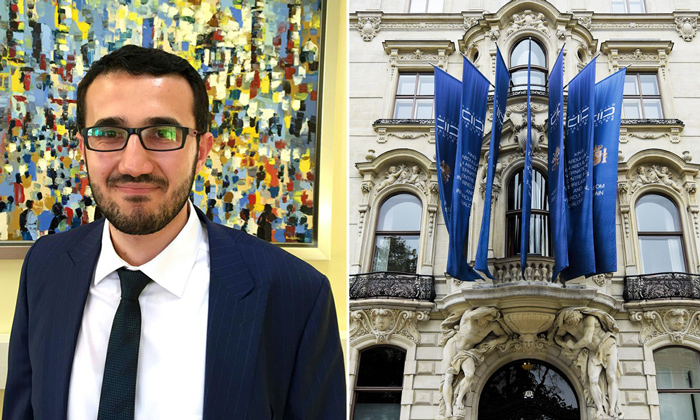
The selection of 28-year-old Ibrahim Olgun (left) as the new leader of the Islamic Religious Community in Austria has been criticized by other local Muslim leaders as “undemocratic” and “illegal.” They believe Olgun will work to increase Turkey’s influence over Muslims in Austria. At right, the Saudi-funded King Abdullah bin Abdulaziz International Centre for Interreligious and Intercultural Dialogue in Vienna, which critics say spreads fundamentalist Wahhabi Islam.

The IGGiÖ, which represents more than 250 Muslim associations across Austria, supplies state-funded Islamic religious education at Austrian public and private schools.

In 2014, the IGGiÖ introduced new taxpayer-funded textbooks for the formal teaching of Islam in all public elementary schools across the country. According to the IGGiÖ, the new textbooks — called “Islam Hour” (Islamstunde) — are based on “secure and recognized sources of Islam” aimed at “embedding Islam into the lives of students.”

Unlike previous versions of the books, which were criticized for being “overly martial in tone” and for not being “sufficiently oriented toward European values,” the new books have been developed based a “completely new didactic model for competency-based education.”

In February 2016, however, the University of Vienna published study which found that Islamic kindergartens in the capital are dominated by “intellectual Salafists and political Islamists” who are contributing to the “theologically-motivated isolation” of Muslim pupils. The report calls into question claims by the IGGiÖ that anti-Western textbooks have been removed from Austrian schools: “In many of their publications the Muslim Brotherhood and Milli Görüs reject the Western way of life as an inferior worldview.”

Olgun rejects the criticism levelled against him: “They say that I am too young, that I am the extended arm of the Turkish state. That is not true. I was born in Austria. I grew up here and am an Austrian citizen. I am not a Turkish civil servant.”

Olgun’s supporters say it is time for a “generational change” at the IGGiÖ because Austria’s Muslim community is young and growing fast. The Muslim population in Austria now exceeds 500,000 (or roughly 6% of the total population), up from an estimated 150,000 (or 2%) in 1990. The Muslim population is expected to reach 800,000 (or 9.5%) by 2030, according to recent estimates.

Muslim students now outnumber Roman Catholic students at middle and secondary schools in Vienna, according to official statistics, which show that Muslim students are also on the verge of overtaking Catholics in Viennese elementary schools. The data confirms a massive demographic and religious shift in Austria, traditionally a Roman Catholic country.

Soeren Kern is a Senior Fellow at the New York-based Gatestone Institute. He is also Senior Fellow for European Politics at the Madrid-based Grupo de Estudios Estratégicos / Strategic Studies Group. Follow him on Facebook and on Twitter. His first book, Global Fire, will be out in 2016.

Translate »
Skip to toolbar