
Monthly Archives: June 2017

Turkey: Child Rapists to Go Free, Journalists Not? by Burak Bekdil

The ruling Islamist party drafted a bill — and then suspended it — that would release about 3,000 men who married children, including men who raped them. In 2011, Salih bin Fawzan, a prominent cleric and member of Saudi Arabia’s highest religious council, issued a fatwa asserting that there is no minimum age for marriage, and that girls can be married “even if they are in the cradle.” A senior Turkish judge mentioned a particular case in which three men kidnapped and raped a girl, then one of them married her and the sentences for all three were lifted. In 2015 alone, 18,033 female children gave birth, including 244 girls under 15. The number of recorded child abuse cases rose from 5,730 in 2005 to 16,957 in 2015. If the government had gone ahead with its plans, a 60-year-old man who married a 12-year-old girl through religious procedures, would benefit from the amnesty. Turkey, officially, is the world’s biggest jailer of journalists. But its ruling Islamist party has drafted a bill that would release about 3,000 men who married children, including men who raped them. Public uproar has only convinced the ruling conservative Muslim lawmakers to consider revising the bill. Muslims in general have a confused mind about the permissible age for marriage. The Quran does not mention a specific minimum age. But most Muslims believe that their prophet, Mohammad, married Aisha when the bride was nine years old — although there are some sources that claim the marriage took place when Aisha was 19 or 20 years of age. Some modern sources of Islamic authority, however, especially Wahhabi, have in recent years issued “extreme” fatwas. In 2011, Salih bin Fawzan, a prominent cleric and member of Saudi Arabia’s highest religious council, issued a fatwa asserting that there is no minimum age for marriage and that girls can be married “even if they are in the cradle.” In 2014, the Saudi Grand Mufti allowed marriages with girls under 15 and avoided mentioning a minimum age. Turkish conservatives are no exception to having an inclination to marry little girls. Earlier in 2016, the head of a department of the Supreme Court of Appeals revealed that nearly 3,000 marriages were registered between female victims of sexual abuse, including rape, and their assailants. Speaking to a parliamentary commission, the senior judge testified that children between the ages of five and 18 could be subjected to sexual abuse in the country, and that girls between the ages of 12 and 15 were more easily tricked by abusers. He mentioned a particular case in which three men kidnapped and raped a girl, then one of them married her and the sentences for all three were lifted. The government’s motion, now suspended in parliament, stipulates that for any crime of sexual abuse committed before November 16, in the event of a subsequent marriage between the victim and the convict, the announcement of the verdict will be deferred, and if there has already been a verdict, the sentencing will be deferred. If the bill passes, child sexual abusers currently in jail will be released. Turkish Justice Minister Bekir Bozdag defends the bill, saying that “it addresses problems stemming from a reality of religious marriages” taking place before the legal age of marriage. In Turkey, marriage under the age of 17 is illegal. Children aged 16 can marry subject to a court ruling. But in practice, thousands of children marry, mostly after cases of rape and their families’ consent. When a child girl gives birth, hospital authorities are obliged to notify law enforcement for legal proceedings, with prison sentences of up to 16 years. According to official statistics, a total of 482,908 children were married off by their families in the past decade. In 2015 alone, 18,033 female children gave birth, including 244 girls under 15. The number of recorded child abuse cases rose from 5,730 in 2005 to 16,957 in 2015. Under pressure, the government on November 20 showed signs of retreat. The ruling Islamists said they were working on a revision of the bill; the final vote had been scheduled to be held on November 22. However the bill ends up, it is problematic. In its proposed form, jurists warned the proposed motion did not include a minimum age for the victims. If the government had gone ahead with its plans, a 60-year-old man who married a 12-year-old girl through religious procedures would benefit from the amnesty. The Turkish controversy reflects a rather bad habit among conservative Muslims. The Turkey’s Prime Minister, Binali Yildirim once said in an interview that he transferred from his university because he feared to “go off the path” after seeing that male and female students at his university were sitting next to each other on benches. In a typically Islamist thinking, former President Abdullah Gul, co-founder of the ruling Justice and Development Party and the closest political ally (until 2014) of current President Recep Tayyip Erdogan, married his wife when she was 15 years old and he, 30 years old. Turkey’s former President Abdullah Gul and his wife Hayrunnisa, pictured standing front and center at an August 2014 reception, married when she was 15 years old and he was 30. For the conservative Turkish mind set, child abuse whitewashed by a religious marriage is more pardonable, but not journalistic dissent. Burak Bekdil, based in Ankara, is a Turkish columnist for the Hürriyet Daily and a Fellow at the Middle East Forum.

Turkey: A Thuggish Ramadan by Burak Bekdil

  • Observant Muslims stubbornly refuse to understand that while the Koran commands them to abstain from alcohol, it does not command them to attack those Muslims (and non-Muslims) who do not do so.

  • It has become the observant Muslims’ self-granted authority collectively to forbid evil and command good, rather than just individually to avoid evil and choose good.

Zaytung, a popular online humor magazine (a kind of Turkish “The Onion”) ran a story:

“Government officials in this eastern city are mulling the possibility of airdropping food, beverages and cigarettes onto busy streets, hoping that this may break some fasters’ resistance to hunger, thirst and tobacco needs. The city has been in shock as, already one week into the holy month of Ramadan, no one has been publicly beaten up for eating, drinking or smoking.”

Zaytung’s mocking was not without a reason. “If one tried to eat in a restaurant [in some parts of Turkey] during Ramadan, one may be insulted or even physically harmed. Indeed, each year there is an incident of an unobservant college student being beaten up or even murdered in the southeast for not fasting during Ramadan,” observed Soner Cagaptay in a 2008 article in the Washington Institute.

In 2010, as art lovers drank sangria out of plastic cups and contemplated iconoclastic pieces of art, a group of locals in central Istanbul attacked them with pepper gas and frozen oranges. For an hour, they smashed windows and injured dozens, including visiting foreigners. The attackers justified themselves, saying that drinking alcohol, especially outdoors, violated Islamic rules. Then Prime Minister Recep Tayyip Erdogan, now president, said, “Such incidents occur everywhere in the world.”

Nearly six years after that incident, a mob of men carrying sticks and bottles attacked a group of Radiohead fans at a record store owned by a South Korean man. The fans had been holding a listening party of the band’s music, again in central Istanbul. Video footage of the incident shows an angry man storming into the store, shouting curses and threats and most of the people hastily leaving. A waiting mob then reportedly attacked the group and the door of the record store was smashed, although fortunately there were no serious injuries reported from the assault.

On June 17, a group of men attacked the Velvet Indieground record store in Istanbul, because they were angry that several people in the small shop were drinking alcohol during Ramadan. At right, Seogu Lee, the shop’s Korean owner, is seen being beaten by some of the attackers.

Once again, the mob was angry because “infidels” had dared to listen to music and to drink during Ramadan. “We were beaten by more than 20 men with pipes in their hands, beer bottles were broken on our heads, I don’t even know how we made it out,” One of the victims explained on social media. Three of the attackers were detained but judicial authorities later released all of them.

But that was not the entire show during the first two weeks of Ramadan in Turkey. The thugs are not always “unofficial.”

The Istanbul Governor’s Office banned the LGBT Pride March, which was set to take place between June 19 and June 26 in Istanbul’s Taksim Square. Officials cited “security concerns and public order.” The decision to ban the march had been prompted by threats from another mob of men. The Alperen Hearths, an ultranationalist/Islamist youth organization, had initially vowed that it would prevent the march, but later stepped back, saying that its members only wanted their religious values to be taken into consideration. Earlier than that, an Islamic youth group also threatened the planned march.

In Turkey, the holy month traditionally has the potential to illustrate the Islamists’ thuggish intolerance to “the other.” It is a curious intolerance.

Observant Muslims stubbornly refuse to understand that while the Koran commands them to abstain from alcohol, it does not command them to attack those Muslims (and non-Muslims) who do not do so. Could conservative Muslims be reacting to alcohol in fear that drinkers may disturb them and their families? What do people normally do if drunken (or sober) people disturb an individual? They call the police.

Why then do some Muslims attack those who do not fast? Because the Koran commands them to break the bones of those infidels? Not necessarily. In fact, the Koran clearly tells the faithful that sinning does not make a Muslim an apostate and that “there is no compulsion in religion.” So why do they ignore the essential Koranic teaching and feel urged to fight the infidel whom the Koran says is not an infidel?

The dirty looks at (lucky) drinkers and the punches in the faces of (less lucky) ones have been at the core of the “Great Turkish Divide,” after the ruling Islamists deeply polarized society since they came to power in 2002. It has become the observant Muslims’ self-granted authority collectively to forbid evil and command good, rather than just individually to avoid evil and choose good.

There is little, if any, reason to expect Turkey’s observant Muslims to learn to respect non-Muslims and other Muslims who practice the same religion in different ways.

Burak Bekdil, based in Ankara, is a Turkish columnist for the Hürriyet Daily and a Fellow at the Middle East Forum.

Turkey: “We Need a Religious Constitution” by Burak Bekdil

  • The new constitution “will emphasize Islam and faith in Allah.” — Abdulkadir Selvi, pro-government columnist.
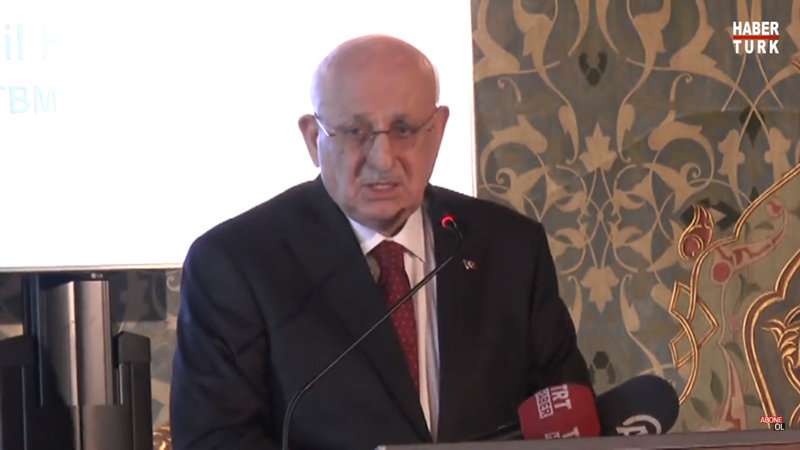
  • “We are a Muslim country. That is why we need a religious constitution,” said Ismail Kahraman, Speaker of Turkey’s Parliament. He lamented that, unlike in other Middle Eastern countries, the word Allah did not appear in the current version of the Turkish Constitution even once.

  • “The chaos in the Middle East is the result of politics instrumentalizing religion.” — Kemal Kilicdaroglu, leader of the opposition Republican People’s Party.
  • “One cannot be secular and Muslim at the same time.” — Turkish President Recep Tayyip Erdogan.

The Speaker of the Parliament is no ordinary office in Turkey. The speaker comes second in the state protocol only after the president (and even before the prime minister). Such is the seat occupied since November by Ismail Kahraman, an MP from the ruling Justice and Development Party (AKP) of President Recep Tayyip Erdogan.

Along with Erdogan, former president Abdullah Gul and eight AKP heavyweights (mostly cabinet ministers) Kahraman comes from the ranks of the National Turkish Student Union (MTTB in its Turkish acronym). Another MTTB bigwig, Huseyin Velioglu, later formed what became the militant Islamist group, “Turkish Hizbullah.” Especially between 1965 and 1980 when a military coup administration dissolved it, the MTTB operated as the youth organization of Turkish political Islam. Kahraman, in late 1960s and early 1970s, was MTTB’s president.

In 1969 Kahraman publicly campaigned against funeral services to be held for Imran Oktem, then president of the Court of Appeals and a well-known anti-Islamist judge. When, finally, a mufti agreed to have the service, MTTB militants attacked the funeral.

Also in 1969, MTTB members attacked a left-wing protest rally and stabbed two students to death.

When, in the late 1990s, Necmettin Erbakan, the founder of political Islam in Turkey, became the country’s first Islamist prime minister (in a coalition government with a center-right party), Kahraman was appointed as Minister of Culture. He immediately curbed the budget appropriations for the state opera and ballet house and rechanneled the funding toward a mosque, and banned alcohol consumption at his ministry’s recreational premises.

His oath as parliamentary speaker requires his full loyalty to the “supremacy of law and to the democratic and secular republic…” But his public speech on Apr. 26 was totally against both his own oath of office and the constitution of the country where he serves — presumably — as an unbiased parliamentary speaker.

“We are a Muslim country,” he said. “That is why we need a religious constitution.” And not just that. Kahraman lamented that, unlike in other Middle Eastern countries, the word Allah did not appear in the current version of the Turkey’s constitution even once. So, he asked: “Why should we, as a Muslim country, distance ourselves from religion?”

His words caused a small political explosion in Ankara, with politicians from the opposition rushing to condemn him and secular Turks to protest him — and to get tear gas and water cannons from the police. The main opposition leader, Kemal Kilicdaroglu of the Republican People’s Party, put it plainly: “The chaos in the Middle East is the result of politics instrumentalizing religion.”

Ismail Kahraman, Speaker of Turkey’s Parliament, last week stated: “We are a Muslim country. That is why we need a religious constitution.”

Although both President Erdogan and Prime Minister Ahmet Davutoglu denied any AKP plan to remove secularism from the new constitution that their specialists are now drafting, Kahraman’s abrupt call for a religious constitution once again revealed Turkey’s old political fault-line, now giving signs of shaking. This is a decades-old political war between the Turks who see the future of their country in the Western civilization, including a secular constitution, and those who insist that Muslim Turkey belongs to the Middle East — including, as Kahraman pointed out, a religious charter that contains the name Allah.

According to Abdulkadir Selvi, a prominent pro-government columnist, the new constitution “will emphasize Islam and faith in Allah.”

In reality, Erdogan and Davutoglu are right to be cautious. Turkey does not need to remove the principle of secularism from its constitution. In Turkey’s poor democratic culture, a constitution is one thing and adherence to constitutional principles is another. Despite its articles strongly defending secularism and banning religion in political life, Turkey, under the AKP’s 14-year-long rule, has largely deviated from secular administration toward an authoritarian, pro-Islamist system with the ruling elite visibly breaching the constitution, including the parliamentary speaker himself.

Erdogan often defines his understanding of secularism as the state standing at an equal distance to all or no faith. In principle, he is right. He expressed that view after Kahraman’s controversial lines. But just saying this does not make him a secular politician. A recent ruling from the European Court of Human Rights (ECtHR) was the best proof that Erdogan’s Turkey failed in fulfilling even his own definition of secularism (that the state is at an equal distance to all religious faith).

The ECtHR condemned Turkey for discriminating against members of the Alevi (Muslim) religious minority, by failing to grant their places of worship the same status and advantages as those of other faiths (Sunni Muslim). Alevis, who draw from Shiite, Sufi and Anatolian folk traditions, account for about 15-20% of Turkey’s 79 million people. Most Sunni Muslims view Alevis as heretics.

A panel of seven judges at the Strasbourg-based court ruled against Turkish courts, which had said that the Alevi prayer places (cemevis) were not religious sites. The Turkish ruling was based on an opinion from the Turkish religious authority stating that the Alevi faith was not a religion. A summary of the ECtHR’s ruling read: “The court rules that the plaintiff foundation was subjected to differing treatment, without objective or reasonable cause, and the method of exemption from payment of electricity bills for religious sites in Turkish law was enacting discrimination on the basis of religion.”

In a speech some years before he came to power Erdogan said: “One cannot be secular and Muslim at the same time.” Back then, at least he was talking more honestly.

Burak Bekdil, based in Ankara, is a Turkish columnist for the Hürriyet Daily and a Fellow at the Middle East Forum.
Turkey: “A Great Muslim Democracy”? by Burak Bekdil

  • Is Japan a democracy or a Shinto democracy?The president of the United States was suggesting to Europe’s rich club of nations that it must admit as full member not a democracy but a “Muslim democracy.”

  • Obama did not understand that Turkey could never join the EU before it has fully transformed from being a Muslim democracy into a democracy.
  • Apparently, Erdogan thinks that the U.S. is ruled as Turkey is ruled. He does not understand that the president of the U.S. cannot phone a judge and order an arrest warrant for a foreign national.

Can there be democracies and democracies with religious prefixes? Is the United States a democracy or a Christian democracy? Is Israel a democracy or a Jewish democracy? Is Japan a democracy or a Shinto democracy?

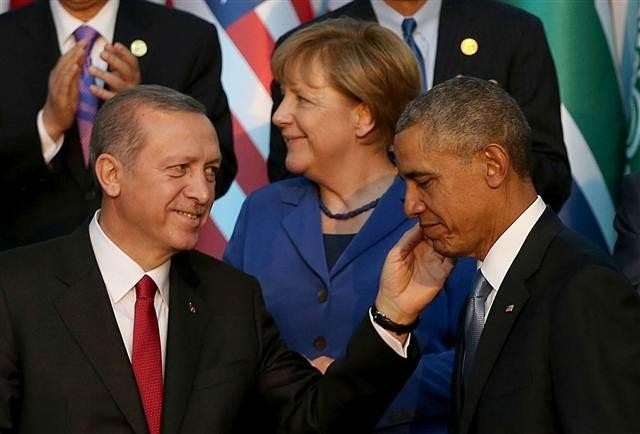
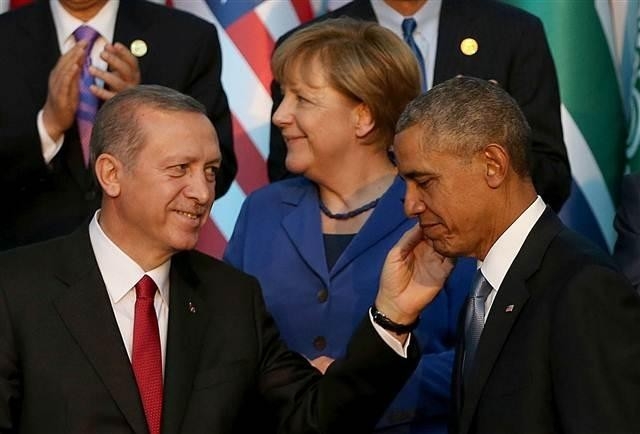
In a 2010 interview with the Italian daily, Corriere della Sera, U.S. President Barack Obama referred to Turkey as a “great Muslim democracy.” In the same interview, he said that: “The U.S. always expressed the opinion that it would be wise to accept Turkey into the European Union.” All that was music to Turkish ears. But in reality, the president of the United States was suggesting to Europe’s rich club of nations that it must admit as full member not a democracy but a “Muslim democracy.” Obama did not understand that Turkey could never join the EU before it has fully transformed from being a Muslim democracy into a democracy.

In later years, though, Obama would painfully understand the difference between a democracy and a Muslim democracy. Now, in the words of James Jeffrey, a former Obama administration ambassador to Ankara, “You have to deal with the Turkey you have, rather than the one you’d like to have.”

Obama’s reference to Turkey aimed to please the political elite in Ankara. Soon after his 2008 election, Obama began to cultivate a private relationship with President Recep Tayyip Erdogan (who was then Prime Minister). In a 2012 Time interview, Obama named Erdogan as one of the five world leaders with whom he had the strongest bonds. In 2011, Tom Donilon, the president’s former national security advisor, said that Obama regarded Erdogan as “a man of principle, and also a man of action.”

Things look different today. “We basically have turned a blind eye to Erdogan’s drive towards an authoritarian, one-man system of rule in Turkey,” said Eric Edelman, who was U.S. ambassador to Ankara from 2003 to 2005. Obama persistently lived in this make-believe world until very recently. Jeffrey Goldberg wrote in The Atlantic‘s April 2016 issue:

“Early on, Obama saw Recep Tayyip Erdoğan, the president of Turkey, as the sort of moderate Muslim leader who would bridge the divide between East and West … But Obama now considers him a failure and an authoritarian…”

Recently Erdogan, his ministers, intelligence chief, senior military officers and top diplomats were in New York for the 71st Session of the United Nations General Assembly. There were bilateral talks between the Turks and Americans, too. Once staunch allies, Turkey and the U.S. now have more divergences than convergences.

According to Jeffrey Goldberg, writing in The Atlantic in April 2016: “Early on, Obama saw Recep Tayyip Erdoğan, the president of Turkey, as the sort of moderate Muslim leader who would bridge the divide between East and West … But Obama now considers him a failure and an authoritarian…” (Image source: RT video screenshot)

The Turks vehemently demand the extradition of Fethullah Gulen, a Muslim preacher in self-exile in Pennsylvania since 1999 and the prime suspect in the July 15 coup attempt against Erdogan’s government. U.S. officials tell the Turks that it is the independent U.S. courts that will decide, based on the evidence provided by Ankara. The Turks do not understand that a court can decide something independently of the country’s elected president.

“We want a terrorist from you … And you still resist … What court? What court for a terrorist [Gulen]? Is it too difficult to cancel a Green Card?” Erdogan said. Apparently, Erdogan thinks that the U.S. is ruled as Turkey is ruled. He does not understand that the president of the United States cannot phone a judge and order an arrest warrant for a foreign national. He does not understand that in the U.S., the administration cannot decide who is a terrorist and who is not without a court verdict. In Turkey, the government does.

Gulen has become a hot potato in the hands of the U.S. administration officials. But he is not the only headache for Washington. Turkey keeps warning Washington that it should not ally with Syrian Kurds whom Ankara views as terrorists — Washington views them as militias fighting the Islamic State (ISIS).

On August 24, Turkish troops began a military incursion into northern Syria to support the “moderates” it backs, and to push ISIS strongholds farther south. Meanwhile, as part of a broader land operation further south into Raqqa (ISIS’s main stronghold), the U.S. is arming Kurds, angering the Turks. “We cannot say anything at the moment as we have not clearly seen the attitude of the U.S. But Turkey will not be part of an operation if the U.S. wants to conduct it with the PYD and YPG [Syrian Kurdish groups],” Erdogan said.

Not enough trouble? Erdogan also asked Vice President Joe Biden about the arrest of the Iranian-Turkish businessman, Reza Zarrab, who has been in a U.S. jail since March on charges of money laundering and sanctions evasion. Erdogan wants the U.S. judiciary to release the shady businessman, who was one of the key interlocutors in a December 2013 corruption scandal in Turkey involving Erdogan and four of his cabinet ministers.

Erdogan said after his visit to New York:

“In my talks with Biden, I also brought up the Reza Zarrab issue when the judiciary subject was raised. The court which the U.S. Department of Justice referred this case to is also interesting. Both the prosecutor [Preet] Bharara and judge Richard Berman are names who had previously been hosted by FETÖ [the Turkish acronym for the alleged terrorist organization operated by Gulen] in Turkey. In other words, the U.S. Department of Justice handed Zarrab over to names which FETÖ had wined and dined.”

Erdogan claimed that Zarrab had not committed any crime, according to the findings of multiple Turkish ministries. He added that Turkey would not remain insensitive to the arrest of any of its citizens in another country. He added: “That person [Zarrab] is a citizen of the Turkish Republic … According to what rule had that arrest been made?” Once again, Erdogan wants to take up the powers of U.S. judges and announce verdicts on their behalf, as he can always do in Turkey. But he does not understand that things work differently in the U.S.

As prominent columnist Tolga Tanis wrote in Hurriyet: “There is no doubt that the Turkish-U.S. relations, just before presidential election in the U.S. in November, are passing through a critical junction. There are no traffic lights at the junction. And both sides are running fast without slowing down.”

Burak Bekdil, based in Ankara, is a Turkish columnist for the Hürriyet Daily and a Fellow at the Middle East Forum.
Turkey-Russia Pact Threatens Western Interests in the Middle East by Con Coughlin

  • In recent months the Kremlin has hinted that keeping Assad in power is not its primary concern. Rather its main objective in Syria is to keep its strategically-important bases in the country.

  • This has led to suggestions that, in return for building closer relations with Turkey, Moscow might be prepared to do a deal whereby Assad is removed from power and Russia’s military interests in the country are safeguarded.
  • If that outcome could be achieved, then Russia and Turkey would be able to forge a powerful partnership, one that would pose a serious threat to Western interests in the Middle East and beyond.

The deepening diplomatic pact between Turkey and Russia represents yet another damning indictment of the Obama Administration’s ability to maintain relations with Washington’s traditional allies in the Middle East.

Western diplomats regard the decision by Turkish President Recep Tayyip Erdogan to restore relations with Moscow last month as part of a carefully-coordinated attempt by Ankara to build a new power base in the region.

For decades Turkey, a key NATO member, has said that it wants to forge closer ties with the West, to the extent that Turkish diplomats insist that Ankara is still serious about joining the European Union.

But the increasingly hard-line Islamist approach taken by Mr Erdogan in the wake of the failed military coup, which has seen tens of thousands of judges, academics and journalists forced from their jobs, has caused the Turkish government to realise the prospects of maintaining relations with its Western allies are remote so long as it continues with the current crack-down.

This had led Mr Erdogan to embark on a campaign to reach out to countries such as Russia, which he regards as a viable alternative to the U.S. in protecting Turkey’s interests in the region.

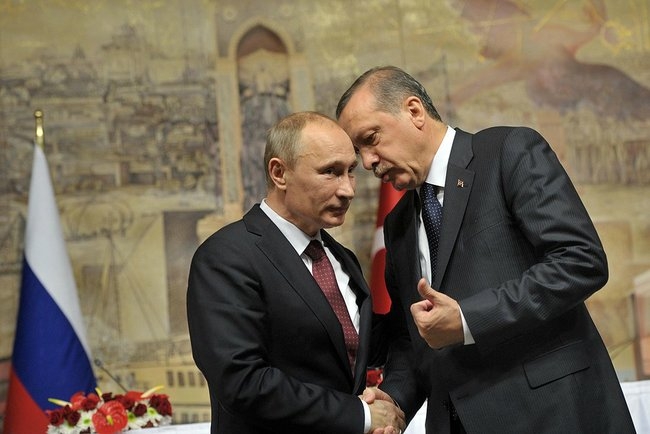
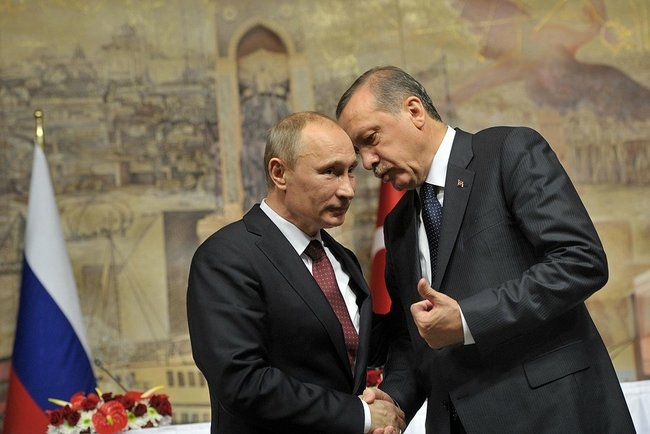
Turkish President Recep Tayyip Erdogan has embarked on a campaign to reach out to countries such as Russia, which he regards as a viable alternative to the U.S. in protecting Turkey’s interests in the region. Pictured: Russian President Vladimir Putin with Turkish President Erdogan (then prime minister), meeting in Istanbul on December 3, 2012. (Image source: kremlin.ru)

The Turkish leader’s disillusionment with U.S. President Barack Obama predates the tensions caused by the military coup and Turkey’s demand that Washington extradites the exiled Turkish cleric Fethullah Gulen, whom Ankara accuses of orchestrating the failed military coup.

The fall-out between Mr Erdogan and Mr Obama dates back to the American president’s failure to follow up on his threat to launch military action against Syrian President Bashar al-Assad if he used chemical weapons against his own people in Syria’s brutal civil war.

From the outset of the conflict, Mr Erdogan has been committed to the overthrow of the Assad regime, which is accused of supporting Kurdish separatist groups. It is for this reason that the U.S. has accused Turkey of turning a blind eye to the activities of Islamic State of Iraq and Syria (ISIS) terrorists on its lengthy border with Syria.

Indeed, the big stumbling block preventing Turkey from having better relations with Russia was that Moscow was helping to keep the Assad regime in power through the military intervention by Russian forces that began last year.

But in recent months the Kremlin has hinted that keeping Assad in power is not its primary concern. Rather its main objective in Syria is to protect its strategically-important military bases in the country.

This has led to suggestions that, in return for building closer relations with Turkey, Moscow might be prepared to do a deal whereby Assad is removed from power and Russia’s military interests in the country are safeguarded.

And if that outcome could be achieved, then Turkey and Russia would be able to forge a powerful partnership, one that would pose a serious threat to Western interests in the Middle East and beyond.

Mr Coughlin is Defence and Foreign Affairs Editor of London’s Daily Telegraph.

Translate »
Skip to toolbar