Monthly Archives: June 2017

Turkey: Erdogan’s Thin-Skinned Government by Robbie Travers

  • Is there any other person you trust to decide which ideas and speech you are entitled to hear — or which are too dangerous for you to hear?

  • The thin-skinned government of Turkey’s President, Recep Tayyip Erdogan, has in the past two years opened at least 1,845 cases over insults to the president.
  • Turkey’s World Press Freedom Index ranking has plummeted to 149 out of 180, below Zimbabwe (131) and Burundi (145).
  • Despite the ruling of Turkey’s judicial system that Erdogan could not eliminate access to Twitter, he nevertheless continues to advance his agenda of censorship. He pledges to “eradicate Twitter” which, according to him, encourages “blasphemy and criticism of the Turkish government.”

Is there any other person you trust to decide which ideas and speech you are entitled to hear — or which are too dangerous for you to hear?

Is there any other person you think should have the ability to decide what criticism of the Government is respectful enough?

Would you cede your autonomy to decide what you to hear to a Government? Probably not.

The Turkish government does not agree. Evidently Turkey’s AKP Government in Ankara believes it is fit to be this authority, and not just domestically. Its urge to censor negative press seems to be going global.

The Government of Turkey’s President Recep Tayyip Erdogan in Ankara recently summoned the German ambassador to demand the deletion of a satirical music video which highlighted his government’s aggression against the Kurdish people, his brutal repression of protestors, and his weak position on equal rights for women. Turkey also insisted that a German comedian be prosecuted under an obscure German law for insulting the leader of a foreign country.

Turkey seems to be spending more time policing the image of Erdogan abroad than the serious security situation it is facing.

Turkey’s latest authoritarian crackdown on the rights of its citizens to freedom of expression should come as no surprise to anyone who has been following the country’s path towards an increasingly Islamist, authoritarian government.

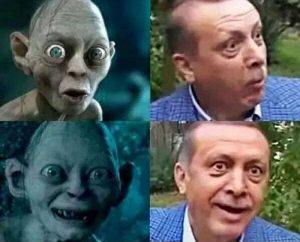
Erdogan’s renowned thin-skinned government has, in the past two years, opened at least 1,845 cases over insults to the president, such as, for instance, comparing the president to Gollum from Lord of the Rings.
Last year, Dr. Bilgin Ciftci of Turkey posted photos on Twitter juxtaposing President Erdogan with the fictional character Gollum. Ciftci was immediately fired from the hospital where he worked. Then he was brought to court for insulting Erdogan, an offense punishable by up to four years in prison.

In March, a court placed the newspaper Zaman in the control of state administrators, with no clear reason given, arguably breaching Article Three of the European Convention of Human Rights:

“2. Everyone charged with a criminal offence has the following minimum rights:

“(a) to be informed promptly, in a language which he understands and in detail, of the nature and cause of the accusation against him;”

Zaman has apparently never received information of the charges against it, or the reason for the court order placing its activities and infrastructure under state control — moves breaching further sections of Article 3, which specify the right to be able to “construct a defence”. Without knowing what charges it faces, Zaman is unable to do that.

In addition, Turkey’s World Press Freedom Index ranking has plummeted to 149 out of 180: below Zimbabwe (131) and Burundi (145).

Turkey also continues to imprison possibly the highest number of journalists of any nation — according the Committee to Protect Journalists, the assessed number is 14 out of 199, worldwide. Other sources claim the number is closer to 30, and still others suggest that Turkey has had the greatest number of incarcerated journalists globally.

Whatever the true number, it is shameful that a NATO member, pledged to uphold the values of democracy as a signatory of the European Convention on Human Rights (ECHR), ranks among some of the worst abusers of press freedom, including Iran, China and Saudi Arabia.

The Turkish government led by Erdogan seems to be undergoing a public transformation into an increasingly totalitarian state. Turkey has been abandoning the pro-Western principles of Kemalism and pivoting, with a more oppressive and expansionist outlook, toward Ottoman Islam.

Prime Minister Ahmet Davutoglu was willing and overtly “proud’ to show solidarity with the massacred Charlie Hebdo satirists in Paris by joining the Marche Republicaine against those who would attack freedom of speech. At home, however, Davutoglu pursues a domestic agenda that not only infringes upon media freedom, but also on the freedoms of individual citizens in fundamental breaches of ECHR legislation. Davutoglu, for example, has suggested women being equal to men causes suicides.

Turkey has also attempted, during Erdogan’s period of governance, to ban both Twitter — for “incit[ing] political dissent” — and YouTube — for “promot[ing] the act of religious defamation (article 216).” Erdogan blocked Twitter during responses to terror attacks and public protests, and attempted to quell any protest against his government.

Under the pretense of “counter terrorism,” Erdogan has repeatedly been attempting to strangle the channels of discussion and the organizing of protests.

In any state claiming that protests are linked to terrorism and blasphemy is unjustifiable. These are classic intimidatory tactics. They illustrate why the West must begin to criticize Erdogan’s regime to a greater extent on its infringement on freedom of speech, rather than to make deals with it.

Had Charlie Hebdo been a Turkish publication, its material would most likely have been branded illegal or brought under state control: it would likely no longer exist.

Despite the ruling by Turkey’s judiciary that Erdogan could not eliminate access to Twitter, he nevertheless continues to advance his agenda of censorship.

This position Erdogan holds, of branding opposition to his regime as blasphemy, creates a religious divide between those who are “pure” and those who are “dangerous.” Further, as mentioned, the notion that an idea is too politically toxic to be discussed contravenes the principles of free speech and freedom of expression that Turkey pledged as a signatory to the European Convention of Human Rights.

Turkey’s lurch to establish its government as some form of unassailable authority beyond questioning again breaches the ECHR, this time Article 9:

“1. Everyone has the right to freedom of thought, conscience and religion; this right includes freedom to change his religion or belief and freedom, either alone or in community with others and in public or private, to manifest his religion or belief, in worship, teaching, practice and observance. “

Turkey is also likely to fall afoul of Article 10 of the ECHR:

“Everyone has the right to freedom of expression. This right shall include freedom to hold opinions and to receive and impart information and ideas without interference by public authority and regardless of frontiers.”

Turkey’s blocking of social media, which targets communication with the outside world, also clearly infringes on the “regardless of frontiers” stipulation.

And finally, Turkey’s actions are also clearly in breach of Article 11

“Everyone has the right to freedom of peaceful assembly and to freedom of association with others, including the right to form and to join trade unions for the protection of his interests.”

The European Union and the liberal democracies have remained silent on Turkey’s aggressive campaign against civil liberties. But it is time to stop betraying Turkish liberals, democrats and Kurdish people facing persecution for their views — before it comes “soon to a theater near you.”

Countries in the West sometimes seem to fantasize that Turkey, with half of Istanbul in Europe, can therefore can modernized, be become progressive and work with the West.

They distance themselves and turn a blind eye to the Turkish government’s assaults on human rights. Before Turkey is capitulated to even further, or again considered for membership in the European Union, shining a serious light on the country seems long overdue.

Robbie Travers, a political commentator and consultant, is Executive Director of Agora, former media manager at the Human Security Centre, and a law student at the University of Edinburgh.
Turkey: Erdogan’s Promised “Reforms” by Burak Bekdil

  • In third world democracies such as Turkey, there is a vast gap between what laws say and how they are enforced.
  • “As many as 2,000 individuals — reporters, celebrities, academics and students — are reportedly being officially investigated on charges of insulting President Recep Tayyip Erdogan or spreading ‘terrorist propaganda.'” — “Reporters Without Borders” Report.

  • The EU must understand that it has too little, if any, leverage on a country that is going full speed toward darker days of Islamist authoritarianism.
  • With or without legal amendments to its anti-terror laws or a deal with the EU, Erdogan’s Turkey will de facto follow the path of Islamist autocracies, where any kind of dissent amounts to terrorism and treason.

Turkey and the European Union (EU) have been negotiating a deal that ostensibly would stem the flow of hundreds of thousands of migrants into Europe; Turkey, on its part, would bring dozens of laws and regulations, including its draconian anti-terror laws, in line with Europe’s; and nearly 80 million Turks would then be given visa-free travel to the EU’s borderless Schengen zone. But now, as Turkey refuses to amend its anti-terror laws, the deal seems to be facing a stalemate.

That is hardly the heart of the matter. In reality, both Turkish President Recep Tayyip Erdogan and the EU are pursuing a deal that will not work.

In theory, Turkey would complete some tough homework, containing a list of 72 items. All went well until recently, when apparently the most controversial item on the list, which obliged Turkey to change its anti-terror laws, stalled the deal.

On May 14, according to Hansjörg Haber, the EU’s top envoy in Ankara, the European Commission was still working to find an acceptable solution to the impasse with Turkey over the definition of “terror.” Haber commented that “Turkey has long been mature for visa liberalization. I personally feel we had to do it much long ago. I still remain optimistic that we will eventually manage it.”

Days before that, Turkey’s president, Recep Tayyip Erdogan made it clear that he had no intention of changing the disputed legislation. In response, European Commission President Jean-Claude Juncker said that the visa requirement would not be lifted for Turks before all criteria were met. That, in Erdogan’s words, would mean “you go your way and we go ours.”

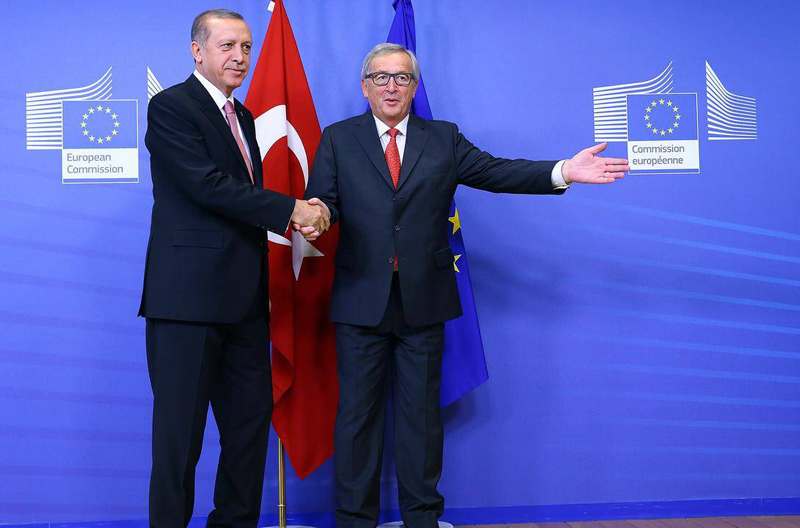
European Commission President Jean-Claude Juncker (right) said that the visa requirement would not be lifted for Turks before all criteria in the EU-Turkey deal were met. That, in the words of Turkish President Recep Tayyip Erdogan (left), would mean “you go your way and we go ours.” (Image source: Turkish President’s Office)

Erdogan, for his part, wants to win the visa waiver in order to save millions of Turks from the torment of queuing up in front of European countries’ embassies for visas — undoubtedly a big vote-winner for him if he puts to a referendum the executive presidential system he so desperately craves.

The EU’s leaders aim at a skillful balancing act: Return tens of thousands of future migrants to Turkey — as stipulated in the accord — and at the same time find a face-saving formula against criticism that to stop the flow of migrants, the European club is granting a totally undemocratic country what it wants. So, a little bit of pressure for a better-looking Turkish anti-terror law could help Brussels save face: We are not betraying our democratic culture merely to stop the migrant inflow; see how we forced Turkey to liberalize a key law!

That will be a commodity too hard to sell. According to Reporters Without Borders (RSF), Turkey witnessed a drop in press freedom during the past year, as a result of a media crackdown that one prominent editor called a “witch-hunt.” In its latest report, RSF ranked Turkey 151 out of 180 countries in its World Press Freedom Index, down two points since 2015. It said:

“As many as 2,000 individuals – reporters, celebrities, academics and students – are reportedly being officially investigated on charges of insulting President Recep Tayyip Erdogan or spreading ‘terrorist propaganda.'”

Erdogan’s deep problem with free speech is not only limited to Turkey. It recently moved, ironically, into the heart of Europe. Erdogan sought and won — from Germany’s Chancellor, Angela Merkel — a green light for the prosecution of comedian Jan Böhmermann, who recited a crude poem about the Turkish president, on German television.

In a letter published in the German daily Welt am Sonntag, Mathias Döpfner, chief executive of the German publisher Axel Springer, expressed solidarity with Böhmermann by saying he had laughed out loud at the poem and ‘wholeheartedly’ supported what Böhmermann said. Erdogan’s lawyers sued Döpfner too. A German court rejected Erdogan’s injunction against Döpfner, but Erdogan’s lawyers said they would appeal that decision. This is the man the EU is, presumably, trying to convince that his country’s anti-terror laws should be given a more democratic touch if he wants visa liberalization for the Turks.

The EU must understand — or maybe it already has, but too late — that it has too little, if any, leverage on a country that is going full speed toward darker days of Islamist authoritarianism. If they are not trying to fool a European population of more than 500 million with a too-cheap pragmatism, they should understand that in third world democracies such as Turkey, there is a vast gap between what laws say and how they are enforced.

Here is a nice assortment of what the Turkish constitution says about civil rights and abuse of religion in politics, in contrast with how real life in Erdogan’s Turkey is about:

  • Article 5, for example, promises “to ensure the welfare, peace and happiness of the individual and society (and) to strive for the removal of (obstacles) which restrict the fundamental rights and freedoms.” Not funny enough?
  • Take Article 10, then: “All individuals are equal before the law without any discrimination irrespective of language, race, color, sex, political opinion, philosophical belief, religion and sect or any such consideration.”
  • Article 20 states that “everyone has the right to demand respect for his private and family life.
  • Article 22 guarantees that “secrecy of communications is fundamental.”
  • When read in 2016, Article 24 is probably one of the funniest in the whole charter: “Everyone has the right to freedom of conscience, religious belief and conviction … No one shall be allowed to exploit or abuse religion or religious feelings … for the purpose of personal or political influence, or for even partially basing the fundamental, social, economic, political and legal order of the State on religious tenets.”
  • It is not an awfully bad joke: Article 28 even claims “the press is free, and shall not be censored.”

With or without legal amendments to its anti-terror laws or a deal with the EU, Erdogan’s Turkey will de facto follow the path of Islamist autocracies, where any kind of dissent amounts to terrorism and treason.

Burak Bekdil, based in Ankara, is a Turkish columnist for the Hürriyet Daily and a Fellow at the Middle East Forum.

Turkey: Erdogan’s Grab for Absolute Power by Burak Bekdil

  • Erdogan will effectively consolidate the power of three legislative bodies into one powerful executive office: himself.
  • Erdogan’s “Turkish-style presidency” is already a presidency with too much power held by one man. If approved at the referendum, the changes will make Erdogan head of government, head of state and head of the ruling party — all at the same time.

  • It would transfer powers traditionally held by parliament to the presidency, thereby rendering the parliament merely a ceremonial, advisory body.
  • The opposition looks fragmented and helpless in telling the masses that reforms would concentrate excessive powers in the hands of a leader who has increasingly displayed authoritarian tendencies.
  • At the moment, Erdogan is effectively the absolute ruler. If he wins the vote he becomes the absolute ruler. If he loses, he remains effectively the absolute ruler until he tries again to become the absolute ruler.

Turkish President Recep Tayyip Erdogan’s one-man show goes on; he may soon progress from effectively having absolute authority to actually having absolute authority. He would apparently like to put an official seal on his increasingly autocratic regime. If a simple majority of Turks vote “yes” in a national referendum on proposed constitutional amendments in April, Erdogan will effectively consolidate the power of three legislative bodies into one powerful executive office: himself. He would then be installed as a leader with virtually unlimited authority.

Although the current constitution grants him largely symbolic powers, Erdogan has acted as the effective head of the executive branch since he became Turkey’s first elected president in August 2014. He has explicitly — and, it appears, happily — violated the constitution by acting as an absolute head of government. In May 2016, he forced Ahmet Davutoglu, his own confidant and prime minister, out of office; Erdogan evidently suspected that the man was not working hard enough to push for the absolute executive presidential system Erdogan has evidently been craving. Only seven months ago, Davutoglu had won a parliamentary election with 49.5% of the national vote.

Erdogan replaced Davutoglu with Binali Yildirim, who has proven to be more enthusiastic about terminating the prime minister’s office and transferring all powers to an all-powerful president. As Erdogan’s (and Yildirim’s) ruling Justice and Development Party (AKP) lacked the parliamentary majority to put any constitutional amendment to public vote, the proposed changes therefore required support from the opposition benches. (A minimum of 330 votes is required in the country’s 550-member assembly, as opposed to 317 seats controlled by the AKP.)

A year ago, that would have looked unimaginable. But a nationalist opposition party, the Nationalist Movement Party (MHP), made a U-turn from its public pledges of “never letting Erdogan become the executive president,” and decided to support the reform bill. Political observers are still trying to figure out what may have pushed the MHP from one extreme to the other; there is not yet a clear explanation.

Erdogan’s “Turkish-style presidency” is already a presidency with too much power held by one man. If approved in the referendum, the changes will make Erdogan head of government, head of state and head of the ruling party — all at the same time. Erdogan would have the power to appoint cabinet ministers without requiring a confidence vote from parliament, propose budgets and appoint more than half the members of the nation’s highest judicial body. He would also have the power to dissolve parliament, impose states of emergency and issue decrees. Alarmingly, the proposed system lacks the safety mechanisms of checks and balances that exist in other countries such as the United States. It would transfer powers traditionally held by parliament to the presidency, thereby rendering the parliament merely a ceremonial, advisory body.

With support from MHP, the reform bill passed in parliament with 339 votes in favor — nine more than required to put it to a national vote.

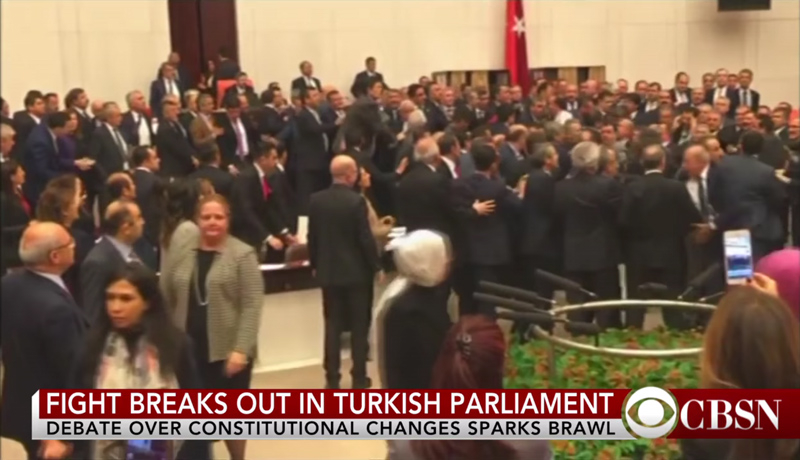
The way the Turkish parliament debated the bill looked like a prelude to the way Erdogan’s totally autocratic presidency will fuel tensions in the months ahead. Several rounds of fist-fighting broke out. Brawls were daily scenes in parliamentary sessions. Screaming matches and physical altercations sent lawmakers to hospitals.

In one instance, an independent female lawmaker handcuffed herself to the microphone on the lectern for an hour to protest the presidential bill. Deputies from the government benches tried to remove her but opposition deputies sprang to her defense, while punches and kicks were exchanged. The assembly saw its first-ever brawl between female lawmakers who punched each other and pulled one another’s hair. One female opposition deputy was thrown to the floor and her prosthetic artificial arm knocked off, injuring her severely.

Several brawls recently broke out in Turkey’s parliament during debate on a bill for constitutional amendments. (Image source: CBS News)

Nevertheless, Erdogan is happy. He will soon launch his “yes” campaign together with the nationalists in the opposition (MHP). He is confident that he will win — he has not lost a single election or referendum since he came to power in November 2002. Observers expect that a clear majority of his party loyalists (around 40% of 50%) will vote “yes” in addition to around half of the nationalists in opposition (around 6% of 12%). That makes a combined 46% of the vote. Some of the splinter Islamist parties and non-AKP voters who favor a presidential system, too, are expected to vote “yes,” lifting the pro-Erdogan vote to a range of 50% to 55%. There is a sizeable group of “undecided” whose preferences may be influenced by Erdogan’s huge propaganda machinery or by the argument that a strong president would strengthen Turkey as it confronts a broad array of internal and external security threats.

The opposition (Kurds and secular and liberal Turks), on the other hand, looks fragmented and helpless in telling the masses that reforms would concentrate excessive powers in the hands of a leader who has increasingly displayed authoritarian tendencies. There are concerns that the opposition, under the state of emergency Erdogan’s government declared in 2016, may find it too difficult effectively and freely to campaign against the proposed amendments.

Even in the unlikely event of a win for the “no” campaign it will not be the end of the world for Erdogan. He would be bruised, perhaps badly. But he would play another card: a snap election. He would win new parliamentary elections and push for similar amendments, once again trying his chances. He would have nothing to lose. He appears to rely on a popular support keeping him afloat.

From a policy-making point of view, however, a “yes” or a “no” vote will not fundamentally change the dynamics under which Turkey is being ruled. At the moment, Erdogan is effectively the absolute ruler. If he wins the vote, he becomes the absolute ruler. If he loses he remains effectively the absolute ruler until he tries again to become the absolute ruler.

Burak Bekdil, one of Turkey’s leading journalists, was just fired from Turkey’s leading newspaper after 29 years, for writing what was taking place in Turkey for Gatestone. He is a Fellow at the Middle East Forum.

Turkey: Death to Free Speech by Burak Bekdil

  • A criminal indictment was filed against Sedat Ergin, editor-in-chief of the country’s most influential newspaper, Hurriyet. Prosecutors demanded up to five years in prison for Ergin, for allegedly insulting President Erdogan. The indictment claims that Hurriyet insulted the president by paraphrasing what the president had said.

  • “[T]his is a ‘democracy’ with a growingly diminishing freedom of speech. It is ‘democracy’ where the ‘voice of the nation,’ which practically is the voice of the political majority and its glorified leader, intimidates and silences dissenting voices.” — Mustafa Akyol, columnist, Hurriyet.
  • According to a report by the Turkish Journalists Association, 500 journalists were fired in Turkey in 2015, while 70 others were subjected to physical violence. Thirty journalists remain in prison, mostly on terrorism charges. Needless to say, the unfortunate journalists invariably are known to be critical of Erdogan.
  • Europe, cherishing its “transactional” relations with Turkey, prefers to look the other way and whistle. All the EU could say about the prosecution of academics was that it is “extremely worrying.” Brussels cannot see that Turkish affairs passed the threshold of “extremely worrying” a long time ago.

Defending his quest for an executive presidential system Turkish President Recep Tayyip Erdogan cited Hitler’s Germany as an effective form of government. Yes, he said, you can have the presidential system in a unitary state as in Hitler’s Germany. His office later claimed that the president’s “Hitler’s Germany” metaphor had been “distorted” by the media. Erdogan’s words on Hitler’s Germany may or may not have been distorted, but the way he rules Turkey reminds one powerfully of how Hitler ruled the Third Reich.

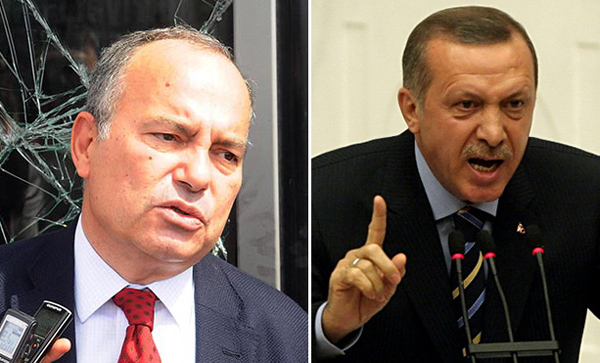
With or without a distortion of Erdogan’s words, a criminal indictment was filed against Sedat Ergin, editor-in-chief of the country’s most influential newspaper, Hurriyet. Prosecutors demanded up to five years in prison for Ergin, for allegedly insulting Erdogan. The indictment claims that Hurriyet insulted the president by paraphrasing his Sept. 6, 2015 remarks about an attack by the outlawed Kurdistan Workers’ Party (PKK) on the Iraqi border, in an attack that killed 16 Turkish soldiers.

A criminal indictment was filed against Sedat Ergin (left), editor-in-chief of the country’s most influential newspaper, Hurriyet. Prosecutors demanded up to five years in prison for Ergin, for allegedly insulting Turkish President Recep Tayyip Erdogan (right).

Such insane charges are no longer news in Erdogan’s Turkey. On Jan. 11, prosecutors opened a criminal investigation into the host and the producer of a popular talk show on charges of “terrorist propaganda.” The move came after a caller, identifying herself as a schoolteacher, protested the civilian casualties during recent security operations against the PKK. The caller was urging the public to raise its voice against the deaths of “unborn children, babies and mothers.” She did not even mention the PKK.

According to a report by the Turkish Journalists Association, 500 journalists were fired in Turkey in 2015, while 70 others were subjected to physical violence. Thirty journalists remain in prison, mostly on terrorism charges. Needless to say, the unfortunate journalists invariably are known to be critical of Erdogan.

Journalists are not the only ones threatened by a judiciary and law enforcement apparatus staunchly loyal to Erdogan. On Jan. 15, police detained scores of academics whom Erdogan had labelled “dark people” for signing a declaration that denounced military operations against the PKK.

Over 1,100 Turkish and 300 foreign academics signed the declaration that Turkish prosecutors think “insulted the state and engaged in terrorist propaganda on behalf of the PKK.” Just before the arrests, Erdogan decried the signatories and called on the judiciary to act against the “treachery.”

“Just because they have titles such as professor, doctor in front of their names does not make them enlightened. These are dark people,” Erdogan said. “They are villains and vile because those who side with the villains are villains themselves.”

In their declaration, these “traitors” said they refused to be “a party to the crime” and called on the government to halt what they called a “massacre.”

One convicted mafia leader, a notoriously nationalistic man, publicly threatened the signatories that “we will take a shower in their blood.” Unlike the “terrorist” academics, he has not so far been indicted for that threat.

“For Turkish democracy (whatever that is) this is yet another low. It confirms that this is a ‘democracy’ with a growingly diminishing freedom of speech. It is ‘democracy’ where the ‘voice of the nation,’ which practically is the voice of the political majority and its glorified leader, intimidates and silences dissenting voices,” wrote Hurriyet columnist Mustafa Akyol.

The Turkish Justice Ministry’s statistics perhaps best explain the huge democracy deficit in the Turkey of Erdogan. Turkey’s prisons have a total capacity to house 180,176 inmates. As of January 13, Turkey had a total of 179,611 inmates, meaning that there will not be any space if Turkish prosecutors detain just 565 more.

All of this is happening not in Germany of the late 1930s but in Turkey of the 21st century.

Meanwhile, Europe, cherishing its “transactional” relations with Turkey, prefers to look the other way and whistle.

All the European Union could say about the prosecution of the academics who signed the declaration was that it is “extremely worrying.” Brussels cannot see that Turkish affairs passed the threshold of “extremely worrying” a long time ago.

Prominent journalist Can Dundar, who has been in jail on terrorism charges since Nov. 26, was right when he wrote in an open letter to Italy’s prime minister, Matteo Renzi, that “the rapprochement between Turkey and the European Union over refugees should not overshadow violations of fundamental rights and freedoms in Turkey during the country’s EU accession process.”

In reality, Turkey’s irregularities are too big to be hidden behind the usual diplomatic words such as “concern” and “worrying.” Ahead of Turkish Prime Minister Ahmet Davutoglu’s meeting in London with Britain’s David Cameron, more than two dozen prominent writers, including David Hare, Tom Stoppard, Hari Kunzru, William Boyd, Ali Smith, Sarah Waters and Monica Ali, called on the British prime minister to urge the Turkish government to halt its crackdown on freedom of speech.

The English, Welsh and Scottish branches of PEN put it in plain language: “Over the past five months, intimidation, threats and even physical assaults against journalists, writers and publishers have become the norm [in Turkey].”

Turkey is now more than “worrying.”

Burak Bekdil, based in Ankara, is a Turkish columnist for the Hürriyet Daily and a Fellow at the Middle East Forum.

Turkey: Container Cities, Uprooting Alevis, Fear of Infiltrating Jihadis by Uzay Bulut

  • “This is a policy of forcing Alevis to immigration and dissolving the Alevi population,” said Gani Kaplan, the head of the Pir Sultan Abdal Alevi Cultural Association. “We are not against immigrants, but it is impossible for us to live alongside jihadists in the same village.”

  • The province of Sivas is also a terrible choice by the government to build another container city for “refugees”: Alevis in Sivas have already been exposed to a deadly attack there at the hands of Islamists.
  • “After the attempt to build a refugee camp in the middle of the Alevi villages… where the [1978] massacre happened — is it a coincidence that you are building yet another refugee camp in the predominantly Alevi town of Divrigi in Sivas — where the [1993] massacre… took place? What is the objective of all of that?” — Zeynep Altiok, an MP from the Republican People’s Party (CHP).
  • The denial of the Alevi faith seems to be an effective way of assimilating Alevis into the Islamic culture or making them “invisible.” There are also other methods — such as trying to change the demographic character of the predominantly Alevi places by building container cities in the middle of Alevi villages.

Since late February, locals from the predominantly-Alevi populated villages in the province of Kahramanmaras, or Maras, have been protesting government plans to build a “container city” (housing made from used shipping containers) in their villages supposedly for the Syrian “refugees.”

There are 16 Alevi villages in the region where the container city for “27,000 refugees” is being built by the Prime Ministry’s Disaster and Emergency Management Authority (AFAD).

The villagers are deeply concerned that militants might infiltrate, and that the container city “could be turned into a human resources department of jihadists such as ISIS and al-Nusra.”

The Alevis in Turkey are a persecuted religious minority who have been exposed to several massacres and deadly attacks — in both the Ottoman Empire and the Republic of Turkey.

The Alevis in Maras say that they are afraid of being exposed to yet another massacre or forced displacement — this time at the hands of foreign jihadists.

When the plans for building a container city for Syrians first came up, the Alevis sought help from the governor. When their complaints were mostly met with silence or indifference, the villagers started peaceful protests in which they set up tents and read statements to the press to express their opposition to the camp being built.

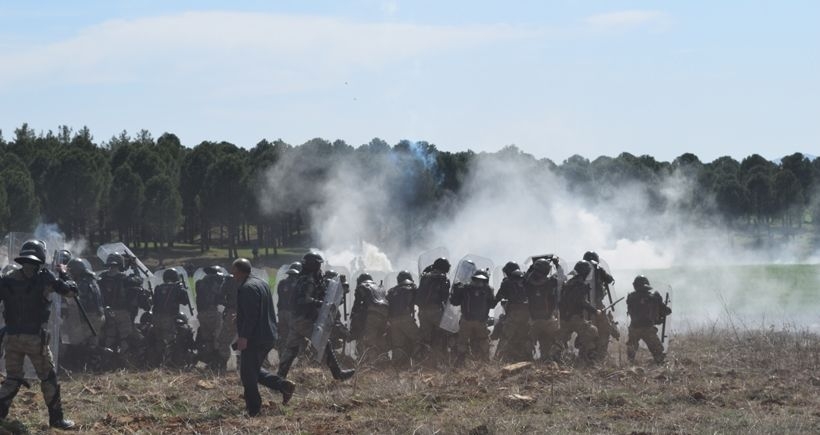
On April 3, however, the gendarmerie forces attacked the villagers with water cannons and tear gas, and detained six people.

Affected by the police’s tear gas, Mor Ali Kabayel, 82, was taken to hospital, where he died.

Turkish gendarmerie forces attack Alevi villagers with tear gas near Maras, April 3, 2016.

According to the journalist Gulsen Iseri, the villagers are “scared of being exposed to a new 1915 [genocide] in which Armenians were deported.”

Hasan Huseyin Degirmenci, an Alevi from Maras, said:

“The real project here is to carry out another 1915. Just like Armenians were deported from here, they want to deport us in the same way. I lived through 1978 Maras [massacre]. I was 24 years old back then. I had to go abroad afterwards.”

As for the container camp and the 27,000 potential newcomers, Degirmenci said:

“The camp that is being built is 360 square meters. They say it will be all-inclusive. But it will not be able to take 27,000 people. Those people will disperse to villages and cities. The local people here will then have to leave behind their homes and become refugees elsewhere. We are scared of living through another 1915. Of course, we are uneasy.”

In protest, Alevis have staged demonstrations across Turkey and Europe.

On April 10, when hundreds of Alevis in Ankara wanted to march protesting the container city in Maras, the police attacked them with plastic bullets, tear gas and water cannons, and detained 10 people. [1]

“We are not against refugees,” said Salman Akdeniz, the head of the Maras branch of the Pir Sultan Abdal Alevi Cultural Association. “We have no problem with the oppressed peoples that have been persecuted in the war and forcibly displaced from their lands. Alevi Kurds in these lands know very well what it means to be a refugee. We have become refugees in other countries for years. We just think this choice of a place is wrong.”

A researcher, Turan Eser, told the newspaper Birgun that,

“there will be some dire consequences for the establishment of the camps in Maras. The demographic character of the region will be changed. The publicly-owned, fertile lands will be destroyed. Damage to the co-existence of Alevis could pave the way to forced emigration [of Alevis]. There are also assessments that industrial enterprises will use those in refugee camps as cheap labor.

“The reports about what is going on inside refugee camps in Turkey have also jogged people’s memories. That there are Salafis or families of ISIS members as well as the cadres of the [Syrian] Train and Equip Program in those camps and that the ID cards of AFAD [the Prime Ministry’s Disaster and Emergency Management Authority] have been given to ISIS members steer people’s perceptions of the camps to different directions. Naturally, people get uneasy when AFAD camps are mentioned.”

Syrian refugees will also be settled in Alevi villages in the province of Sivas. The district governors in the city have reportedly asked the local authorities in those villages to provide them with the list of the empty houses in the villages as well as with the winter and summer populations there.

“This is a policy of forcing Alevis to immigration and dissolving the Alevi population,” Gani Kaplan, the head of the Pir Sultan Abdal Alevi Cultural Association, told the Dicle News Agency (DIHA). “We are not against immigrants, but it is impossible for us to live alongside jihadists in the same village.”

Kaplan added that in the 1980s, Afghans were settled in the Alevi villages in the province of Tokat. “Today there is not an Alevi population there. The state policy towards Alevis does not change.”

The province of Sivas is also a terrible choice by the government to build another container city for “refugees”: Alevis in Sivas were already exposed to a deadly attack there at the hands of Islamists in 1993.[2]

Zeynep Altiok, an MP from the Republican People’s Party (CHP), whose father lost his life in the Sivas massacre in 1993, asked in a parliamentary motion to Prime Minister Ahmet Davutoglu:

“After the attempt to build a refugee camp in the middle of the Alevi villages… — where the [1978] massacre happened — is it a coincidence that you are building yet another refugee camp in the predominantly Alevi town of Divrigi in Sivas — where the [1993] massacre… took place? What is the objective of all of that?”

“The immigration of Syrian refugees whose population is almost 10 times higher than the Alevi community in those villages,” Altiok noted, “especially after the reports about the camps and about what is going on in those camps came out — is extremely disturbing for the Alevis.”

Unfortunately, the government has not taken any steps to relieve the tension in the region or eliminate the fears of Alevis. So the protests continue, as well as establishing the camps.

Alevis are the second largest religious community in Turkey, although no official statistics are available.

Though systematically denied by the Turkish regime, the Alevi faith is a genuine and distinct religious faith. The state tries to portray the Alevi faith as just an Islamic sect or an interpretation of Islam, but objective scholars, as well as Alevis who have the courage to challenge the state official ideology, contradict that:

“Islam has a dynamic based on conquest and booty,” wrote the sociologist Ismail Besikci.

“A country is conquered; its people are invited to Islam; if they do not accept Islam, their women, children, and properties all become booty. The properties of those who accept Islam are also seized. They are only able to escape death. Are these things existent in Alevism? Does Alevism require conquering here and there, inviting people to the Alevi faith, murdering those who do not accept the faith, and plundering their properties, women and children?”

Alevism places love for the whole of humanity, peaceful coexistence and reason in its center, so such crimes in Alevism do not exist. Alevis also reject ethnic and religious discrimination.

Salah [Islamic prayer], fasting [during the month of Ramadan], hajj [Islamic pilgrimage to Mecca], zakat [Islamic religious tax], and shadada [Islamic declaration of faith] are the basic forms of worship in Islam. There are no such rules in Alevi worship,” Besikci noted as well.

Kemal Bulbul, the former President of the Pir Sultan Abdal Alevi Cultural Association, also emphasizes that Alevism is a faith in its own right:

“Alevi faith has been influenced by Islam but Alevism is Alevism. And Alevism respects all other faiths.

“The religious centre of Sunnism is the mosque. They carry out the requirements of the Sunni faith and do salat (Islamic prayer, five times a day) at mosques. The centre of Alevism is the cem house. They carry out [the religious ritual called] cem. This is where the difference between the two begins. Their religious rituals are completely different.

“Alevism is not ‘Anatolian Islam’. To call Alevism as such is the Turkish-Islamic view of the state.” ‘Anatolian Islam’ is a perspective that the official ideology of the state tries to promote.

“If Alevis were ‘Anatolian Muslims’, why have Alevis been denied in this country? If Alevism is ‘Anatolian Islam’, why have those who call themselves Muslims opposed this faith, its practice of cem and its cem houses? That is a heavy contradiction.”

Apparently, carrying out massacres is just one way the Turkish state uses to exterminate the Alevis. For when you deny Alevism, there is no need officially to recognize Alevis in your constitution, build cem houses for them or prepare school courses where Alevism is also taught extensively. The denial of the faith seems to be an effective way of assimilating Alevis into the Islamic culture or making them “invisible.”

There are also other methods — such as trying to change the demographic character of the predominantly Alevi places by building container cities in the middle of Alevi villages, especially where the locals have already been exposed to appalling mass killings and social pressures.

Alevis have justifiable reasons for opposing these container cities. They, as everyone else, already see the growing jihadist presence in Turkey. And they have seen as well that forced displacements and deportations of non-Muslim communities have always been common practices in Turkey: If you can’t kill them all off outright, terrorize them to the point that they will eventually have to flee for their lives.

Uzay Bulut is a Turkish journalist born and raised as a Muslim in Turkey. She is presently based in Washington D.C.


[1] Maras, where the “refugee camps” are being built, was the scene of a massacre by radical Muslims and Turkish nationalists in 1978. In a series of attacks in December, 1978 in Maras that lasted a week, 111 people were killed and hundreds more wounded. The victims were mostly Alevi Kurds.

The author Aziz Tunc who wrote a book on the massacre said that on the day of the attack, members of the Turkish Nationalist Movement Party (MHP) incited people to violence by making it a religious war.

“They shouted slogans like ‘today is the day of jihad’, ‘if you kill an Alevi, you will go to heaven’, ‘today is the last day of Alevis’ and ‘there is a Kurdish wedding today’. By ‘Kurdish wedding’, they meant a Kurdish massacre,” Tunc said.

“After those announcements, the fascists started a massacre that is too hard to verbalize,” said Kemal Bulbul, the former President of the Pir Sultan Abdal Alevi Cultural Association. “They burned people to death, cut them to pieces and slaughtered even children, elderly people and pregnant women.”

The massacre scared many people who packed up and left their homes forever and settled elsewhere in Turkey or Europe.

(More about the 1978 Maras massacre, please read: “Deadly 1978 Maras Attack Still Fresh in Minds of Survivors“, By Uzay Bulut, Rudaw, December 29, 2013.)

[2] On July 2, 1993, a group of Islamic fundamentalists surrounded the Madimak Hotel in which many intellectuals were staying for the Pir Sultan Abdal Festival.

The novelist Aziz Nesin, who had got Salman Rushdie’s book The Satanic Verses translated and published and who criticized Islam, was one of the participants of the event. The demonstrations to protest his appearance turned violent; the fundamentalist crowd set fire to the Madimak Hotel.

Nesin was able to escape, but 33 others, mostly intellectuals and Alevis, who stayed inside the hotel, were murdered. Security forces and state officials did not stop the massacre on time.

(More about the massacre: “2 July 1993: How Turkish Islamists Publicly Massacred Alevi Intellectuals“, by Uzay Bulut, Jerusalem Online, July 30, 2015)

Translate »
Skip to toolbar