Monthly Archives: June 2017

U.S. Bankrolling Hezbollah by Majid Rafizadeh

  • Hassan Nasrallah, Hezbollah’s leader, said that U.S. sanctions would have no impact on the organization, as it already obtains complete financial and weaponry assistance from the Islamic Republic of Iran.

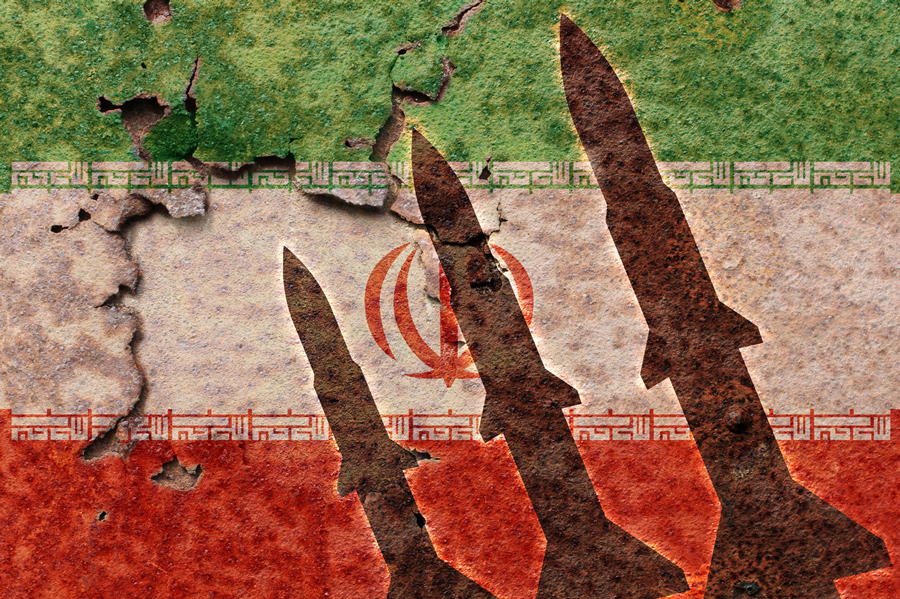
  • After the flimsy and uncompleted nuclear agreement, the Obama Administration immediately began transferring billions of dollars to Iran’s Central Bank. One of the payments included $1.7 billion transferred in January 2016. $1.4 billion of this sum came from American taxpayers.
  • Thanks to President Obama and the continuing lifting of sanctions, the money that Iran is receiving from the U.S., from international trade, and from increased oil sales is most likely being directed toward Hezbollah and the Revolutionary Guards, Iran’s major beneficiaries, which keep attempting to scuttle U.S. foreign policy objectives in the region.

Nearly 34 years after its inception, Hezbollah, a Lebanese Shiite militant group, has publicly admitted that it is fully receiving its money and arms from the Iranian government.

Hassan Nasrallah, the leader of Hezbollah, ridiculed the recent U.S. sanctions targeting Hezbollah. His speech was broadcast by the Al-Manar, the Shiite party’s TV station, which is funded by the Iranian government. Nasrallah said that the U.S. sanctions would have no impact on the organization, as his group already obtains complete financial and weaponry assistance from the Islamic Republic of Iran.

The Shiite leader pointed out that “We do not have any business projects or investments via banks…” He added that Hezbollah’s survival depends on Iran: “We are open about the fact that Hezbollah’s budget, its income, its expenses, everything it eats and drinks, its weapons and rockets, come from the Islamic Republic of Iran,” he said, and pressed the notion that his group “will not be affected” by any type of sanctions.

Nasrallah’s recent speech was also part of a ceremony that marked 40 days after the death of a high level Hezbollah commander, Mustafah Bedreddine, in the Syrian capital of Damascus. Nasrallah has recently vowed to increase Hezbollah’s military presence in Syria, and assist Bashar Al Assad’s forces, although Hezbollah has suffered significant losses in the latest fighting in Aleppo, Syria.

Nasrallah stated on Al Manar television:

“We are facing a new wave… of projects in our war against Syria. They are being waged in northern Syria, particularly in the Aleppo region… The defense of Aleppo is the defense of the rest of Syria, it is the defense of Damascus, it is also the defense of Lebanon, and of Iraq….We will increase our presence in Aleppo. Retreat is not permissible.”

Iran maintains that Hezbollah is a legitimate social, political and religious organization. Iran fostered the birth of Hezbollah and transformed it into one of its militant proxies in the region. Iran also helped Hezbollah become part of Lebanon’s political system.
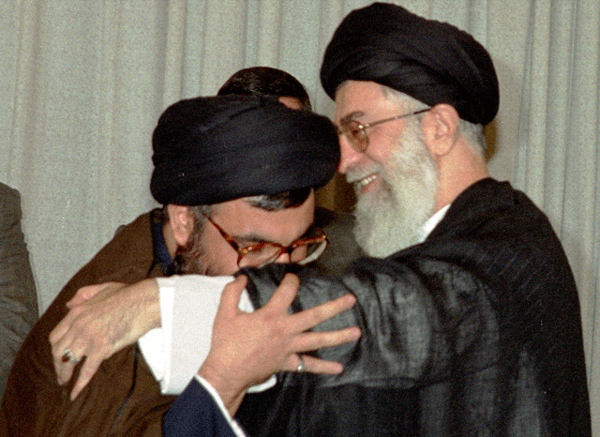
Hezbollah leader Hassan Nasrallah (left) hugs and kisses Iran’s Supreme Leader, Ayatollah Ali Khamenei.

The United States and several other countries, including Canada, France, Australia, the Netherlands, and even the Arab League and the Gulf Cooperation Council (GCC), have long listed Hezbollah as a global terrorist group.

Hezbollah has been accused of terrorist attacks, including the 1983 bombing of the U.S. Marines barracks in Beirut, in which 241 U.S. Marines were killed, the 1983 U.S. Embassy bombing in Beirut; the 2009 Hezbollah plot in Egypt; the 1984 United States Embassy annex bombing in Beirut; the 2012 bus bombing in Burgas, Bulgaria, as well as the 9/11 attacks in the United States, in which federal courts ordered Iran to pay $7.5 billion to the victims’ families. Hezbollah and Iran were also reportedly behind the 1992 attack on Israel’s Embassy in Buenos Aires in which 29 were killed.

U.S. President Barack Obama gave hope that the nuclear agreement (which is still unsigned by Iran), the lifting of sanctions against Iran, and engagement with Tehran will possibly help to change Iran’s behavior towards the moderates in Iran, and diminish Iran’s antagonistic, anti-Semitic stance towards Israel. He pointed out that as a result of the nuclear agreement,

“Iran being able to recognize that what’s happening in Syria for example is leading to extremism that threatens their own state and not just the United States; that some convergence of interests begins to lead to conversations between, for example, Saudi Arabia and Iran; that Iran starts making different decisions that are less offensive to its neighbors; that it tones down the rhetoric in terms of its virulent opposition to Israel. And, you know, that’s something that we should welcome.”

Instead, the rhetoric of Iran’s Supreme Leader, Ayatollah Ali Khamenei and his proxy, Hezbollah, appear to have grown harsher against Israel and the US. As Nasrallah emphasized, “As long as Iran has money, we have money… Just as we receive the rockets that we use to threaten Israel, we are receiving our money. No law will prevent us from receiving it…”

In December 2015, the U.S. Congress voted to impose fresh sanctions on Hezbollah, through the Hezbollah International Financing Prevention Act, by targeting those banks that are “knowingly facilitating a significant transaction or transactions for” Hezbollah and those financial institutions that “knowingly facilitating a significant transaction or transactions of a person identified on the List of Specially Designated Nationals and Blocked persons.”

Nasrallah lashed out at the U.S.: “We totally reject this law until the Day of Judgment. … Even if the law is applied, we as a party and an organizational and jihadi movement, will not be hurt or affected.” He added: “We have no money in Lebanese banks, either in the past or now. … We don’t transfer our money through the Lebanese banking system.”

The Congressional bill does pose some minor challenges to Hezbollah’s financial logistics, but it will not prevent its military operations, terrorist attacks and expansion in any significant way — due to the Obama administration’s grand policy towards Iran and Hezbollah.

After the flimsy and uncompleted nuclear agreement, the Obama Administration immediately began transferring billions of dollars to Iran’s Central Bank. One of the payments included $1.7 billion transferred in January 2016. $1.4 billion of this sum came from American taxpayers.

Iran immediately increased its military budget by $1.5 billion from $15.6 billion to $17.1 billion.

Iran also began witnessing the flow of money due to the lifting of international sanctions.

The major primary beneficiaries of the sanctions relief and flow of money are Hezbollah and the Islamic Revolutionary Guards Corps (IRGC). Previously, when sanctions were imposed on Iran, Tehran had to reduce funding to Hezbollah and the its television station, Al-Manar, from approximately $200 million a year. However, thanks to President Obama and the continuing lifting of sanctions, the money that Iran is receiving from the U.S., from international trade, and from increased oil sales is most likely being directed toward Hezbollah and IRGC, Iran’s major beneficiaries, which keep attempting to scuttle U.S. foreign policy objectives in the region.

Dr. Majid Rafizadeh, political scientists and Harvard University scholar is president of the International American Council on the Middle East. He can be reached at Dr.rafizadeh@post.harvard.edu
U.S. and West Victimize Christians Fleeing ISIS by Raymond Ibrahim

  • Western nations are not merely ignoring Muslim persecution of Christians in the Middle East, they are actively supporting it by sponsoring “moderate” rebels who in reality are as “radical” and anti-Western as the Islamic State.


  • “Why the federal government has failed to take steps to expedite such reunification in cases where family and religious leaders are willing to vouch for and help those seeking asylum here… remains an unfathomable mystery.” —East County Magazine, San Diego.

  • Such “unfathomable mysteries” are reminiscent of the U.S. State Department’s habit of inviting Muslim representatives but denying visas to Christian representatives. Since the start of 2015, 4,205 Muslims have been admitted into the U.S. from Iraq, but only 727 Christians. For every Christian granted asylum, the U.S. grants asylum to five or six Muslims — even though Christians, as persecuted “infidel” minorities, are in much greater need of sanctuary.

  • “Most European governments, especially those that are Christian explicitly or implicitly, are failing in their duty to look after their fellow Christians in their hour of need.” — Lord Weidenfeld.

  • When persecuted Christian minorities manage to flee the Islamic State and come to the West for asylum, they are imprisoned again. All the while, Muslims — in the Mideast and in the West — are being empowered and welcomed in the West with open arms.

Not only does the West facilitate the persecution of Christians in the Middle East, but in the West as well.

According to a recent NPR report, the U.S. supported “moderate” coalition fighting both Bashar Assad and the Islamic State in Syria “has extremists in its own ranks who have mistreated Christians and forced them out of their homes” — just as the Islamic State (IS) has done.

Christian minorities forced out of their homes who manage to reach Western nations — including the United States — sometimes encounter more trouble.

Despite having family members to sponsor them, a group of 20 Christians who fled the Islamic State in Iraq have been imprisoned indefinitely, some since February, at the Otay Detention Facility in San Diego, even though they have local family members and Christian leaders who vouch for them (a primary way that the majority of detained foreign nationals are released is to the supervision of American citizens who vouch for them).

Activists say that the men and women in detention have been held for too long, including by the U.S. government’s own standards. Some have been imprisoned for over seven months with no hearing date for release even set.

“They are being held without a real reason…. They’ve escaped hell. Let’s allow them to reunite with their families,” said Mark Arabo, a spokesman for the Chaldean community in San Diego.

The detainees include a woman who had escaped the clutches of IS, and who had pleaded to see her sickly mother. Her mother died before she could see her. “She had been begging to be let out to see her dying mother,” said a priest familiar with the case.

Discussing the ongoing plight of these Iraqi Christians, San Diego’s East County Magazineconcluded: “Why the federal government has failed to take steps to expedite such reunification in cases where family and religious leaders are willing to vouch for and help those seeking asylum here, then, remains an unfathomable mystery.”

Such “unfathomable mysteries” are reminiscent of the U.S. State Department’s habit of inviting Muslim representatives but denying visas to Christian representatives. Since the start of 2015,4,205 Muslims have been admitted into the U.S. from Iraq, but only 727 Christians. For every one Christian the U.S. grants asylum, it grants asylum to five or six Muslims — even though Christians, as persecuted “infidel” minorities, are in much greater need of sanctuary, not to mention more assimilating to American culture than Muslims.

Faith McDonnell, of the Institute on Religion & Democracy, said regarding the detainment of Iraqi Christians in San Diego:

This follows the disturbing pattern that we have seen from the State Department of ignoring the particular targeting of Christians by ISIS while giving preferential treatment for asylum to other groups with expedited processing — like Somalis, Iraqis, and Syrians, some of whom could very well be members of jihadist movements.

The same is happening in the United Kingdom. Church leaders accuse David Cameron of “turning his back” on Christians facing genocide in Syria and Iraq by failing to grant them refuge in the UK — even though thousands of Muslims have been allowed entry.

Lord Carey, the former Archbishop of Canterbury, signed a petition calling on the UK government to “welcome Christian refugees and give them priority as asylum seekers,” emphasizing that “Syrian and Iraqi Christians are being butchered, tortured and enslaved.”

Similarly, Lord Weidenfeld, 95, who fled Nazi-occupied Austria in 1938 with the help of British Quakers, said:

Why is it that the Poles and the Czechs are taking in Christian families and yet the British government stands idly by?

This mood of indifference is reminiscent of the worst phases of appeasement, and may have catastrophic consequences. Europe must awake and the Conservative British Government should be leading from the front.

Most European governments, especially those that are Christian explicitly or implicitly, are failing in their duty to look after their fellow Christians in their hour of need.

This is not necessarily true of east European nations. Along with countries like Poland and Czechoslovakia, Slovakia recently went so far as to say it will only accept Christians when it takes in Syrian refugees under an EU relocation scheme. The Slavic nation argues that “Muslims would not be accepted because they would not feel at home,” including because there are no mosques in Slovakia.

Meanwhile, many of those Christians who are granted asylum in Western countries arrive there only to be further persecuted by Muslim asylum seekers — indicating, once again, who does and who does not really need asylum; who does and who does not assimilate in Western culture.

Most recently in Sweden, two small families of Christian asylum seekers from Syria were recently harassed and abused by approximately 80 Muslim asylum seekers, also from Syria.

The Christians and Muslims — described by one Swedish newspaper as “fundamentalist Islamists” — resided in the same asylum house. Among other humiliations, the Muslims ordered the Christians not to wear their crosses around their necks and not to use the communal areas when in use by Muslims.

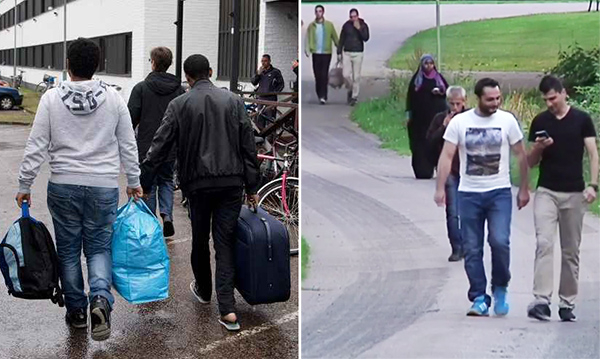
Asylum seekers in the Swedish city of Kalmar, where Christian refugees were forced to move out of public housing after being harassed and threatened by Muslims.

After continuous harassment and threats, these Christian refugees, who had managed to escape the Islamic State, left the Swedish asylum house “fearing for their own safety.” A spokesman for the government migration agency responsible for the center they had been staying in said:

“They dared not stay. The atmosphere became too intimidating. And they got no help… They chose themselves to organize new address and moved away without our participation because they felt a discomfort.”

Western nations are not merely ignoring Muslim persecution of Christians in the Middle East, they are actively supporting it by sponsoring “moderate” rebels who in reality are as “radical” and anti-Western as the Islamic State. And when these persecuted Christian minorities manage to flee the Islamic State and come to the West for asylum, they are imprisoned again. All the while, Muslims — in the Mideast and in the West — are being empowered and welcomed in the West with open arms.

Twagiramungu Faustini,yigishije FDLR,icenga rya politike.

Amakuru agera ku nyangeNews.com aturuka muri FDLR,aya makuru tukaba tuyafitiye gihamya,aravuga yuko ingabo za FDLR nyuma yokubona abanyapolitiki nk’ishyaka ry’ingabo ryari rimaze hafi imyaka (2); ritagira abanyapolitiki babasevlle biravugwa ko,bamaze kubona abo banyapolitiki barimo uwigeze kuba ministiri w’Intebe Twagiramungu Faustini,noneho ngo yaba yabigishije icenga rya politiki ryo kurambika hasi kandi nyamara batazirambitse,ahubwo aramayeri ya za 600 zo muri CND nabo bashaka kugeraho.intwaro


Nkuko tubikesha ushinzwe gutanga amakuru muri FDLR,yemeza yuko ngo uhereye 1996,FDLR yarifite ibihumbi bigera kuri 40,000 byabasirikare bo mu bwoko bw’Abahutu “KIGA batavangiyemo Nduga cyangwa Tutsi”.Nkuko baca umugani ko uburo bwinshi butagira umusururu ninako byaje kugendekera ingabo za FDLR zashiriye mu mashyamba ya Congo maze baza kwisanga basigaye umubare bafite ubu ubarirwa hagati y’ibihumbi 5700 na 4500 byabasirikare bo mu bwoko bw’Abahutu.

Kuba FDLR yarifite umubare mu nini cyane ujya kungana hafi ningabo FPR yarifite 1994 ugera kubihumbi 60,000 byabasirikare byari byoroshye ko, bibahesha gufata igihugu,usibye ko,banabigerageje bakagarukira hafi ku giti kin yoni bagasubira inyuma icyabiteye ngirango nabo barakizi ni uko zimwe mu nagbo za FPR ziyeje gutera itabi ahitwaga Muruhengeri bityo batsemba igiti n’ibuye maze FDLR itsindwa gutyo!.

Nyuma ya Twagiramungu Faustini uzwiho cyane kuba ar’umunyamoko,kandi akaba azwiho kuba igisambo muri politike,agendana nibigezweho aho ubu yifatanije n’Abakiga kandi aribo yagamabaniye mbere ya 1994 akifatanya na FPR,azwiho ubuhanga bwo kumenya aho bihiye bityo akajyayo hakiri kare mbere yuko babigabura akifatanya nababiteguye maze byamara gushya bikamwitirirwa ariko mubyukuri nta nakimwe aba yakoze gihambaye usibye gutanga amacenga ya politiki y’ubugambanyi kugirango abone umuryango yinjiriramo bityo yigaragaze nk’umunyapolitike wokurwego rwo hejuru muri politike.

Ni muri urwo rwego FDLR nyuma yokwifatanya na Twagiramungu leta y’Urwanda yahise igira ubwoba bw’ibigiye kuyibaho,aho bisanze babwirwa yuko FDLR yemeye kurambika intwaro hasi ingabo zitagera ku ijana kuko iabazwe zari 95,mu gihe imibare amahanga yatangaga yerekanaga ingabo 105,zabasirikare.

Tekereza mubihumbi bigera kuri 5700, hakagaragara ingabo 105, zemera gutanga ibirwanisho kumugaragaro,kugirango zinjire mu mu Rwanda zisaba imishyikirano,maze bahanganire na FPR,mu gihugu.Kuko ntabwo bazapfa gutaha gutya gusa,ahubwo hazabaho ubwumvikane icyo gihe leta ya FPR,niyanga ibe iguye mu mutego,niyompamvu FPR yahise ishimuta umusirikare wa Congo ndetse bagerekaho kumwica bibwira yuko har’icyo byabafasha mu ikoni rya politike yo kurwanya amacenga ya FDLR.

Ariko amakuru dufite agaragaza yuko ntacyo leta ya Kigali yabyungukiyemo kuko yanze ikunze nk’uko ubuhanuzi bubivuga FPR na FDLR bigambo kugirana imishyikirano kuko ntayindi nzira yamahoro ihari,bitaba ibyo izo ngabo zikazashyirwa kubutaka bw’Urwanda kugirango zive kubutaka bwa Congo no neho tuzarebe ko Umwakagara atazemera ko bumvikana kuko nawe Habyara yemewe kumvikana nawe atar’uko,amukunze ahubwo ni uko yari yarafashe agace kamwe kubutaka bw’Urwanda kandi bakaba bari batangaje ko badashobora gusubira mu gihugu cy’Uganda,ahubwo ko,bagomba kugirana imishyikirano.

Amakuru agera ku nyangeNews.com aturuka muri FDLR,aya makuru tukaba tuyafitiye gihamya,aravuga yuko ingabo za FDLR nyuma yokubona abanyapolitiki nk’ishyaka ry’ingabo ryari rimaze hafi imyaka (2); ritagira abanyapolitiki babasevlle biravugwa ko,bamaze kubona abo banyapolitiki barimo uwigeze kuba ministiri w’Intebe Twagiramungu Faustini,noneho ngo yaba yabigishije icenga rya politiki ryo kurambika intwaro hasi kandi nyamara batazirambitse,ahubwo aramayeri ya za 600 zo muri CND nabo bashaka kugeraho.

Nkuko tubikesha ushinzwe gutanga amakuru muri FDLR,yemeza yuko ngo uhereye 1996,FDLR yarifite ibihumbi bigera kuri 40,000 byabasirikare bo mu bwoko bw’Abahutu “KIGA batavangiyemo Nduga cyangwa Tutsi”.Nkuko baca umugani ko uburo bwinshi butagira umusururu ninako byaje kugendekera ingabo za FDLR zashiriye mu mashyamba ya Congo maze baza kwisanga basigaye umubare bafite ubu ubarirwa hagati y’ibihumbi 5700 na 4500 byabasirikare bo mu bwoko bw’Abahutu.

Kuba FDLR yarifite umubare mu nini cyane ujya kungana hafi ningabo FPR yarifite 1994 ugera kubihumbi 60,000 byabasirikare byari byoroshye ko, bibahesha gufata igihugu,usibye ko,banabigerageje bakagarukira hafi ku giti kin yoni bagasubira inyuma icyabiteye ngirango nabo barakizi ni uko zimwe mu nagbo za FPR ziyeje gutera itabi ahitwaga Muruhengeri bityo batsemba igiti n’ibuye maze FDLR itsindwa gutyo!.

Nyuma ya Twagiramungu Faustini uzwiho cyane kuba ar’umunyamoko,kandi akaba azwiho kuba igisambo muri politike,agendana nibigezweho aho ubu yifatanije n’Abakiga kandi aribo yagamabaniye mbere ya 1994 akifatanya na FPR,azwiho ubuhanga bwo kumenya aho bihiye bityo akajyayo hakiri kare mbere yuko babigabura akifatanya nababiteguye maze byamara gushya bikamwitirirwa ariko mubyukuri nta nakimwe aba yakoze gihambaye usibye gutanga amacenga ya politiki y’ubugambanyi kugirango abone umuryango yinjiriramo bityo yigaragaze nk’umunyapolitike wokurwego rwo hejuru muri politike.

Ni muri urwo rwego FDLR nyuma yokwifatanya na Twagiramungu leta y’Urwanda yahise igira ubwoba bw’ibigiye kuyibaho,aho bisanze babwirwa yuko FDLR yemeye kurambika intwaro hasi ingabo zitagera ku ijana kuko iabazwe zari 95,mu gihe imibare amahanga yatangaga yerekanaga ingabo 105,zabasirikare.

Tekereza mubihumbi bigera kuri 5700, hakagaragara ingabo 105, zemera gutanga ibirwanisho kumugaragaro,kugirango zinjire mu mu Rwanda zisaba imishyikirano,maze bahanganire na FPR,mu gihugu.Kuko ntabwo bazapfa gutaha gutya gusa,ahubwo hazabaho ubwumvikane icyo gihe leta ya FPR,niyanga ibe iguye mu mutego,niyompamvu FPR yahise ishimuta umusirikare wa Congo ndetse bagerekaho kumwica bibwira yuko har’icyo byabafasha mu ikoni rya politike yo kurwanya amacenga ya FDLR.

Ariko amakuru dufite agaragaza yuko ntacyo leta ya Kigali yabyungukiyemo kuko yanze ikunze nk’uko ubuhanuzi bubivuga FPR na FDLR bigambo kugirana imishyikirano kuko ntayindi nzira yamahoro ihari,bitaba ibyo izo ngabo zikazashyirwa kubutaka bw’Urwanda kugirango zive kubutaka bwa Congo no neho tuzarebe ko Umwakagara atazemera ko bumvikana kuko nawe Habyara yemewe kumvikana nawe atar’uko,amukunze ahubwo ni uko yari yarafashe agace kamwe kubutaka bw’Urwanda kandi bakaba bari batangaje ko badashobora gusubira mu gihugu cy’Uganda,ahubwo ko,bagomba kugirana imishyikirano.

If you want comments space please register by creating new an acount on inyangenews.com with valid e-mail,you will get a message in your e-mail activate then get comments page space.

Turks’ Unrequited Love for Palestinians by Burak Bekdil

  • The flag the Turkish prime minister proudly witnessed while being hoisted at the United Nations is an inspiration of the flag used by the Arab Palestinian nationalists in the first half of the 20th century, which was the flag of the 1916 Arab Revolt against Prime Minister Davutoglu’s beloved Ottoman Empire.

  • In his speech, Abbas did not forget to “convey our best wishes to our beloved Armenian brothers in Palestine, in Armenia and in the entire world,” and invited Armenian President Serzh Sarghsyan “to visit Palestine and we hope he will accept the invitation.”

Although it came as no surprise, Turkish Prime Minister Ahmet Davutoglu, in his weekly parliamentary group speech last December, spoke like a Palestinian politician, not a Turkish one:

“The most oppressed people of the 20th and 21st centuries is the Palestinian people … Our support will continue until Jerusalem becomes the capital of independent Palestine … No one should doubt our devotion to the Palestinian cause … We won’t forget Palestine, Gaza, Jerusalem, not even in our dreams … We do politics for this holy way.”

He then narrated an anecdote:

“We were in the front rows when three months ago the Palestinian flag was hoisted at the United Nations. In November 2012, I was the only representative, as [then] foreign minister, from the Islamic world when Palestine was given non-member status at the United Nations general assembly. I sat with [Palestinian leader] Mahmoud Abbas when the Palestinian flag was hoisted recently and we hugged … That’s why I felt honored on behalf of my nation to witness the hoisting of the Palestinian flag at the United Nations. Inshallah [God willing] that flag will one day be waved in Jerusalem … Whatever is wrong for Palestine is wrong for us too.”

What generous Turkish affection for the Palestinian flag and leader! But both history and present times would forcefully remind one that the Turks’ love affair for the Arabs in general, and the Palestinians in particular, is quite unrequited.

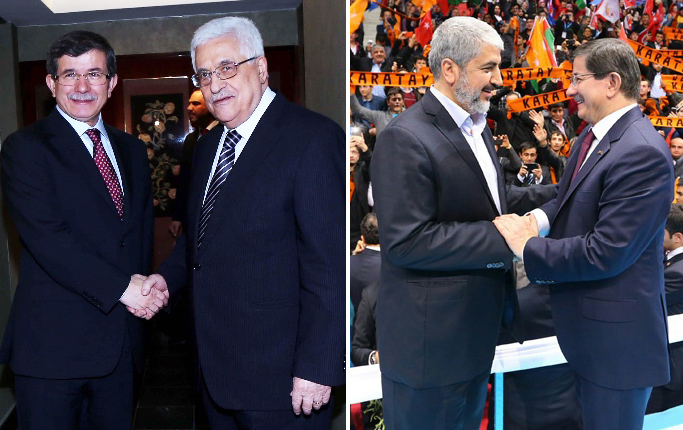
Turkish Prime Minister Ahmet Davutoglu (pictured left with Fatah leader Mahmoud Abbas and right with Hamas leader Khaled Mashaal) now finds his affection and emotional support for the Palestinian cause unrequited.

First, the flag. The colors of the Palestinian flag (red, white, green and black) are pan-Arab colors. The Palestinian flag is almost identical to that of the Arab Socialist Ba’ath Party. It is also very similar to the flags of Jordan and Western Sahara. Before being the Palestinian flag, it was the flag of the short-lived Arab Federation of Iraq and Jordan. All of these flags draw their inspiration from the Arab Revolt against Ottoman Turkey (1916-1918).

In short, the flag the Turkish prime minister proudly witnessed while being hoisted at the UN is an inspiration of the flag used by the Arab Palestinian nationalists in the first half of the 20th century, which was the flag of the 1916 Arab Revolt against Davutoglu’s beloved Ottoman Empire. The Arabs, including Palestinians, joined the Allies to fight the Turks during the war.

Similarly, Davutoglu’s emotional encounters with Mahmoud Abbas do not sound as if they are being shared by the Palestinian leadership. Abbas’s Christmas message, which went unnoticed in Turkey, contained references to the Armenian genocide (still largely a taboo topic in Turkey) that would have caused a small political earthquake in Turkey, along with fits of anger and threats, had they been spoken by an Israeli or European politician. Displaying the usual hypocrisy, Turkish leaders preferred not to hear what the Abbas said:

“We, Palestinians, have gone through similar experiences as the Armenians; both of us have been repressed, terrorized and banished. As the Armenian people emigrated from their country to ours and then to another place, we too are experiencing the same struggle; we emigrated in 1948 and the refugees in Syria are migrating to the sea, into exile and to places only God knows about.”

In his speech, Abbas did not forget to “convey our best wishes to our beloved Armenian brothers in Palestine, in Armenia and in the entire world,” and invited Armenian President Serzh Sarghsyan “to visit Palestine and we hope he will accept the invitation.”

That was “From Palestine with Love” — to Turkey. Without caring much about whether the Palestinians love the Turks, the Turks keep on loving to love the Palestinians. Political Islam has its many prerequisites. If one of them is unconditionally to hate Israel and the Jews; the other is an unconditional devotion to the “Palestinian cause.” Turkey’s leaders successfully fulfill both prerequisites.

Burak Bekdil, based in Ankara, is a Turkish columnist for the Hürriyet Daily and a Fellow at the Middle East Forum.

Turkish Professor: “Those Who Do Not Do Islamic Daily Prayers Are Animals” by Robert Jones

  • “Salah [prayer] is not done by animals. Those who do not do salah are animals.” — Turkish Professor Mustafa Askar, School of Divinity, Ankara University.

  • Intimidation by Muslim extremists against those who do not follow a strict Islamist lifestyle does indeed produce “results.” Physical or verbal attacks against those who do not fast during Ramadan are commonplace all across Turkey. If you happen to find yourself there during Ramadan, stay indoors if you would like to eat, drink or smoke.
  • “If the faith of those who do not do salah is different from that of the professor, murdering them could even bring sawab [reward for Islamic good deeds]. Such are the views that feed the perverse faith and doctrinal background of Muslim terrorists. … Is this professor aware of the fact that with this claim of his, he could cause the murder of so many innocent people?” — Yasin Ceylan, professor of philosophy, Middle East Technical University, Ankara.

Many Muslims claim that the Islamic month of Ramadan is not simply an exercise in fasting during the day. It is, they say, a chance for “a spiritual boost,” “mental peace” or “a moral awakening.”

During Ramadan, however, it often seems as if hate speech and intolerance are as rampant as ever, possibly even more — especially with the “Ramadan TV programs,” which are popular.

With the advent of Ramadan, Turkey has not opened only the season of fasting; it has also opened the season of “Ramadan Intolerance.”

This frequently consists of statements which threaten or dehumanize those who do not fast. During this season, many national television channels and social media users in Turkey disgorge hatred against those who do not carry out the strictest Islamic requirements.

Turkish professor Mustafa Askar, at Ankara University’s School of Divinity, said on the “Joy of Ramadan” program, aired on the state-funded TRT channel: “Those who do not do Islamic daily prayers are animals.”

Askar proclaimed, on June 12, that “no beings other than humans touch the ground with their foreheads [to do sujud, the position of worship in which the forehead, nose, both hands, knees and all toes touch the ground together]. Human beings, he said, were created in a “salah [worship] ergonomic” way, and that is why “humans do sujud.”

“Let me put it straight,” the professor said. “Salah is not done by animals. Those who do not do salah are animals.”

Yasin Ceylan, a professor of philosophy at Ankara’s Middle East Technical University, reacted to Askar’s statements on his social media account:

“If the claim that ‘those who do not do salah are animals’ comes from a professor, that could serve as an excuse for the massacres carried out by a terrorist organization such as ISIS. If killing an animal is not considered murder, those who do not do salah may be killed, too.

“Moreover, if the faith of those who fail to do salah is different from that of the professor, murdering them could even bring sawab [a reward for Islamic good deeds]. Such are the views that feed the perverse faith and doctrinal background of Muslim terrorists. The main source of violence is the judgments of minds. Is this professor aware of the fact that with this claim of his, he could cause the murder of so many innocent people?”

Askar, after being criticized by many for his remarks, told the pro-government daily newspaper, Akit:

“My words have been distorted by the enemies of Islam who almost every day hurl insults at Islam and Muslims. I have not strayed from the views I expressed. I am not taking a step back from my words. This is a scholarly evaluation. … I said what I think is right. But I made a mistake in my choice of words. If there are those offended by my mistake, we apologize.”

When journalists asked Nurettin Canikli, Deputy Prime Minister of Turkey, during a press conference in Ankara on June 13, about his views on Askar’s statements, Canikli said, “I shall pass on this topic.”

Meanwhile, on the June 13 edition of the “Blessing of Ramadan” television program, broadcast on the pro-government Star TV, a viewer asked, “Is it vacip [a religious obligation] to kill those who do not do salah [Islamic daily prayers]?”

“Decrees about giving certain punishments do not rest with individuals,” answered Fatih Citlak, the presenter of the program and also a columnist for the pro-government daily, Haberturk.

Later, on Ahsen TV — an Islamist internet outlet that usually conducts interviews about Islamic issues with the public — broadcast a video clip shows a child become panic-stricken after seeing his cat eat in the kitchen during Ramadan. He leaves home and starts frantically looking for his father. “Dad!” says the child upon finding him, “the cat has broken the fast!”

The father, played by Bulent Yapraklioglu, an Ahsen TV reporter, replies:

“So what is wrong with that? Don’t you know, son? Animals do not fast. Animals do not do salah. Animals do not pay zakat [Islamic religious tax]. Animals do not go on the Hajj [pilgrimage to Mecca] … So now you know.”

Social media, of course, is also used to spread the spirit of Ramadan — and the hatred of non-Muslims and Muslims who may be not-as-observant.

Hakan Arslanbenzer, a Turkish publisher and poet, declared on his Twitter account in June 2015: “There is no religious inconvenience in beating those who do not fast.”

A Twitter user asked him in response: “Did our Prophet beat anyone? Was there such a practice during his lifetime?”

“He is asking me,” Arslanbenzer repeated, “if they beat people who did not fast during the time of Mohammed. First show me the courageous munafiq [hypocrite] who would publicly violate fasting during the time of the Prophet!”

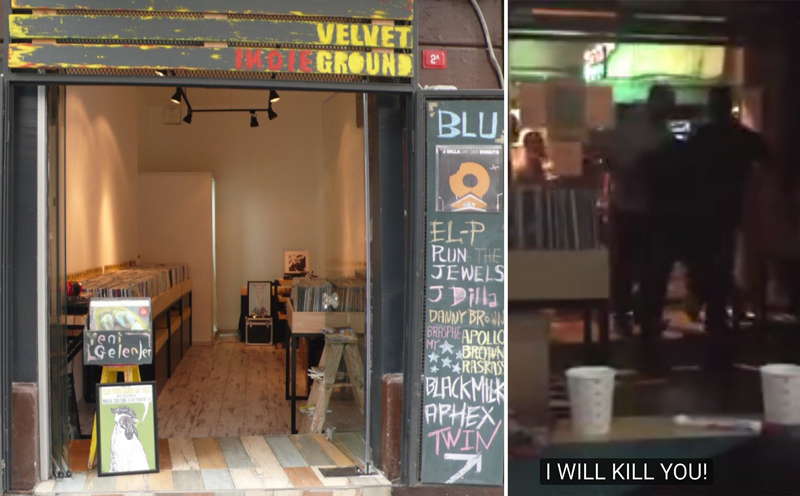
On June 17, Seogu Lee, the Korean owner of an Istanbul record store, Velvet Indieground, invited people to his store for a worldwide “live-streaming” event to celebrate of the release of the latest album of the band Radiohead. They were attacked by a group of men, apparently angry that they had been drinking alcohol during Ramadan — a double sin, as Muslims are not supposed to drink alcohol altogether. It is tantamount to declaring a desire for death. If people learn you are drinking alcohol during Ramadan, they could well threaten, beat or kill you. The men, in fact, raided the store, beat those inside and drove them out. One of the attackers was heard yelling, among other threats, “we will burn you inside!”

Seogu Lee was also beaten by the assailants. The next morning, he was seen in tears, locking the door of his store as he left.

On June 17, a group of men attacked the Velvet Indieground record store in Istanbul, because they were angry that several people in the small shop were drinking alcohol during Ramadan. At right, Seogu Lee, the shop’s Korean owner, is seen being beaten by some of the attackers.

Record stores all over the world had participated in this event, but Muslim assailants did not allow young people in Istanbul to enjoy a few hours of music and drink in the store of a Korean. Apparently it is an attempt to “throw terror into the hearts of those who disbelieve.” (Quran 3:151).

Intimidation by Muslim extremists against those who do not follow a strict Islamist lifestyle does indeed produce “results” — so they keep on doing it. Physical or verbal attacks against those who do not fast during Ramadan are commonplace all across Turkey. If you happen to find yourself there during Ramadan, stay indoors if you would like to eat, drink or smoke.

Turkey is — ironically and unbelievably — a candidate for European Union membership and a member of NATO, as well as other Western institutions. But culturally and sociologically, the impact of religious intolerance seems to have become so institutionalized that no amount of time, or so-called relations with the West or with the rest of the world, seems to change the situation appreciably. Despite all those military, commercial and diplomatic deals Turkey has made with the West, the country still appears to promote the same historical Islamic pressures against non-Muslims — and even secular Muslims — as it always did.

Many Muslims nevertheless claim that other religions are just as violent as theirs, and indeed 600 years ago, during the Inquisition, some were. At present, however, there would seem no other religion that not only promotes, but carries out the violence prescribed in it to the extent of extremist Islam. If, however, one points out a discernible fact such as that, one is accused of Islamophobia, which many extremist Muslims still insist is the main threat, even though the frequency and degrees of violence against Muslims are nowhere near comparable.

Little mention is ever made — dismayingly even in the West — of the justifiable rationality of being alarmed by people mass-slaughtering in the name of religion, and who are promising to continue doing so.

To people who are concerned about protecting freedom, the author Daniel Greenfield asks: “We are learning to be tolerant of Islam. Perhaps, it’s time to ask that rarely asked of questions, when are Muslims going to finally learn to be tolerant of others?”

Robert Jones, an expert on Turkey, is currently based in the UK.

Translate »
Skip to toolbar