Monthly Archives: June 2017

Is the Pope Ending Catholic Anti-Semitism? by Susan Warner

  • “Nostre Aetate,” released in 1965, called for friendship and dialogue between Catholics and Jews, instead of the centuries-long repudiation of Jews by Catholics; St Joseph’s University became the first to respond by establishing the Institute for Jewish-Catholic Relations. Is Pope Francis picking up where Pope Paul VI left off?


  • Can Pope Francis’ hopes and dreams for reconciliation of Catholics and Jews override some unfortunate but pressing realities, such the Church’s desire to placate the Palestinians?

  • If Pope Francis is serious about a “journey of friendship” with the Jewish people, perhaps he would not be so quick to approve President Obama’s Iran nuclear deal in the name of a hoped-for peace that will most certainly ignite an unhoped-for war between Iran and Israel.

  • By assisting the UN in establishing the “sustainable development platform,” the Pope is offering his permission to the UN — one of the most anti-Semitic, anti-Israel bodies on the face of the earth — to usurp power on behalf of a shared utopian agenda. Sustainable development notwithstanding, the UN should be encouraged to clean up its own house before it tries to clean up the world.

A lot of water as passed under the bridge between Catholics and Jews in the past 1800 years or so. Most of it has been polluted by the evils of anti-Semitism perpetrated by the Catholic Church against the Jews of Europe, starting with the earliest published Christian writings by the early ante-Nicene Church Fathers, such as Tertullian. His document “Judeos Adversos” has stood for centuries as one of the key church position papers against the Jews.

During those seemingly endless centuries, the Catholic Church continuously demonized the Jews, stripped them of their livelihoods, and frequently their lives.

In the Catholic mindset, the Covenant that God made with the Jews had been replaced by the Church as God’s new “chosen people.”[1] God no longer had any use for the Jews, and theChurch vowed never to let them forget it.

Then in 1965, under the leadership of Pope Paul VI, the document “Nostre Aetate” was presented to the world as part of an overhaul of the Catholic Church known as the Second Vatican Council, or more popularly, Vatican II. “Nostre Aetate” was one of the most significant documents to emerge from the period. Designed to heal the relationship between the Catholics and the Jews, it was to be a total reset of the Catholic-Jewish relationship — at least on paper.

“Nostra Aetate, the 1965 Declaration on the Church’s Relationship to Non-Christian Religions was one of the most influential and celebrated documents issued by the Second Vatican Council, a gathering of the world’s Catholic bishops. In particular it made possible a new and positive relationship between Jews and Catholics.”[2]

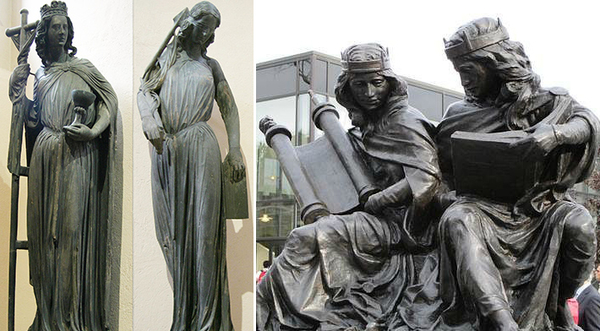
Since the thirteenth century, one prominent symbol pointing to the Catholic animus against the Jews was a sculpture entitled “Ecclesia et Synagoga.” The original version of this allegorical stone sculpture was carved for the Gothic Cathedral in Strasbourg, France. It consists of two elegant female figures, one representing a victorious Church, “Ecclesia,” and the other representing the defeated Jew, “Synagoga.”

Replicated hundreds of times in the famed Gothic cathedrals of Europe, the sculpture presented the figure of Synagoga sometimes blindfolded, representing the Jews as “spiritually blind.” Some sculptures and murals depicted Synagoga with a fallen crown and a broken scepter, with a severed goat’s head or with a demon — all allegorically representing the vanquished Jews.

In all of its sordid variations, the image was revered as an honored visual symbol of the understanding of the relationship between triumphant Christianity and defeated Judaism. The two figures symbolized the Catholic Church’s theological position, often called “supersessionism” or “replacement theology.” According to this theology, the Church has replaced the Jews in God’s view and is now to be celebrated as “the New Israel.” The same theology exists in the Catholic Church today.[3]

After 1965, “Nostre Aetate” provided Catholics with a new opportunity to rethink the worthiness of an ancient theology that bolstered animosity between the two groups. At last, the Catholic Church acknowledged the biblical role of Jewish thought in human history:

“The Church, therefore, cannot forget that she received the revelation of the Old Testament through the people with whom God in His inexpressible mercy concluded the Ancient Covenant. Nor can she forget that she draws sustenance from the root of that well-cultivated olive tree onto which have been grafted the wild shoots, the Gentiles. Indeed, the Church believes that by His cross Christ, Our Peace, reconciled Jews and Gentiles. making both one in Himself. [4]

Pope Francis this week dedicated a new version of this ancient sculpture, which now installed at St. Joseph’s University, in the plaza near the University Chapel.

“Ecclesia et Synagoga”: The original 13th century sculptures from the Strasbourg Cathedral (left), and a recent example from St. Joseph’s University in Philadelphia (right) that Pope Francis blessed this week.

According to Phillip A. Cunningham, Director of the Institute for Jewish-Catholic Relations at St. Joseph’s University:

The new sculpture employs Synagoga and Ecclesia rendered with nobility and grace, to bring to life the words of Pope Francis: “Dialogue and friendship with the Jewish people are part of the life of Jesus’ disciples. There exists between us a rich complementarity that allows us to read the texts of the Hebrew Scriptures together and to help one another mine the riches of God’s word.” The work will depict the figures enjoying studying each other’s sacred texts together.

When “Nostre Aetate” was released in 1965, it called for friendship and dialogue between Catholics and Jews, instead of the centuries-long repudiation of Jews by Catholics; St Joseph’s University became the first to respond by establishing the Institute for Jewish-Catholic Relations and now, five decades later, commissioning the memorial sculpture by Philadelphia artist Joshua Koffman, and hosting the Pope for this remarkable event.

Hundreds of Jews and Catholics from around the region assembled to hear the Pope speak.Rabbi Abraham Skorka, Pope Francis’ close friend, came from Argentina to speak at the dedication ceremony. Event co-sponsors gathered from Philadelphia’s Catholic and Jewish organizations: The archdiocese of Philadelphia; the World Meeting of Families; American Jewish Committee; The Greater Philadelphia Board of Rabbis; Jewish Federation of Greater Philadelphia and the Anti-Defamation League.

The new sculpture “will vividly convey what Pope Francis has called the ‘journey of friendship’ that Jews and Catholics have experienced in the past five decades,” says professor and Institute Assistant Director Adam Gregerman. “We are looking forward to area Jews and Catholics coming together to celebrate the remarkable rapprochement that is occurring.”

Are we actually realizing the moment when the end of Catholic anti-Semitism shall finally be realized? Is this reality in line with Pope Paul VI’s dream of “Nostre Aetate?” Is Pope Francis picking up where Pope Paul VI left off?

The question lingers: Can Pope Francis’ hopes and dreams for reconciliation of Catholics and Jews override some unfortunate but pressing realities, such the Church’s desire to placate the Palestinians?

At least four trouble spots need to be addressed before the Pope can complete his sought-after “journey of friendship” between Jews and Catholics:

1. The first squeamish issue is the universality of the current Catholic teaching of supersessionism or “replacement theology.” If the Catholic Church is still claiming to be “The New Israel,” there is no room on the planet for a Jewish Israel. Under this unfortunate and false teaching, the Jewish people, the Jewish religion and the Jewish nation are only valid if the Jews convert to Catholicism.[5]

2. If Pope Francis is serious about a “journey of friendship” with the Jewish people, perhaps he would not be so quick to approve President Obama’s Iran nuclear deal in the name of a hoped-for peace that will most certainly ignite an unhoped-for war between Iranian proxies, Iran and Israel.

3. By prematurely, preemptively and unilaterally recognizing Palestine as a state, he selected some very unfortunate timing — on the anniversary of Israel’s declaration of independence, called Nakba Day [“Catastrophe Day”] by Palestinians — for his attempt to destroy and supplant the Jewish state.

This was a theft of Israel’s hopes for a legitimate negotiated peace settlement and an insult to Israel in the international arena. The Pope robbed Israel of a vital negotiating position. He robbed them of their international standing, and gave the Palestinians another legitimate pathway to act on their vow to destroy Israel. As one of the most prestigious leaders in the world, the Pope’s unilateral action was a kick in the teeth for Israel and hardly the “journey of friendship” he claims to desire.

4. By collaborating with — and even assisting — the United Nations in establishing the “sustainable development platform,” the Pope is freely offering his permission to the UN — one of the most anti-Semitic, anti-Israel bodies on the face of the earth — to usurp power on behalf of a shared utopian agenda. “Sustainable development” notwithstanding, the United Nations should be encouraged to clean up its own house before it tries to clean up the world.

Pope Francis has been in his office only since 2013. During this short time, he has managed to straddle both sides of a very dangerous divide — between the Jews and Israel on one side and on the other, their Islamist neighbor nations that daily vow to annihilate all Jews along with their state.

For an average person, this might seem less like a “journey of friendship” and more like a pathway to war.

Susan Warner is a Distinguished Senior Fellow of Gatestone Institute and co-founder of a Christian group, Olive Tree Ministries in Wilmington, DE, USA. She has been writing and teaching about Israel and the Middle East for over 15 years. Contact her at israelolivetree@yahoo.com.


[1] The actual quote from the conclusion of a teaching from “The Church = The New Israel“: “So to sum up, the Catholic Church is the Kingdom of God on earth, the new Israel (Jesus said in Matthew 21:43 that he was taking the Kingdom away from Israel, and giving it to a nation that will produce the fruits of it – namely, the Catholic Church), and is modeled after David’s Kingdom, with a huge temple (the Vatican), a prime minister (our Pope), a sacred tabernacle containing the Ark of the Covenant (our tabernacle containing the Eucharist), officers who take care of the kingdom (our Cardinals and bishops), high priests (our priests), a Passover Meal (our Eucharist), and a Queen Mother (The Blessed Virgin Mary).”

[2] This document was published expressly as an education device to the study of the 50thAnniversary of Nostre Aetate by the Council of Centers on Jewish Christian Relations.

[3] This quote is from a current teaching from “The Catholic Knight” but is available from many other sources. “Where does this put the Church in relation to the rest of the Jewish people? Simply put, we (the Church) are Zion! We are Israel! That is what it explicitly says in the New Testament and the Catechism of the Catholic Church. To become complete as a Jew is no different than what it takes to become complete as a Gentile. We all must be “grafted in” to Israel – which is The Catholic Church!”

[4] From the original Nostre Aetate document section 4.

[5] Nostre Aetate was intended to soften the harsh reality of supersessionism or replacement theology in the Catholic Church, which was the cornerstone of Catholic anti-Semitism. However, a simple internet search of today’s Catholic teachings brings up numerous resources that perpetuate this false idea that was generated by the early Church fathers and became part of the founding documents under the Emperor Constantine in 325 CE. Sometimes the concept is quite blatant and sometimes it is subtle, but the idea of the Catholic Church as the “New Israel” is ubiquitous.

Is Sally Yates A Hero or a Villain? by Alan M. Dershowitz

Acting Attorney General Sally Yates was fired by President Donald Trump because she instructed the Justice Department lawyers not to defend Trump’s Executive Order regarding travel to the U.S. by people from certain Muslim countries. She is neither a hero, nor a villain. She made an honest mistake when she instructed the entire Justice Department not to defend President Trump’s wrong-headed executive order on immigration. The reasons she gave in her letter referred to matters beyond the scope of the attorney general. She criticized the order on policy grounds and said that it was not “right.”


She also referred to its possibly unconstitutionality and unlawful. Had she stuck to the latter two criteria she would have been on more solid ground, although perhaps wrong on the merits. But by interjecting issues of policy and directing the Justice Department not to defend any aspect of the order, she overstepped her bounds.

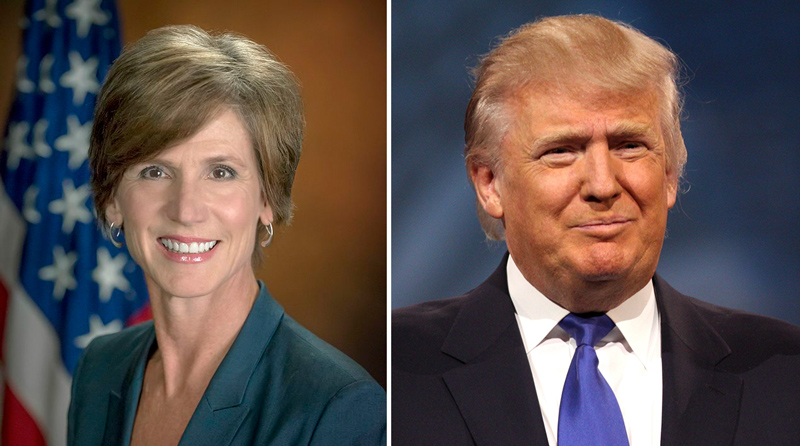
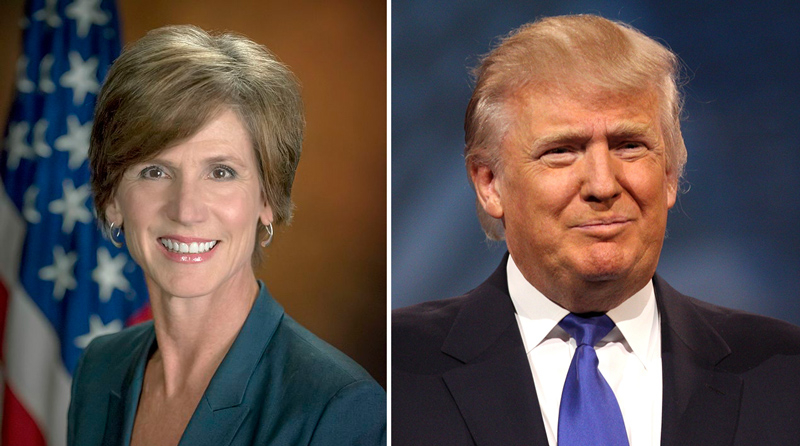
Former U.S. Acting Attorney General Sally Yates (left), and President Donald Trump. (Images source: Wikimedia Commons)

An Attorney General, like any citizen, has the right to disagree with a presidential order, but unless it is clear that the order is unlawful, she has no authority to order the Justice Department to refuse to enforce it. This order is multi-faceted and complex. It raises serious constitutional and legal issues that deserved nuanced and calibrated consideration from the nation’s highest law officer. There are significant differences between the constitutional status of green card holders on the one hand, and potential visitors from another country who are seeking visas. Moreover, there are statutory issues in addition to constitutional ones. A blanket order to refuse to defend any part of the statute is overkill. If she strongly disagreed with the policies underlying the Order, she should have resigned in protest, and left it to others within the Justice Department to defend those parts of the Order that are legally defensible.

I, too, disagree, with the policy underlying the order, but I don’t immediately assume that any policy with which I disagree is automatically unconstitutional or unlawful.

The President has considerable constitutional authority to control entry into the United States by non-citizens and non-residents. Congress, too, has some degree of control over our borders. The precise relationship between presidential and congressional power has never been defined by the Supreme Court. A more responsible Attorney General would seek to analyze these complex issues before jumping into the political fire by a blanket refusal to defend any part of the order.

In addition to failing to do her duty as Attorney General, Sally Yates handed President Trump an underserved political victory. She gave him the power to control the situation by firing her, instead of herself maintaining control by resigning in protest. It is the President who emerges from this unnecessary confrontation with the undeserved status of hero among his constituents.

I do not know Sally Yates except by reputation. She is highly regarded as a career prosecutor and public servant. My criticism of her is not personal, but rather institutional. These are dangerous and delicate times, and anyone who wants to confront the newly elected president must do so with wisdom, nuance and calibration. She played directly into his hands by responding to an overbroad order with an overbroad response. President Trump has now appointed a new acting Attorney General who will defend the order, or at least those parts of it that are legally defensible. Any individual Justice Department official who feels uncomfortable defending this controversial order should be given the freedom by the Department to decline to participate in the case. There are plenty of good lawyers in the Department who would have no hesitation standing up in the courtroom and making the best ethically permissible argument in defense of the order. I have had many experiences with Justice Department lawyers who personally disagreed with the prosecutorial decision in particular cases, but who vigorously defended the government’s position.

Sally Yates did what she thought was right. In my view she was wrong. She should neither be lionized nor accused of betrayal. Nor should President Trump’s critics, and I include myself among them, accuse him of doing anything even remotely close to President Nixon’s infamous “Saturday night massacre.” Nixon fired the very officials who were seeking to prosecute him. That constituted a personal and unethical conflict of interest. President Trump fired Yates over policy differences. It may have been unwise for him to do so, but it was clearly within his authority.

Now we will see our adversarial system at work. Excellent and dedicated lawyers will continue to bring challenges throughout the country against this ill-advised executive order. Other excellent lawyers will defend the order vigorously in court. Ultimately the issue may come to the Supreme Court (with or without a full complement of Justices). That is the way our system of checks and balances is supposed to work.

Alan M. Dershowitz, Felix Frankfurter Professor of Law, Emeritus, is the author of Taking the Stand: My Life in the Law and Electile Dysfunction. A version of this article appeared in The Hill.

Is Russia Really a Threat to Brexit? by Con Coughlin

  • Even if Britain does vote to leave the European Union, it will still work with the EU, albeit as a separate diplomatic entity rather than having its voice submerged by the dead hand of Brussels bureaucracy.

  • Britain outside the EU will be just as vigorous in opposing further acts of Russian aggression as it has been as a member of the EU.
  • NATO, rather than the EU, is the most important organization for keeping Moscow in its place.

For all his claims to the contrary, there can be little doubt that Russian President Vladimir Putin will be taking a keen interest in the outcome of Britain’s historic referendum on its membership of the European Union on Thursday.

The Kremlin’s official line is that Moscow has no interest in whether the British people decide to leave or remain a member of the 28-state economic and political union. And in his first public comment on the vote last weekend. Mr Putin said the decision was “the business of the people of the UK,” even though he could not help having a gratuitous swipe at British Prime Minister David Cameron, accusing him of trying to “blackmail Europe” by calling the vote.

But even though the Kremlin’s official position is that it is observing a strict neutrality on the outcome, the reality is that there is nothing that would please Mr Putin more than a British vote in favour of Brexit.

Ever since he embarked on his aggressive military campaign to restore Russia to its former Soviet glory, Mr Putin has made no secret of his hostility to the EU. He deeply resents the EU’s successful integration of former Soviet satellite states such as Poland, Hungary and the Czech Republic, which he still regards as falling within Moscow’s traditional sphere of influence.

Indeed, it was the EU’s attempts to build a strategic partnership with Ukraine, another former Soviet satellite, that prompted Mr Putin’s illegal annexation of Crimea two years ago, as well as his continuing military intervention in eastern Ukraine. The Baltic States, which also celebrated their freedom from Soviet control when the Iron Curtain collapsed in 1989, have also been subjected to menacing intimidation by Russian forces.

Mr Putin believes that, if Britain leaves the EU, then the alliance will be less robust in confronting Moscow over its aggressive posture in Central Europe and the Baltics. Moscow is still subject to punitive sanctions imposed in response to its invasion of Crimea and eastern Ukraine, which, together with the collapse in the global price of oil, have inflicted significant damage on the Russian economy.

But while the sanctions have helped to persuade Mr Putin to rein in his military adventurism in Europe, the sanctions are not universally popular among all EU member states. In particular, Germany and Italy, which have close trading ties with Moscow, have been lukewarm about maintaining the sanctions. It is mainly due to Britain’s hardline stance on the subject that EU policymakers have managed to summon the diplomatic backbone to keep the sanctions in place.

Britain’s strained relationship with Moscow dates back to the 2006 murder of Russian dissident Alexander Litvinenko, who was poisoned with polonium during a meeting with Russian intelligence agents at a London hotel.

The British military has also taken a lead role in NATO’s robust response to Russian sabre-rattling in Central Europe, and has deployed a heavy-armoured battle group to the Polish border and fighter jets in the Balkans to deter further acts of Russian aggression.

But Mr Putin is badly mistaken if he believes that a British “leave” vote will result in Europe taking a less robust approach to Russian aggression. For a start, even if Britain does vote to leave the EU, it will still work with the EU, albeit as a separate diplomatic entity rather than having its voice submerged by the dead hand of Brussels bureaucracy. And Britain outside the EU will be just as vigorous in opposing further acts of Russian aggression as it has been as a member of the EU.

Furthermore, NATO, rather than the EU, is the most important organization for keeping Moscow in its place. Apart from France, the only other European country with serious military clout is Britain, and Britain will continue to be a cornerstone of the transatlantic alliance, irrespective of how it votes in Thursday’s EU referendum.

Con Coughlin is Defence and Foreign Affairs Editor of the London Telegraph and author of Churchill’s First War (St Martin’s Press).

Is Europe Giving Up? by Judith Bergman

  • As a response to a gang of a thousand migrant men sexually assaulting women in Cologne on New Year’s Eve, the mayor suggested a “code of conduct” for German girls and women, as a measure to “prevent such things from ever happening again.”

  • The idea of a “code of conduct” for girls and women to accommodate male predators not only places the blame on the victim but is an inversion of responsibility unseen in Western jurisprudence. The politically correct urge to accommodate the culture of immigrants means that justice is no longer blind.
  • Each asylum seeker, upon entering Europe, needs to be informed, in the clearest possible manner, that all women, even infidels, must be treated with respect.
  • “I feel betrayed by Britain. I came here to get away from this and the situation is worse here than in the country I escaped from.” — A Muslim woman, quoted by Baroness Caroline Cox.

The cathedral opposite the main train station used to be the traditional gathering spot for New Year’s Eve revelers in the German city of Cologne.

This year, Germans who poured out from the train station to celebrate the New Year they were met by a crowd of some 1000 young men. The men, according to German police, seemed to be of Arab or North African origin. They had taken over the entire public square in front of the station, and divided themselves into smaller gangs to surround women who were passing by. They then sexually assaulted them, and stole their wallets, purses and phones.

Police have so far received over 100 criminal complaints; three-quarters of them for sexual assault, and one for rape.

According to the British Telegraph, “Women were robbed, groped, and had their underwear torn from their bodies, while couples had fireworks thrown at them.”

“Shortly after midnight, the first women came to us… Crying and in shock they described how they had been severely sexually harrassed. We went to look for women in the crowd. I picked one up from the ground. She was screaming and crying. Her underwear had been torn from her body,” an unnamed policeman said.

In Hamburg, according to the police, a series of similar incidents took place in the city’s Reeperbahn red-light district. Witnesses described groups of five to fifteen men of who “hunted” women in the streets.”

The Mayor of Cologne, Henriette Reker, suggested in response, a “code of conduct” for German girls and women, as a measure to “prevent such things from ever happening again.” Her proposed code of conduct entails staying at an arm’s length from strangers, remaining within one’s group, and asking bystanders to intervene or help as a witness.

The “code of conduct” Mayor Reker recommended sparked a storm of criticism against her. She later said that not only German women but visitors from “other cultures” should also be educated on acceptable conduct as well. “We need to prevent confusion about what constitutes happy behaviour and what is utterly separate from openness, especially in sexual behaviour,” she said.

So Cologne is facing mass sexual assaults, robbery and violence from what appear to be huge organized gangs of young migrant men, and the mayor is talking of teaching “happy behavior”?!

Yet, this is the approach that is often taken in other countries of Europe. As Andrew Higgins wrote in the New York Times last month, in Norway, Muslim immigrants are taught how to relate to women:

“Fearful of stigmatizing migrants as potential rapists and playing into the hands of anti-immigrant politicians, most European countries have avoided addressing the question of whether men arriving from more conservative societies might get the wrong idea once they move to places where it can seem as if anything goes. But, with more than a million asylum seekers arriving in Europe this year, an increasing number of politicians and also some migrant activists now favor offering coaching in European sexual norms and social codes.”

“The biggest danger for everyone is silence,” said a clinical psychologist in Norway, Per Isdal, who has been working with the immigrants. Many refugees come from cultures that are not gender equal and where women are the property of men. We have to help them adapt to their new culture,” Mr. Isdal said.

A course manual in Norway sets out a simple rule that all asylum seekers need to learn and follow: “To force someone into sex is not permitted in Norway, even when you are married to that person.”

Other than the “code of conduct” for German women to help keep criminal immigrant sexual predators away, Cologne’s Mayor Reker was most cautious in her statements. She avoided criticizing in any way Germany’s immigration policies, which led last year to one million migrants entering Germany. “It’s completely improper… to link a group that appeared to come from North Africa with the refugees,” said Reker.

But facts are facts. Of the more than one million migrants arriving in Germany in 2015, most were from Muslim countries, mainly from the Middle East or North Africa.

“We will not tolerate such cowardly and abhorrent attacks,” said German Justice Minister Heiko Maas. “This is apparently an entirely new dimension of organized crime.” All of those involved, Maas demanded, must be “identified and made accountable.”

That is not going to be easy, German officials made clear: “Footage from surveillance cameras mounted at the entrance to the Cologne station will certainly help, but the number of people on the square combined with darkness and the not entirely reliable memories of many of those partying at the site will make the process dramatically more difficult.”

Germany’s Chancellor Angela Merkel, however, despite the problems being caused by the wave of migrants, has refused to set a limit on how many migrants Germany should admit.

Despite German officialdom’s assurances that it will seek justice for the victims of the sexual assaults and violence on New Year’s Eve in Cologne, Hamburg, Dusseldorf and elsewhere, Mayor Reker’s “code of conduct” for women and girls in the face of sexual assaults represents a new low in the way that Europe approaches crime — which is becoming increasingly rampant.

What will be next? Will there be further “codes of conduct” requesting girls and women only to walk outside accompanied by a male escort? As unimaginable as this sounds, that is the kind of measure the “code of conduct” will invite.

The flaw in the “code of conduct” is that it makes girls and women responsible for the criminal conduct of male predators.

What will be the defendant’s argument in a future case: “Well, your honor, she did not keep me at arm’s length, so of course I assumed she was game”?

The idea that there should be any “code of conduct” for girls and women to accommodate male predators not only places the blame on the victim; it is an inversion of responsibility. This has no precedence in the West, either in culture or in jurisprudence. Blaming female victims only emboldens male sexual predators.

The migrants know what laws are — there are plenty of them under Islamic sharia law. In the West, there is another type of law in their new host countries, which have welcomed them as guests. In the Middle East, “host countries” with “guests” is also a familiar concept. Virtually all the monarchies and emirates hold the view that the state is their “house” and newcomers their guests; so if a guest cannot behave the way the host expects, he is escorted out. No one would expect a host to put up with a guest who trashed his house.

In the same way, each asylum seeker, upon entering Europe, needs to be informed immediately, in the clearest possible manner, that all women, even infidels, must be treated with respect.

The politically correct urge to accommodate the culture of immigrants only means that justice is no longer blind. It means regressing to unequal justice before the law. It means that because of even a well-intentioned courtesy, half the citizens — women — remain mistreated, disregarded, and with scant, if any, rights.

Unacceptable behavior is not exclusive to Germany. It is a troubling trend that has spread in recent years over large parts of Britain and the European continent.

In March 2014, the British Law Society adopted controversial guidelines for solicitors on how to compile “Sharia compliant” wills. The guidelines allowed British solicitors to write Islamic wills that deny women an equal share of inheritances and exclude “unbelievers” altogether. Children born out of wedlock — and even those who had been adopted — could not be counted as legitimate heirs. The idea, apparently, was that these guidelines, favoring inequality, should be recognized by British courts. At the time, Nicholas Fluck, then president of the Law Society, said the guidance would promote “good practice” in applying Islamic principles in the British legal system.

Facing a barrage of protests, the Law Society, just eight months later, had to apologize and withdraw the controversial recommendations. Andrew Caplen, then the new president of the society, apologized and said that the criticism had been taken on board.

Keith Porteous Wood, executive director of the National Secular Society, who had campaigned for the guidelines to be withdrawn, said:

“This is an important reverse for what had seemed to be the relentless march of sharia to becoming de facto British law. Until now, politicians and the legal establishment either encouraged this process or spinelessly recoiled from acknowledging what was happening. I congratulate the Law Society for heeding the objections we and others made. This is particularly good news for women who fare so badly under sharia law, which is a non-democratically determined, non-human rights compliant and discriminatory code”.

Another example of accommodation in Britain came in December 2015. A two-year commission, the Commission on Religion and Belief in Public Life, chaired by former senior judge Baroness Butler-Sloss, concluded in its report ,”Living with Difference: community, diversity and the common good,” that Britain is no longer a Christian country, and should stop acting as if it were one. The Commission’s report stated that the decline of churchgoing and the rise of Islam and other faiths means that a “new settlement” is needed for religion in the UK.

Perhaps most controversially, the report called for a new approach to anti-terror policy (page 37):

“In universities two of the biggest problems put to us in our consultation were to do with a tendency to view issues of religion and belief through a lens of security and counter-terrorism… there is currently concern about the requirements of the Counter-Terrorism and Security Act 2015 in relation to universities. ‘Enabling free debate within the law,’ wrote the Russell Group of universities, ‘is a key function which universities perform in our democratic society. Imposing restrictions on non-violent extremism or radical views would risk limiting freedom of speech on campus and may potentially drive those with radical views off campus and underground, where … [they] cannot be challenged in an open environment. Closing down challenge and debate could foster extremism and dissent … “

Simply put, the report advocates, in the name of free speech and “living with difference,” that students should be allowed to voice extremist and radical views on campus without fear of being reported to the security services.

The report was condemned by Cabinet ministers as “seriously misguided,” and the Church of England said it was “a waste.” Among those who fathered the report and provided input to it were the former and present Archbishops of Canterbury, Rowan Williams and Justin Welby; Home Secretary Theresa May, and senior executives at the BBC and Channel 4.

In the United Kingdom, Baroness Caroline Cox, a member of the House of Lords and a nurse by training, is attempting to reverse this trend. This October, she introduced a bill in the House of Lords to make it illegal for any arbitration tribunal to “do anything that constitutes discrimination, harassment or victimisation on grounds of sex.” She quoted one Muslim woman who had told her, “I feel betrayed by Britain. I came here to get away from this and the situation is worse here than in the country I escaped from.” When a colleague claimed the Bill was trying to “demonise Muslims,” another colleague, Lord Carlile, said it was really just trying to “demonise discrimination.”
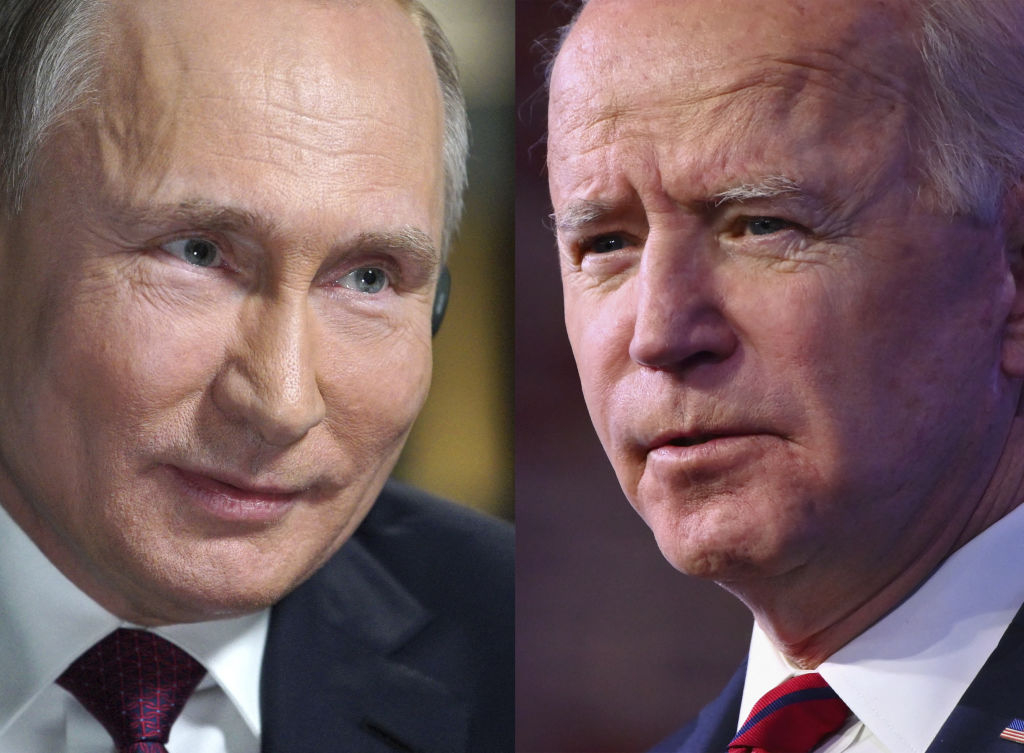
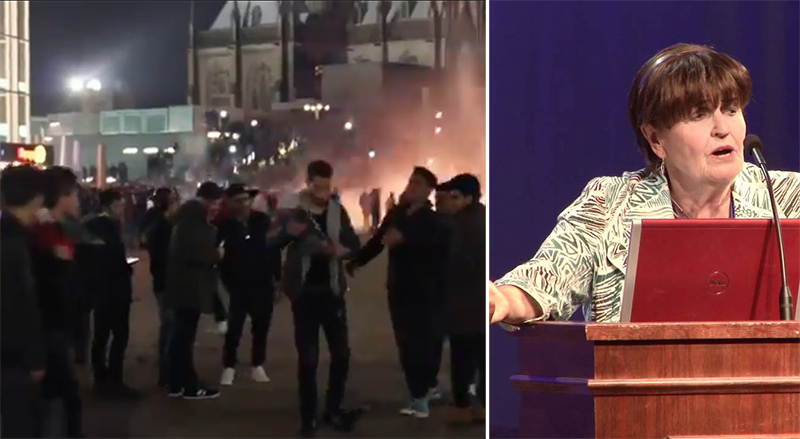
Left: A scene from New Year’s Eve in front of Cologne’s central railway station. Right: Britain’s Baroness Caroline Cox, who is leading a fight to protect women’s rights from the encroachment of Islamic Sharia law on the British legal system.

Europe seems to have learned nothing from the past decades. Its problems with immigrant Muslim populations continue to deteriorate. Accommodation has not solved these problems; more accommodation will undoubtedly not solve them either. More accommodation will make them, if anything, worse.

Judith Bergman is a writer, columnist, lawyer and political analyst.

Is Europe Choosing to Self-Destruct? by Judith Bergman

  • Europe has voluntarily begun the process of giving up its liberal and hard-fought-for freedoms. Free speech no longer exists, only — straight out of totalitarian ideologies — “responsible” free speech: “free” only if it does not “offend” anyone.
  • The desire of many Europeans and other self-declared devotees of “human rights” to cover up, downplay or explain away what is happening in Europe, in fact represents the opposite of respect for others and equality before the law.
  • Absolving such criminal behavior is not only the very opposite of justice, it is also a kind of “inverted racism” — against its own native Europeans.
  • In 2014 and 2015 Jews in Europe were murdered, raped, beaten and stalked — just for being Jewish. Signs in the street read, “Sale Juif” (“dirty Jew”), “Death to the Jews,” and “Jews to the gas.” None of these side effects of Muslim immigration seems to concern the liberals, the media, or the purported defenders of human rights — who so loudly claim to be against “racism.” Or, once again in Europe, does “racism” not include Jews?

After the mass sexual assaults on New Year’s Eve in the European cities of Cologne, Hamburg, Düsseldorf, Bielefeld, Berlin, Frankfurt, Stuttgart, Vienna, Salzburg, Zürich, Helsinki and Kalmar, it is clear that something profoundly disturbing has occurred in Europe. By Sunday, in Cologne alone, 516 women had filed criminal charges — around 40% of them relating to sexual assaults.

The initial reactions to the sexual assaults from German authorities, the media, as well as feminists and others have not been less disturbing.

The German police first claimed, in a surreal statement the morning of Jan. 1, that the situation on New Year’s Eve had been “relaxed.” Cologne Police Chief Wolfgang Albers later admitted “this initial statement was incorrect” and, for his role in what appeared as a cover up, has since been forced into early retirement.

In the “mainstream media,” Germany’s public broadcaster, ZDF, made a decision not to report on the attacks until four days after they had occurred.

A former government official, Hans-Peter Friedrich, Chancellor Angela Merkel’s interior minister from 2011 to 2013, accused the media of imposing a “news blackout” and operating a “code of silence” over negative news about immigrants: “It is a scandal that it took days for the media to pick up the reports,” Mr. Friedrich said.

“Experts,” feminists and liberals tried to downplay the attacks by explaining them away at all costs.

One such “expert,” the German criminologist Christian Pfeiffer, described the men as “largely young, single men, who have arrived in this country and don’t know what to do with themselves… The clarification of their asylum status took such a long time that their frustrations and anger only grew.” This much-respected German criminologist concluded: “This is an alarm signal that we need to do more.” According to him, immigrants commit crimes, but the Germans are at fault because they “need to do more.”

Many feminists in Europe claimed that too much focus had been put on the criminals’ “ethnicity,” which these feminists alleged was “racism” — while ignoring that Islam is not an ethnicity but a religion. This argument was championed especially by the once-hardcore feminists in Sweden and Denmark.

Social media were also rife with excuses for men who had assembled for the sole purpose of sexually assaulting female passersby in a public square. It turns out this pastime — gang-rape — hails from the Arab-Muslim world, and has a specific name: “Taharrush.”

How does the fear of being accused of “racism” become more important than calling out gang-rape?

If any of these attempts at denial sound familiar, they should. For decades, European national authorities, liberals, and the media have either ignored, “relativized” or attempted to explain away whatever unpleasant facts accompanied Muslim mass-immigration into Europe.

The widespread sexual abuse of 1400 children by Muslim men, mainly of Pakistani origin, in Rotherham, England, for more than a decade, between 1999 and 2013, was known by the local British authorities but allowed to continue.

In Paris, Toulouse and Copenhagen, Jews were murdered by Muslims — for just being Jews.

Imams are free to preach and incite hatred against Jews from European mosques. The imams call Jews the descendants of “apes and pigs.”

The terrorist who murdered a young Jewish security guard last year in Copenhagen at a synagogue had been exposed to exactly such incitement in a local Copenhagen mosque the day before he committed the murder.

Jew-hunting season has also opened in France again, and 15,000 Jews have left the country in the past two years. Already in 2014, 75% of all French Jews were considering leaving the country.

In 2006, a young French Jew, Ilan Halimi, was held prisoner and tortured for 24 days by a gang of Muslims, then dumped, naked and handcuffed, in a field. In Europe, this story went practically unreported.

As The Atlantic wrote in April 2015, “France’s 475,000 Jews represent less than 1 percent of the country’s population. Yet last year, according to the French Interior Ministry, 51 percent of all racist attacks targeted Jews.”

The statistics in other countries are similar. In 2014 and 2015, Jews in Europe were murdered, raped, beaten and stalked, only for being Jews. Signs in the street read, “Sale Juif” (“dirty Jew”), “Death to the Jews,” and “Jews to the gas.”

None of these side-effects of Muslim immigration seems to concern liberals, the media, or the purported defenders of human rights — who so loudly claim to be against “racism.” Or, once again in Europe, does “racism” not include the Jews?

In Sweden, there were “widespread sexual assaults” by about 90 young men, mainly from Afghanistan and Syria, at a concert in Stockholm last August. The largest Swedish newspaper, Dagens Nyheter, once it was informed of the national origin of the criminals, did not want to report the story.

Only after the Cologne attacks — five months later — did the Swedish newspaper show interest in what happened in Stockholm last summer.

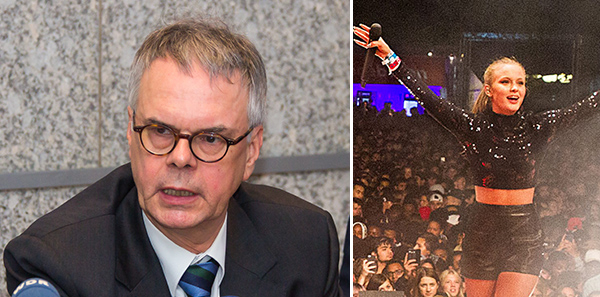
Left: Cologne Police Chief Wolfgang Albers (left) was forced into early retirement, over the cover-up of New Year’s Eve’s mass sexual assaults in his city. Right: The largest Swedish newspaper, Dagens Nyheter, waited five months to report on “widespread sexual assaults” by about 90 young men, mainly from Afghanistan and Syria, at a concert in Stockholm last August.

In Norway, the first statistics on rapes were revealed in 2001: incidences of rape had increased by 40% from 1999 to 2000, and 65% of all rapes were committed by non-Western immigrants (mainly Muslims). At the time, professor Unna Wikan, considered an authority on Muslims in Norway, blamed the rapes on Norwegian women. She accused them of “inviting” the rapes by acting like “Norwegian women” instead of “internalising that we live in a multicultural society and accommodat[ing] that fact. … In most Muslim countries, it is assumed that the woman is at fault for being raped, and it is only fair that Muslim immigrants bring these kinds of opinions with them when they move to Norway.”

Liberals openly admit that they do not wish to talk about what they see: “So no wonder liberals would do anything to avoid fanning these flames, since we see in all this righteous indignation a blatantly racist old trope about barbarians at the gates. We bend over backwards to report it responsibly, to moderate the frothing rage,” said a British self-declared liberal about her unwillingness to talk about the Cologne attacks.

Avoiding “fanning the flames,” however, turns out not to be true. Many liberals seem to have no problems “fanning the flames” of racial hatred, so long as Muslims are not at the receiving end. At the very top of their hatred are Israeli Jews. Many in the media gleefully participate with skewed, selective reporting of facts, especially in the Middle East. The European media have virtually ignored the current wave of almost daily Palestinian stabbings, shootings, car-rammings and stone-throwings — not to mention the rocket attacks into Israel from the Gaza Strip. These attacks are aimed at innocent civilians, and are whipped up by the Palestinian Authority, with Mahmoud Abbas at the helm.

The desire of many Europeans and other self-declared devotees of “human rights” to cover up, downplay or explain away what is happening in Europe, in fact represents the opposite of what people genuinely concerned with human rights care about: respect for others and equality before the law.

When a society

Translate »
Skip to toolbar