- The tendency of modern liberals to wring apologies out of governments for the actions of their ancestors, from the slave trade to Orientalist depictions of the peoples of Islam, is a pointless attempt to re-write history. There are, of course, no calls for Muslim governments to apologize for anything from their slave trade to the early Arab conquests.
- “The ethics of establishing a campus in an authoritarian country are murky, especially when it inhibits free expression.” — Professor Stephen F. Eisenman, Northwestern University (which has a branch in Qatar)
- Oxford and Cambridge, have accepted more than 233.5 million pounds sterling from Saudi and Muslim sources since 1995 — the largest source of external funding to UK universities.
- “Several agreements made between the MEC [Oxford’s Middle East Centre] and donors appear to indicate that funders have sought to influence the centre’s output and activities.” — Robin Simcox, A Degree of Influence, 2009, p.35
- One of those “dilemmas” is the influence by teachers across the United States on impressionable students who organize Israel Apartheid Weeks. They join with assorted anti-Semitic demonstrators, condemn Israel for every sin under the sun, and use intimidation against Jewish and Zionist colleagues, but are never told any historical, legal, or political facts by their equally biased faculties.
- Fundamentalist Islam, backed by vast monetary power, is corrupting our dearest Enlightenment values.
In asking why Western civilization has been the greatest in history, many point to European and, later, American military power, the strength of the British, French, Spanish and Portuguese empires, their command of the oceans, or the progress brought about through the Industrial Revolution. Today, of course, there is a general trend to picture Western achievements in a uniformly negative light, often for valid reasons, including our use of slavery or the mistreatment of so many Native Americans. This negativity is, however, highly selective. Why, for example, are Western Christian empires considered a blight on mankind while the great many Muslim empires of the past — which lasted over a much longer period, engaged in the largest and longest-lasting slave trade in history, sought to impose one religion over all others, and placed enormous barriers on rational thought from about the 10th century — regarded as a blessing?
The greatness of the modern West owes much to those discoverers, conquerors, and traders and to the worldwide enterprises they built — just as the Islamic empires had their explorers, traders, and international networks (as in the great Sufi orders). Important civilizations were created in both realms: great urban developments, great architecture, the first universities, great poetry, great art, great philosophy, a flurry of scientific and mathematical activity in the Muslim middle ages, and then in the Renaissance and the Industrial Revolution in Europe. The tendency of modern liberals to wring apologies out of governments for the actions of their ancestors, from the slave trade to Orientalist depictions of the peoples of Islam, is a pointless attempt to re-write history. There are, of course, no calls for Muslim governments to apologize for anything from their slave trade to the early Arab conquests.
The modern world of the West is a product of a period that created the greatest advances in human history: the Enlightenment. From that era we can date the beginnings of the most important strengths of our modern world. It is these strengths, in spite of the many blessings they have bestowed and their role as buttresses for cohesive societies, that are derided and often attacked from the Islamic sphere as well as by forces within the West. It is not hard to remember what those strengths are: liberal democracy, human rights, religious tolerance, international instruments for the managing of conflict, women’s rights, minority rights of all kinds, legislation out of political debate, an abhorrence of tyranny, freedom of thought, belief, and speech, critical inquiry, freedom of the press and other media, secularization that permits freedom of religious worship, and safety for the authors of opinions that dissent.
Of these blessings, the most important would seem the last: freedom of thought, belief, and speech, critical inquiry, freedom of the press and other media, secularization that permits freedom of religious expression, and safety for the authors of dissenting opinions. Without them, none of the others would last. There is also another, closely related to them: academic freedom. The liberation of the universities from the 18th century onwards from restrictions placed on scholars by kings and churches, the use of censorship to maintain the status quo, the blocking of scientific advances by appeals to scripture or the power of the clergy or simple traditionalism[1] and all the other forces of obscurantism, meant a quantum leap, not just in the physical sciences, but in all areas of human understanding, from politics to society to philosophy and to religion and the arts. We owe more than we often imagine to the freedoms of academia: that a teacher or researcher may not be censored, dismissed, or financially ruined for expressing his opinions;[2] that publications, whether books, monographs or entire learned journals, be free to include critical, even controversial content, and that controversy itself, far from being an impediment to a search for truth, is an essential mechanism for that search to take place.
This process did not take hold in the Islamic world, where, as mentioned, rationality was dismissed in favour of faith, from public and scholarly discourse early on.[3] Starting with an internal dispute between rationalists and theologians of a fundamentalist bent, the shift from fairly open enquiry was shut down when the dogma of the Qur’an’s “uncreatedness,” perfection and infallibility was established. Questioning was a risk to faith; it was safer to avoid hellfire by accepting all aspects of sacred scripture and law without a “wherefore?” or “why?” This doctrine of infallibility and the dangers of reason were promulgated by the most important thinker in the history of Islam, Abu Hamid al-Ghazali (1058-1111). According to this doctrine, God acts at every instant within every atom, destroying and creating as He wills, so that it is impossible to predict just what will happen at any given moment — thus precluding the need or worth of rational enquiry. It is this conclusion that creates the fatalism which denies any human responsibility for the slightest action or exercise of personal will. An extreme modern statement of this anti-rationalism may be found in comments made by Mukhtar Mukhtar (Muchtar Muchtar), a leader of the Egyptian terrorist organization, al-Gama’a al-Islamiyya, to the reformist Muslim, Tawfik Hamid: “On the way (to the mosque) Muchtar emphasized the central importance in Islam of the concept of al-fikr kufr, the idea that the very act of thinking (fikr) makes one become an infidel”.
This is not meant to be some paean to the West and a mockery of Islam: there is a growing threat to Western leadership around the world. The threat is not Islamic terrorism (although that is a real and growing threat, especially in Europe, but increasingly in the United States). The threat is not about growing Muslim demographics (although this is taking its toll in Europe, too). The threat is not even from the rise in influence of Islam across the globe. Those are genuine issues; Western leaders have so far failed adequately to respond to the threats they represent. The clear and present danger here eclipses all the others: it is to the values of the Enlightenment themselves. If not curtailed, this risk could usher in the abandonment of the very intellectual freedoms on which our wider freedoms rest. It is our complicity in the rapid and so far unstoppable growth of direct Islamic (and indeed Islamist) control over whole departments and centers in a burgeoning number of Western universities in Europe and the USA. And it is the encroaching censorship – and criminalization — of free speech in Europe – and the US. These range from the tactics of intimidation on campus (and, apparently, off) to shut down dissent, to the European Commission issuing a “code of conduct” on May 31, 2016, presumably to close down “hate speech” online, but in practice it is usually those quoting “hate speech” or pointing out dangers, to warn others of them, who are closed down instead.
Do a handful of donations from Muslim governments to a number of European and American universities merit an entire article that starts out with claims that Western civilization is under threat? As a matter of fact, the scale of the donations is far beyond a handful, the universities involved are among the top academies in the world, the money involved is hundreds of billions of dollars, and the targets of Islamic finance are, for the most part, specific and form part of a distinct agenda. Some money may be given to business schools or science departments, but the overwhelming majority goes to support or create large departments and academic centers for Middle East, Islamic, or Arabic Studies. There is a seeming logic in this – aren’t extremely rich Muslim states entitled to further the study of their own societies, history, and religion, thereby creating a corps of knowledgeable men and women with the requisite language skills and close familiarity with the subjects they first study then teach or with which they engage as government advisors, civil servants with governments, the UN or international NGOs, think tank members, public experts, media analysts and perhaps politicians? Well, if they observed complete neutrality and left academics to their own counsel, their input would pass as simple generosity or as a contribution to good relations within the international community. What could be nicer? Isn’t the Islamic world badly misunderstood in the West, and wouldn’t more teaching and research on it and its beliefs be a real boon? And how can someone like myself, who has spent a lifetime studying, teaching and writing about Islamic and Middle Eastern subject think badly of such an endeavour?
One obvious criticism is the sheer scale of the operation, meaning that fundamentalist Muslim states such as Saudi Arabia and Qatar now effectively exercise a swathe of influence over the way in which Islam and Middle East Studies are taught in key Western universities. The dilemma for the universities is a harbinger of crises to come. Even fairly rich universities such as Harvard and Oxford experience financial difficulties. State funds are often hard or impossible to obtain; academics have to scramble to find funding for their projects, their jobs or their departments.
Universities have responded in a number of ways. One has been to bring in more and more students from abroad, including extremely high numbers from Islamic countries (where the standard of education is almost uniformly poor). ICEF Monitor reports:
“At its inception in 2005, there were just over 3,000 Saudi students in the US, a country that has been the primary destination for KASP-funded students in the years since and that saw its Saudi enrolment swell to just under 60,000 students in 2014/15 (for a nearly 2,000% increase over the last ten years). For the past five years in a row, Saudi Arabia has been the fourth-largest sending country for the US.”
There are also large numbers of Saudi students in Canada and the UK.
A second response for a small number of universities has been to open satellite campuses in foreign countries, several in the Gulf. For example, University College London, Heriot-Watt University, New York University and Ireland’s Royal College of Surgeons run programs, respectively, in Qatar, Dubai, Abu Dhabi, and Bahrain. Unsurprisingly, these campuses are far from free from external supervision. According to Professor Stephen F. Eisenman of Northwestern University (which has a branch in Qatar), “The ethics of establishing a campus in an authoritarian country are murky, especially when it inhibits free expression, and counts among its allies several oppressive regimes or groups”.
Problematic as all this is, it is eclipsed by the impact on the study of the Islamic world in Western universities at home. Starting with the UK alone, Arab News reports:
Over the past decade, Saudi Arabia has been the largest source of donations from Islamic states and royal families to British universities, much of which is devoted to the study of Islam, the Middle East and Arabic literature. A large share of this money went toward establishing Islamic study centers. In 2008, Prince Alwaleed bin Talal donated £8 million (SR 48.5 million) each to Cambridge and Edinburgh for this purpose, Al-Eqtisadiah business daily reported yesterday. Oxford has been the largest British beneficiary of Saudi support. In 2005, Prince Sultan, the late crown prince, gave £2 million (SR 12 million) to the Ashmolean Museum. In 2001, the King Abdul Aziz Foundation gave £1 million (SR 6.1 million) to the Middle East Center. There are many other donors. Oxford’s £75 million (SR 454.6 million) Islamic Studies Center was supported by 12 Muslim countries. Ruler of Oman, Sultan Qaboos bin Said, gave £3.1 million (SR 18.8 million) to Cambridge to fund two posts, including a chair of Arabic. Ruler of Sharjah, Sheikh Sultan bin Mohammed Al-Qassimi, has supported Exeter’s Islamic studies center with more than £5 million (SR 30 million) since 2001. Trinity Saint David, part of the University of Wales, has received donations from the ruler of Abu Dhabi Sheikh Khalifa bin Zayed Al-Nahyan.
Here, as well, is a summary of moneys given to U.S. universities, dating back as far as 1976:
The story of the Saudi donations in the United States dates back to 1976, when Riyadh transferred one million dollars to the University of Southern California.
In 1979, Saudi Aramco World magazine published a list of Middle Eastern gifts, including $200,000 from the Saudis to Duke University for a program in Islamic and Arabian development studies; $750,000 from the Libyan government for a chair of Arab culture at Georgetown University; and $250,000 from the United Arab Emirates for a visiting professorship of Arab history, also at Georgetown.
Until that time, Ryadh spent one hundred billion dollars to spread Wahhabism, the most anti-Semitic and extremist version of Islam.
Leading the list of “beneficiaries” is Harvard, with about $30 million. The jewel of the Ivy League received $20 million in 2005 alone.
20 million dollars were donated to the Middle East Studies Center at the University of Arkansas; $5 million to the Center for Middle East Studies at Berkeley, in California; $11 million to Cornell University in Ithaca, New York and a half million dollars to Texas University (the seventh university, in order of size, in the United States); $1 million to Princeton; $5 million dollars to Rutgers University….
Oxford has a research center funded by the Iranian regime, while at Cambridge the funds come from Saudi Arabia, Oman and Iran.
Scholarships and degree programs are the favorite and easiest weapons of the Islamist regimes to influence the Western academies and their freedoms. Eight universities, including Oxford and Cambridge, have accepted more than 233.5 million pounds sterling from Saudi and Muslim sources since 1995. The total sum, revealed by Anthony Glees, the director of Brunel University’s Centre for Intelligence and Security Studies, amounts to the largest source of external funding to UK universities.
Universities that have accepted donations from Saudi royals and other Arab sources include Oxford, Cambridge, Durham, University College London, the London School of Economics, Exeter, Dundee and City.
In a 2009 study of the funding of strategically important subjects in UK universities, Robin Simcox, then a Research Fellow for the Centre for Social Cohesion, provides detailed tables and longer commentaries on the provision of funds to Arabic and Islamic Studies. A Degree of Influence[4] looks at eleven universities, including some with major centers for Islamic and Middle East Studies, such as Oxford (22 entries), Cambridge, London’s School of Oriental and African Studies, Edinburgh, Durham and Exeter. Some of his observations are pertinent. Writing of Oxford’s heavily-endowed Middle East Centre, he notes that
“The MEC has received substantial sums of money from sources in the Middle East. The way in which this money has been used means there is a clear risk that donors will seek to influence the output and activities of the MEC. In addition, many large donations to the MEC have been anonymous, creating a lack of transparency. In many cases, Oxford has knowingly accepted money from undemocratic states with poor human rights records…. Several agreements made between the MEC and donors appear to indicate that funders have sought to influence the centre’s output and activities.”[5]
Of Cambridge, he writes:
“Cambridge University is an example of how funding has had a significant impact upon how the university is run. Recent donations have been attached with conditions that could lead to donors gaining oversight via university Management Committees. While the principal donor’s intentions seem honourable, a precedent appears to have been set where wealthy donors can influence the running of an independent academic institution.”[6]
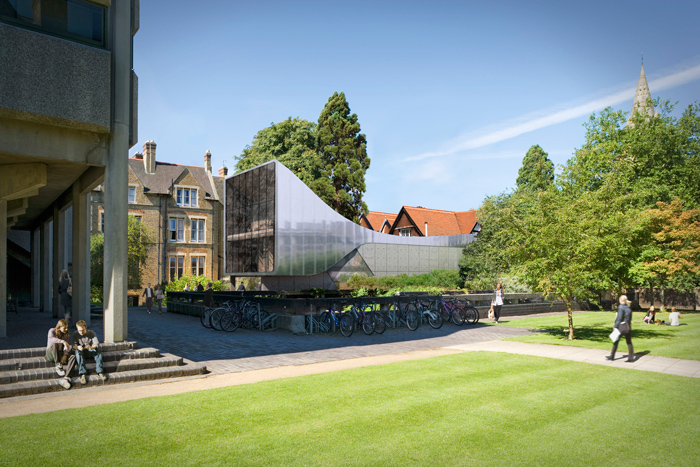
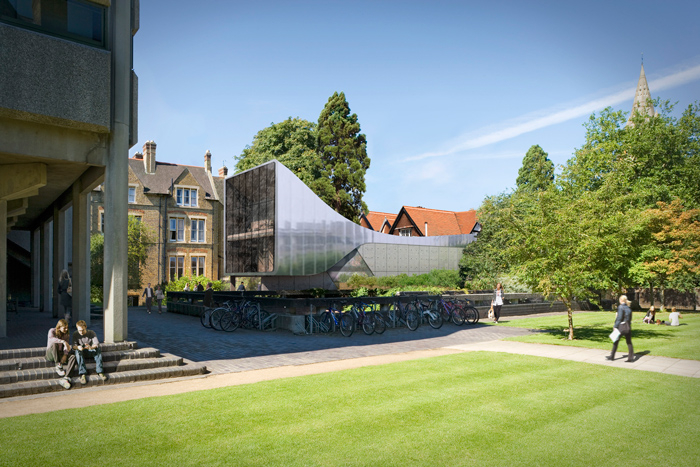
Oxford’s Middle East Centre “has received substantial sums of money from sources in the Middle East. The way in which this money has been used means there is a clear risk that donors will seek to influence the output and activities of the MEC. — Robin Simcox, A Degree of Influence. (Image source: Zaha Hadid/Flickr)
|
What does this unprecedented influence from countries and individuals with low expectations for academic freedom bring to our most revered institutions of learning? There are some positives. The money can allow genuine scholars to lecture or carry out valuable research, to teach languages such as Arabic, Persian, Turkish, Kurdish or Urdu (although not, of course, Hebrew), and to hold conferences open to a wide array of colleagues. All that is to the good, provided academics steer clear of controversy and subjects that upset their donors. In truth, academic freedom is at risk.
What so many fail or prefer not to grasp is that the subventions from Saudi Arabia and Qatar in particular are part of a much wider pattern. The Saudis for decades have disbursed hundreds of billions of dollars in order to propagate their puritan form of Islam, Wahhabism, across the globe, while building hundreds of mosques, schools, libraries, and Islamic centres, and sending out streams of hardline preachers trained in their seminaries and Islamic universities, to spread their message to Muslims everywhere, creating and financing bodies for Islamic missionary work, recruiting young Muslims to commit to an extreme form of their faith – all to the end of making the Saudi state the key player in the world of Islam and a leader in the propagation of Islam in the West. That is the nature of the doctrine. Deep pockets for academic study in Europe and North America are stitched tightly against their pockets that fund the missionary work and the enforcement of the most fundamentalist form of the Islamic faith.
Another way of looking at it is that earlier this year, Saudi Arabia’s Grand Mufti, Shaykh Abd al-‘Aziz bin-Abdullah al-Shaykh, issued a fatwa forbidding Muslims to play chess. He is far from the first to do so. He justifies the ban by saying, “The game of chess is a waste of time and an opportunity to squander money. It causes enmity and hatred between people”. On February 3, 2016, a young Saudi cleric, Shaykh Sa’ad al-‘Atiq, appeared on a fatwa advice programme on al-Ahwaz TV, and stated that if people publish pictures on social media sites, someone else may copy them and apply sorcery to them, which will result in the original poster becoming ill with cancer and other diseases. He even says he knows many cases of this. Over the past several years, several people have been beheaded in Saudi Arabia on charges of witchcraft and sorcery.
In May 2016, I read that another Saudi shaykh, Salih bin Fawzan Al Fawzan, a member of the Saudi Council of Senior Scholars, said that, “taking pictures is prohibited if not for a necessity — not with cats, not with dogs, not with wolves, not with anything”. This, of course, is in direct line with the ancient ban on images of living creatures that has had such a marked effect on Islamic art. It is not hard to see that, if this is the height of scholarship in Saudi Arabia, their motives in financing academic study in Western universities may not be as noble as some would like to believe.
The Saudi antipathy to critical, rational, and secular scholarship is surely a warning. More than one Saudi shaykh, including the notorious Grand Mufti Bin Baz, have declared that the earth is stationary and that the sun revolves around it. Some are still doing so. Of course, better educated Saudis and others will find this laughable; but the fatwa declaring it has become the basis for intense debate among the highly religious.
The moment Western scholarship infringes the sensitivities of the Saudis, Qataris, Kuwaitis, Bahrainis and others, the barriers go up. Academics are denied visas to attend conferences, criticism of Gulf states is toned down, debate is shifted away from the Gulf monarchies themselves, and, compared to study of other Arab regions, rigorous critiques on subjects in the Gulf, such as political reform, human rights and suppression of dissent are largely excluded. According to Kristian Coates Ulrichsen of Rice University’s Baker Institute, “Almost every centre of Middle East studies in the UK is linked somehow to a Gulf backer. It’s created dilemmas, especially over the last few years as the threshold for self-tolerance of any dissenting view has got lower”.
One of those “dilemmas” is the influence by teachers across the United States on impressionable students who organize Israel Apartheid Weeks. The students join with assorted anti-Semitic demonstrators, condemn Israel for every sin under the sun, and use intimidation against Jewish and Zionist colleagues, but are never told any historical, legal, or political facts by their equally biased faculties. America’s Campus Watch monitoring organization keeps a close eye on this sort of abuse by identifying teachers and researchers who go far outside the boundaries of balanced academic discourse to mislead, indoctrinate, and validate student extremists. It exposes professors who make exaggerated claims about Islamophobia or who offer support to terrorist entities such as Hamas. Its steady record of news associated with Middle East Studies provides ample evidence of the distortions now hawked as balanced scholarship.
But for the clearest evidence that Gulf backers cannot be entrusted with the support of Western university studies of Islam and the Middle East, we need not look further than one of the earliest cases of Saudi investment in the field. In 1981, the Saudi Ministry of Higher Education paid for a lectureship at Britain’s Newcastle University, to teach Arabic and Islamic Studies in the Department of Religious Studies.[7] The appointee, a non-Muslim British teacher with a solid research record, embarked on an ambitious range of topics designed to give students a wide background in Islamic history and doctrine. Five years later, funding for his post was abruptly ended. The reason was that he included among his courses lectures on Sufism and Shi’ism — vital subject for any study of Islam, yet, to the Wahhabis, both anathema.
This was bad enough — academics at neighbouring Durham University’s Centre for Middle East and Islamic Studies were vociferous in condemning the action and the reason given for it — but the Saudis went further. They appointed (unilaterally, without any involvement with an interview by a university board) a Saudi teacher with no qualifications whatsoever in Islamic Studies (his PhD was in English Literature). The department and the university, eager to receive more money, allowed this amateur to teach and examine their students for several years more, after which the post fell by the wayside.
This is one of the most remarkable academic stories of recent history. A dismissal and an appointment based solely upon religious doctrine. But it had its effect. Other academics in the field, receiving or hoping to receive Saudi funding, now had their eyes open: There are topics, however important within the subject, that anyone who wants to keep his job must steer clear of. There are teachers who have research and publication interests in those topics who should not be appointed to Saudi-financed posts. In 1981, the Saudis were dipping their toes in the water. Now they are offshore, swimming in the strong currents.
Fundamentalist Islam, backed by vast monetary power, is corrupting our dearest Enlightenment values. This May, the Organization of Islamic Cooperation (OIC), the Muslim body likened to the United Nations, prohibited eleven gay and transgender organizations from attending a conference at the UN on research to end the AIDS epidemic.
“Egypt wrote on behalf of the Organization of Islamic Cooperation to the 193-member general assembly about its decision without citing a reason. Clearly, protecting individuals most affected by the epidemic — trans people globally are 49 times more likely to be living with HIV than the general population — is not on the agenda.”
It has to be assumed that the real reason for this was the deep-seated homophobia within the Muslim world. Potentially life-saving medical advances were blocked because Islam proscribes homosexuality (Qur’an: 77: 80-84).
We cannot continue to live like this. We cannot let hardline Muslims and Muslim states elbow aside their reform-minded brethren and trample on our most essential freedoms. Without the example and standards set up by Western nations, the Muslim world itself will fall into even greater decline, and that will lead to greater violence everywhere. If we owe it to ourselves to resist this onslaught on our values, we also owe it to the Muslim world to protect it from its own resistance to and fear of change.
Dr. Denis MacEoin is a Distinguished Senior Fellow at the Gatestone Institute.
[1] A process described in appealing detail by Thomas Kuhn in his masterwork The Structure of Scientific Revolutions, 50th anniversary ed., U. of Chicago Press, 2012.
[2] A disturbing recent example of a Muslim teacher losing his post for reasonable interpretations of Islam is that of Professor Mouhanad Khorchid, who had been a professor of Islamic pedagogy at the University of Münster. In 2013, he published a liberal study of Islam, which was seized on by Germany’s largest Muslim organization and condemned by them as a “rejection of the teachings of classical Islam” and an “insult to Muslim identity.” For this, he was dismissed from his position at the university. See: Susanne Schröter, ‘Opinion: A German Islam must be liberal, self-critical, Deutsche Welle, 23 May, 2026; available online here: http://www.dw.com/en/opinion-a-german-islam-must-be-liberal-self-critical/a-19277619
[3] A readable account of this may be found in Robert Reilly, The Closing of the Muslim Mind: How Intellectual Suicide Created the Modern Islamist Crisis, Wilmington, Delaware, 2010.
[4] Robin Simcox, A Degree of Influence: The funding of strategically important subjects in UK universities, Centre for Social Cohesion, London, 2009