Daily Archives: June 19, 2017

Palestinians: Why a “Regional Peace Process” Will Fail by Khaled Abu Toameh

Many Palestinians sometimes refer to Arab leaders and regimes as the “real enemies” of the Palestinians. They would rather have France, Sweden, Norway and Belgium oversee a peace process with Israel than any of the Arab countries.

Hani al-Masr, a prominent Palestinian political analyst, echoed this skepticism. He, in fact, believes the Arabs want to help Israel “liquidate” the Palestinian cause.

The Jordanians are worried that a “regional solution” would promote the idea of replacing the Hashemite kingdom with a Palestinian state. Former Jordanian Minister of Information Saleh al-Qallab denounced the talk of a “regional conference” as a “poisonous gift and conspiracy” against Jordan and the Palestinians.

The Lebanese have for decades dreamed of the day they could rid themselves of the Palestinian refugee camps and their inhabitants, who have long been subjected to apartheid and discriminatory laws.

Israel as a Jewish state is anathema to Palestinian aspirations. Any Arab or Palestinian leader who promotes such compromise is taking his life in his hands. And Palestinian history will record him as a “traitor” who sold out to the Jews and surrendered to American and Israeli pressure.

Abbas and his Ramallah cohorts are already up at night worrying about the talking between Israel and some Arab countries, particularly Saudi Arabia and other Gulf states. Such “normalization”, in the view of the PA, is to be reserved for after Israel submits to its demands.

Any “regional solution” involving Arab countries would be doomed to fail because the Palestinians and their Arab brethren hate each other. Any solution offered by the Arab governments will always be regarded as an “American-Zionist dictate.”

Here is what Palestinians really want: to use the Europeans to impose a “solution” on Israel.

Here is a fundamental misapprehension: Arab countries can help achieve peace in the Middle East by persuading, or rather pressuring, the Palestinians to make concessions to Israel.

This misapprehension is both misleading and baseless.

Recently, officials in Israel and Washington started talking about a “regional approach” to solving the Israeli-Palestinian conflict. In this view, as many Arab countries as possible would be directly involved in the effort to achieve a lasting and comprehensive peace agreement between Israel and the Palestinians. Advocates of the “regional approach” believe that Arab countries such as Jordan, Egypt, Lebanon, Qatar and Saudi Arabia have enough leverage with the Palestinians to compel them accept a peace agreement with Israel.

The Palestinians, however, were quick to dismiss the idea as yet another American-Israeli-Arab “conspiracy to “liquidate” their cause and force them to make unacceptable concessions. Chief among these “unacceptable concessions” are recognizing Israel as a Jewish state and giving up the demand for a “right of return” for millions of Palestinian refugees into Israel.

What the recent Washington-Israeli notion misses is that Palestinians simply do not trust their Arab brothers. The Palestinians consider most of the Arab leaders and regimes as “puppets” in the hands of the US and its “Zionist” allies. Worse, Many Palestinians sometimes refer to Arab leaders and regimes as the “real enemies” of the Palestinians. They would rather have France, Sweden, Norway and Belgium oversee a peace process with Israel than any of the Arab countries.

Palestinian leaders would rather have France, Sweden, Norway and Belgium oversee a peace process with Israel than any of the Arab countries. Palestinians simply do not trust their Arab brothers. Pictured: French President François Hollande (L) hugs Palestinian Authority President Mahmoud Abbas during a press conference in Ramallah, on November 18, 2013. (Image source: Oren Ziv/Getty Images)

In general, Palestinians have more confidence in Western countries than they do in their Arab brothers. That is why the Palestinian Authority (PA) headed by Mahmoud Abbas continues to insist on an international conference as its preferred method for achieving peace in the region and not a “regional approach” that would give Arab countries a major role in solving the conflict. Arab involvement in a peace process with Israel is, in fact, the last thing Abbas and other Palestinians want.

Hani al-Masr, a prominent Palestinian political analyst, echoed this skepticism concerning a potential role for Arab countries in the Middle East peace process. He, in fact, believes the Arabs want to help Israel “liquidate” the Palestinian cause.

He also predicted that the recent rapprochement between Israel and some Arab countries would embolden “all opposition and jihadist groups” that are fighting against the Arab regimes. According to al-Masri, it is not even clear that any Arab states, especially Israel’s neighbors, are keen on a “regional solution.” The Jordanians, for example, are worried that a “regional solution” would promote the idea of replacing the Hashemite kingdom with a Palestinian state.

Echoing this fear, former Jordanian Minister of Information Saleh al-Qallab denounced the talk of a “regional conference” as a “poisonous gift and conspiracy” against Jordan and the Palestinians.

The Egyptians, for their part, are worried that a “regional approach” would mean giving up land from Sinai to the Palestinians of the Gaza Strip — a highly unpopular idea in Egypt. The Egyptians have good reason to be worried: some Arab leaders and countries have expressed interest in this idea.

Likewise, the Lebanese are worried that a “regional solution” would force their country to grant full citizenship and equal rights to hundreds of thousands of Palestinian refugees living in that country. The Lebanese have for decades dreamed of the day they could rid themselves of the Palestinian refugee camps and their inhabitants, who have long been subjected to apartheid and discriminatory laws.

Another adjacent state, Syria, is far too preoccupied with own implosion to think about peace between the Palestinians and Israel. Besides, when have the Syrians ever expressed concern for the Palestinians? Since the beginning of the civil war five years ago, more than 3,400 Palestinians have been killed and thousands injured. In addition, more than 150,000 Palestinians have been forced to flee Syria to neighboring Arab countries or to Europe. The Syrian regime does not care about its own people, who are being massacred in large numbers on a daily basis. Why, then, might it be expected to care about Palestinians? It would be a Syrian nightmare to resettle Palestinians and grant them full rights and citizenship. Like most Arab countries, Syria just wants its Palestinians to disappear.

Jordan, Egypt, Lebanon and Syria are rather wary, then, about a “regional solution.” And no wonder: it poses a massive threat to their national security. So, which Arab countries would help to end the Israeli-Palestinian conflict? Saudi Arabia? Qatar? Kuwait? Oman? Tunisia? Morocco? Really?

Israel as a Jewish state is anathema to Palestinian aspirations. No Arab leader in the world can persuade the Palestinians to give up the “right of return” for Palestinian refugees or accept a solution that allows Israel to retain control over certain parts of the West Bank and East Jerusalem. Any Arab or Palestinian leader who promotes such compromise is taking his life in his hands. And Palestinian history will record him as a “traitor” who sold out to the Jews and surrendered to American and Israeli pressure.

Moreover, Abbas and the Palestinian Authority are far from interested in any Arab-Israeli rapprochement. Abbas and his Ramallah cohorts are already up at night worrying about the talking between Israel and some Arab countries, particularly Saudi Arabia and other Gulf states. This is “normalization” — plain and simple. Such “normalization”, in the view of the PA, is to be reserved for after Israel submits to its demands.

Abbas’s foreign minister, Riad al-Malki, made it clear this week that the Palestinians reject the idea of a “regional solution” that would give Arabs a role in the peace process. Israeli Prime Minister Binyamin Netanyahu, he said, was mistaken to think that rapprochement between Israel and some Arab countries would produce anything good. Al-Malki denounced Netanyahu’s “regional approach” as a “twisted policy,” adding: “Netanyahu thinks that by establishing ties with Arab governments he could force the Palestinians to enter negotiations with Israel.” According to him, the Palestinians wish to see the Europeans, and not the Arabs, at their side when they “negotiate” with Israel.

The Palestinian foreign minister is saying that the Palestinians would rather have the Europeans in their court than their Arab brothers when it comes to trying to squeeze the life out of Israel. The Palestinians think that this is a better bet.

In any event, any “regional solution” involving Arab countries would be doomed to fail because the Palestinians and their Arab brethren hate each other. Moreover, even if Abbas were to accept terms dictated to him by such an alliance, his own people would reject them. Any solution offered by the Arab governments will always be regarded as an “American-Zionist dictate.”

Here is what Palestinians really want: to use the Europeans to impose a “solution” on Israel. That is why Abbas sticks to the idea of an international conference like a dog that holds for dear life onto his bone.

Khaled Abu Toameh, an award-winning journalist, is based in Jerusalem.

Palestinians: When the Mountain of Fire Erupts by Khaled Abu Toameh

  • The Palestinian Authority is now paying the price for harboring, funding and inciting gang members and militiamen who until recently were hailed by many Palestinians as “heroes” and “resistance fighters.”

  • Hamas’s dream of extending its control to the West Bank now seems more realistic than ever — unless Mahmoud Abbas wakes up and realizes that he made a big mistake by authorizing local and municipal elections.
  • The blood pouring out in Nablus and other Palestinian towns is proof that Abbas is on his way to losing control over the West Bank, just as he lost Gaza to Hamas in 2007. In an emergency meeting held on August 25 in Nablus, several Palestinian factions and figures reached agreement that it would be impossible to hold the vote under the current circumstances.

Hours after his security officers lynched a detainee, Palestinian Authority President Mahmoud Abbas urged Palestinian businessmen living abroad to support the Palestinian economy by investing in the Palestinian territories. The Palestinian Authority (PA), he asserted, was “working to provide security and safety to encourage investment.”

According to Abbas, “The Palestinian territories are living in a state of security stability, which we are working to provide for residents and investors alike by enforcing the rule of law and enhancing transparency and accountability.”

It must be nice to create your own reality, especially if your true reality is that of the 81-year-old Abbas.

In his speech before the businessmen, Abbas neglected any reference to the latest wave of “security chaos” in PA-controlled areas in the West Bank, specifically Nablus, the largest Palestinian city.

Five Palestinians, including two PA police officers, were killed in the worst scenes of internecine violence to hit the West Bank in recent years. Abbas was either playing the businessmen for fools or hoping that they share his deaf and blind state.

The violence in Nablus did not come as a surprise to those who have been monitoring the situation in the West Bank in recent months.

In fact, scenes of lawlessness and “security chaos” have become part of the norm in many Palestinian cities, villages and refugee camps — a sign that the PA may be losing control to armed gangs and militias. Palestinians refer to the situation as falatan amni, or “security chaos.” An article published in Gatestone in June referred to the growing instances of anarchy and lawlessness in PA-controlled areas in the West Bank, first and foremost Nablus.

Palestinians refer to Nablus as the “Mountain of Fire” — a reference to the countless armed attacks carried out against Israelis by residents of the city since 1967. Current events in Nablus, however, have shown how easily fire burns the arsonist. The Palestinian Authority is now paying the price for harboring, funding and inciting gang members and militiamen who until recently were hailed by many Palestinians as “heroes” and “resistance fighters.” Unsurprisingly, most of these “outlaws” and “criminals” (as the PA describes them) are affiliated in one way or another with Mahmoud Abbas’s Fatah faction.

Nablus, the so-called Mountain of Fire, is now threatening to turn into a volcano that is set to erupt in the face of Abbas and his PA government.

The situation in Nablus the past few days raises serious questions about the ability of the PA to perform basic security measures and rein in armed gangs and militiamen. Moreover, the unprecedented violence has further shattered Palestinian confidence in the PA and its leaders ahead of the local and municipal elections, scheduled to take place on October 8.

Hamas’s dream of extending its control to the West Bank now seems more realistic than ever. Under the current circumstances, Abbas would be offering the West Bank to Hamas on a silver platter — unless he wakes up and realizes that he made a big mistake by authorizing the local and municipal elections.

And the businessmen who met with Abbas? One might guess that they are sophisticated enough to avoid a doomed investment. Nablus will no doubt do the trick: they are likely to go running from the mayhem of the PA-controlled territories.

Things lately began to unravel when on August 18, in the Old City of Nablus, two Palestinian Authority security officers, Shibli bani Shamsiyeh and Mahmoud Taraira, were killed in an armed clash with gunmen.

Hours later, PA policemen shot dead two Palestinian gunmen who were allegedly involved in the killing of the officers. The two were identified as Khaled Al-Aghbar and Ali Halawah. The families of the two men accused the PA of carrying out an “extrajudicial” killing, and claimed their sons were captured alive and only afterwards shot dead. The families called for an independent commission of inquiry into the circumstances surrounding the killing of their sons. Palestinian human rights organizations have also joined the call for an inquiry into the killings.

On August 18, two Palestinian Authority policemen were killed in an armed clash with gunmen in Nablus (left). In April of this year, a fierce gun battle erupted between Palestinian Authority policemen and members of the Jaradat clan in the refugee camp of Jenin (right). The clash started during an attempt to arrest a clan member.

In June, two other PA security officers, Anan Al-Tabouk and Uday Al-Saifi, were also killed in a shootout with gunmen in Nablus. The PA claimed that “outlaws” were behind the killings and vowed to punish the culprits.

Tensions in Nablus reached their peak on August 23, when scores of PA policemen lynched Ahmed Halawah, a former policeman suspected of leading a notorious gang belonging to Abbas’s Fatah faction. Halawah was beaten to death by PA policemen shortly after he was arrested and taken to the PA-run Jneid Prison in Nablus.

The PA leadership, which has since admitted that Halawah was lynched by its policemen, says it has ordered an inquiry into the case. Its leaders have described the lynching as an “unacceptable mistake.”

The lynching of the detainee sparked widespread protests throughout the West Bank, with many Palestinians calling for an immediate inquiry into the circumstances surrounding the case and demanding that those responsible be brought to trial.

The Palestinian Bar Association issued a statement strongly condemning the lynching of Halawah as a “crime and a human rights violation.” The Association called for holding those responsible, adding, “The regrettable and painful events, including the crime of killing Ahmed Halawah, do not serve the interest of the citizen or homeland and deepens divisions in our society.” It also called on the PA and its security forces to abide by the law and honor the human rights of the Palestinians and their public freedoms.

Alarmed by the widespread condemnations of the lynching of Halawah, some Palestinian Authority officials began issuing direct and veiled threats against Palestinian critics.

Palestinian lawyer Wael Al-Hazam, who called on Abbas to “withdraw” his security forces from Nablus, was visited by unidentified gunmen who sprayed his house with 14 bullets. The attorney and his family members were not hurt in the shooting attack, which was clearly designed to send a warning message to anyone who dared to raise his or her voice against human rights abuses by the PA security forces. And in this instance, the message arrived.

Shortly after the attack on his house, the lawyer issued a statement in which he said, “14 bullets are enough to silence me. I’m a man of the law and I cannot face bullets. My pen and voice are the only weapon I have. I do not possess armed militias to defend myself.” The attack on his house came shortly after PA security officers threatened the lawyer, warning him against appearing on a TV show to discuss the latest wave of violence in his city.

The turmoil in Nablus has prompted many Palestinians to call on Abbas to make a decision to postpone the upcoming municipal election in their city. In an emergency meeting held on August 25 in Nablus, several Palestinian factions and figures reached agreement that it would be impossible to hold the vote under the current circumstances.

Sarhan Dweikat, a senior member of Abbas’s Fatah, said that an election delay was needed, to

“protect the social fabric and preserve our national project, which is facing an existential threat in light of the security chaos and anarchy in Nablus. … Conditions in Nablus do not provide a positive climate for holding elections.”

It is hard to see how Abbas, delusional as he appears to be, would heed the calls to postpone the local and municipal elections. His pathetic attempt to persuade Palestinian businessmen to invest their money in PA-controlled areas at a time when the flames are engulfing his backyard is yet another sign of the man’s refusal — or inability — to see the reality on the ground.

This is the same president who claims that he is seeking to lead his people toward statehood and a better future. Incredibly, Abbas can probably continue to fool world leaders into believing that he and the Palestinian Authority are prepared for statehood. Yet the blood pouring out in Nablus and other Palestinian cities and villages is proof positive that Abbas is on his way to losing control over the West Bank, just as he lost the Gaza Strip to Hamas in 2007. If until now it seemed that Hamas posed the biggest threat to Abbas’s rule over the West Bank, it is now obvious that that is not so. The real threat, as brought home in blood in the West Bank, is coming from Abbas’s homegrown loyalists-turned-rebels.

Khaled Abu Toameh, an award-winning journalist, is based on Jerusalem.
Palestinians: When in Doubt, Try Intimidation by Khaled Abu Toameh

  • The Palestinians argue that security cameras on the Temple Mount would be used by Israel to identify and arrest Muslim worshippers who protest against visits by Jews. What they seem to have forgotten is that these “protesters” regularly harass Jewish groups and individuals touring the Temple Mount.

  • While Mahmoud Abbas claimed he was in favor of the plan to install the security cameras, his Islamic clerics and Palestinian Authority (PA) officials continued to incite against the plan
  • The straw that broke the Jordanian back was a leaflet that was distributed at the Temple Mount during Friday prayers two weeks ago. The leaflet urged Muslims to smash any cameras installed at the holy site.
  • In one blow, Palestinians have managed to undermine Jordan’s historic role as “custodian” of the holy sites in Jerusalem and humiliate King Abdullah, who was the mastermind of the camera plan.

Succumbing to Palestinian intimidation, Jordan has dropped its plan to install surveillance cameras at the Haram Al-Sharif (Noble Sanctuary), or Temple Mount.

The cancellation of the plan is seen as a severe blow not only to Jordan, but also to U.S. Secretary of State John Kerry, who, in October 2015, brokered the agreement to install the cameras at the site.

Kerry announced then that Jordan and Israel had agreed to round-the-clock video surveillance, with the goal of reducing tensions at the Temple Mount.

Since then, however, the Palestinians, who have unleashed a wave of violent attacks on Israel in a purported response to Israeli “provocations” at the Temple Mount, have been campaigning against the plan to install the security cameras there. This week, it turned out that this campaign of intimidation was not in vain.

The Palestinians argue that the cameras would be used by Israel to identify and arrest Muslim worshippers who protest against visits by Jews to the Temple Mount. What they seem to have forgotten is that these “protesters” regularly harass Jewish groups and individuals touring the Temple Mount. The “protesters” are known as murabitoun (the Steadfast) and their main mission is to stop Jews from touring the Temple Mount. Some are affiliated with the Palestinian Authority (PA), while others are on the payroll of the Islamic Movement in Israel.

How Kerry will respond to this spit in the face remains to be seen. Not a sound was heard from him throughout the months of the Palestinian campaign to scuttle the plan.

With the U.S. deafeningly quiet on the subject, the Jordanians were left alone to deal with the Palestinian intimidation.

As the Palestinian threats intensified, Jordan’s King Abdullah dispatched his foreign minister, Nasser Judeh, to an urgent meeting with Palestinian Authority President Mahmoud Abbas in Ramallah.

At the meeting, Abbas did his old bait-and-switch trick. Claiming that he was in favor of the plan to install the security cameras at the Temple Mount, his Islamic clerics and Palestinian Authority officials continued to incite against the plan.

Abbas’s foreign minister, Riad Malki, denounced the plan as a “new trap.” He warned that Israel would use the cameras to arrest Palestinians under the pretext of “incitement.”

Malki is here referring to the male and female Muslim worshippers whose mission is to harass and intimidate Jewish visitors to the Temple Mount. Thus, the PA foreign minister wishes to maintain the right to threaten Jews at the Temple Mont without being documented or caught on camera.

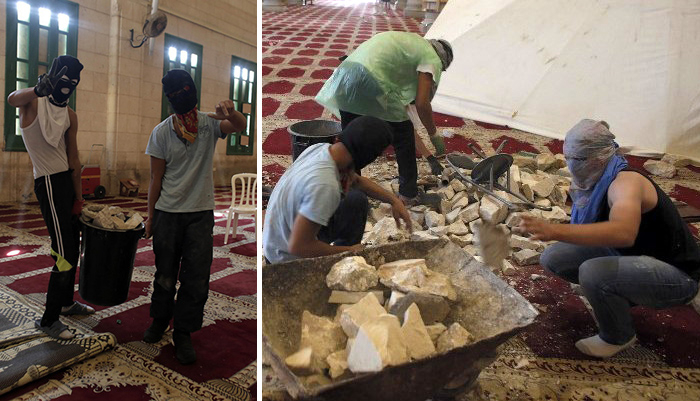
Palestinian Arab young men with masks, inside Al-Aqsa Mosque (some wearing shoes), stockpile rocks to use for throwing at Jews who visit the Temple Mount, September 27, 2015.

The Islamic Movement in Israel, headed by Sheikh Raed Salah, joined the chorus of critics by issuing its own threats to thwart the camera plan.

The straw that broke the Jordanian back was a leaflet that was distributed at the Temple Mount during Friday prayers two weeks ago. The leaflet urged Muslims to smash any cameras installed at the holy site. Who was behind the leaflet remains unclear, but sources in East Jerusalem blamed Palestinian activists and members of the Islamic Movement in Israel. The latest threat came as Jordan announced that the cameras would be installed at the site in the coming days.

Jordanian Prime Minister Abdullah Ensour made no bones about the decision to drop the plan: it was, he stated, a direct response to Palestinian “opposition” and “reservations.” He also noted that Israel had agreed to the installation of the cameras.

“At the beginning, Israel tried to hinder the project through various means,” Ensour said. “But we were able to overcome that.” He said that Jordan was nevertheless “surprised” by the reaction of the Palestinians to the cameras initiative.

Jordan has made clear that it was the Palestinians, and not Israel, who foiled the installation of more than 50 surveillance cameras at the Temple Mount as a stop towards easing tensions there.

Yet, no reaction from Kerry.

In one blow, Palestinians have managed to undermine Jordan’s historic role as “custodian” of the holy sites in Jerusalem and humiliate King Abdullah, who was the mastermind of the camera plan. They managed to do so largely thanks to the failure of the U.S. Administration to follow up on the implementation of the Kerry-brokered agreement.

We are seeing an old movie. Once again, the Palestinians have strong-armed their way to disaster. Their incessant intimidation fails to achieve a truly worthy goal: a better life under a non-dictatorial regime.

Once again, the Palestinians have prevailed — and in their win, they lose yet again.

Khaled Abu Toameh, an award-winning journalist, is based Jerusalem.

Palestinians: Welcome to the World of Western-Funded Terrorism

  • Palestinians and their families are being financially rewarded by the West for taking part in terror attacks against Jews. It does not take a brain surgeon to figure out that this promotes terrorism.

  • Palestinian terrorists released from prison have far higher chances of getting a job with the Palestinian Authority (PA) government than people who went to university, because by carrying out an attack against Jews they become heroes, entitled to a superior job and salary.
  • The more time you spend in an Israeli prison, the more prestigious the job you will receive. Graduating from an Israeli prison is better than graduating from an Ivy League university.
  • These people have not been imprisoned for running a red light. Most of them are behind bars because they have masterminded suicide bombings and other terror attacks that have killed and maimed hundreds of innocent civilians during the past few decades.
  • So, when you hear that it is the PLO, not the PA, that pays the terrorists’ salaries, you might want to mention that this statement is a sleight of hand designed to dupe unsuspecting and well-intentioned American and European donors.
  • It is time to tell Abbas and his associates, in terms that they understand, that the West will no longer fund terrorists. This message, above all others, will discourage terrorism — and perhaps even encourage peace.

Killing Jews has become a profitable business. Palestinians who think of launching a terror attack against Jews can rest assured that their well-being and that of their family will be guaranteed while they are in Israeli prison. Here is how it works:

The Western-funded Palestinian Authority (PA) government, through its various institutions, provides a monthly salary and different financial benefits to jailed Palestinian terrorists and their families. Upon their release, they will continue to receive financial aid, and are given top priority when it comes to employment in the public sector. Their chances of getting a job with the PA government are higher than those who went to university, because by carrying out an attack against Jews they become heroes, entitled to a superior job and salary.

For the record, these people have not been imprisoned for running a red light. Most of them are behind bars because they have masterminded suicide bombings and other terror attacks that have killed and maimed hundreds of innocent civilians during the past few decades. In the U.S., these convicted Palestinian terrorists would have been sentenced to life in prison without the possibility of parole, or the death penalty. What they would not be receiving are the privileges offered to them by Abbas and the PA leadership.

Ready for a dose of linguistic reality? In addition to his title as president of the Palestinian Authority, Mahmoud Abbas is also chairman of the Palestine Liberation Organization (PLO). So it makes no difference at all whether the PA or the PLO is paying salaries to the terrorists: the same man is authorizing the funds. In reality, the PA and the PLO are one and the same. Israel signed the Oslo Accords with the PLO, and as a result of these agreements, the PA was created. We are dealing with the same people and same ideology.

So, when you hear that it is the PLO, not the PA, that pays the terrorists’ salaries, you might want to mention that this statement is a sleight of hand designed to dupe unsuspecting and well-intentioned American and European donors.

Let us look beyond the smoke and mirrors: Palestinians and their families are being financially rewarded by the West for taking part in terror attacks against Jews. It does not take a brain surgeon to figure out that this promotes terrorism. A Palestinian who kills or wounds a Jew can lie comfortably in his prison cell, secure in the knowledge that his future and that of his wife and children taken care of.

Welcome to the world of President Abbas and his government. By providing financial and other aid to those involved in terrorism against Israel, these leaders actively encourage Palestinians to choose the path of violence, and not peace, in dealing with the Israelis.

Let us get specific. The more time you spend in an Israeli prison, the more prestigious the job you will receive. If, for example, you spent more than 15 years in an Israeli prison, and you are affiliated in one way or another with Abbas’s ruling Fatah faction, you will most likely be offered the rank of Colonel or Lieutenant General in one of the Western-funded PA security services.

If, by chance, you masterminded a series of terror attacks that resulted in the deaths of multiple Jews, and your name is Marwan Barghouti, your chances of becoming the next Palestinian president are very high. Barghouti, who is serving five life terms in an Israeli prison for his role in a series of terror attacks that killed at least five Jews, is so popular that he won the first slot in the Fatah “primaries” that were held in Ramallah in late October.

Issa Qaraqi, the head of the Palestinian National Commission for Prisoners and Detainees Affairs, described the election of Barghouti as a “victory for the prisoners and their sacrifices.” In other words, the terrorists should be happy because a bright future awaits them.

Qaraqi’s description is accurate. Like many Palestinians, he too believes that a terrorist who was responsible for the killing of Jews should be honored and offered the finest privileges. Palestinian public opinion polls indicate that Barghouti’s chances of succeeding Abbas as the next PA president are very strong. According to these polls, Barghouti, who has been imprisoned for 15 years, is the Palestinians’ front-runner for the presidency.

These polling results should come as no surprise whatsoever. Palestinians regularly rise to power on the fact of having killed or wounded a Jew. These are, shall we say, optimum credentials for leadership. “Graduating” from an Israeli prison is better than graduating from an Ivy League university.

Moreover, the payments made to the prisoners and their families are far from “humanitarian” in nature. Many of those who receive the benefits are, in fact, not in need of the money: they own their own houses and their families own agricultural lands and farms. In addition, the Palestinian tribal system, where the clan rallies behind one of its members, allows for the prisoners and their families to benefit from financial and moral support. The family bond is very strong in these instances, and it is the duty of each member of the clan to help in accordance with his or her abilities.

Instead, the payments have a political and national goal, as Palestinian leaders themselves remind us again and again. The declared goal is to support the “steadfastness” of the prisoners and their families, “alleviate their suffering,” and pave the way for their “rehabilitation and reintegration” into Palestinian society.

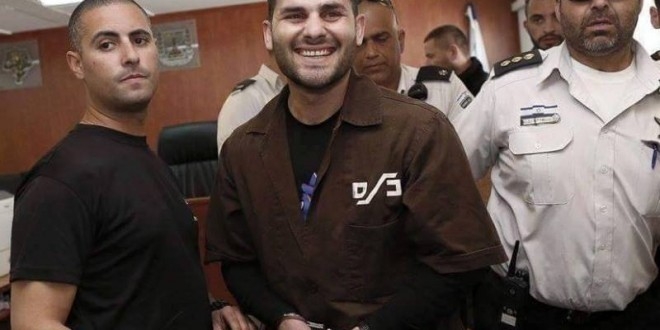
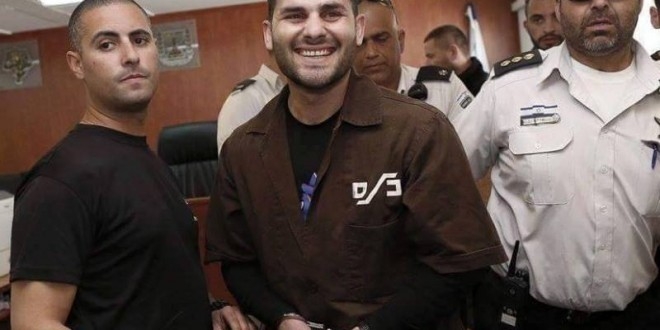
The Palestinian leadership and many Palestinians consider the terrorist prisoners “heroes” — “soldiers” in the fight against Israel. These are the “good boys,” who “sacrificed their lives and freedom” in order to fight the “Zionist enemy.” Take, for example, Maher Hashlamoun, a 32-year-old Palestinian man from Hebron who was recently sentenced to two life terms in prison for murdering a Jewish woman and wounding others in a car-ramming and stabbing attack near Bethlehem. Hashlamoun is now being praised by the PA and many Palestinians as a “hero” and “struggler.” At his sentencing, Hashlamoun laughed, sarcastically telling the judge: “Do you think you will remain on my homeland for another 200 years?”

Maher Hashlamoun (center), a Palestinian from Hebron, was recently sentenced to two life terms in prison for murdering a Jewish woman and wounding others in an attack near Bethlehem. He is pictured above, smiling and laughing at his sentencing. (Image source: Palestinian Authority Ministry of Detainees and Ex-Detainees Affairs)

The terrorist had good reason to laugh in the face of the judge. He knows that Abbas, the Palestinian Authority, or some other entity will look after his family and him while he is sitting in prison. He knows that thanks to Western donations to the Palestinians, his family and he will enjoy monthly payments. The family will even be exempt from paying school and university tuition, as well as their electric and water bills, which will be fully covered by the PA government, directly or indirectly. He also knows that if and when he is released from prison, his chances of finding a job in the public sector are much higher than those of someone who did not kill a Jew or spend time in an Israeli prison.

Until a few years ago, the PA government was dealing with the Palestinian prisoners held in Israel through the Ministry of Detainees and Ex-Detainees Affairs, which was established in 1995, shortly after the signing of the Oslo Accords.

The ministry aims, among other things, to “ensure a decent life for prisoners and care for their children and their families.” Its mission also includes the “rehabilitation and reintegration of ex-detainees into Palestinian society.”

In 2014, the Palestinian Authority, under pressure from Western donors, abolished the ministry and replaced it with a new body called the Higher National Commission for Prisoners and Detainees Affairs. The decision to abolish the ministry and turn it into a PLO-associated commission was seen as an attempt by Abbas to appease Israel and the Western donors. As a consequence of the change, the PLO, and not the PA government, would be in charge of paying salaries and other social benefits to the prisoners and their families. The move was aimed at showing Western donors that their financial aid to the Palestinian Authority was not going to support terrorists in Israeli prison. (The PLO does not receive direct funds from Western donors).

But Abbas’s move was nothing but another dirty deception. The so-called Higher National Commission for Prisoners and Detainees Affairs is actually the same abolished ministry, but under a different name. The commission is directly linked to the Palestinian Authority government and appears as one of its institutions on its official website. The website declares that the Commission provides the prisoners and their families with “legal and material services,” as well as professional training, health insurance, loans, grants and university scholarships for ex-prisoners.

While many in the international community have fallen for Abbas’s trickery concerning the support of convicted terrorists who are imprisoned by Israel, a few have discovered the ploy. Earlier this year, the British government’s Department for International Development reportedly froze part of its aid to the PA, following demands for action from UK lawmakers, after revelations that British aid was being used to fund payments to Palestinian terrorists. Some of the funds were reported to have gone to families of Palestinian suicide bombers and teenagers who have attacked Israelis.

But the world according to the PA is still not the world according to the international community. Taxpayers have the right to know if their money is covering the dental expenses of a terrorist and his family. It is time to tell Abbas and his associates, in terms that they understand, that the West will no longer fund terrorists. This message, above all others, will discourage terrorism — and perhaps even encourage peace.

Bassam Tawil is based in the Middle East.

Palestinians: We Want Our Own Knesset by Khaled Abu Toameh

  • Apparently Najat Abu Bakr forgot that she is a member of the Palestinian parliament and not the Israeli one. She and her colleagues have no right to criticize President Abbas or any senior official in Ramallah. Such criticism is considered an “insult” to top officials and even an act of treason.

  • And so we have two legislators. One is forced to seek shelter within her own parliament for fear of being arrested by the Palestinian security forces. The other receives all the rights and privileges enjoyed by her fellow Arabs inside Israel — in spite of her immensely provocative behavior.
  • That is the difference between a law-abiding country and the Palestinian Authority, which has been functioning for many years as a mafia.
  • Najat Abu Bakr and many Palestinians dream of the day they too will have a Knesset, a true parliament, where leaders are held accountable.

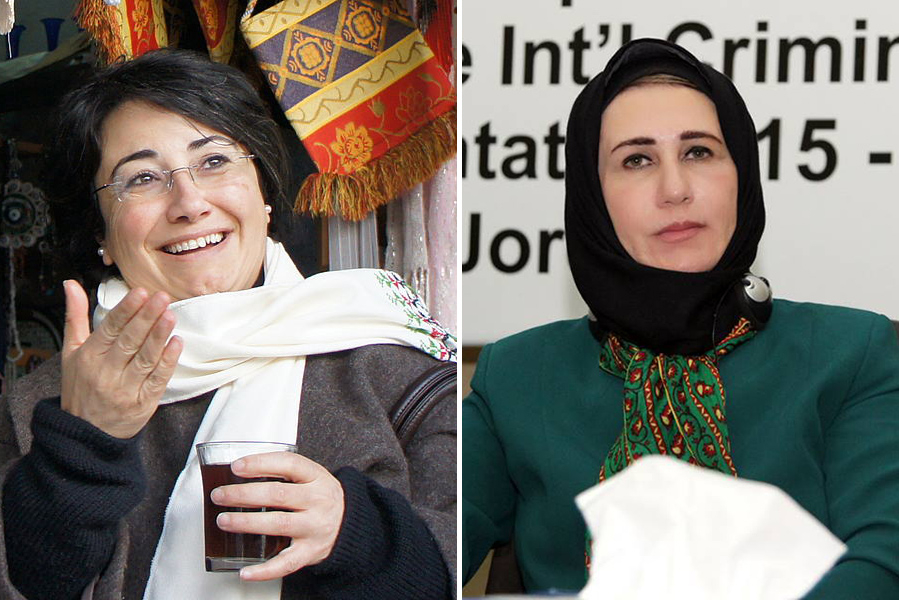
What do Haneen Zoabi and Najat Abu Bakr have in common?

Both women are outspoken members of parliament — Zoabi in Israel and Abu Bakr in the Palestinian territories.

Zoabi, who hails from Nazareth, is a citizen of Israel. Abu Bakr, from the West Bank city of Nablus, is an elected member of the Palestinian Legislative Council (PLC), the parliament that has been effectively paralyzed since 2007, when Hamas expelled the Palestinian Authority (PA) from the Gaza Strip.

Haneen Zoabi (left) and Najat Abu Bakr (right) are outspoken members of parliament — Zoabi in Israel and Abu Bakr in the Palestinian territories. That is pretty much where the similarities end.

But outspoken participation in parliaments is pretty much where the similarities end.

Zoabi, who resides inside Israel, lives a rather different life from her colleague, Abu Bakr, who is a Palestinian citizen.

Zoabi, the Israeli member of parliament, is a provocateur of long standing who regularly enrages the Jewish-Israeli public. She joined a flotilla “aid” convoy to the Gaza Strip — a move that left many Israelis furious.

On other occasions, her statements have also been interpreted as a show of solidarity with Israel’s enemies. More recently, she received a light sentence after signing a plea-bargain admitting she had insulted an Arab working for the Israel Police.

Zoabi was back in the headlines again last month — along with two other Arab members of Israel’s Knesset, Jamal Zahalka and Basel Ghattas — for meeting with families of Palestinians who had carried out terror attacks against Israelis.

By all accounts, for that performance she and the other two Knesset members received a mere “slap on the wrist:” they were suspended from attending parliamentary committee meetings for a few months.

Even though Zoabi’s behavior and rhetoric are thoroughly abhorrent to many Israelis, including some of Israel’s Arab citizens, Israel’s president, Reuven Rivlin, along with other Israelis, came out against expelling her and some other Joint Arab List colleagues from the Knesset.

“We cannot allow the Knesset, whose representatives are chosen by the public, to independently overturn the public’s choice,” Rivlin said, referring to proposed legislation that would allow Knesset members to vote out their colleagues who express support for terrorism.

But let us return to the question: how are Haneen Zoabi and Najat Abu Bakr, our two female parliamentarians, each doing?

While Zoabi, an Arab Muslim citizen of Israel, carries out her duties — and lives her life — freely, Abu Bakr has been forced to seek refuge within the Palestinian Legislative Council building in Ramallah.

In short, the two women are living in different worlds.

Since last week, when President Mahmoud Abbas ordered her arrest, Abu Bakr has been holed up inside the Palestinian Authority parliament building. Her crime: blowing the whistle on the financial corruption of a cabinet minister who is closely associated with President Abbas.

Her claim is that the minister has been privately selling water to Palestinians and has illegally taken more than $200,000 from the Palestinian budget.

But that is not her only alleged crime. A further one concerns her public support for a teacher’s strike in the West Bank. The strike has seriously embarrassed President Abbas and the Palestinian Authority leadership. Abbas has ordered scores of striking teachers arrested and has deployed hundreds of policemen at checkpoints to foil a protest organized by the teachers, who are demanding higher salaries and better conditions.

Apparently, Abu Bakr forgot that she is a member of the Palestinian parliament and not the Israeli one. She and her colleagues have no right to criticize President Abbas or any senior official in Ramallah. Such criticism is considered an “insult” to top officials and even an act of treason.

Members of the Palestinian Authority’s Parliament enjoy none of the rights enjoyed by Arab members of Israel’s parliament, the Knesset.

Parliamentary immunity, for instance, means that Zoabi and her colleagues cannot be detained or summoned for interrogation by the authorities.

In truth, there is no life in the Palestinian parliament. It has been paralyzed, thanks to the PA and strife with Hamas, and mostly functions as the butt of Palestinian jokes.

But the absence of an effective parliament suits President Abbas and his government just fine. No parliament means no one to hold them accountable.

Meanwhile Abu Bakr, the MP who dares to open her mouth against the president or a top-echelon Palestinian Authority official, is grabbed by the long arm of the Palestinian security forces.

Abu Bakr is now a fugitive. Monday was the sixth day she has been huddling in the parliament building. She has refused to leave the building or report for interrogation, and is demanding that Abbas cancel the arrest warrant issued against her.

Where is comrade Zoabi now? The Joint Arab List in Israel has been conspicuously silent about the harassment of their fellow member of parliament in Ramallah.

What a different picture we would have seen had Abu Bakr been delayed at an IDF checkpoint for fifteen minutes. In less time than that, Zoabi would have strung Israel up for violating the rights of a parliament member in the Palestinian territories.

And so we have two legislators. One is forced to seek shelter within her own parliament for fear of being arrested by the Palestinian security forces. The other receives all the rights and privileges enjoyed by her fellow Arabs inside Israel – in spite of her immensely provocative behavior.

That is the difference between a law-abiding country and the Palestinian Authority, which has been functioning for many years as a mafia.

Najat Abu Bakr and many Palestinians dream of the day they too will have a Knesset, a true parliament, where leaders are held accountable. For now – and for the foreseeable future – that day is just a pipedream.

Zoabi and her fellow Arab citizens of Israel will not be packing their bags and heading for Ramallah anytime soon, however. It seems that another Arab dictatorship is not their idea of prime real estate.

Khaled Abu Toameh, an award-winning journalist, is based in Jerusalem.

Translate »
Skip to toolbar