
Daily Archives: June 19, 2017

President Mahmoud Abbas: The Palestinian “Untouchable” by Khaled Abu Toameh

For many years, Palestinians hoped that one day they would enjoy public freedoms under the leadership of the Palestinian Authority (PA), like the freedoms their neighbors in Israel have. But more than two decades after the establishment of the PA, democracy and freedom of speech are still far from being introduced to Palestinian society.
A PA court sentenced Anas Saad Awwad to a year in prison for posting on Facebook a photoshopped picture of Abbas wearing a Real Madrid shirt.
“Come and invest in the Palestinian areas, but if you don’t bribe their corrupt officials, the Palestinian Authority will arrest you. This is a desperate political arrest by an undemocratic Palestinian Authority president who has no credibility amongst his people. ” — Khaled al-Sabawi, son of Palestinian-Canadian investor Mohamed al-Sabawi, who was jailed for recommending the removal of Mahmoud Abbas from power.
It is not easy for an Arab journalist to criticize his or her leaders. If there is one thing Arab dictators cannot tolerate, it is criticism, especially when it comes from an Arab journalist, columnist or political opponent.
For many years, Palestinians were hoping that one day they would enjoy freedom of expression under the leadership of the Palestinian Authority (PA). But more than two decades after the establishment of the PA, Palestinians have learned that democracy and freedom of speech are still far from being introduced to their society.
Since then, Palestinians have also learned that their leaders are “untouchable” and above criticism. Both Mahmoud Abbas and his predecessor, Yasser Arafat, have even taught Palestinians that “insulting” their president is a crime and an act of treason.

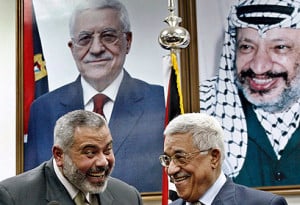
Both Mahmoud Abbas (right) and his predecessor, Yasser Arafat (left) have taught Palestinians that “insulting” their president is a crime and an act of treason. Pictured above: A Fatah propaganda poster featuring Abbas and Arafat. The Arabic text reads “Bearer of the trust” on top.
During the past two decades, several Palestinians who dared to criticize Abbas or Arafat have been punished in different ways.
The latest victim of this campaign against critics is Jihad al-Khazen, a prominent Lebanese journalist and columnist who recently wrote on article about the need for the “failed and corrupt” Palestinian Authority leadership to retire.
Al-Khazen, a veteran journalist with the London-based pan-Arab newspaper Al-Hayat, is now under attack by the PA. The goal: deterrence of free speech.
In the Looking Glass land of the Palestinian Authority, criticism of Abbas is classed as “insult to the president” and has landed critics behind bars — or worse.
In 2013, a Palestinian journalist working for the al-Quds TV channel in Bethlehem, Mamdouh Hamamreh, was sentenced to one year in prison for posting a picture on Facebook that was deemed insulting to President Abbas. Abbas was depicted in the image as a fictional character who collaborated with French colonial forces in Syria. Abbas later pardoned the journalist.
That same year, a Palestinian Authority court sentenced Anas Saad Awwad, from the West Bank village of Awarta, to a year in prison for posting on Facebook a photoshopped picture of Abbas wearing a Real Madrid shirt.
Also in 2013, PA security forces detained a Palestinian-Canadian investor, Mohamed al-Sabawi, 68, on charges of insulting Abbas. Al-Sabawi was president of the Board of Directors of Ahlia Insurance Group, which employs hundreds of Palestinians in the West Bank. He was detained for two weeks after he publicly called for the removal of Abbas from power.
The businessman’s son, Khaled, who is from Ontario, Canada, said that the detention of his father showed that U.S. Secretary of State John Kerry’s plan to bring $4 billion in private investment to the Palestinian territories was “nonsense.” He added:
“Come and invest in the Palestinian areas, but if you don’t bribe their corrupt officials, the Palestinian Authority will arrest you. This is a desperate political arrest by an undemocratic Palestinian Authority president who has no credibility amongst his people. I think my father hurt President Abbas’s feelings.”
In the past few years, Palestinian officials who have also dared to criticize Abbas, or were accused of insulting him, paid a heavy price. The list of officials who were punished for raising their voices against their president includes Mohamed Dahlan, Yasser Abed Rabbo and Salam Fayyad.
Mohamed Dahlan, an elected Fatah member of the Palestinian Legislative Council and a former PA security commander in the Gaza Strip, was expelled from Fatah in 2011 at the request of Abbas. Dahlan was also forced to flee the West Bank after Abbas sent his security forces to raid the Dahlan’s Ramallah residence and arrest some of his supporters. Dahlan has since found refuge in the United Arab Emirates.
Until recently, Yasser Abed Rabbo served as Secretary-General of the PLO and was considered one of Abbas’s closest aides. Last year, however, Abbas removed him from his job after he reportedly criticized the president in closed meetings.
Salam Fayyad, the former Palestinian Authority prime minister, was also punished for allegedly criticizing Abbas. Last year, the PA froze Fayyad’s bank account and accused him of money laundering. The decision came after Fayyad received a large sum from the United Arab Emirates for a non-governmental organization that he, Fayyad, heads. Under pressure from the international community and some Arab countries, Abbas was later forced to rescind the decision.
Now Jihad al-Khazen has joined the list of critics who are being targeted by Abbas and the Palestinian Authority. Al-Khazen’s crime is that he wrote an article lambasting Abbas and the veteran leadership of the PA.
The controversial article was published earlier this month in the Al-Hayat daily.
The article quotes an unnamed senior Gulf official saying that the time has come for Abbas and the entire Palestinian Authority leadership to retire. “We don’t trust them,” the Gulf official is quoted as saying, referring to the PA leadership. Although the Gulf official is not mentioned by name, Abbas and his aides in Ramallah say they believe the man is Crown Prince Mohamed bin Zayed of Abu Dhabi (the emirate that hosts and funds Abbas’s arch-enemy, Mohammed Dahlan).
Commenting on Abbas’s decision to freeze the bank account of Fayyad, the senior Gulf official is quoted in the article as having said:
“Do you really believe that the United Arab Emirates would choose to launder money though the Palestinian territories? The Palestinian prosecutor-general later admitted that Abu Mazen [Abbas] had ordered him to fabricate the charge. The United Arab Emirates is now demanding a public apology from Abbas. We have suspended all aid to the Palestinian Authority.”
Al-Khazen said that the Gulf official also spoke with him about Abbas and his wife and children. “But I have decided not to publish these things,” he added. Al-Khazen said he spent nearly two hours talking to the Gulf official whom he quotes in the article.
The response from the Palestinian Authority was swift. In Ramallah, calling for the retirement of the president and the PA leadership in an influential Arab newspaper is a deadly serious matter. The 77-year-old al-Khazen can consider himself fortunate that he does not live in the fair city of Ramallah with the PA leadership.
The first attack on al-Khazen was framed in the traditional Palestinian theory of a Zionist conspiracy. Published by the official Palestinian Authority news agency Wafa, which is controlled by Abbas loyalists, the article referred to the al-Khazen’s charges as “vulgarities,” and attempted to establish a link between Israeli “incitement” against the PA and the article in Al-Hayat.
Next we read of the beleaguered defensive posture. Abbas’s agency notes that the article aired at a time when the Palestinian Authority is “facing the Zionist project on all fronts.” Finally, we get to the heart of the matter: dictatorial censorship. As in, where is it?
“Does a respected and responsible newspaper have the right to allow such filthy words to appear on its pages?” the Wafa agency asks. “And does Jihad al-Khazen or anyone else have the right to say whatever they want without any control? And do they have the right to insult people or Arab leaders without being held accountable?”
Abbas’s ruling Fatah faction has also been recruited to defend its leader’s reputation. Again, the faction resorted to the famous tactic of linking any legitimate criticism of Abbas to Israel. In a statement, Fatah accused the columnist of “serving the state of occupation [Israel] and those who are working towards undermining President Abbas, Fatah, the Palestinian leadership and the Palestinian people.” The statement added: “This is a service for the [Israeli] government of Binyamin Netanyahu, which is interested in stepping up its organized campaign against President Abbas.”
In the eyes — and words — of Abbas and his cronies, anyone who opens his mouth in criticism of the Palestinian president — from a Gulf leader to a respected Arab columnist — is a mouthpiece for the Zionist project.
Deterrence is the name of this game. And prison is probably the best place some would-be whistleblowers can hope for. This is not what Palestinians were hoping for when the Oslo Accords were signed with Israel, paving the way for the creation of the Palestinian Authority. Many Palestinians were hoping back then that, under the PA, they would enjoy public freedoms like the ones their neighbors in Israel have. Sadly, most Palestinians are no longer living under the illusion that their current leaders would ever bring them democracy and freedom of speech.
The case of al-Khazen, who is facing a campaign of intimidation and insults, serves as a reminder to Palestinians that their leaders are infallible and untouchable, and that the liberty they had hoped for is still far, far away.
Khaled Abu Toameh, an award-winning journalist, is based in Jerusalem.

Pope Francis: The Good Shepherd Now Must Protect His Sheep by Lawrence A. Franklin

  • Pope Francis might review the decisions of former pontiffs who once organized resistance against existential threats to Judeo-Christian Civilization. Several of his predecessors seized the initiative whenever a weak or divided Europe appeared incapable of defending itself.

  • Pope Francis also could author an encyclical condemning radical Islam. This would be wholly within the purview and tradition of the Papacy. Such an encyclical would mirror in significance Pope Pius XI’s “Mit Brennender Sorge” (With Burning Anxiety) which condemned the racist supremacy doctrine of the Nazis.
  • Some of the passages in Pius XI’s “Divini Redemptoris” (The Divine Redeemer) could also serve as appropriate criticism of various tenets of extremist Islam. One example: “Communism aims at upsetting the social order and undermining the very foundation of Christian civilization.” Another: “Entire peoples find themselves in danger of falling back into a barbarism worse than which oppressed the greater part of the world at the coming of the Redeemer (Roman Empire).”

It was uplifting to hear Pope Francis denounce the genocide of the Armenians in Turkey last week and remind the world that it must never again happen.

The Vatican has several other options to meet head-on the challenge of Islamic extremism. Pope Francis could capitalize on his widespread popularity to combat Jihadi aggression by word, pen, and sword. He might also review the decisions of former pontiffs who once organized resistance against existential threats to Judeo-Christian Civilization. Several of his predecessors seized the initiative whenever a weak or divided Europe appeared incapable of defending itself.

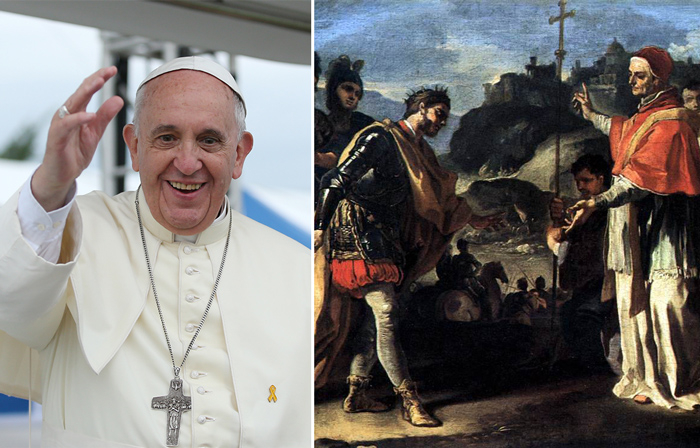
Pope Francis could begin his review with Pope Saint Leo the Great. In 452 A.D., he rode out of Rome on horseback to meet Attila the Hun, persuading him not to invade the Eternal City.

Pope Francis (left) could begin his review of the actions of former pontiffs with Pope Saint Leo the Great (right). In 452 A.D., Leo rode out of Rome on horseback to meet Attila the Hun, persuading him not to invade the Eternal City.

Pope Francis could then study the statecraft of Saint Pope Pius V, who helped establish the Holy League in March 1571. This alliance – of Venice, Spain, the Republic of Genoa, the Papacy, and Austrian Hapsburg military contingents – pooled their maritime military assets to fight an overwhelmingly superior Ottoman fleet.[1] If the Turks triumphed, the entire Mediterranean Sea would be theirs. However, on June 7, 1571, the Holy League destroyed the Turkish Navy in the waters of the Gulf of Corinth, southwest of Greece.[2] The Vatican judged the victory, a miracle. This unexpected naval triumph certainly seemed a providential response to the prayers of tens of thousands of sailors and soldiers kneeling on the decks of their vessels.

Pope Francis could also consult the speeches and letters of Pope Urban II, whose solemn and inspirational oratory catalyzed the Knights of Europe to defend the Holy Land’s sacred sites. Urban’s urging of Europe’s professional warrior class “to take up the Crusader Cross” was Christendom’s response to Islam’s often predatory policy against Christian pilgrims.

In addition, places important to Christians everywhere were being destroyed by the Seljuk Turkish Empire. Anti-Christian pogroms became so intense that, in 1095, the Orthodox Emperor of Constantinople Alexius Comenius I appealed to Pope Urban to send forces to tame the Turks. Urban took up the challenge, calling the Council of Clermont in 1095. He urged European knights to sanctify their violent inclinations in defense of their fellow Christians.

The first of seven Crusades embarked for the Holy Land later that same year, capturing Jerusalem on July 14, 1099. This movement was the beginning of Europe’s counterattack, after several centuries of Muslim Conquests of former Christian lands. After hundreds of years of occupation, violence, and slave-like servitude, Christians had become a threatened species in lands once the first to embrace Christianity.

Pope Francis also could author an encyclical condemning radical Islam. This would be wholly within the purview and tradition of the Papacy. Such an encyclical would mirror in significance Pope Pius XI’s “Mit Brennender Sorge”[3] (With Burning Anxiety) which condemned the racist supremacy doctrine of the Nazis. This encyclical criticized National Socialism’s excessive emphasis on the priority of the state over the sovereignty of God. Somewhat ironically, the encyclical was authored by Cardinal Eugenio Pacelli, who two years later, became Pope Pius XII. He was the Pontiff often criticized for not confronting the Nazis strongly enough, while mass murder occurred in German concentration camps during World War II.

Far more effective was Pius XI’s condemnation of Communism in his “Divini Redemptoris”[4] (The Divine Redeemer). This encyclical challenged the suppression of human rights, class warfare, and materialism. Some of its passages could also serve as appropriate criticism of various tenets of extremist Islam. One example: “Communism aims at upsetting the social order and undermining the very foundation of Christian civilization.”[5] Another: “Entire peoples find themselves in danger of falling back into a barbarism worse than which oppressed the greater part of the world at the coming of the Redeemer (Roman Empire).”[6]

The Holy Father could seize the opportunity to address the plague of Muslim violent extremism in Islamic education — as did Grand Imam Ahmed al-Tayeb, head of the Egypt’s Al-Azhar University — the leading center of learning for Sunni Islam, in Februray 2015 — on an international stage, as he did regarding climate change at a UN General Assembly Meeting also in 2015.

Another international opportunity could be a Vatican call for a convocation of world religions at Assisi, the site of three past such assemblies.[7] Just as dramatic a maneuver, having the potential to revive the ghosts of Christian Europe, would be a Papal address to a plenary session of the European Union. The rarity of such an event would rivet the attention of the continent’s political elite. A more emphatic gesture would be a request by the Pope to address a meeting of NATO. Such a move would demonstrate the gravity which the world’s most powerful religious institution views the Muslim threat to supplant Greco-Roman ideals and Judeo-Christian values. These initiatives could serve as teaching moments, where the Vatican could detail past instances when an aggressive Islamic thrust threatened to swallow Christian realms. Francis could easily sketch out the jihads of history. He could demonstrate how “we” have seen all this before: outside the Gates of Vienna,[8] in the mountains of the Pyrenees,[9] and the blood-soaked isles of the Mediterranean.[10]

He could challenge Islamic leaders to institute specific reforms which would root-out theological justification for violent and intolerant behavior. He could call upon Muslims of good will to summon their courage to recapture their faith. He could help moderates by suggesting changes in Islam which would be welcomed by both many Muslims and by Western civilization. Pope Francis might host periodic working sessions with moderate Sunni and Shi’a Muslims. These sessions may serve as an opportunity to build a better, more trusting relationship between Christendom and the Islamic World. At these convocations, the Vatican could urge Muslim scholars to “re-open the gates of Ijitihad [independent questioning, reasoning],” to review certain martial passages of the Koran. Nevertheless, the bugle must be sounded without hesitation. The tone must not be tentative. It must be decisive in word, speech, and deed.

The Good Shepherd now must protect his sheep, saving civilization in the process. The Holy Father must assume the role of Supreme Pontiff, indeed, Leader of the West. Like the Prophets of old who counseled Israel’s Kings in times of danger, the Pope can don the mantle of spiritual guide of the West and urge its leaders to summon up the courage to fight and the will to endure.

Dr. Lawrence A. Franklin was the Iran Desk Officer for Secretary of Defense Rumsfeld. He also served on active duty with the U.S. Army and as a Colonel in the Air Force Reserve, where he was a Military Attaché at the U.S. Embassy in Israel.

Polygamy: Europe’s Hidden Statistic by Judith Bergman

  • The sheer volume of polygamous marriages shows that such marriages are also entered into in Europe, in secret, through Islamic marriage ceremonies conducted by imams. In most European countries, imams are not required to report these marriages to the authorities.

  • Daham Al Hasan fled from Syria to Denmark, leaving behind his three wives and 20 children. Under the Danish rules of family unification, one of his wives and eight of his children have joined him in Denmark. But Al Hasan wants all his children with him, as well as all his wives. Lawyers estimate that the remaining wives will be able to join their children in Denmark. The case has caused a shock not only because of what it will cost the Danish state just in child allowance, but because Al Hassan claims that he is too ill to work or even learn Danish. “I don’t only have mental problems, but also physical problems…” He has admitted that his “mental illness” consists of missing the children he voluntarily left behind.
  • Even if theoretically women can go to the police or press charges, they run the risk of being beaten or possibly divorced. Women’s shelters are “full of Muslim women.”
  • The spokeswoman of Germany’s Federal Employment Agency said that the establishment of a central registry of Islamic marriages would be helpful for investigating claims of fraud.

A few years ago, Sweden’s Center Party, one of the four parties in the center-right governing coalition at the time, proposed legalizing polygamy. The idea caused outrage; the proposal was dropped. The party’s youth division, however, refused to let go: “We think it is important for the individual to decide how many people he or she wants to marry,” said Hanna Wagenius, head of Center Youth, predicting that polygamy would be legal in ten years, when her generation would enter parliament and make sure of it.

Sweden is not the only place in Scandinavia where “idealistic” youths have advocated polygamy. In 2012, the youth division of Denmark’s Radikale Venstre Party (“Radical Left”), then part of the governing coalition in Denmark, also proposed that polygamy should be legalized in Denmark. The move came four years after an Iraqi asylum seeker, who had worked for the Danish military in Iraq as a translator and then fled to Denmark, arrived with two wives. As Denmark does not recognize bigamy and as he refused to divorce his second wife, he returned to Iraq. “It is unacceptable that we are so narrow-minded in Denmark, and will not help a man who has helped us. We want to do something about that,” Ditte Søndergaard, head of Radikale Venstre Youth, said at the time. The proposal, however, did not find favor with any of the other political parties.

As far-fetched as these proposals may sound, they signify the shifts taking place in the West regarding fundamental ethical issues of gender equality and the willingness to accommodate Islamic sharia law. They are also proof of an enduring willful blindness to the detrimental effects of the practice of polygamy, not only in terms of financial costs to the state, but also to the Muslim women and children, whose rights these young politicians purport to support.

Muslim polygamy is only rarely debated in the media. The practice, therefore, despite its spread across the European continent — spanning, among other countries, Sweden, Denmark, the UK, Germany, France and the Netherlands — continues largely to hide under the public radar. As the practice is illegal across the continent and therefore not supposed to exist, there are no official statistics of polygamous marriages anywhere in Europe.

Several countries, such as the UK, the Netherlands, Sweden and France, nevertheless recognize Muslim polygamous marriages if they were contracted abroad under certain circumstances, such as if polygamy is legal in the country where the marriage took place. It is estimated that as many as 20,000 polygamous Muslim marriages exist in Britain. In France, as polygamy was legal until 1993, the minimum estimate as early as 2006 was around 20,000 polygamous marriages. In Germany, it was estimated in 2012 that, in Berlin alone, 30% of all Arab men were married to more than one wife.

In April, Swedish professor Göran Lind argued that it was time to “put one’s foot down” regarding polygamy in Sweden, after it was disclosed that Sweden had recognized “hundreds” of polygamous marriages contracted abroad. Professor Lind pointed out that polygamy is not compatible with Swedish law, especially the principles of equal treatment of spouses, the equality of all human beings, and the prohibition against discrimination on the basis of gender, as codified in the European Convention on Human Rights. One might add to those the principles enshrined in the UN’s Convention on the Elimination of All Discrimination Against Women, article 16, according to which,

“States Parties shall take all appropriate measures to eliminate discrimination against women in all matters relating to marriage and family relations and in particular shall ensure, on a basis of equality of men and women:

“(a) The same right to enter into marriage;

“(b) The same right freely to choose a spouse and to enter into marriage only with their free and full consent.”

Considering how much time leading European politicians spend on assuring their electorates of their dedication to human rights, their tacit acceptance of these glaring violations of women’s rights, as enshrined in the above conventions, which polygamy constitutes, is rather peculiar.

The sheer volume of polygamous marriages, however, attests to the fact that such marriages are also entered into in Europe, in secret, through Islamic marriage ceremonies conducted by imams. In most European countries, imams are not required to report these marriages to the authorities. Therefore, despite the probable knowledge of the authorities, this illegal practice is basically allowed to flourish unhindered. As Islamic marriage does not legally exist in Europe, the woman entering into the union is left legally stranded and vulnerable with no means — other than the local imam or sharia council — of getting out of the marriage. Even if women can theoretically go to the police or press charges, they run the risk of being beaten or possibly divorced. Women’s shelters are “full of Muslim women,” as Ayaan Hirsi Ali, who worked in them, attests.

Polygamous Muslim marriages are bound to become an even bigger problem in the wake of the migrant crisis.

In Denmark these days, Daham Al Hasan is making headlines. He has twenty children with three wives, but two years ago fled alone from Syria to Denmark, and left his wives and children behind. Recently, under the Danish rules of family unification, one of his wives and eight of his children have joined him in Denmark. But Al Hasan wants all his children with him, as well as all his wives. He has been granted permission for nine additional children to join him, but as Denmark does not allow polygamy, the two remaining wives, under the same rules of family unification, are not permitted to join him. Lawyers, however, estimate that the remaining wives will also be able independently to join their children in Denmark, once they are there.

The case has caused rather a shock in Denmark, not only because of the extraordinary size of the family, and what it will cost the Danish state just in child allowance, but because Al Hassan claims that he is too ill to work or even to learn Danish. “I don’t only have mental problems, but also physical problems”, he says by way of explanation, “My back and my legs hurt.” He has admitted that his “mental illness” consists of missing the children he voluntarily left behind. This means that he and his family live exclusively off the Danish taxpayers’ money.

What is noteworthy about the current debate, however, is what is not being debated: namely that Al Hassan is a polygamist. While it is only natural that politicians and citizens feel violated and aggrieved about the financial costs to the Danish state, they should be equally concerned about the practice of polygamy. Yet not a single Danish feminist has spoken out about it.

In the television documentary, “Sharia in Denmark”, several imams recorded on a secret camera answered in the affirmative and without the least hesitation the question of whether a woman’s husband was allowed to take another wife against his first wife’s wish. For them, in fact, despite the fact that they live in a country where bigamy and polygamy are prohibited, for a man to take a second, third or fourth wife regardless of what any of them thought, seemed perfectly natural.

A qualitative study about Muslim women in Denmark from 2009, performed by Tina Magaard for the Danish Ministry of Welfare, documented the practice of polygamy among Danish Muslims. One Turkish woman told the interviewers:

“A growing group of women marries a man who is already married. They get married by an imam because then they become more accepted. Apparently, they have no alternative. They become ostracized if they were divorced and are on their own. Many would rather live a life where they get an identity — then they belong somewhere and then they are accepted. And it is sad that it exists in Denmark. I think if they could count the numbers, which is very difficult, they are probably much higher than we think.”

Another woman, a Muslim convert, said:

“This [polygamy] is something that I have really seen a lot of, there was a period when it became fashionable. I think it was five or six years ago, it was crazy, I think almost every second couple I knew, the man got himself an extra wife. But then, after a year or so, he regretted it or he divorced the first wife. I actually think there were twelve from my circle of friends where the husband got himself another wife.”

In a German documentary from 2013, the journalists found that Muslim men used polygamy as a means to commit fraud and obtain more welfare benefits. The tactic was to have their wives claim at the Employment Center that they were single women who did not know the father of their children. The story works because Germany, like other European countries, has no way of ascertaining the existence of an Islamic marriage, especially as German law does not obligate women to inform the authorities of their marital status.

In the film, the journalists asked the spokeswoman of the Federal Employment Agency — the supervisor of the local Employment Agencies responsible for paying out welfare benefits — whether the Federal Employment Agency was aware of the many instances of fraud. The woman said that they were indeed aware of the polygamy and the ensuing fraud and even enumerated the places where it was rife: large cities in Western Germany, such as Berlin, Cologne and Frankfurt. The journalist then asked the woman why nothing was being done about it. “I believe these cultural differences are very sensitive, we are a very tolerant country,” the woman said. Asked whether the Federal Employment Agency was perhaps too tolerant, the woman said that indeed she herself was wondering how it will all end.

The woman then said that the establishment of a central registry of Islamic marriages would be most helpful and desirable, as it would make possible investigating claims of fraud; but that this was a matter for the politicians.

“How will it all end?” Not well.
Judith Bergman is a writer, columnist, lawyer and political analyst.
Poll: Most Palestinians Prefer Terror War, Not Peace Negotiations

The Palestinians distrust their leadership and are generally opposed to a two-state solution with Israel, a recent poll reveals. A majority favor a new terror war, known as ‘intifada’, against Israel.


Mahmoud Abbas

Palestinians do not believe Abbas will resign. (AP/Majdi Mohammed)

The latest poll by the Palestinian Center for Policy and Survey Research (PSR) indicates a crisis of faith in the Palestinian leadership. Nearly two-thirds of Palestinians surveyed believe that Palestinian Authority (PA) President Mahmoud Abbas should resign, but he has no clear successor. Just over halfoppose a two-state solution, but support for a one-state solution stands at less than one-third. A majority are in favor of armed intifada.

The poll shows that 65 percent of Palestinians want Abbas to resign. The same percentage, however, believes that his intention to resign from the Palestine Liberation Organizationexecutive committee is an act. Thirty-two percent would prefer that he be replaced by terroristMarwan Baghouti, and 19% would like to see Hamas’s Ismail Haniyeh take his place. If an election were held now and the only candidates were Abbas and Haniyeh, Haniyeh would just barely win at 49% to Abbas’s 44%.

Terror attack at Hebrew University's Mt. Scopus campus in 2002.

A majority of Palestinians favor a return to violence. (AP)

Palestinian support for the two-state solution has also dropped. Sixty-six percent said they oppose an unconditional return to negotiations with Israel, and 60% rejected aFrench proposal at the UN that would force a resolution to the conflict on both sides. Forty-eight percent said they favor a two-state solution, with 51% opposed. In the absence of negotiations, 57% are in support of an armed intifada, as compared to 49% three months ago.

PSR conducted the survey on September 17-19, and the results reflect the events of that time period, which include: President Mahmoud Abbas submitting his resignation to the PLO Executive Committee; a growing rift between Hamas and Fatah over rumors that Hamas was indirectly negotiating a truce in Israel; the eruption of riots on the Temple Mount on Rosh Hashana; and the deaths of three members of the Dawabshe family from Duma.

The pollsters interviewed 1,270 adults in face-to-face interviews at 127 randomly selected locations across the PA-administered territories.

By: Sara Abramowicz, United with Israel

Sign the Pe

Political Revolution Is Brewing in Europe by Geert Wilders

  • The German authorities are dangerously underestimating the threat of Islam… They have betrayed their own citizens.
  • Let no-one tell you that only the perpetrators of these crimes are to blame. The politicians, who welcomed Islam into their country, are guilty as well. And it is not just Frau Merkel in Germany, it is the entire political elite in Western Europe.

  • Out of political-correctness, they have deliberately turned a blind eye to Islam. They have refused to inform themselves about its true nature. They refuse to acknowledge that is all in the Koran: the permission to kill Jews and Christians (Surah 9:29), to terrorize non-Muslims (8:12), to rape young girls (65:4), to enslave people for sex (4:3), to lie about one’s true goals (3:54), and the command to make war on the infidels (9:123) and subjugate the entire world to Allah (9:33).
  • We will have to de-islamize our societies…. But it all begins with politicians with the courage to face and speak the truth.
  • More and more citizens are aware of that. This is why a political revolution is brewing in Europe. Patriotic parties are rapidly growing everywhere. They are Europe’s only hope for a better future.

Yesterday, the Islamic State claimed the Berlin terror attack of Monday evening, in which twelve people were killed with a truck at a Christmas market.

The killer managed to escape. However, in the truck the police found identity papers belonging to Anis A., a Tunisian who came to Germany as an asylum seeker in 2015.

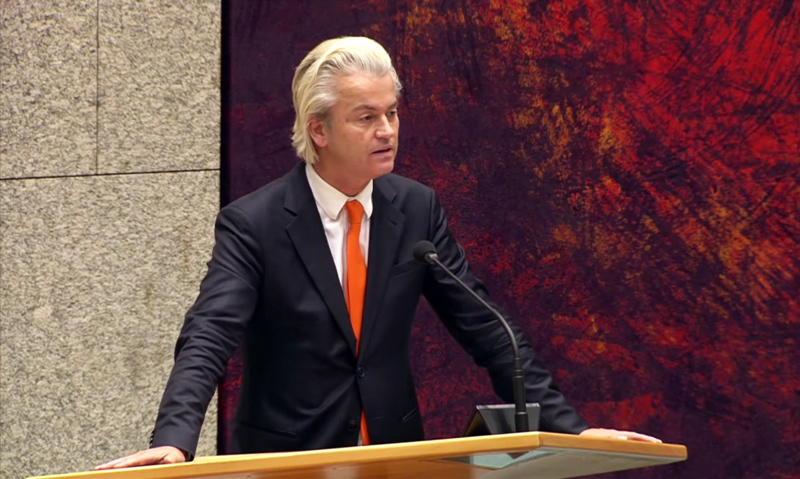
(Image source: RTL Nieuws video screenshot)

When last year German Chancellor Angela Merkel opened Germany’s borders to almost one million refugees and asylum seekers, she invited the Trojan horse of Islam into her country. Among the so-called refugees were many young men of Islamic background, filled with hatred for the West and its civilization. One of them was Anis A.

It took almost a year for the German authorities to reject his asylum request, but meanwhile the man had disappeared. The police are now looking for him as a prime suspect of Monday’s attack in Berlin.

The German authorities are dangerously underestimating the threat of Islam. They signs are there for all to see. In October, an Afghan asylum seeker raped and murdered a 19-year old German girl in Freiburg. And a 12-year old Iraqi boy was caught before he could explode a nail bomb at a Christmas market in Ludwigshafen.

Last Summer, an Afghan with an axe attacked train passengers in Heidingsfeld, a Syrian murdered a pregnant woman with a machete in Reutlingen, another Syrian detonated a suicide bomb at a music festival in Ansbach, a Palestinian attempted to decapitate a surgeon in Troisdorf. And who has forgotten last New Year’s eve, when migrant sex mobs assaulted hundreds of women in Cologne?

This year, 1,500 police officers will be patrolling the streets in Cologne on New Year’s eve. Ten times more than last year. But how many police officers will be needed next year? And the year after that? And what will happen when they are outnumbered? What is needed are not just more police officers; what is needed is a democratic political revolution.

The Politicians Are Guilty

Let no-one tell you that only the perpetrators of these crimes are to blame. The politicians, who welcomed Islam into their country, are guilty as well. And it is not just Frau Merkel in Germany, it is the entire political elite in Western Europe.

Out of political-correctness, they have deliberately turned a blind eye to Islam. They have refused to inform themselves about its true nature. They refuse to acknowledge that is all in the Koran: the permission to kill Jews and Christians (Surah 9:29), to terrorize non-Muslims (8:12), to rape young girls (65:4), to enslave people for sex (4:3), to lie about one’s true goals (3:54), and the command to make war on the infidels (9:123) and subjugate the entire world to Allah (9:33).

Instead of informing themselves, they have opened their country’s borders to mass immigration and invited asylum seekers in, despite the fact that IS had announced that it would send terrorists to the West as asylum seekers.

They even allowed Syria fighters to return to Europe, instead of denaturalizing them and blocking their re-entry. They have not even imprisoned them. In short, they are guilty of serious negligence. They have betrayed their own citizens.

The asylum tsunami of 2015 has only exacerbated an already terrible situation. Almost a decade ago, in 2008, a study by the (very leftist) University of Amsterdam revealed that 11% of all Muslims in the Netherlands agree that there are situations in which they find it acceptable for themselves to use violence for the sake of their religion.

This means that, in my country, the Netherlands, alone, there are 100,000 Muslims who are personally prepared to use violence. The Dutch army, however, is less than 50,000 soldiers strong. Hence, even if we deploy the entire army to protect Christmas markets, theaters, night clubs, festivals, shopping malls, churches and synagogues, we cannot guarantee the safety of all our citizens.

That is why there is little doubt that 2017 will bring Germany and the entire West more violence, more attacks on our women and daughters, more bloodshed, more tears, more sorrow. The terrible truth is that, in all likelihood, we ain’t seen nothing yet.

But this does not mean that there is no hope.

Just as the present dangerous situation has been created by politicians refusing to see the horrible reality of Islam and refusing to do their duty, the solution to the gigantic self-inflicted problem the West is currently suffering from, needs to be a political one.

Fixing a broken Europe

We will have to de-islamize our societies. Indeed, every single measure we take to achieve this goal, from ending all immigration from Islamic countries, to preventive detention of radical Muslims, to the promotion of voluntary remigration, to the denaturalization and expelling of criminals with dual nationality, will be a step towards a safer society for ourselves and our children. But it all begins with politicians with the courage to face and speak the truth.

More and more citizens are aware of that. This is why a political revolution is brewing in Europe. Patriotic parties are rapidly growing everywhere. They are Europe’s only hope for a better future.

We have to drive politicians, such as Angela Merkel, my own weak Dutch Prime Minister Mark Rutte, and their like minded colleagues in other countries, from power. We must liberate our countries.

And believe me, my friends, that is exactly what we are going to do. Terrorists, who hope to break our resolve with bloody atrocities will not succeed. We will choose new and brave leaders, we will de-islamize, we will win!

Geert Wilders is a member of the Dutch Parliament and leader of the Party for Freedom (PVV).

Translate »
Skip to toolbar