

Daily Archives: June 19, 2017

Palestinian Authority Antisemitism: Overview of 2015 by Itamar Marcus

Since the Palestinian Authority (PA) was established, and continuing throughout 2015, it has systematically used Antisemitism to indoctrinate young and old to hate Israelis and Jews. The PA has actively promoted religious hatred by demonizing Judaism and Jews, spreading libels that present Jews as endangering Palestinians, Arabs, and all humanity.

The PA presents Jews as possessing inherently evil traits. Jews are said to be treacherous, corrupt, allied with the devil, as well as descendants of apes and pigs. In 2015, PA Chairman Mahmoud Abbas’ advisor on Islam and head of PA Shari’ah courts taught on PA TV that Jews throughout history have represented “falsehood… evil… the devils and their supporters… the satans and their supporters.” Accordingly, the conflict between Israel and the Palestinians is a conflict of “Allah’s project vs. Satan’s project.”


The official PA daily published an op-ed saying Jews “are thirsty for blood to please their god (against the gentiles), and crave pockets full of money.” These Jewish “attributes” and traditions are presented as the unchangeable nature of Jews. These messages come from the top of the Palestinian Authority.

In 2015, children were broadcast on official PA TV reciting poems with strong Antisemitic content. Young kids had learned by heart that Jews are “most evil among creations,” “barbaric monkeys” and “Satan with a tail.”

According to the PA, the Jews’ evil nature and corruption caused the nations of the world to take defensive measures. The PA regularly claims that Jews were forced out of Europe in the past because of the threat that their “evil nature” posed to Europeans. These Jewish “traits” and “ways of behavior” constitute a danger, not only to all Muslims and Arabs but to all of humanity. As taught in a religious lesson on official PA TV: “Humanity will never live in comfort as long as the Jews are causing devastating corruption throughout the land… If a fish in the sea fights with another fish, I am sure the Jews are behind it.”

The Russian forgery The Protocols of the Elders of Zion is said to be an authentic Jewish text in which the Jews exposed their plan to rule over all humanity. Indeed, the Antisemitism and oppression Jews have suffered throughout history is presented as the legitimate response of nations seeking revenge for the injury that the Jews caused them. The creation of the State of Israel is said to have been a European plot, motivated by the Europeans’ desire to get rid of the Jews and save Europe from the evils of the Jews among them.

The following are examples of Antisemitic statements by Palestinian Authority and Fatah leaders as well as Antisemitic content broadcast on official Palestinian Authority television and published in the official Palestinian Authority daily.

Children taught Antisemitic hate speech

Jews are “barbaric monkeys,” “most evil among creations,” in poem recited by girl on PA TV (Video)

Girl reciting poem on official PA TV children’s program The Best Home: “Oh, you who murdered Allah’s pious prophets (i.e., Jews in Islamic tradition)

Oh, you who were brought up on spilling blood
Oh Sons of Zion, oh most evil among creations
Oh barbaric monkeys
Jerusalem opposes your throngs
Jerusalem vomits from within it your impurity
Because Jerusalem, you impure ones, is pious, immaculate
And Jerusalem, you who are filth, is clean and pure
I do not fear barbarity
As long as my heart is my Quran and my city
As long as I have my arm and my stones
As long as I am free and do not barter my cause
I will not fear your throngs, I will not fear the rifle”

[Official PA TV, May 29, 2015]

Girl in Gaza on PA TV recites poem about Jews: “You are doomed to humiliation and suffering” (Video)

Palestinian girl in Gaza: “I do not fear the rifle
because your throngs are in delusion and are ignorant herds
Jerusalem is my land, Jerusalem is my honor
Jerusalem is my days and my wildest dreams
Oh, you who murdered Allah’s pious prophets (i.e., Jews in Islamic tradition)
Oh, you who were brought up on spilling blood
You are doomed to humiliation and suffering”

Palestinian Assault on Freedoms by Khaled Abu Toameh

  • The Palestinians seem to be marching towards establishing a regime that is remarkably reminiscent of the despotic and corrupt Arab and Islamic governments.By failing — or, more accurately, refusing — to hold the PA accountable for its crackdown on public freedoms, American and European taxpayers actively contribute to the emergence of another Arab dictatorship in the Middle East.

  • Palestinian professor Abdel Sattar Qassem, who teaches political science at An-Najah University in Nablus, is facing trial for “extending his tongue” against PA President Mahmoud Abbas and other senior PA officials.
  • Many Palestinians used to say that their dream is that one day they would have a free media and democracy like their neighbors in Israel. But thanks to the apathy of the international community, Palestinians have come to learn that if and when they ever have their own state, its role model will not be Israel or any Western democracy, but the regimes of repression that control the Arab and Muslim world.

A novelist, a journalist and a university professor walk into a bar. Sounds like a joke, but it stops being funny when these three figures are the latest victims of the Palestinian Authority’s (PA) crackdown on public freedoms, above all, freedom of expression.

The crackdown is yet more proof of the violent intolerance that the Western-funded PA has long shown its critics.

It is also a sad reminder that more than two decades after the foundation of the PA, Palestinians are as far from democracy as ever. In fact, the Palestinians seem to be marching in the opposite direction — towards establishing a regime that is remarkably reminiscent of the despotic and corrupt Arab and Islamic governments.

PA officials like to boast that Palestinians living under their rule in the West Bank enjoy a great deal of freedom of expression, especially compared to the situation under Hamas in the Gaza Strip. However, a good look at the actions of the PA and its various security branches shows that they are not much different than those enforced by Hamas.

Sometimes it even seems as if the PA and Hamas are competing to see which one of them can most successfully silence critics and cracks down on journalists. This is the sad reality in which Palestinians living under the rule of these two parties have found themselves.

While it is understandable why an extremist Islamic movement like Hamas would seek to muzzle its critics, there is no reason why a PA government funded by Americans and Europeans should not be held accountable for persecuting dissidents and throwing objectors into prison.

By failing — or, more accurately, refusing — to hold the PA accountable for its crackdown on public freedoms, American and European taxpayers actively contribute to the emergence of another Arab dictatorship in the Middle East.

Hundreds of Western-funded non-governmental organizations (NGOs), operating in both the West Bank and Gaza Strip, pay scant attention to the real problems facing Palestinians as a result of the actions of their PA and Hamas governments. The same applies to Western mainstream media and human rights organizations and advocates.

This willful neglect by the West encourages the Palestinian leaders in the West Bank and Gaza Strip to continue repressing their own people. There are times, however, when the international community pays attention to the plight of Palestinians: when the complaints concern Israel.

The PA government bans a Palestinian novel and confiscates copies from bookstores. Where is the outcry? There is none to be heard from the international community – because Israel was not behind the incident.

This is what happened last week when the PA Prosecutor-General issued an order banning the novel “Crime in Ramallah” by the author Abbad Yahya under the pretext that it contained “indecent texts and terms that threaten morality and public decency, which could affect the public, in particular minors.”

Yahya said he was summoned for questioning and his editor, Fuad Al-Aklik, was detained for 24 hours. PA policemen raided several bookshops in a number of Palestinian cities and confiscated all copies. The author, who is on a visit to Qatar, has since received multiple death threats and is afraid to return home.

The decision to ban the novel prompted 99 Palestinian writers, academics and researchers to sign a petition criticizing the PA authorities and calling for rescinding the ban. The petition called on the PA to cancel its punitive measures, which “cause harm to the Palestinians and their struggle for freedom from oppression, dictatorship and censorship.” The petition warned that the ban was a “grave breach of freedom of expression and creativity” and creates a situation where authors are forced to practice self-censorship.

The petition signed by the prominent Palestinians does not seem to have left an impression on the PA leadership in Ramallah.

Undeterred, PA security forces arrested journalist Sami Al-Sai, from the city of Tulkarem in the northern West Bank, for allegedly posting critical comments on Facebook. The PA has accused Al-Sai, who works as a correspondent for a private television station, of “fomenting sectarian strife.”

This is an accusation that is often leveled against journalists or authors who dare to criticize the PA leadership. A PA court has ordered Al-Sai remanded into custody for 15 days. Protests by some Palestinian journalists against the arrest of their colleague have thus far fallen on deaf ears.

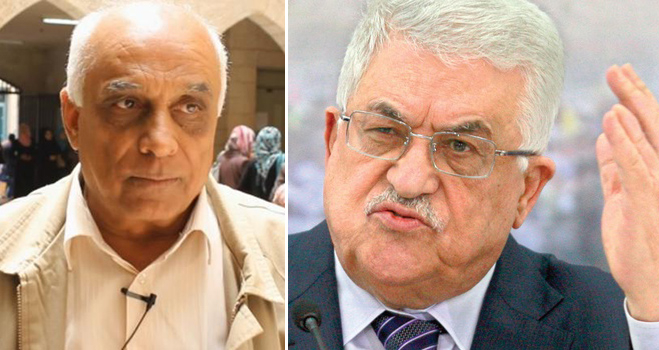
Meanwhile, Palestinian professor Abdel Sattar Qassem, who teaches political science at An-Najah University in the West Bank city of Nablus, is facing trial for “extending his tongue” against PA President Mahmoud Abbas and other senior PA officials. He is also charged with spreading “fake news” and “fomenting sectarian strife.” The decision to prosecute Qassem came following a TV interview where he strongly criticized Abbas and commanders of the PA security forces. Qassem has long been a vocal critic of the PA leadership and as a result he has been arrested on a number of occasions; shots have been fired at his home.
Professor Abdul Sattar Qassem (left) is facing trial for “extending his tongue” against Palestinian Authority President Mahmoud Abbas (right) and other senior PA officials.

These three cases are only the tip of an iceberg of oppression. It is very difficult to distinguish between Mahmoud Abbas’s government and the Arab and Islamic dictatorships, where human rights violations and assaults on public freedoms are the established norm. In his despotic behavior, Abbas has also shown himself to be rather akin to his clampdown-prone predecessor, Yasser Arafat.

Dr. Khalil Assaf, member of the Palestinian Public Freedoms Committee in the West Bank, accused the PA of systematic assaults on public freedoms and human rights.

He noted, for example, that refusing to issue or renew passports was one the measures taken by the PA to punish its opponents. He also accused the PA of “inventing” a law that authorizes its governors to order the detention without trial of any Palestinian. He pointed out that although the Palestinian High Court had ruled that this law was illegal, the PA governors continue to use it to detain Palestinians.

“Palestinians are being detained for days without being brought before a judge and houses are being searched without warrants,” Dr. Assaf complained. “Detainees are often prevented from contacting their families to inform them of their incarceration.” He also noted that Palestinians are sometimes denied driving licenses or jobs because of their political activities. Palestinians are also being detained or summoned for interrogation because of their posts on Facebook, he added.

Many Palestinians used to say that their dream is that one day they would have a free media and democracy like their neighbors in Israel. But thanks to the apathy of the international community, the Palestinians have come to learn that if and when they ever have their own state, its role model will not be Israel or any Western democracy, but the regimes of repression that control the Arab and Muslim world.

Khaled Abu Toameh, an award-winning journalist, is based in Jerusalem.
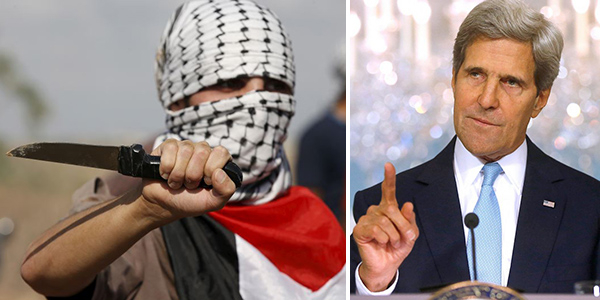
Palestinian and Western Leaders: Blood on Their Hands by Richard Kemp

  • Secretary Kerry’s comments will encourage the continuation of violence and lead to further deaths of both Israelis and Palestinians. His explanation for the widespread knifings, suicide bombings, shootings, arson, firebombings, vehicle attacks and lethal rock-throwing is either naive or mendacious; perhaps both.

  • Kerry asserts that the frustrations of Israeli settlement activity are responsible for the Palestinians’ murderous behaviour. The reality is that this new wave of killings is a continuation of the aggression against Jews that has been going on in the territory of Palestine for many decades — since long before 1948 and pre-dating the first Israeli settlements in the West Bank that Kerry falsely brands as illegal.
  • The violence is motivated by the same racist and sectarian zeal that drives the Islamic State and numerous Arab governments and jihadist groups that have sought to eradicate the presence of “infidels,” whether Jews, Christians or Yazidis, from land that they consider the exclusive preserve of Muslims.
  • Palestinian children are taught that Jews are descended from apes and pigs and must be killed before their “filthy feet” desecrate the holy places of Islam — in the words of President Abbas.
  • Secretary Kerry, the UN, and the EU should be discouraging further violence by condemnation and by meaningful threats of sanction against the Palestinian Authority leadership. The international community has encouraged Hamas’s illegal use of human shields and berated Israel for defending itself and for inflicting civilian casualties, which were in reality the unavoidable consequence of Hamas’s unprovoked aggression and its way of fighting from within private houses, schools, hospitals and mosques.
  • This encouragement of Hamas violence, especially the effectiveness of its human shield strategy, did not go unnoticed by other Islamist terrorist groups. That is also what Hizballah wants: the wholesale deaths of their own people as a trigger for unbearable international pressure against Israel.

U.S. Secretary of State John Kerry has shockingly justified the latest Palestinian murder campaign in Israel. His comments this week at Harvard University will encourage the continuation of violence and lead to further deaths of both Israelis and Palestinians.

Secretary Kerry’s remarks are particularly troubling because it is unimaginable that he would provide such justification other than for the killing of Israelis. His explanation for the widespread knifings, suicide bombings, shootings, arson, firebombings, vehicle attacks and lethal rock-throwing is either naive or mendacious; perhaps both. He asserts that the frustrations of Israeli settlement activity in the West Bank are responsible for the Palestinians’ murderous behaviour. Of course this is nonsense.

The reality is that this new wave of killings is a continuation of the aggression against Jews that has been going on in the territory of Palestine for many decades — since long before the re-establishment of the Jewish state in 1948 and pre-dating the first Israeli settlements in the West Bank that Secretary Kerry falsely brands as illegal. The violence is motivated by the same racist and sectarian zeal that drives the Islamic State and numerous Arab governments and jihadist groups that have sought to eradicate the presence of “infidels,” whether Jews, Christians or Yazidis, from land that they consider the exclusive preserve of Muslims.

For years, the Palestinian people have been betrayed by their weak, divided and jaundiced leadership who have consistently rejected every opportunity to make peace with their Israeli neighbours. Seeking to divert attention from their gross failures, the immediate trigger for the current murder campaign was the unfounded accusations of Palestinian Authority (PA) President Mahmud Abbas and other rabble-rousers that the Israeli government was planning to change the status of the Temple Mount in Jerusalem — a holy place for both Jews and Muslims.

But what made it possible to conjure up widespread violence so rapidly and to such devastating effect were the years of incitement to hatred against Jews by the Palestinian leadership, including President Abbas. In propaganda that would have impressed Nazi Germany’s Dr. Josef Goebbels himself, Palestinian children are indoctrinated with hatred for Jews and the Jewish State from the very earliest stages of their learning. In schoolbooks, on the TV and in the mosques, they are taught that the whole of the land of Israel, Gaza and the West Bank is Arab territory, stolen from them by the Jews. They are taught that Jews are descended from apes and pigs and must be knifed, blasted and stoned to death before their “filthy feet” are allowed to desecrate the holy places of Islam — in the words of President Abbas.

It is this type of sustained, government-sponsored incitement to hate, reducing the objects of their venom to subhuman status, which made it so easy for ordinary Germans to indulge readily in the orgy of violence that enabled the most efficient genocide in the history of the world.

Although the Palestinian leadership must bear the brunt of responsibility for their incitement to murder, Western leaders also have blood on their hands. Much of the material of hate that inspires Palestinian children is funded by the U.S., Europe and other Western as well as Arab nations.

Rather than seeking to appease the perpetrators by blaming the victims for their fate, Secretary Kerry should be discouraging further violence by outright condemnation and by meaningful threats of sanction against the Palestinian Authority leadership. Instead, he adopts a morally relativistic stance that has the darkest consequences. Understanding that, as so often in the past, the U.S. and the West sympathizes with their fascistic barbarity against a Western democratic state, the Palestinians will step up their violence.

This is the same moral failure that has encouraged three wars in Gaza since Israel withdrew in 2005. Western governments, international bodies such as the UN and the EU and human rights groups consistently refused to condemn salvo after salvo of Hamas rocket attacks against Israeli civilians. Only when Israel has been forced to strike back in self-defence have they bestirred themselves. Then, more often than not, it has only been to justify Hamas’s terrorist aggression, as Secretary Kerry has justified Palestinian violence this week. Emboldened first by a lack of international interest and then by international condemnation of Israel’s defensive response, Hamas and their fellow Gaza terrorists continued, repeatedly, to attack Israel. There is little doubt that this will happen again in the future.

In each of the Gaza wars, the international community encouraged Hamas’s illegal use of human shields that resulted in so much death and suffering in Gaza and Israel. At best with only token criticism of Hamas’s war crimes, international leaders vigorously berated Israel for defending itself and for inflicting civilian casualties which were in reality the unavoidable consequence of Hamas’s unprovoked aggression and its way of fighting from within private houses, schools, hospitals and mosques.

This encouragement of Hamas violence, especially the effectiveness of its human shield strategy, did not go unnoticed by other Islamist terrorist groups. Lebanese Hizballah, for example, has embedded 100,000 rockets — all pointed at Israel — among the towns and villages of southern Lebanon. Many houses have a kitchen, sitting room and rocket room. Should Israel need to defend itself against these missiles, which threaten their civilian population, many hundreds — perhaps thousands — of Lebanese civilians will inevitably be killed in the process. As with Hamas, that is what Hizballah wants: the wholesale deaths of their own people as a trigger for unbearable international pressure against Israel.

It is here that Secretary Kerry should be focusing his energies — on the removal of this threat, which is certain to materialize if international action is not taken. But of course, he will not. Because those missiles are under the control of Iran. Indeed, today Iran is intent on strengthening and reinforcing Hizballah’s offensive capability against Israel. And Secretary Kerry and President Obama have invested too much political capital in their nuclear deal with Iran. Itself catastrophic for the region and the world, the deal is nevertheless their proud legacy, and they cannot afford to upset the ayatollahs and risk them walking away.

Neither will the UN nor the EU lift a finger to prevent the inevitable future conflict and death in southern Lebanon or in Gaza. Like Secretary Kerry, they and the international human rights industry will continue to justify and encourage anti-Israel aggression, reserving their efforts for the repudiation of the Jewish State and perpetuating current and future waves of violence and death.

Colonel Richard Kemp spent most his 30-year career in the British Army commanding front-line troops in fighting terrorism and insurgency in hotspots including Iraq, the Balkans, South Asia and Northern Ireland. He was Commander of British Forces in Afghanistan in 2003. From 2002 – 2006 he heading the international terrorism team at the Joint Intelligence Committee of the British Prime Minister’s Office.

Palaces of inspiration: How architecture feeds the imagination of art.

Architect Daniel Libeskind is CNN Style’s first guest editor and has commissioned a series of features exploring the theme of “Architecture and Emotion,” that will be published throughout July. In this, his first commission, Daniel asked us to look at the common thread between architecture and the expressive arts.


(CNN)“Some, if not most of my moving aesthetic experiences have been in buildings,” claims the Turner Prize-winning British artist Grayson Perry, who believes these interactions with architecture played a key role in helping to define his creative direction.

In this regard, Perry is similar to many artists who draw inspiration from the built environment. So, what sorts of ideas do artists like to borrow from architecture, and how do concepts applied to buildings translate into fine art, music or sculpture?

Perry, who is best known for his decorative ceramics, feels that religious architecture in particular has profoundly influenced both his own work, and that of generations of artists before him. “For me the very template of how we look at art was laid down in such buildings,” he explains. “We make pilgrimages to special places and admire the special objects loaded with significance and emotion [within them].”

Sacred spaces

There is certainly evidence that the construction of religious buildings over the centuries helped artistic movements develop, both because of the money lavished on their construction and decoration, and the resulting visual spectacle they provided. The Gothic, Renaissance and Baroque buildings of Prague, for instance, are known to have inspired the elaborate compositions of Mozart and Beethoven, who both visited the city in the late eighteenth and early nineteenth centuries.

British Artist Grayson Perry's 'A House for Essex' is a conceptual holiday home and in the words of the artist a homage to the 'single mums in Dagenham, hairdressers in Colchester, and the landscape and history of Essex'.

The work of contemporary American composer Neil Rolnick, who is renowned as a pioneer of the use of computers in music, illustrates how musicians today also find inspiration in the work of great architects. Rolnick’s 2012 concerto Gardening at Gropius House draws on his encounters with the modernist architect and founder of the Bauhaus art school, Walter Gropius, for whom he worked as a gardener in the mid-1960s.

Describing how he translated the principles of modernism into a composition that layers melodies and rhythms produced by acoustic instruments and electronic equipment, Rolnick states: “Musically, this style meant the inclination to hear all sound as music, the inclusion of chaos and clangor, and the imposition of various kinds of abstract structural ideas on musical materials.”

He adds that the fundamental similarity between architecture and music is that “both depend on an underlying structure which is often invisible to the user or audience.” Despite the disparity between the tangibility of architecture and the ephemerality of music, Rolnick believes the integrity of this underlying structure is what determines whether either will appeal to the user or listener.

A sketch of the Gropius house, one of the seven Meisterhaeuser or Master Houses, of the Bauhaus.

EXPAND IMAGE

Sound and structure

For artist, Olafur Eliasson, it is in ideas pertaining to space rather than structure that he finds parallels between his work and architecture. “What interests me in general is the production of space — be it in an exhibition, an art installation, on a stamp, inside someone’s head, or in a building or bridge,” says the artist, known for creating experiential artworks that engage the viewer’s senses. “This is the potential I see in architecture, to create a space that is hospitable, generous, and gives the visitor a feeling of being welcome.”

In particular, he admires the late Icelandic architect Einar Thorsteinn, whose knowledge of geometrical and tensile structures formed the basis of regular collaborations between the two that began in 1996. “Einar tackled the spatial problems of the world with an individual approach that was not constrained by the pragmatic considerations of traditional architecture and rationality,” Eliasson claims.

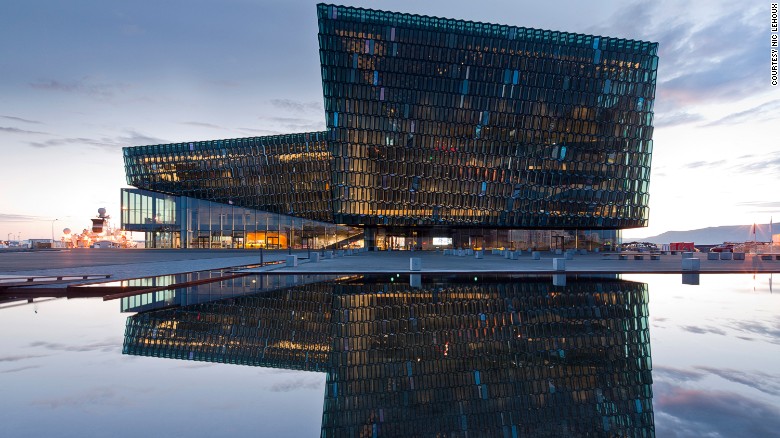
The first artwork they developed together was a geodesic dome containing a fountain illuminated by a strobe light (By means of a sudden intuitive realisation, 1996) and Thorsteinn’s influence is evident in numerous subsequent projects, including Eliasson’s three-dimensional geometric facade for the Harpa Reykjavik Concert Hall and Conference Centre (2011).

Harpa, a combo concert hall and convention center, in Reykjavik, Iceland.

Like other contemporary artists, including James Turrell, Anish Kapoor and Richard Serra, Eliasson’s work often sits within an architectural context, but can always be distinguished from architecture because it focuses on the experiential properties of space, light, shelter and warmth, rather than their practical applications.

“If a boundary has to be drawn between art and architecture, I believe it is physical functionality that divides the two disciplines,” claims British artist, Alex Chinneck. “As an artist, I see functionality as a cage to creative imagination, anchoring sculptural possibilities and freedom.”

Form vs function

Chinneck’s work takes the form of temporary public installations that subvert familiar elements of the built environment. Examples have included a house in London made from wax bricks that gradually melted and an illusory sculpture next to Covent Garden market which appeared to show the upper part of a building breaking free and hovering above the ground.

Although architecture provides a basis for his theatrical interventions, Chinneck endeavours to avoid the constraints imposed on architects by clients and briefs, which he feels stifle true creative potential. “I find that architects and designers are better versed in the balancing of aesthetics and function,” he adds, “whereas artists thrive with freedom, liberated from the need to address a brief.”

The "Sliding House" by artist Alex Chinneck, known for his playful experiments with our perception of architecture

Despite the fundamental functions that architecture must perform, the best examples continue to inspire artists across all genres with their masterful use of space, harmony and proportion. The next time you visit an amazing building, look beyond its practical purpose and think about how it makes you feel, because truly great architecture can stimulate our emotions as much as any Picasso painting or Mozart opera.

Pakistan: ISIS Plans Terrorist Campaign against Christians by Lawrence A. Franklin

The wave of anti-Christian attacks will allegedly include Pakistan’s Christian churches, schools, and hospitals. Few Pakistanis will shed a tear for people who do not, in their eyes, represent Pakistan’s Islamic values. The Pakistani government and military have warned the nation’s tiny Christian minority that Islamic terrorist groups plan to target Christian religious institutions in the near future. The wave of anti-Christian attacks will allegedly include Pakistan’s Christian churches, schools, and hospitals. The warning issued by Pakistan’s leading generals represents an extraordinary, positive development in the military’s relationship with minorities in general and with Christians in particular. Their warming relationship appears to be a calculated political move to complement the military leadership’s ongoing offensive against the terrorist havens in the northwestern corner of the country. Emissaries of the most powerful Pakistani generals and the Ministry of Interior have apparently personally warned Christian clerics that the assault will first be launched in the country’s northwest region of Khyber Paktunkhwa.[1] This region abuts the Pushtun-dominated provinces of Afghanistan where Pakistan’s Tehrik-e-Taliban is a potent force. According to the warnings, the planned attacks against Christian communities in Pakistan will be carried out by some splinter groups that formerly belonged to the Pakistani Taliban. According to sources in the area, these splinter groups have already forged an alliance with the more extremist and brutal Islamic State (ISIS) cells that have already entered Pakistan. The former Pakistani Taliban Commander, Hafiz Saeed Khan, is said to have pledged an oath of allegiance in January to Islamic State leader Abu Bakr al-Baghdadi.[2] Several other Pakistani Taliban groups have reportedly also agreed to join up. In addition, Ahmed Marwat, a.k.a. Farhad Marwat, commander of Pakistan’s Jundallah terrorist organization, specifically threatened in June that “the Jundallah will attack kafir Shi’ites, Ismailis and Christians.”[3] Marwat met with Islamic State representatives in November 2014. Later the same month, he took responsibility for attacking aid workers in Quetta, Pakistan, and labeled the volunteers “Yahood o Nasara”: “Jews and Christians.” The Jundallah group, reputedly the Islamic State’s most potent ally in Pakistan, claimed responsibility for the twin-suicide bombings against All Saints Church in Peshawar on September 22, 2014.[4] It also probably intends to initiate more anti-Christian atrocities. One Christian cleric explained that the anti-Christian strategy by Islamic terrorists might be a bitter response to the effectiveness of the Pakistani Army’s ongoing offensive — a campaign that targeted Islamist jihadists in their hideouts in the northwest. Another Christian cleric complimented Pakistan’s military leaders for the ongoing drive to subdue the Pakistani Taliban and several smaller jihadi groups in the far northwest, especially in North Waziristan. The Pakistani generals most responsible for the planning and execution of this anti-terrorist offensive include Army Chief of Staff General Raheel Sharif; Inter Services Intelligence (ISI) chief General Rizwan Akhtar, and the commander of Pakistan’s Army Rangers, General Bilal Akbar. Sources claim that these three generals have forged an aggressive battle plan with which to roll back extremist Muslim jihadists threatening Islamabad’s sovereign control over the country. This triad has apparently also purged the Pakistani Army officer corps of anyone suspected of sympathizing with Islamic terrorist factions. Shortly after assuming command of the Pakistani Army, General Sharif vowed that “eradicate the last sanctuary of Islamic militants in the tribal regions” of Pakistan’s northwest.[5] These tribal regions include the Federal Administered Tribal Areas, as well as North and South Waziristan. The campaign against terrorist havens in Pakistan’s northwest, launched on June 14, 2014, has already killed more than 3000 militants, according to Army headquarters.[6] In August 2014, Pakistani Air Force planes bombed what was said to be the last sanctuary of terrorists in North Waziristan, the thickly forested Shawal. Some observers speculate that it was the success of this offensive that elicited the attack by terrorists on the Public School Compound in Peshawar on December 16, 2014, which killed 132 boys and 9 members of the staff. Lending credence to this revenge-attack theory was a phone call from Taliban spokesman Mohammad Umar Khorasani to the local media in Peshawar. “We wanted them to feel our pain,” he said.[7] Some of the Pakistani Army soldiers who participated in the bombing offensive in the northwest apparently had children enrolled in the school. An office at the Public School Compound in Peshawar, Pakistan, after the December 16, 2014 terrorist attack that killed 132 boys and 9 members of the staff. (Image source: BBC video screenshot) The methodical nature of the terrorist operation at the school, and the heartless nature of that mass killing of children, may foreshadow future attacks on similar easy targets such as defenseless Christian neighborhoods. Members of Pakistan’s military who asked to remain anonymous said they expected the terrorist factions in Peshawar to stage mass atrocity spectaculars like the school massacre in the near future. Christian clerics have been warned not to venture far from their churches. One minister was told no longer to take his morning or evening walks. Other Christians have been warned not to agree to any outside meetings unless they know the party well. General Sharif and his allies in the military’s high command have been in large part responsible for shifting the nation’s security concerns away from India and to groups such as the Pakistani Taliban. As police guards have proven inadequate and unreliable, Christian groups are hoping that the military will protect them. There is, as well, another incentive for Islamic terrorists to attack Christians: Few Pakistanis will shed a tear for people who do not, in their eyes, represent Pakistan’s Islamic values. Dr. Lawrence A. Franklin was the Iran Desk Officer for Secretary of Defense Rumsfeld. He also served on active duty with the U.S. Army and as a Colonel in the Air Force Reserve, where he was a Military Attaché at the U.S. Embassy in Israel. [1] Khyber Paktunkhwa was formerly called the Northwest Territory. The new name reflects nationalist sentiment to “cleanse” Pakistani institutions reminiscent of colonial occupation by the United Kingdom. [2] Militant Leadership Monitor, July 2015, Special Issue; Animesh Roul, Executive Director of Research at the Society for the Study of Peace and Conflict, New Delhi. [3] Pakistan’s Express Tribune, 28 November 2014. [4] Dawn, 23 September 2015, Karachi, Pakistan. [5] General Sharif Raheel’s vow reported on 17 December 2014, BBC. [6] “For Pakistan” website, 21 August 2015. [7] The school is a short walk to a Peshawar military installation where some of the soldiers involved in the ongoing offensive against the militants are stationed. Yahoo News India, 16 December 2015.

Translate »
Skip to toolbar