
Daily Archives: June 19, 2017

Palestinians: We Are the New Nazis by Bassam Tawil

  • These are people behaving in a way that does not deserve being rewarded with anything, let alone a state. They far more resemble all tyrannical thugs throughout history who spend their lives telling other people how to live, and using violence, or threats of violence, to coerce anyone who does not agree. Sadly, we already have too much of that kind of muscling in our Arab and Muslim world, as Egypt’s forward-looking President, Abdel Fattah el-Sisi, as well as many others, regularly point out.

  • We have now reached the same stage as Germany’s Nazis — the same thing, ironically, we falsely accuse the Jews of being — where the appearance of a Jew on a Palestinian television show is considered as an act of “treason” and a “crime.” In reality, it is we who are the New Nazis.

A Palestinian TV talk show host is facing strong condemnations and threats for hosting an Israeli Jewish singer who is extremely popular among Palestinian youths.

The condemnations expose the ugly face of the anti-Israel Boycott, Divestment and Sanctions Movement (BDS), whose followers are vehemently opposed to any form of “normalization” between Palestinians and Israelis.

The BDS activists are demanding that those who brought the singer, Zvi Yehezkel, to the TV show in Ramallah be punished. The activists do not even seem to care that the singer supports peace between Israel and the Palestinians.

They are more bothered by the fact that a Palestinian TV station in Ramallah dared to invite a Jew to an interview. The BDS activists are also not ashamed to expose their anti-Semitism by expressing their outrage over the fact that Yehezkel is an observant Jew wearing a skullcap.

Judging from the angry reactions to the Yehezkel interview, one can only deduce that members of the BDS movement are a deeply antisemitic racists who hate Jews just because of their faith and appearance.

Dozens of Palestinians took to social media to hurl abuse at the Palestinian TV show and its presenters, calling them “traitors,” “spies,” “dogs” and “pigs.”

Palestinian artist Faten Kabha wrote that she decided to cancel an interview with the TV show “after it hosted a Jewish Zionist in the heart of Ramallah.”

The Palestinian Journalists’ Syndicate, a body dominated by Fatah activists in the West Bank, and several political groups also joined the bandwagon of denunciations over the Jewish singer’s appearance on a Palestinian TV show; and the “anti-normalization” activists are also targeting the five-star Grand Park Hotel in Ramallah for hosting the Jewish singer.

One of the leaders of the “anti-normalization” campaign, Fadi Arouri, demanded that the hotel distance itself from the TV show, which was recorded in one of its halls, or face being labeled advocates of “normalization” with Israel. It would seem he has more to worry about by being labeled a racist.

Arouri, on his Facebook page, lashed out at the Palestinian Broadcasting Corporation and the hotel for bringing the Jewish singer to Ramallah. He threatened to add the hotel to the list of advocates of “normalization” with Israel, saying: “You will be fought against the same way we fight the occupation and its institutions.”

Arouri and his friends are also angry with the TV show for using Hebrew names of Israeli cities during the interview with Yehezkel, who lives in Ashkelon, and argued that the presenter should have used the Arabic name of Majdal instead of Ashkelon.

The Jewish singer is fortunate that Arouri and his friends did not know about his presence in Ramallah in real time, otherwise they would have attacked the TV studio and forced him to flee Ramallah, as these BDS activists have been doing for the past few years: violently breaking up meetings between Israelis and Palestinians in the West Bank and east Jerusalem, and intimidating the participants like jackbooted thugs. These are people behaving in a way that does not deserve being rewarded with anything, let alone a state. They far more resemble all tyrannical thugs throughout history who spend their lives telling other people how to live, and using violence, or threats of violence, to coerce anyone who does not agree. Sadly, there already seems to be too much of that kind of muscling in our Arab and Muslim world, as Egypt’s forward-looking President Abdel Fattah el-Sisi, as well as many others, regularly point out.

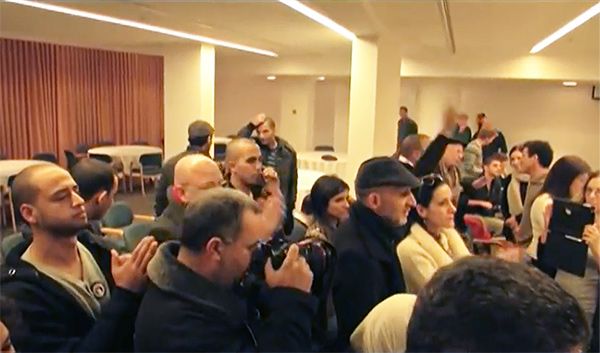
Palestinian “anti-normalization” activists disrupt an unofficial Israeli-Palestinian peace conference last year, in Jerusalem’s Ambassador Hotel.

The public outcry over a Jewish singer’s appearance on a Palestinian TV talk show is yet another reminder of how we Palestinians have made ourselves intolerable to Israelis, even to those who are sympathetic to our cause and believe in peace and coexistence.

The campaign on social media against the singer and the TV show also provides proof of increasingly racist sentiments among our people. We automatically dismiss anyone wearing a kippa because we assume he is a “settler” who hates Arabs and Muslims. It is embarrassing to read many of the comments posted by Palestinian activists concerning the singer’s religion and kippa.

With such attitudes, how can we ever make peace with Israel? If hosting a Jewish singer on a Palestinian TV talk show has drawn such fierce opposition and denunciations, what will happen the day any Palestinian leader signs a peace treaty with our Jewish neighbors?

How many times have Palestinians appeared in the Israeli media during the past few decades? Has anyone ever heard of such protests by Israeli Jews? Israeli media outlets have even been conducting interviews with some of Israel’s worst enemies, including Palestinians who mercilessly killed innocent Jews. Still, we never saw disgusting and racist reactions like the ones posted on social media after the interview with the Jewish singer.

Over the years, we have taught our people to hate not only Israel, but Jews as well — as is already cemented in the Hamas charter. We have done this through incitement in mosques, media outlets and public rhetoric. We have now reached the same stage as Germany’s Nazis — the same thing, ironically, we falsely accuse the Jews of being — where our people consider the appearance of a Jew on a Palestinian TV show an act of “treason” and a “crime.” In reality, it is we who are the New Nazis.

The case of the Jewish singer shows that the BDS and “anti-normalization” folks are nothing but a group of racist brown-shirts working to destroy any chance of peace and coexistence between Palestinians and Israel. Their hysterical reaction to the TV interview with Yehezkel proves that our people are continuing to march backward, toward more extremism, racism and Nazism.

Bassam Tawil is a scholar based in the Middle East.


Palestinians: University Students Vote For Terror by Khaled Abu Toameh

  • Palestinian political analysts said that the Hamas victory is an indication of what would happen if general elections were held these days in the West Bank.

  • The 3,481 students who voted in favor of the Hamas-affiliated list want to see the destruction of Israel.
  • Both Hamas and the PFLP are strongly opposed to any peace process with Israel. They continue to call for terror attacks against Israelis. The results of the election mean that most of the students at Bir Zeit University in the West Bank, not Gaza, support groups that have chosen terrorism over peace.
  • The Hamas victory at Bir Zeit University also shows that it does not matter how much money you pour on Fatah’s campus supporter; a majority of students would still prefer to vote for terror groups that do not believe in Israel’s right to exist.
  • The main charge against Fatah is that it has failed to reform and pave the way for the emergence of new and younger leaders.
  • “Fatah needs an internal shake-up before it faces more defeats.” –Sufyan Abu Zayda, a senior Fatah official from the Gaza Strip.
  • Hamas leaders also called for holding long overdue presidential and parliamentary elections in the Palestinian territories. They said they had no doubt that their movement would easily defeat Fatah.
  • Under such circumstances, it is not a good idea to promote the idea of free and democratic elections in the Palestinian territories. Worse, the talk about a renewed peace process and a two-state solution has become a tasteless joke.

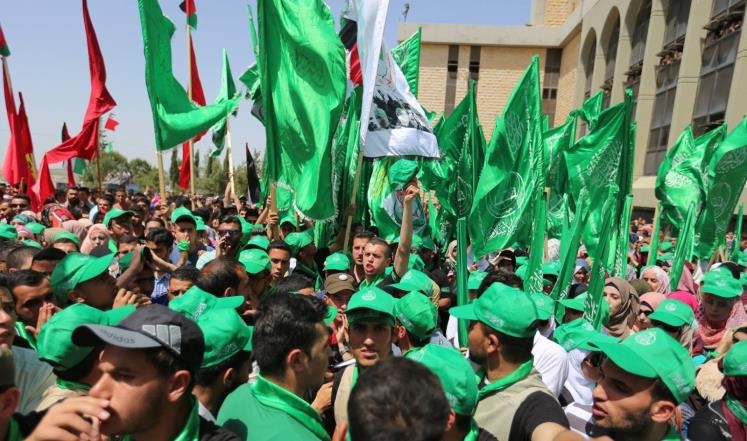
Students at Bir Zeit in the West Bank celebrating Hamas victory. (Image source: Al Jazeera)

Palestinian Authority President Mahmoud Abbas’s Fatah faction suffered yet another humiliating defeat at the Bir Zeit University student council elections, held on April 27. Last year, for the first time since 2007, the Hamas-affiliated student list on campus also won the vote.

The results of this year’s election at one of the Palestinians’ most important universities reflects the growing discontent with Abbas’s Fatah faction among Palestinians in the West Bank. Palestinian political analysts said that the Hamas victory is an indication of what would happen if general elections were held these days in the West Bank.

The Wafaa list, which belongs to Hamas, won 25 of the student council seats, while Fatah’s Martyrs Yasser Arafat list got 21 seats. A list belonging to the terror group Popular Front for the Liberation of Palestine (PFLP) won five seats.

Both Hamas and the PFLP are strongly opposed to any peace process with Israel. They continue to call for terror attacks against Israelis. The results of the election mean that most of the students at Bir Zeit University in the West Bank, not Gaza, support groups that have chosen terrorism over peace.

Bir Zeit University, which has 12,000 students, is located only a few miles from Ramallah, which houses the headquarters of the Palestinian Authority and Fatah leadership. As such, the Hamas victory carries symbolic significance because it shows that even in Abbas’s own backyard, he Islamist movement remains as strong and popular as ever.

What Is also significant is that the Hamas victory came despite a massive crackdown by Abbas’s security forces on Hamas supporters in the West Bank. The crackdown included university students affiliated with the Islamist movement. Not surprisingly, this crackdown seems to have backfired, driving more university students into the waiting open arms of Abbas’s political enemies.

The Hamas victory at Bir Zeit University also shows that it does not matter how much money you pour on Fatah supporters on campus; a majority of students would still prefer to vote for terror groups that do not believe in Israel’s right to exist.

The results of the election should be seen more as a vote of no-confidence in Fatah and Abbas’s policies than a Hamas win.

Palestinian analysts said that the results reflected Palestinians’ distrust of Fatah, a faction that has long been suffering from internecine fighting and splits. The main charge against Fatah is that it has failed to reform and pave the way for the emergence of new and younger leaders.

Sufyan Abu Zayda, a senior Fatah official from the Gaza Strip, commented on the results of the Bir Zeit University election by saying, “Fatah needs an internal shake-up before it faces more defeats.” He noted that those who were defeated were not the Fatah-affiliated students, but their leaders.

In recent years, the Fatah leadership in the West Bank and Gaza Strip has been torn apart by internal strife. In the Gaza Strip, rival Fatah activists have been beating and shooting at each other. In the West Bank, Abbas has been busy getting rid of his critics in Fatah. The latest victim of Abbas’s measures is Gen. Akram Rajoub, the Palestinian Authority Governor of the largest West Bank city, Nablus. Last week, Abbas surprisingly fired Rajoub, who is also a senior Fatah official.

Rajoub’s dismissal came days after he walked out of a Passover ceremony organized by the tiny Christian Samaritan community near Nablus. Rajoub and scores of Palestinian dignitaries walked out of the event after discovering that some leaders of the Jewish community in the West Bank had also been invited. Some Palestinians said that Abbas decided to fire the governor because his action seriously embarrassed the Palestinian Authority leadership in the eyes of the international community and threatened to damage relations between the Samaritan community and the Palestinians.

Other Palestinians, however, surmised that Abbas’s decision was related to criticism the governor had made against top Fatah officials.

Whatever the reason, many Palestinians agreed that the dismissal of the powerful and popular governor was a sign of increased tensions among the top brass of the Palestinian Authority and Fatah leaderships.

It is precisely because of this internal bickering that many Palestinians have lost confidence in Abbas and Fatah.

The results of the Bir Zeit University elections are also an indication of the Palestinian students’ rejection of Abbas’s general policies, especially regarding Israel. This is a vote of no-confidence in the Oslo Accords with Israel, the “peace process” and ongoing security coordination between the Palestinian Authority and Israel.

The 3,481 students who voted in favor of the Hamas-affiliated list want to see the destruction of Israel. Similarly, the he 668 students who voted for the PFLP-affiliated list support terrorism and would also like to see the destruction of Israel. These numbers reflect the general sentiments that have long been prevalent among many Palestinians, including students and professors on various campuses in the West Bank and Gaza Strip.

“How can Fatah win any election when it is divided and its leaders are openly saying that they listen to Zionist songs?” remarked Palestinian political analyst Hisham Sakallah. He pointed out that while Hamas supporters on campus ran in the election on a ticket that promoted “armed resistance” against Israel, Fatah leaders were continuing to conduct security coordination with the Israelis.

Hamas correctly sees its victory in the Bir Zeit University election as a sign of growing Palestinian support for its “armed resistance” and the “Al-Quds Intifada” against Israel.

Hamas leaders were quick to celebrate the victory of their list. They stressed that the vote was a severe blow to Abbas, Fatah and all those who believe in any “peace process” with Israel. Buoyed by the victory, the Hamas leaders also called for holding long overdue presidential and parliamentary elections in the Palestinian territories. They said they had no doubt that their movement would easily defeat Fatah. “The results of the election (at Bir Zeit University) are a victory for the path of resistance,” declared Hamas leader Khaled Mashaal.

The Hamas victory provides further evidence of the increased radicalization in Palestinian society. This is the direct result of the ongoing campaign of anti-Israel incitement that continues to be waged not only by Hamas, but the Palestinian Authority and Fatah too, and that is funded in large part by Europe.

Under such circumstances, it is not a good idea to promote the idea of free and democratic elections in the Palestinian territories. Worse, the talk about a renewed peace process and a two-state solution has become a distasteful joke.

Khaled Abu Toameh, an award-winning journalist, is based in Jerusalem.
Palestinians: Turning Refugee Camps into Weapons Warehouses

  • Most of the Palestinian camps in Lebanon and Syria have long served as large weapons warehouses controlled by various militias belonging to different groups. This has been happening while the United Nations Relief and Works Agency for Palestine Refugees in the Near East (UNRWA), which is formally in charge of the refugee camps, continues to look the other way.


  • The 120,000 Palestinians living in Ain al-Hilweh are “unfortunate” because they are not being targeted by Israel. Otherwise, there would have been an international outcry and the UN Security Council would have held an emergency session to condemn Israel and call for an immediate cessation of hostilities. Instead, Ain al-Hilweh may soon fall into the hands of Al-Qaeda and Islamic State terrorists.

  • The Syrian Army has also been dropping barrel bombs on the camp almost on a weekly basis. But because Israel cannot be blamed, Palestinians killing Palestinians is not something that the international media and community are interested in.

  • Instead of admitting their responsibility for turning the camps into military bases, Palestinian leaders often prefer to blame others, preferably Israel, for the plight of their people.

Palestinians are once again paying a heavy price for allowing terror groups and armed gangs to operate freely inside their communities. But this is not happening in a refugee camp in the West Bank or the Gaza Strip. Rather, it is taking place in Lebanon, one of three Arab countries that host hundreds of thousands of Palestinians.

This explains why the international media and human rights organizations have shown little interest in what is happening inside the largest Palestinian refugee camp in Lebanon, Ain al-Hilweh.

For the past two weeks, dozens of Palestinian families from Ain al-Hilweh have fled their homes after fierce clashes that erupted between Fatah militiamen and terrorists belonging to a radical Islamist gang affiliated with Al-Qaeda and Islamic State.

The UN Security Council has clearly not heard of the fighting in Ain al-Hilweh. That is why it has not even issued a statement expressing “concern” over the plight of the Palestinians in the camp.

The international media, for its part, has thus far shown little interest in the story. Why? The answer, as usual, is simple: No Israeli involvement.

The 120,000 Palestinians living in Ain al-Hilweh are “unfortunate” because they are not being targeted by Israel. Otherwise, there would have been an international outcry and the UN Security Council would have held an emergency session to condemn Israel and call for an immediate cessation of hostilities.

But, because Israel cannot be blamed, Palestinians killing Palestinians is not something that the international media and community are interested in.

The clashes in Ain al-Hilweh have so far resulted in the killing of four Fatah militiamen. At least 35 people were wounded in the fighting, which has been described as the worst in years. According to eyewitnesses, the rival parties have used various types of weapons to attack each other, including rocket-propelled grenades.

The four dead men have been identified as Fadi Khdeir, Ala Othman, Rabi Mashour and Hussein al-Saleh.

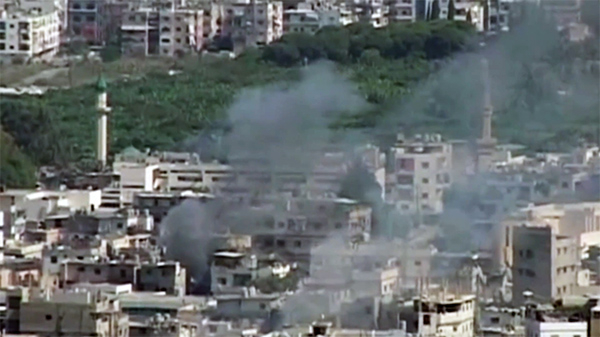
Smoke from explosions rises from Ain al-Hilweh refugee camp in Lebanon, Aug. 25, 2015. (Image source: Arab Tomorrow video screenshot)

The latest round of fighting in Ain al-Hilweh began after Islamist terrorists tried unsuccessfully to assassinate Abu Ashraf al-Armoushi, a senior Fatah security commander. Earlier, the terrorists managed to kill another top Fatah official, Talal al-Urduni.

Palestinian refugee camps in Lebanon have always been considered “extraterritorial” zones, managed exclusively by various armed groups. The Lebanese police and army have no role in maintaining law and order inside the camps. As in most similar situations, where armed clashes have erupted inside refugee camps, all that is left for the Lebanese Army to do is monitor the situation from a distance.

In 2007, however, the Lebanese Army was forced to intervene to stop armed clashes at another refugee camp, Nahr al-Bared. Dozens of people, many of them soldiers, were killed in the fighting, which also resulted in the near destruction of the camp. Nearly 30,000 Palestinians were displaced, and Nahr al-Bared remains a closed military zone.

Residents of Ain al-Hilweh are worried that they will meet the same fate as Yarmouk refugee camp in Syria. Yarmouk was once home to some 200,000 Palestinians. Today, the number of the residents has dropped to 12,000. Hundreds of Yarmouk residents have been killed and injured in fierce fighting between rival militias during the past four years. The Syrian Army has also been dropping barrel bombs on the camp almost on a weekly basis.

Yarmouk, Nahr al-Bared and Ain al-Hilweh continue to pay an extremely heavy price for agreeing to turn their camps into military bases. Most of the Palestinian camps in Lebanon and Syria have long served as large weapons warehouses controlled by various militias belonging to different groups. This has been happening while the United Nations Relief and Works Agency for Palestine Refugees in the Near East (UNRWA), which is formally in charge of the refugee camps, continues to look the other way.

As the fighting in Ain al-Hilweh shows, the Palestinians have once again fallen victim to what many of them describe as the “chaos of weapons.” It is this type of anarchy that allowed Hamas to expel the Palestinian Authority from the Gaza Strip in 2007. Refugee camps in the West Bank and Gaza Strip are also full of weapons and gunmen belonging to various groups, including Fatah and Hamas.

Maher al-Shawish, a Palestinian writer and political analyst from Lebanon, says that Ain al-Hilweh is now facing a serious humanitarian crisis due to the ongoing fighting. “If you see the destruction inside the camp, you will realize that it is facing a real catastrophe that needs to be stopped immediately,” al-Shawish said. “The clashes are disgraceful for the Palestinian cause.”

But instead of admitting their responsibility for turning the camps into military bases, Palestinian leaders often prefer to blame others, preferably Israel, for the plight of their people.

Ain al-Hilweh may soon fall into the hands of Al-Qaeda and Islamic State terrorists. Yet instead of facing this threat and calling on the international community to assist in foiling the terrorists’ plan, Gen. Subhi Abu Arab, a top Fatah security commander in Lebanon, chose to hold Israel responsible. Needless to say, Israel has nothing to do with the latest round of fighting in Ain al-Hilweh or the “chaos of weapons” inside Palestinian refugee camps.

Still, Palestinian officials such as Gen. Abu Arab never miss an opportunity to lay the blame at Israel’s door. They also continue to lie to their people by claiming that Israel is behind Islamic State. Referring to the clashes in Ain al-Hilweh, Gen. Abu Arab had no problem explaining that, “This is a Zionist scheme to eliminate the right of return, displace the Palestinians and stir trouble inside the camp by using a fifth column.”

As long as Palestinian and Arab leaders continue to believe conspiracy theories and refuse to wake up to the reality of the dangerous situation inside the refugee camps, the Palestinians of Ain al-Hilweh, like those of Yarmouk, sadly will face a bleak future.

Palestinians: The Secret West Bank by Bassam Tawil

  • As Abbas and his advisors prepare for the May 3 meeting with Trump, thousands of Palestinians gathered in Ramallah to call on Arab armies to “liberate Palestine, from the (Jordan) river to the (Mediterranean) sea.” The Palestinians also called for replacing Israel with an Islamic Caliphate.

  • It is possible that deep inside, Abbas and many of his top aides identify with the goals of Hizb ut Tahrir, namely the elimination of Israel. Abbas also wishes to use these Islamic extremists to depict himself as the “good guy” versus the “bad guys.” This is a ploy intended to dupe Westerners into giving him more funds “out of fear that the Islamists may take over.”
  • Abbas’s claim that he seeks a just and comprehensive peace with Israel is refuted by fact after fact on the ground. His sweet-talk about peace and the two-state solution will have far less impact on Palestinians than the voices of Hizb ut Tahrir and its sister groups, which strive to “liberate Palestine, from the river to the sea.”

Westerners often refer to Ramallah as a modern and liberal city dominated by Palestinian leader Mahmoud Abbas’s Fatah faction. The city boasts fancy restaurants and bars where alcohol is served freely to men and women in Western dress, who sit together to eat and to smoke water pipes (nargilas).

But the scenes on the streets of Ramallah, headquarters of Abbas’s Palestinian Authority (PA) last week broadcast a rather different message — one that calls for the elimination of Israel. The message came on the eve of Abbas’s visit to the White House for his first meeting with US President Donald Trump.

According to PA officials, Abbas is scheduled to affirm during the meeting with Trump his commitment to the two-state solution and a “comprehensive and just peace” with Israel.

As Abbas and his advisors prepare for the May 3 meeting with Trump, however, thousands of Palestinians gathered in Ramallah to call on Arab armies to “liberate Palestine, from the (Jordan) river to the (Mediterranean) sea.” The Palestinians also called for replacing Israel with an Islamic Caliphate.

The call for the elimination of Israel was made in the center of Ramallah, only a few hundred meters away from Abbas’s office. It came during a rally organized by Hizb ut Tahrir (Party of Liberation), a radical pan-Islamic political organization whose goal is the re-establishment of the Islamic Caliphate, or Islamic state. Like the terrorist group ISIS, Hizb ut Tahrir seeks to establish a state to enforce Islamic sharia law and carrying the da’wah (preaching) of Islam to the rest of the world.

The rally was organized to mark the 96th anniversary of the abolition of the Islamic Caliphate in 1924. It was held with the permission of the Palestinian Authority leadership, even though Hizb ut Tahrir is vehemently opposed both to Abbas’s policies and Israel’s right to exist, which it rejects. PA officials claim that despite its radical ideology, Hizb ut Tahrir does not pose a threat to stability in the region, because, unlike Hamas, its influence is limited and it does not resort to violence.

One after the other, leaders of Hizb ut Tahrir stood up in Ramallah this week to proclaim the need to “liberate all Palestine” and to restore the Islamic Caliphate. Dr. Maher Ja’bari, a Hizb ut Tahrir leader, said:

“The Islamic Caliphate will be restored only when Palestine is fully liberated. Palestine was occupied because of the collapse of the Islamic Caliphate. The issue of the caliphate has united the [Islamic] nation and it is the basic case for the liberation of Palestine and the implementation of Sharia for all Muslims under one [Muslim] ruler.”

Once the Muslim extremists come to power, Abbas and most of his officials would be the first to be beheaded or hanged in public squares for “selling out to the Jews.” Still, Abbas’s leadership did not see a need to prevent the Hizb ut Tahrir supporters from holding their rally in Ramallah to voice their extremist views, which also included an appeal for the “mobilization of Arab and Islamic armies to liberate Palestine and the Aqsa Mosque.”

Thousands of supporters of Hizb ut Tahrir, a radical pan-Islamic political organization, participate in a rally in Ramallah, on April 22, 2017. (Image source: Hizb ut Tahrir video screenshot)

Many of the extremist groups hoping to take over the West Bank despise Abbas and his PA leadership, who for them are arch-infidels. A brief statement, recently issued, again, by Hizb ut Tahrir concerning the transfer of ownership of land in Hebron to a Russian church, is telling:

“For more than a month, the Palestinian Authority and its most brutal criminals are practicing repression, arrests and intimidation, lies and misinformation in order to close the chapter of the land of the companion Tamim bin Aws Ad-Dari; the PA gave away 72 dunams of land in the heart of Hebron to the hateful and criminal Russians.”

Referring to the PA’s crackdown on supporters of Hizb ut Tahrir and similar groups that have also been protesting the transfer of the land to Russians, the statement added:

“The PA commits one evil crime after another, with no shame or bashfulness; from surrendering of endowment land to the arrest of the sincere people of the country to the spreading of lies and fabrications – all to reward the crimes of the Russians against the Ummah in Palestine, ignoring the rules of Islam. The PA gives no weight to the sanctities of Islam.”

In addition to the rally, Hizb ut Tahrir and similar groups have also been organizing a series of lectures and seminars throughout the PA-controlled territories in a bid to rally supporters behind their plan to “liberate all Palestine” and establish an Islamic state that governs according to sharia.

The annual Hizb ut Tahrir rally, which draws thousands of Palestinians, is yet another reminder of the growing influence of radical Islamic groups among Palestinians. In many ways, it is hard to tell the difference between Hamas, ISIS, Islamic Jihad and Hizb ut Tahrir. They all share the same goal: the elimination of Israel and the establishment of an Islamic regime where non-Muslims (dhmmis) would live as minorities and pay jizya, the tax levied by Islamic states on non-Muslims residing in Muslim countries.

Why, then, do Abbas and his PA allow these extremists to send their poisonous messages towards Israel? Some Palestinians argue that fear is what drives them to refrain from stopping Hizb ut Tahrir from issuing calls for the annihilation of Israel. Others claim that Abbas already has huge problems with Hamas and does not want to add to his list of enemies another radical Islamic group, which, they explain, does not engage in violence and terrorism as does Hamas. It is also possible that deep inside, Abbas and many of his top aides identify with the goals of Hizb ut Tahrir, namely the elimination of Israel. Abbas also wishes to use these Islamic extremists to depict himself as the “good guy” versus the “bad guys.” This is a ploy intended to dupe Westerners into giving him more funds “out of fear that the Islamists may take over.”

This stance may work for Abbas. However, Israel, and secular Palestinians who are not eager to live under an Iranian-style or Saudi-style Islamic regime, are the big losers here.

Meanwhile, such rallies in the center of Ramallah will only help raise another generation of Palestinians on the glorification of jihad and will further incite them against Israel.

Abbas’s claim that he seeks a just and comprehensive peace with Israel is refuted by fact after fact on the ground. His sweet-talk about peace and the two-state solution will have far less impact on Palestinians than the voices of Hizb ut Tahrir and its sister groups, which strive to “liberate Palestine, from the river to the sea.” One wonders on whose behalf Abbas is speaking when he talks about coexistence with Israel. Indeed, one wonders if he is even speaking on behalf of himself, with the center of Ramallah the stage for Hizb ut Tahrir and its jihadi friends?

Bassam Tawil, an Arab Muslim, is based in the Middle East.

Palestinians: The Right Time to Take Big Steps? by Bassam Tawil

  • Despite the “official” surveys taken among Palestinians, which show support for Hamas, the residents of the West Bank are terrified that Hamas will gain control and destroy our lives and property, the way they did in the Gaza Strip.

  • The BDS organizations are trying to boycott products made in the West Bank, which only throws masses of Palestinians out of good jobs in an effort to force Israel into a hasty withdrawal that has no chance of taking place. The Israelis and everyone else remember all too well that the last Israeli withdrawals — from southern Lebanon and the Gaza Strip — led to the terrorist takeover of the vacuums created.

  • Ikrima Sabri, the former Mufti of Jerusalem, often said that Palestinians were better off with the Jews in charge of Al-Aqsa mosque and Jerusalem, because in the future they could be removed and killed off, but if the Crusaders returned to Jerusalem — such as an international commission headed by the French — it would be harder to get rid of them.

During a visit to Berlin, German Chancellor Angela Merkel told Israel’s Prime Minister Benyamin Netanyahu that now is not time to move forward with the “two-state solution” and the establishment of a Palestinian state.

Merkel, evidently seeing Israel as a dam protecting Europe from Islamist extremists, told Netanyahu that while the Germans recognized the terrorist threat faced by Israel, and that a peace process had to be advanced based on two states for two peoples, now was not the right time to take big steps.

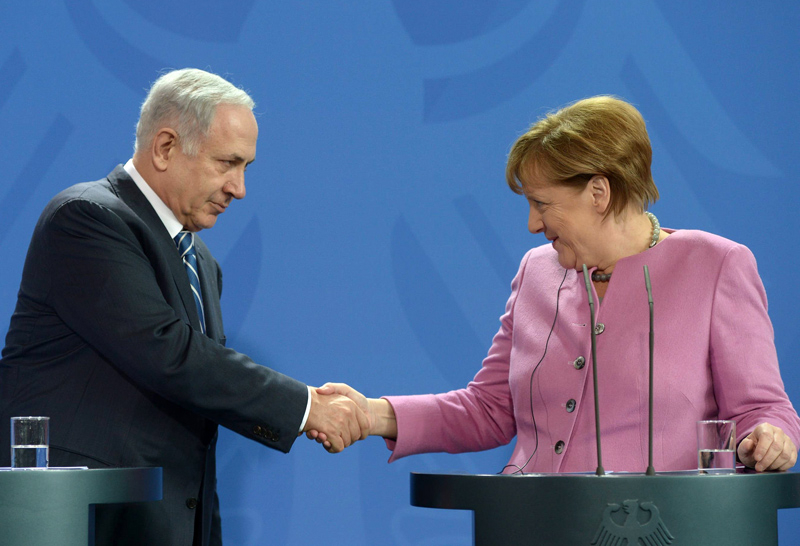
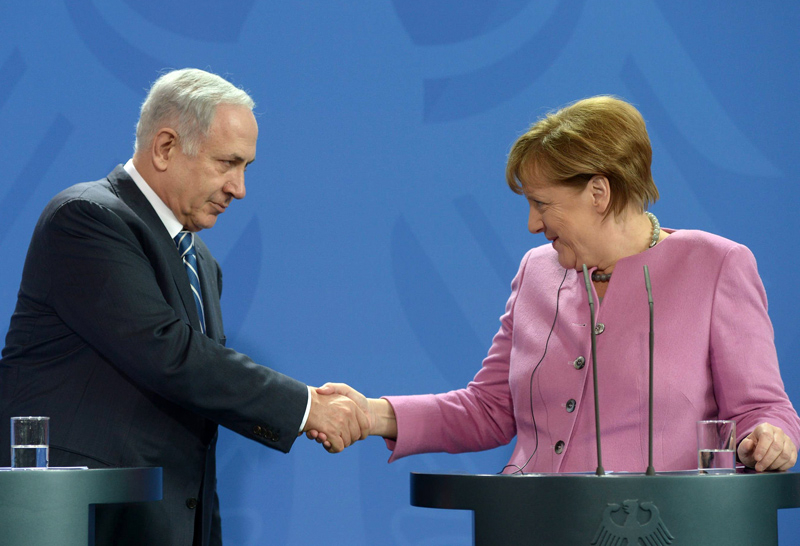
Agreed: It’s not a good time to establish a Palestinian state. Pictured: Israeli Prime Minister Benjamin Netanyahu and German Chancellor Angela Merkel address a press conference in Berlin, Germany, on February 16, 2016. (Image source: Israel Government Press Office)

The Palestinians living in the Gaza Strip are well aware that they are hostages of the terrorist organizations, in particular Hamas. Jibril Rajoub, a senior official in the Palestinian Authority (PA), told Al-Jazeera TV the same thing just last week.

The Palestinians in the West Bank, regardless of public declarations, also secretly support security collaboration with Israel, which protects us from radical Islamist terrorism. Therefore, despite the “official” surveys taken among Palestinians, which show support for Hamas, the residents of the West Bank are terrified that Hamas will gain control and destroy our lives and property the way they did in the Gaza Strip. We do want a Palestinian state, but one that will preserve the lifestyle and accomplishments we have built over the years — not a state that will have them fall to the horrors of Hamas and ISIS.

In light of the quiet, passive public support for the regime of Mahmoud Abbas, Hamas is inciting Palestinians against it. Hamas, in an attempt to overthrow the Palestinian Authority, is portraying Abbas’s security forces as traitors who transmit information to Israel.

Like Germany — and unlike Sweden and France — Britain has recently instituted a more balanced policy. The UK has begun to fight the anti-Israel BDS (Boycott, Divestment and Sanctions) organizations. Matthew Hancock, Britain’s Minister for the Cabinet Office, who coordinates activities between various government ministries, is advancing protocols to prevent the ongoing boycotts by the British establishment.

These BDS organizations are trying to boycott products made in the West Bank, but the boycott only throws masses of Palestinians out of good jobs and great benefits in an effort to force Israel into a hasty withdrawal that has no chance of taking place. The Israelis and everyone else remember all too well that the last Israeli withdrawals — from southern Lebanon and the Gaza Strip — were nothing more than case-studies for the terrorist takeover of the vacuums created, exactly the same way as the U.S. withdrawal from Iraq made room for the Islamic State (ISIS).

As Palestinians we know that the BDS may or may not harm Israel, but it does untold damage to the Palestinians who support their families by working in the settlement factories and would otherwise be unemployed and then, as a scarcity of jobs will have been created, hired by various terrorists. When the SodaStream factory moved out of the West Bank, 500 Palestinians lost their well-paid jobs.

In view of the current U.S. helplessness in dealing with the Russians, Iranians and Syrians, the Obama administration has now chosen to bare its fangs at Israel. Despite what are apparently his predictable personal objections, U.S. President Barack Obama is expected to sign into law the Trade Facilitation and Trade Enforcement Act, which includes anti-BDS provisions. It introduces new policy language by including all “Israeli-controlled territories” as part of Israel. Meanwhile, the American customs authority is still continuing to enforce a 20-year-old law, marking products made in the West Bank and hurting Palestinians. Labeling products hurts the Palestinians, who then are driven look for work in the eager arms of the terrorist organizations radicalizing the region.

The French, as usual, slither and shift. A number of months ago, they tried to build up steam for an international commission of inquiry into the Al-Aqsa mosque. Both the Israelis and the Palestinians objected.

Ikrima Sabri, the former Mufti of Jerusalem, often said that Palestinians were better off with the Jews in charge of Al-Aqsa mosque and Jerusalem, because in the future they could be removed and killed off, but if the Crusaders returned to Jerusalem through the back door — such as an international commission headed by the French — it would be harder to get rid of them.

The French, fearing for their lives at the hands of their own local Islamist enclaves, are in dire straits and doggedly try one maneuver after another to appease them. In desperation, they have proposed peace negotiations for the Palestinians and Israel “with international mediation.” They even brazenly suggested that if the negotiations failed, they would recognize the Palestinian state. The outcome is written on the wall: the Palestinians, who will have no reason to negotiate, will fall over themselves rushing to the conference, then automatically veto every proposal or possible compromise, and then receive the promised recognition of Palestine.

The French are masters of diplomatic flimflam: on the one hand, they will do anything to appease their own Islamists at the expense of Israel, and on the other, they know full well neither Israel nor any other Western country will accept their self-serving suggestion. The French keep revealing their duplicity again and again. They refuse to designate Iranian-backed Hezbollah as a terrorist organization; they instead call it a “political party,” despite its full participation in slaughtering Sunni Muslims in Syria. Hezbollah is also one of the main actors pushing the countless asylum-seekers (and occasional ISIS operative) flooding Europe, Turkey and Jordan.

The atrocities committed today in the Middle East are the direct result of the refusal of Europe (including France) and the United States to intervene, and the stunning silence of the Arab states. Unwilling to fight ISIS, they are more than willing to condemn, slander and criticize Israel, while the Middle East slips into anarchy.

The result for us Palestinians will be bloodletting, either in the Hamas-Fatah rivalry, or as collateral damage in the Israelis’ war against Islamist terrorism, or, when the Palestinian Authority falls, at the hands of ISIS and Al-Qaeda and the Al-Nusra Front as they sweep through the Jordan Valley on their way to attack Israel.

Al-Jazeera TV is also trying to serve its master, Qatar, radicalize the Palestinians by saying that the Palestinian Authority’s security coordination with Israel, which benefits everyone here by keeping out Islamic terrorists, is betraying the Palestinian cause. In addition, Israeli intelligence, by saying that a seaport for Hamas should be built is, for some mysterious reason, trying to kill off the Palestinian Authority by strengthening Hamas. Both the Egyptians and we Palestinians — and even the Israelis — do not need Hamas strengthened at our expense. Hamas and the many other extremist organizations that have infiltrated the Gaza Strip, including ISIS, are what enable Israelis to justify their security concerns as well as those regarding peace negotiations with the Palestinians, and that prevent a withdrawal from the West Bank. Given the current situation in the Middle East, Angela Merkel was correct. It is not the right time now to take big steps.

Bassam Tawil is a scholar based in the Middle East.

Translate »
Skip to toolbar