

The Chinese regime’s protection of its AI businesses raises the issue of what America must now do to protect its tech. There are two things. First, America should mirror China’s actions…. Xi Jinping is determined to keep Chinese technology in China. America should be at least equally determined to keep American technology in America. Therefore, if Americans cannot buy Chinese AI companies, then China should not be allowed to buy American AI companies. Reciprocity has to be reintroduced as the fundamental basis of relations with China.
America is ahead of China in AI, so interchanges will generally benefit China, on the principle that water flows downhill.
Unfortunately, America’s AI lead these days is measured in months, not years. Chinese criminality explains why the U.S. lead has been narrowed.
The second thing America should do is not sell any advanced microchips, such as Nvidia’s H200 chip, to China.
“You want to sell the Chinese enough that their developers get addicted to the American technology stack,” Lutnick explained last July to CNBC’s Brian Sullivan. “That’s the thinking.”
That “thinking,” reasonable on its face then, no longer holds up after the reversal of the Manus deal. Xi has made it clear that he is developing his own tech universe.
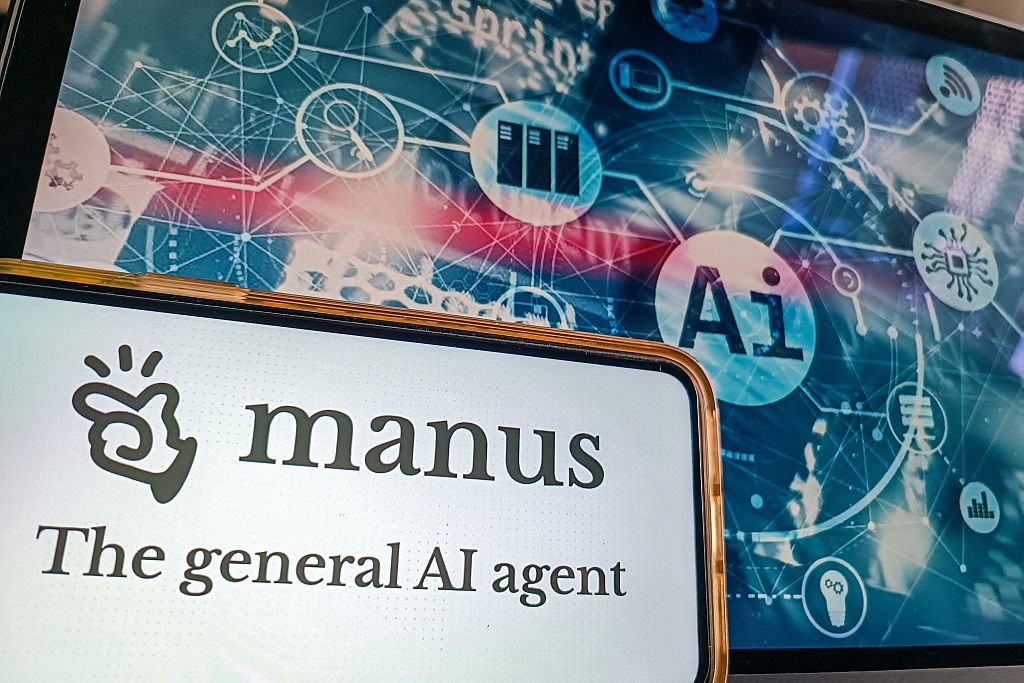
On April 27, China’s National Development and Reform Commission (NDRC) announced it had blocked a foreign acquisition of Manus, the Chinese AI startup.
The one-line statement did not explain the NDRC’s reasoning. Nor did it mention that the acquirer was Meta Platforms, which had agreed to acquire Manus for more than $2 billion. Meta had wanted to offer Manus’s AI agent, a product the company offers, which can perform skilled work autonomously, across its various platforms.
Manus was founded in China but migrated to Singapore. A number of Chinese startups have moved to the city-state in a technique known as “Singapore-washing” to facilitate, among other things, raising capital.
The Meta-Manus deal was announced in December. In January, the NDRC said it was investigating the acquisition. In March, the two Manus co-founders were barred from leaving China. On April 27, the U.S. social media giant said the acquisition “complied fully with applicable law.”
CNBC contributor Dewardric McNeal reports that review of the Manus deal moved from the central government’s NDRC to the Communist Party’s National Security Commission, which is chaired by Xi Jinping.
“When a transaction is elevated from review by a state economic agency to consideration by a party national security body, the calculus changes,” writes McNeal. “At that level, decisions are evaluated through a broader strategic lens that integrates economic resilience, technological development, and geopolitical competition—narrow legal or economic considerations rarely determine the outcome.”
In other words, the deal was doomed once the xenophobic Communist Party started to examine the acquisition as a foreign threat.
“The recent decision by the Chinese central government to reverse the merger of Singapore-based Manus by Facebook’s parent is part of a large geopolitical picture,” Brandon Weichert, senior national security editor of 19FortyFive.com, told Gatestone. “There are, as of now, two visions for artificial intelligence development in the world, one China’s and the other America’s.”
The harsh action by the Communist Party — Meta had already fully incorporated Manus’s AI agent into its business — is a sign of China’s weakness as much as its strength. As Weichert notes, “Beijing’s cancellation of the merger reflects the risk that AI development poses to the Chinese party-state, especially if that development is not fully controlled by the Communist Party.”
The Chinese regime’s protection of its AI businesses raises the issue of what America must now do to protect its tech. There are two things.
First, America should mirror China’s actions, so Washington must force Chinese businesses to divest American tech companies.
Xi is determined to keep Chinese technology in China. America should be at least equally determined to keep American technology in America. Therefore, if Americans cannot buy Chinese AI companies, then China should not be allowed to buy American AI companies. Reciprocity has to be reintroduced as the fundamental basis of relations with China.
The Biden administration had a “small yard, high fence” approach. In other words, the administration did not protect much technology, but what it did protect, it protected with high barriers. Now that China is going to great lengths to keep foreigners out, it is time for the Trump administration to go to a policy of “large yard, high fence.”
People say that if a country tries to protect everything, it protects nothing. Perhaps, but if links are severed, protecting everything becomes feasible.
America is ahead of China in AI, so interchanges will generally benefit China, on the principle that water flows downhill.
Unfortunately, America’s AI lead these days is measured in months, not years. China’s criminality explains why the U.S. lead has been narrowed. On April 23, Michael Kratsios of the White House Office of Science and Technology Policy publicly charged China with the mass theft of American AI. “The U.S. government has information indicating that foreign entities, principally based in China, are engaged in deliberate, industrial-scale campaigns to distil US frontier AI systems,” he wrote in a memo shared on social media.
Stopping the theft of intellectual property is hard, but at least the U.S. can make that task easier by cutting links with China.
One of those links is the sale of advanced microchips. The second thing America should do is not sell any advanced microchips, such as Nvidia’s H200 chip, to China.
In January, the Trump administration announced it would approve Nvidia’s H200 chip for export to China. Commerce Secretary Howard Lutnick this month revealed that so far no H200 sales have been made to that country.
What is the rationale for allowing China to have America’s chips? “You want to sell the Chinese enough that their developers get addicted to the American technology stack,” Lutnick explained last July to CNBC’s Brian Sullivan. “That’s the thinking.”
That “thinking,” reasonable on its face then, no longer holds up after the reversal of the Manus deal. Xi has made it clear that he is developing his own tech universe.
egretnewseditor@gmail.com