Is Trump Being Bamboozled?: Islamic State Terrorists Threaten Comeback Thanks to His Support for Syria’s Islamist Leader
Trump’s attempts to improve ties with both Turkey and Saudi Arabia brought about the US lending its endorsement to al-Sharaa’s Islamist regime in Damascus. The result is that al-Sharaa has now set about, at the very least, failing to prevent (here, here and here) wholesale attempts, apparently by his own government’s security forces, to slaughter Syria’s religious and ethnic minorities: Druze, Alawites and Kurds, including America’s presumed allies, the Kurdish Syrian Democratic Forces Army (SDF), who courageously defeated Syria’s Islamic State terrorists.
Syria’s Christians may well be the al-Sharaa government’s next target.
Trump’s willingness to give his backing to al-Sharaa is said to be the result of his attempts to deepen ties with Middle East states such as Qatar, Turkey and Saudi Arabia which, for different reasons, appear keen to see an Islamist government in power in Damascus — as elsewhere. For Qatar and Turkey, supporting al-Sharaa fits in with their long-established policy of backing radical Islamist groups, such as the Muslim Brotherhood, while the Saudis’ backing for the new Syrian regime is based on their desire to prevent Iran’s ayatollahs from re-establishing a foothold in a country, Syria, that was once Tehran’s closest regional ally.
If the US ever does pull its troops from Syria, the vacuum will most assuredly be filled instantly by Turkey and other Jihadists, as well as by Russia again and possibly China.
The US president could find himself facing an extremely difficult predicament, especially during midterm elections, if, as a result of his support for Syria’s Islamist leader, more Americans and others are killed or suffer serious injury at the hands of al-Sharaa’s government, IS terrorists who have escaped from Syrian prisons, as well as al-Sharaa’s apparent commitment to ethnically cleanse, then Islamise, Syria.
US President Donald Trump’s campaign to prevent Islamic State (IS) terrorists from staging a comeback is in serious danger of being undermined because of his support for Syria’s Islamist “interim” president, Ahmed al-Sharaa.
It was not that long ago that al-Sharaa had a $10 million bounty on his head after Washington designated him a terrorist for his close links to al-Qaeda in both Iraq and Syria.
The bounty was subsequently lifted after al-Sharaa, with significant military backing from Turkey, succeeded in overthrowing the Baathist dictatorship of Syrian President Bashar al-Assad in late 2024.
Trump’s attempts to improve ties with both Turkey and Saudi Arabia brought about the US lending its endorsement to al-Sharaa’s Islamist regime in Damascus. The result is that al-Sharaa has now set about, at the very least, failing to prevent (here, here and here) wholesale attempts, apparently by his own government’s security forces, to slaughter Syria’s religious and ethnic minorities: Druze, Alawites and Kurds, including America’s presumed allies, the Kurdish Syrian Democratic Forces Army (SDF), who courageously defeated Syria’s Islamic State terrorists.
Syria’s Christians may well be the al-Sharaa government’s next target.
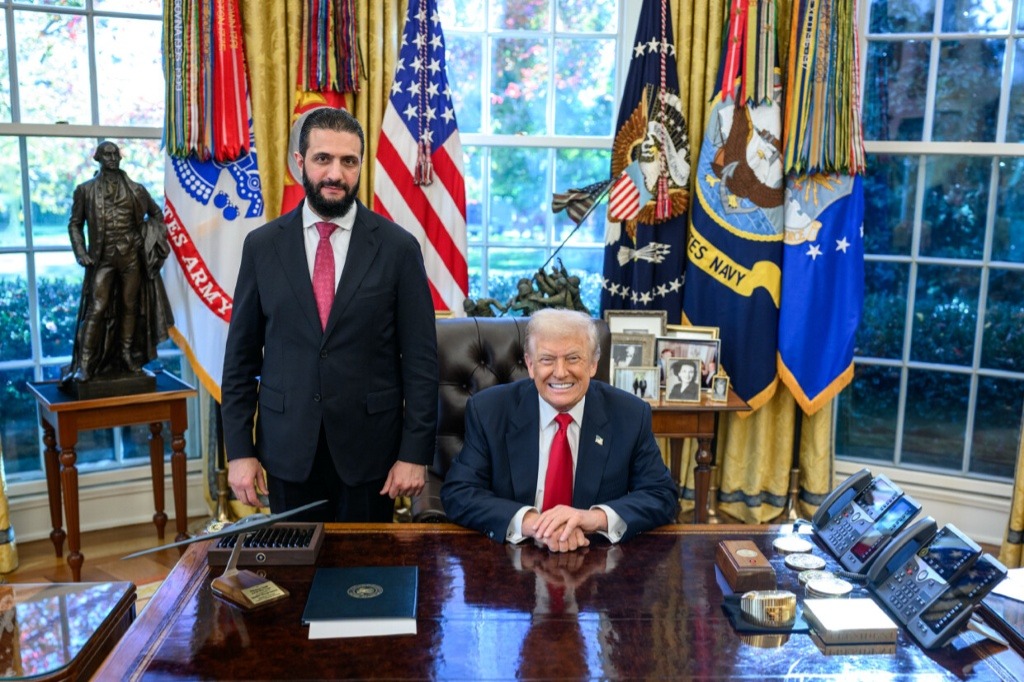
Al-Sharaa’s meeting with Trump at the White House in November 2025 ended with US officials announcing that the new Syrian regime had been invited to join Trump’s international coalition to combat the threat posed by IS terrorists — a remarkable turnaround in al-Sharaa’s fortunes, given his previous close association with Islamist terrorist organizations.
The Trump administration has become increasingly concerned at the prospect of IS staging a comeback after suffering a catastrophic defeat at the hands of US coalition forces in 2017, which succeeded in destroying the so-called caliphate that IS had established in the Syrian city of Raqqa.
The prominent role played by the Kurdish-led SDF proved crucial to the eventual outcome of that US-led offensive.
Trump’s decision, therefore, to invite a known Islamist such as al-Sharaa to join the latest US effort to crush IS understandably raised many eyebrows in Washington, with critics questioning whether the new Syrian leader could be trusted to take a firm stand against IS terrorists.
Following his White House meeting with al-Sharaa, Trump appeared impervious to such concerns. He claimed that his main priority was “to see Syria become a country that’s very successful. And I think this leader can do it. I really do.”
Al-Sharaa, for his part, assured Fox News that his visit to the White House represented a “new era” in which the country would cooperate with the US.
Trump’s willingness to give his backing to al-Sharaa is said to be the result of his attempts to deepen ties with Middle East states such as Qatar, Turkey and Saudi Arabia which, for different reasons, appear keen to see an Islamist government in power in Damascus — as elsewhere. For Qatar and Turkey, supporting al-Sharaa fits in with their long-established policy of backing radical Islamist groups, such as the Muslim Brotherhood, while the Saudis’ backing for the new Syrian regime is based on their desire to prevent Iran’s ayatollahs from re-establishing a foothold in a country, Syria, that was once Tehran’s closest regional ally.
Trump’s backing for al-Sharaa, at a time when he has repeatedly declared his determination to prevent IS terrorists from staging a comeback, now faces the very real prospect of backfiring spectacularly after recent events in Syria, where al-Sharaa’s attacks against Kurdish strongholds in the north of the country have resulted in hundreds of IS terrorists escaping from Kurdish-run prison camps.
Al-Sharaa’s forces earlier this month launched a series of assaults, ostensibly with Trump’s backing, against Kurdish-controlled regions of northern Syria as part of his efforts to assert his control over the entire country.
The Kurds established their own autonomous zone while fighting alongside US forces during Syria’s long-running civil war, and around 1,500 US troops still remain in the area, partly to protect the Kurds, as well as to help maintain security for the estimated 50,000 IS terrorists and their dependents that were taken prisoner following the fall of Raqqa.
Trump has made no secret of his desire to end America’s military involvement in Syria. At the end of his first term in office, he tried to withdraw the remaining US forces, but had to abandon the plan after being accused of betraying the Kurds, who had proved themselves to be such valued allies during the war against IS.
Since returning to office last year, Trump has renewed his efforts to end US military involvement in Syria – a move said to be one of the reasons behind his decision to back al-Sharaa’s Islamist regime.
If the US ever does pull its troops from Syria, the vacuum will most assuredly be filled instantly by Turkey and other Jihadists, as well as by Russia again and possibly China.
Trump’s support for Al-Sharaa has, in addition, raised concerns about the fate of the IS prisoners still being held in Kurdish-controlled territory, after reports that significant numbers managed to escape during recent fighting between government forces and the Kurdish-led SDF.
There have even been reports of IS raising its flag again in Raqqa after al-Sharaa’s forces seized control of the city from the Kurds.
Certainly, any development that results in IS terrorists re-establishing a foothold in Syria could prove more than embarrassing for the Trump administration after the president personally pledged his commitment to maintain the US military effort to prevent the terrorist group from regrouping.
The White House recently authorised strikes against IS bases in both Syria and Nigeria after three US military personnel were killed in an IS ambush in December, prompting Trump to promise that his administration would undertake “very serious retaliation” against those responsible for the killings.
The US president could find himself facing an extremely difficult predicament, especially during midterm elections, if, as a result of his support for Syria’s Islamist leader, more Americans and others are killed or suffer serious injury at the hands of al-Sharaa’s government, IS terrorists who have escaped from Syrian prisons, as well as al-Sharaa’s apparent commitment to ethnically cleanse, then Islamise, Syria.
egretnewseditor@gmail.com