President Trump’s Farsighted Policy on Venezuela, Iran’s ‘Second Home’ in the Americas
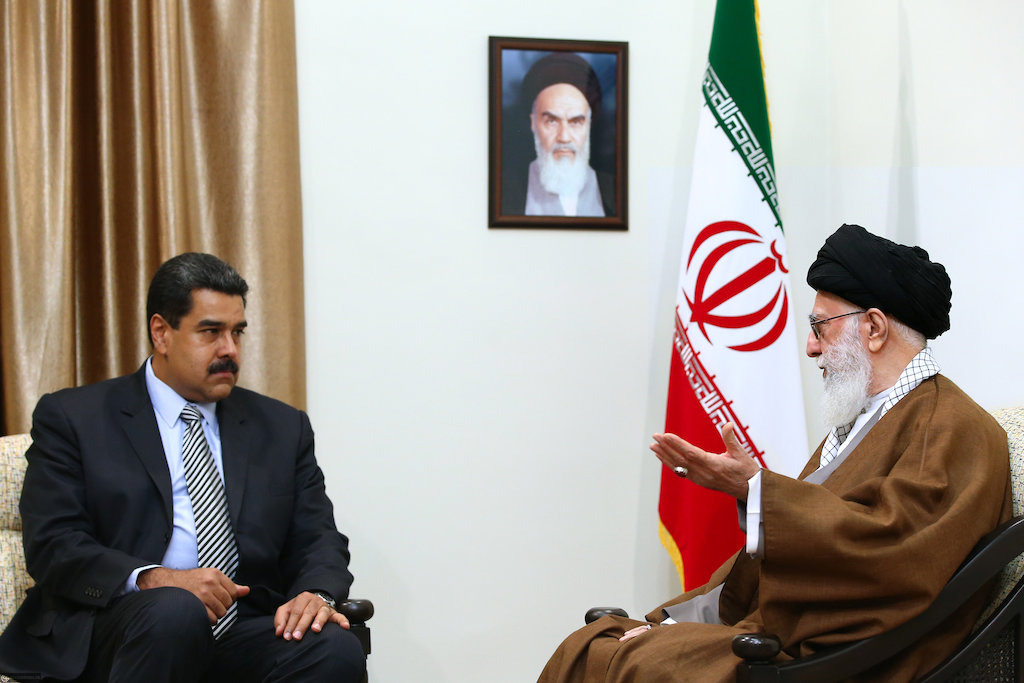
Venezuela functions both as a forward operating base and as an insurance policy for the regime, safeguarding its operatives and extending its reach. Allowing Iran to entrench itself in the Western Hemisphere would only create a hostile foothold from which it could coordinate operations, support proxy groups, and control regional dynamics with near impunity.
President Donald J. Trump’s policy on Venezuela is not only strategically sound but necessary to finally put a stop to Iran’s explicit plans for the U.S.
Iran has recently come out publicly, voicing strong support for Venezuela against the United States. Its statement reflects a deep strategic and military relationship that serves multiple interests for Tehran. The Iranian regime openly views its partnership with Venezuela as a rare foothold in the Western Hemisphere, a staging ground for influence, and a safe haven for key figures and networks. The relationship encompasses military cooperation, intelligence sharing, support for proxy groups, and opportunities for illicit trade, all of which bolster Iran’s global reach while challenging U.S. interests.
Venezuela can, in effect, be viewed as a prized extension of Iranian power — a “second home” where Iran can operate relatively freely, project influence close to the United States, and maintain strategic depth far beyond its borders.
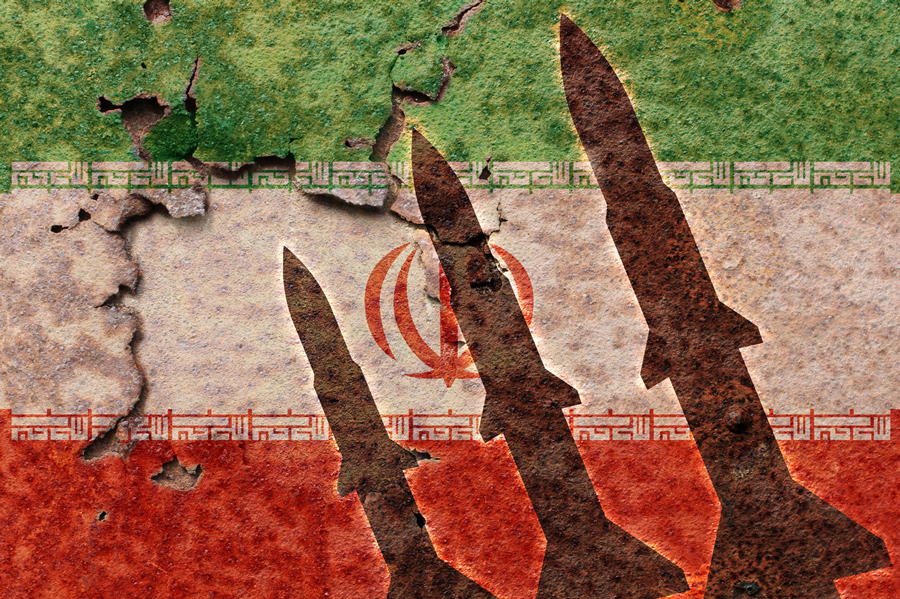
The Iranian regime’s fondness for Venezuela is rooted in several ideological and strategic advantages. Militarily, Venezuela allows Iran to experiment with logistics, training and potentially the deployment of drone and missile capabilities in the Americas. Intelligence-sharing between the two countries, far from Iran’s territory, facilitates coordination with allied groups such as Hezbollah and other proxies.
Politically, Venezuela serves as an additional approach into Israel’s backyard. Just as Tehran openly backs Hamas and Hezbollah near Israel, it now enjoys a safe platform near the United States where it can extend asymmetric pressure. In addition, Venezuela’s weakened state institutions, opaque financial systems, and corrupt governance make it fertile ground for illicit operations, including narcotics trafficking and criminal networks, which Iran can leverage to sustain its wider geopolitical ambitions. This combination of intelligence, military and financial utility makes Venezuela a critical hub for the regime’s global strategy.
The role of Venezuela as a sanctuary for Iranian elites only accentuates its strategic value. During moments of internal crisis in Iran, particularly during its so-called “12-day war” with Israel, reports surfaced that high-ranking Iranian officials were actively exploring safe havens abroad, with Venezuela emerging as a viable destination.
The prospect of having Iranian operatives and mullahs so close to the United States should create justifiable concerns: it allows Tehran to maintain influence and operations from a location that is geographically advantageous, politically aligned, and relatively insulated from Western oversight. Venezuela functions both as a forward operating base and as an insurance policy for the regime, safeguarding its operatives and extending its reach.
The partnership between Iran and Venezuela is not symbolic — it is deeply functional, encompassing military, intelligence and criminal domains. Isaias Medina III, who served as legal adviser for Venezuela’s Permanent Mission to the United Nations until he resigned in 2017 over Venezuelan President Nicolás Maduro’s human rights abuses, recently told Fox News:
“Iran’s partnership with the rogue Venezuelan narco-dictatorship is far from a principled stand for ‘sovereign rights’ under the U.N. Charter. It is a calculated strategy serving mutual interests in criminal enterprise and asymmetric warfare, posing a direct and evolving threat to U.S. national security…. This is a partnership for power, not principles. Iran’s engagement centers on deepening military, criminal, and intelligence cooperation that blatantly disregards international norms.”
From a U.S. strategic perspective, the partnership between Venezuela and Iran highlights the importance of applying consistent pressure on both regimes. The Trump administration’s policy of applying maximum pressure on the Maduro regime addresses directly with the danger posed by Venezuela serving as a strategic base for Iranian operations. Allowing Iran to entrench itself in the Western Hemisphere would only create a hostile foothold from which it could coordinate operations, support proxy groups, and control regional dynamics with near impunity. Pressure on Venezuela is therefore inseparable from pressure on Iran. The two regimes contribute to one another’s survival and reinforce each other’s strategic objectives.
By continuing to hold Maduro’s regime accountable and maintaining strong sanctions and diplomatic pressure, the United States is constructively addressing a threat that extends well beyond Venezuela and directly confronts Iran’s ambitions in America’s backyard.
Venezuela represents a multifaceted asset for the Iranian regime: a sanctuary for its elites, a hub for intelligence and military cooperation, and a platform for illicit networks that undermine regional and global security. Iran’s deepening engagement with Venezuela is designed to expand its reach, further its interests, and challenge U.S. influence.
President Donald J. Trump’s policy on Venezuela is not only strategically sound but necessary to finally put a stop to Iran’s explicit plans for the U.S.
egretnewseditor@gmail.com