

“Beijing’s real intention is to create a rationale for the presence of the People’s Liberation Army Navy in the Arctic. The goal for China’s Communist Party is to create its own Arctic Bastion so that Chinese navy ballistic missile submarines can threaten the U.S. from the northern hemisphere.” — James Fanell, a former U.S. Navy captain who served as director of Intelligence and Information Operations at the U.S. Pacific Fleet, to Gatestone Institute, August 12, 2026.
The U.S. Navy, by the way, has no base in Alaska, America’s window on the Arctic.
China, warned EU foreign policy chief Kaja Kallas this year, could militarize Arctic shipping lanes.
In fact, China, with partner Russia, has been working hard to militarize the top of the world.
“The U.S. and its allies expect Beijing will be able to send armed submarines to the North Pole within a few years.” — Wall Street Journal, December 29, 2025.
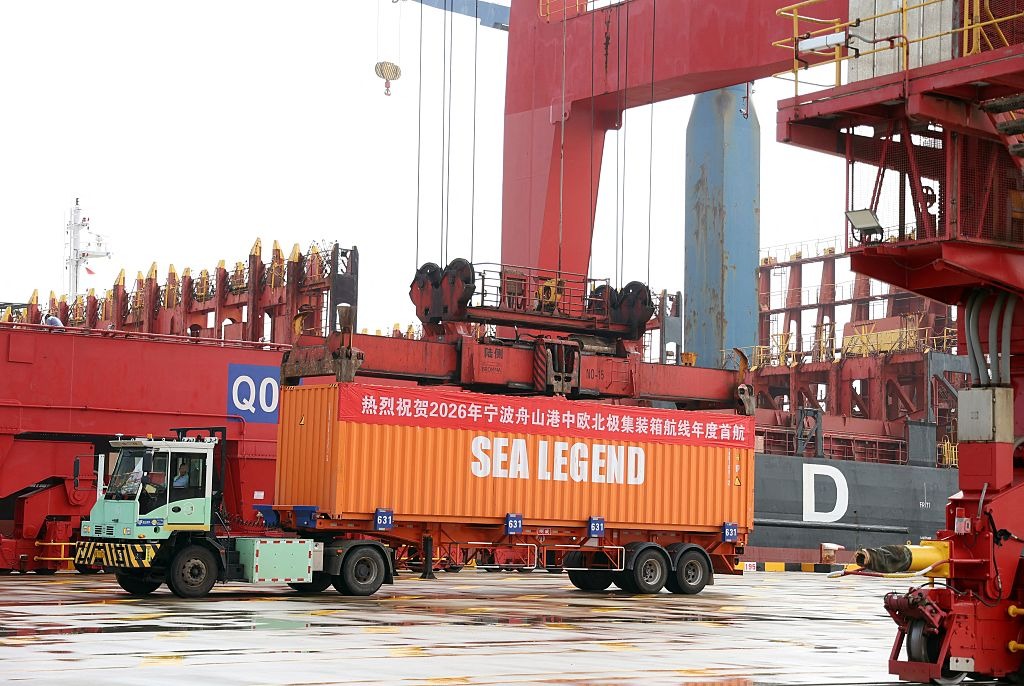
This month, China’s Sea Legend Shipping launched the first regular container service through the Arctic, along what it calls the “Ice Silk Road.” The route, dubbed “China-Europe Arctic Express,” connects Ningbo, on China’s east coast, with England’s Felixstowe. The Chinese-run shipper plans eight voyages this summer season from this month to early October.
Sea Legend, which will use Russia’s Northern Sea Route, promises to cut in half the current 40-day sailing time.
The passage, the Financial Times stated, “bypasses shipping chokepoints.” Sea Legend ships will not go anywhere near the Suez Canal at the top of the Red Sea or the Red Sea’s southern exit, the now-dangerous Bab el-Mandab strait, where the Iran-backed Houthi militia has been targeting vessels. The Northern Sea Route hugs Russia’s coast.
Sea Legend’s route also avoids the world’s most important chokepoint: the Strait of Malacca. Last year, more than 102,500 vessels passed through that waterway, part of the most-used shipping route between East Asia and the Indian Ocean.
“Vessels and shipowners now see it as more of an opportunity, first to save a lot of time and cost,” and also to “take out all the geopolitical chokepoints and conflict zones,” said Rahul Khanna of insurer Allianz, referring to the Arctic route, to the FT.
There is actually only one route between East Asia and Europe that avoids all chokepoints. This involves sailing southeast across the Pacific Ocean, rounding South America at stormy Cape Horn, and then heading north through the Atlantic. That roundabout way is, of course, commercially unviable.
Although Sea Legend’s Ice Silk Road avoids many chokepoints, it does transit one of them: the 51-mile-wide Bering Strait, with Russia on the west side and Alaska on the other.
China’s People’s Daily, the Communist Party’s official mouthpiece, has declared a “total war” on the United States. In short, Sea Legend has traded chokepoints that friends of China control for one controlled by a state Beijing believes to be its enemy.
For many reasons, the world’s biggest shipping companies do not sail the Northern Sea Route. It is, for instance, not passable in winter, and even in summer ships can end up trapped in ice.
Moreover, Russia, after its 2022 invasion of Ukraine, has been heavily sanctioned, and most companies do not want to deal with the state-controlled Russian company Rosatom, which issues permits for the Northern Sea Route.
So why is a Chinese company sailing across the Arctic?
“Commerce leads diplomacy leads military affairs, classic maritime strategy all the way back to Alfred Thayer Mahan,” James Holmes, the first J.C. Wylie Chair of Maritime Strategy at the Naval War College, told Gatestone this month. “Arctic routes cut commercial costs for Chinese shippers by something like one-third depending upon the port of origin and destination, bolstering China’s exports and thus its ability to fund its diplomatic and military ambitions.”
Put the emphasis on the military, James Fanell, a former U.S. Navy captain who served as director of Intelligence and Information Operations at the U.S. Pacific Fleet, told this author. “Sea Legend is not using the traditional high-volume and low-cost routes through the Indian Ocean and Red Sea into Europe,” he said. “A deeper examination of China’s push to use this low-volume Northern Sea Route suggests that Beijing’s real intention is to create a rationale for the presence of the People’s Liberation Army Navy in the Arctic.”
“The goal for China’s Communist Party is to create its own Arctic Bastion so that Chinese navy ballistic missile submarines can threaten the U.S. from the northern hemisphere,” said Fanell, also co-author of Embracing Communist China: America’s Greatest Strategic Failure. “This threat vector is what the U.S. should be on the lookout for.”
The U.S. Navy, by the way, has no base in Alaska, America’s window on the Arctic.
China, warned EU foreign policy chief Kaja Kallas this year, could militarize Arctic shipping lanes.
In fact, China, with partner Russia, has been working hard to militarize the top of the world. In 2024, for instance, China and Russia flew military patrols near Alaska over the Bering Sea for the first time. Chinese bombers took off and landed from a Russian airfield. “Such ‘access transfer’ accelerates and extends China’s ability to threaten North America in the air domain and raises the specter of coordinated military operations in the event of a strategic conflict,” U.S. Air Force Gen. Gregory Guillot, commander of U.S. Northern Command and the North American Aerospace Defense Command, told the House Armed Services Committee in April of last year.
The big concern, as Fanell noted, is China’s subsea activities. Chinese research submarines traveled beneath Arctic ice for the first time last summer, “a technical feat with chilling military and commercial implications for America and its allies,” reported the Wall Street Journal. “The U.S. and its allies expect Beijing will be able to send armed submarines to the North Pole within a few years.”
In the meantime, China’s commercial vessels are leading the way. There is only one country other than Russia that regularly uses the Northern Sea Route. That country, CNN reports, is China.
egretnewseditor@gmail.com