

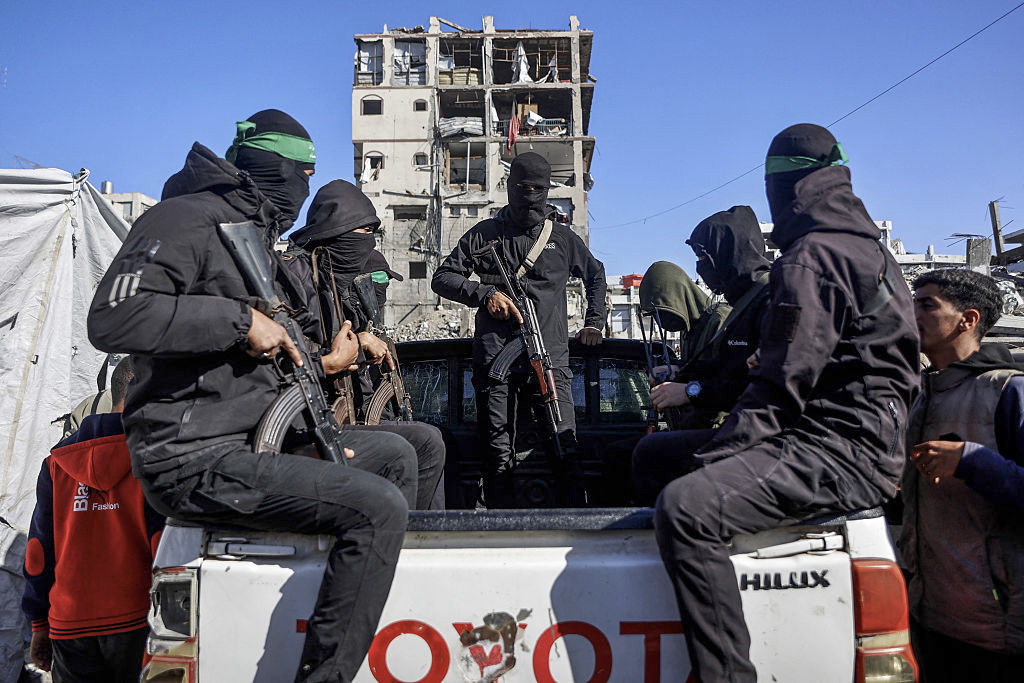
Hezbollah used UNIFIL’s peacekeepers as “shields” to deter any Israeli military activity and prevent compliance in case a peacekeeper might be hit. Israel was forced to just sit and watch while Hezbollah put countless tunnels and weapons in place. The disastrous model of UNIFIL is about to be copied to the Gaza Strip. Hamas will undoubtedly exploit a similar, weak UNIFIL-style “nanny” force to rearm and operate with impunity, exactly as Hezbollah did in Lebanon.
Hamas leaders have repeatedly stressed their opposition to laying down their weapons. They have also emphasized that the role of any international force in the Gaza Strip should be limited to being present on the borders to prevent clashes — meaning firing on Israel should it try to prevent them from rearming — merely to “keep” peace, not impose it.
[Senior Hamas leader Khaled] Mashaal, living comfortably far from Gaza, pointed out that Egypt, Qatar, and Turkey — all three longtime supporters and enablers of Hamas — share its position regarding the role of the proposed international force.
According to Israeli officials, Qatar and Turkey are working to dissuade Hamas from disarming…. Behind both proposals lies the aim of preserving Hamas’s influence in the Gaza Strip, as well as the ability to launch another “October 7” massacre at a convenient date.
The Arabs and Islamic countries clearly do not want to be part of any force that could be drawn into confrontation with Hamas and other Palestinian terror groups…. These leaders are afraid of being labeled traitors working on Israel’s behalf to disarm the Palestinian armed groups.
The Gaza Strip does not need “peacekeepers” or “monitors.” Instead, it needs an extremely strong security force whose members would engage the terrorists, confiscate their weapons, dismantle their military capabilities, and eradicate the terror infrastructure. It is deranged to assume that any UN-authorized force would forcibly disarm terrorists, destroy tunnels, stop rocket fire, or perform counterterrorism operations.
As Trump himself repeats, “peace through strength” is the only way to achieve stability and peace in the Gaza Strip and prevent countless more deaths of both Israelis and Palestinians.
As part of US President Donald J. Trump’s plan for ending the Israel-Hamas war, international troops could be deployed in the Gaza Strip as early as next month, US officials told Reuters on December 12. According to the unnamed officials, the proposed International Stabilization Force (ISF) would not fight Hamas, the Palestinian terror group that sparked the war by invading Israel on October 7, 2023 and murdering more than 1,200 Israelis and foreign nationals and wounding thousands more.
In mid-November, the United Nations Security Council endorsed Trump’s 20-point “Comprehensive Plan to End the Gaza Conflict,” welcomed its establishment of a “Board of Peace” and authorized the Board Member States working with it to establish a temporary ISF in the Gaza Strip.
The resolution gives the ISF “a wide mandate, including overseeing the borders, providing security and demilitarizing the territory.”
According to the text of the resolution:
“The ISF shall work with Israel and Egypt… along with the newly trained and vetted Palestinian police force, to help secure border areas; stabilize the security environment in Gaza by ensuring the process of demilitarizing the Gaza Strip, including the destruction and prevention of rebuilding of the military, terror, and offensive infrastructure, as well as the permanent decommissioning of weapons from non-state armed groups…” [Emphases added.]
The US officials’ announcement that the ISF would not disarm Hamas means that the international troops will end up playing the role of “monitors” or “peacekeepers” in the Gaza Strip. This is exactly what Hamas wants: a security force similar to the United Nations Interim Force in Lebanon (UNIFIL), established in 1978 to “confirm the withdrawal of Israeli forces from southern Lebanon, restore international peace and security, and assist the government of Lebanon in ensuring the return of its effective authority in the area.”
UNIFIL, however, completely failed to disarm the Iran-backed Hezbollah terror group. Instead, UNIFIL allowed Hezbollah to build up a massive arsenal and military infrastructure right under its nose.
Despite UNIFIL’s presence, Hezbollah grew its arsenal from a few thousand missiles to more than 150,000, while embedding weapons in civilian homes and building infrastructure near UN posts. UNIFIL failed to confiscate weapons or dismantle military infrastructure. Moreover, Hezbollah used UNIFIL’s peacekeepers as “shields” to deter any Israeli military activity and prevent compliance in case a peacekeeper might be hit. Israel was forced to just sit and watch while Hezbollah put countless tunnels and weapons in place.
Hussain Abdul-Hussain, research fellow at the Foundation for Defense of Democracies, noted:
“UNIFIL has not engaged outlaw forces in any firefights or law enforcement actions. Instead, it focused on searching for Hezbollah’s arms caches and reporting them to the Lebanese Armed Forces – an effort in which it consistently failed.”
The disastrous model of UNIFIL is about to be copied to the Gaza Strip. Hamas will undoubtedly exploit a similar, weak UNIFIL-style “nanny” force to rearm and operate with impunity, exactly as Hezbollah did in Lebanon.
Hamas leaders have repeatedly stressed their opposition to laying down their weapons. They have also emphasized that the role of any international force in the Gaza Strip should be limited to being present on the borders to prevent clashes — meaning firing on Israel should it try to prevent them from rearming — merely to “keep” peace, not impose it.
Senior Hamas leader Khaled Mashaal was recently quoted as saying that his group rejects any arrangement that would give such a force “powers affecting the people of the Gaza Strip or the weapons of the resistance.” Mashaal, living comfortably far from Gaza, pointed out that Egypt, Qatar, and Turkey — all three longtime supporters and enablers of Hamas — share its position regarding the role of the proposed international force.
According to Israeli officials, Qatar and Turkey are working to dissuade Hamas from disarming. Both countries are reportedly offering alternatives: either Hamas gives its weapons to the Palestinian Authority, or the weapons are transferred to some kind of “secure” storage under oversight — presumably until Trump leaves office, when they might take the weapons out of “secure” storage to attack Israel again. Behind both proposals lies the aim of preserving Hamas’s influence in the Gaza Strip, as well as the ability to launch another “October 7” massacre at a convenient date.
Earlier this month, Turkish Foreign Minister Hakan Fidan said that disarming Hamas should not be the first task of the ISF:
“Disarmament cannot be the first stage. We need to proceed in the correct order and remain realistic. The ISF’s first goal should be to separate Palestinians from the Israelis.”
Egyptian Foreign Minister Badr Abdelatty said in an interview with the German Der Spiegel magazine on December 10, that the ISF “will primarily monitor the ceasefire, secure the external borders and ensure the operation of border crossings in the Gaza Strip.”
Last month, even Jordan’s King Abdullah II announced that he would not send Jordanian forces into the Gaza Strip because his country was “too close politically” to the situation, adding:
“What is the mandate of security forces inside of Gaza? And we hope that it is peacekeeping, because if it’s peace enforcing, nobody will want to touch that.”
The Arabs and Islamic countries clearly do not want to be part of any force that could be drawn into confrontation with Hamas and other Palestinian terror groups. The Arab and Muslim leaders are afraid that such involvement could trigger protests by their own people, many of whom are sympathetic to the Palestinians and Hamas. These leaders are afraid of being labeled traitors working on Israel’s behalf to disarm the Palestinian armed groups.
The Arabs and Muslims seem to prefer a traditional “peacekeeping” model, focused on monitoring and humanitarian aid rather than enforcing demilitarization.
The Gaza Strip does not need “peacekeepers” or “monitors.” Instead, it needs an extremely strong security force whose members would engage the terrorists, confiscate their weapons, dismantle their military capabilities, and eradicate the terror infrastructure. It is deranged to assume that any UN-authorized force would forcibly disarm terrorists, destroy tunnels, stop rocket fire, or perform counterterrorism operations.
The proposed ISF, as first envisioned, should have a clear mandate to open fire at any terrorist roaming the streets of the Gaza Strip. The ISF should help to end Hamas’s rule and ensure that Gaza no longer poses a threat to Israel. As Trump himself repeats, “peace through strength” is the only way to achieve stability and peace in the Gaza Strip and prevent countless more deaths of both Israelis and Palestinians.
egretnewseditor@gmail.com