

The legislation, which intends to strengthen the US’ long-term economic and technological competitiveness, has a dual track approach to deal with workforce shortages — drawing more skilled workers from the global talent pool and increasing federal investments in American STEM education to grow the domestic workforce.
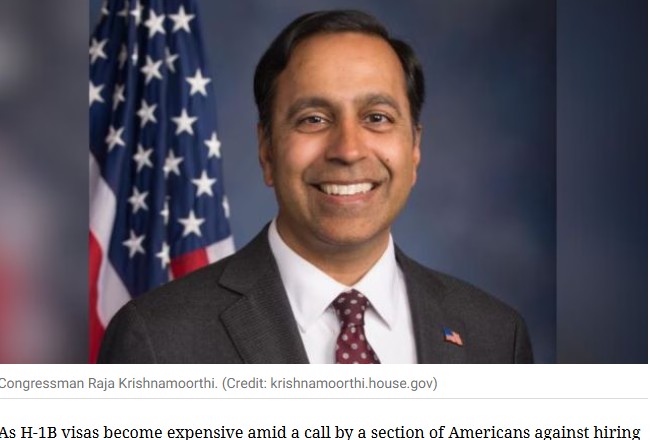
As H-1B visas become expensive amid a call by a section of Americans against hiring employees from abroad, Democrat lawmaker Raja Krishnamoorthi said he has reintroduced the High-Skilled Immigration Reform for Employment (HIRE) Act that aims at doubling the number of H-1B available to 1,30,000.
The legislation, which intends to strengthen the US’ long-term economic and technological competitiveness, has a dual track approach to deal with workforce shortages — drawing more skilled workers from the global talent pool and increasing federal investments in American STEM education to grow the domestic workforce.
What is the HIRE Act
The Act — supported by ITServe Alliance, the nation’s largest association of IT services organizations — would double the number of the highly debated H-1B visas from 65,000 to 1,30,000 to ensure employers, including those in critical and emerging technology sectors, have access to adequate human capital. The Act will also remove the current cap, which is set at 20,000, on additional slots for H-1B visas available to those who have advanced US degrees.
Also Read | ‘Never happened before’: US green card interviews for foreign spouses turn into arrest
The Act will direct funding to science, technology, engineering, and math (STEM) programs in elementary and secondary schools in the US as well.
“To build the jobs and industries of tomorrow, America must stay at the forefront of innovation by strengthening our own workforce while continuing to welcome top talent from around the globe,” Congressman Krishnamoorthi said.
“By growing our domestic talent pipeline and ensuring employers can recruit the skilled workers they need, we can create good-paying jobs and secure America’s leadership in the technologies of the future,” he added.
What is the H-1B debate?
The H-1B visa came under scrutiny of the Trump administration, as the President made the polarising topic of immigration a central theme of his campaign.
Ahead of the 2024 Presidential elections, a YouGov poll revealed that 14.6 per cent registered voters felt it was the most important issue. This number was only 2.1 per cent in 2012.
In September, Trump, now the President, signed a proclamation that will raise the fee for firms hiring overseas talent under the visa programme to $100,000 annually.
According to the US government order, “The H-1B nonimmigrant visa program was created to bring temporary workers into the United States to perform additive, high-skilled functions, but it has been deliberately exploited to replace, rather than supplement, American workers with lower-paid, lower-skilled labor.”
“The large-scale replacement of American workers through systemic abuse of the program has undermined both our economic and national security,” it added.
Indians largest beneficiaries of H-1B visas
People born in India are the largest beneficiaries of the H-1B programme. Data from the US government show that Indians account for more than 70 per cent of all H-1B petitions approved each year since 2015.
Between October 2022 and September 2023, 72 per cent of the nearly 4 lakh visas issued under the H-1B programme went to Indian nationals.
Besides the American President, Commerce Secretary Howard Lutnick called the popular programme a “scam,” saying that American businesses should be focused on hiring American workers.
Recently, a US diplomat said an “industrialised fraud” was taking place under the umbrella of the H-1B visa programme, alleging that 80-90 per cent of the working visas issued to Indian nationals were allegedly obtained through “fraudulent” means.
byaruhangaissac@gmail.com