

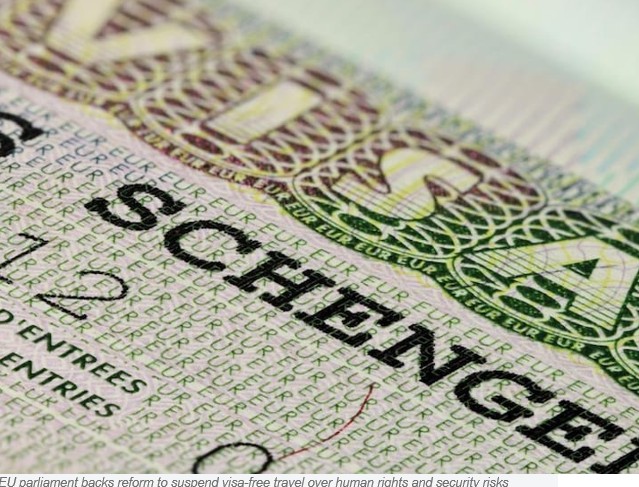
The legislation targets 61 countries whose nationals can currently enter the Schengen area for short stays of up to 90 days in any 180-day period without a visa. The European Parliament has passed new rules that make it easier for the EU to revoke visa-free access for countries whose c citizens pose security threats or fail to respect human rights. The legislation applies to 61 countries that currently allow short-term stays in the Schengen Zone of up to 90 days in any 180-day period without a visa.
Under the updated framework, the European Commission can begin by temporarily suspending visa-free entry for a nation if there are concerns about safety, serious criminal activity, overstays, or a spike in rejected asylum applications. If these issues remain unresolved, the suspension can be made permanent. Until now, the only instance of revoked visa-free travel has involved Vanuatu.
Expanded reasons for suspension
The reforms introduce several new triggers for removing visa privileges. These include hybrid threats, such as the manipulation of migration by a foreign state, including investor citizenship programs (often referred to as “golden passports”), violations of international law or UN mandates, and failure to comply with international court decisions. Existing factors, like general security risks or lack of cooperation on returning migrants, remain part of the criteria.
Clear thresholds are now set: a 30% rise in serious crimes or overstaying incidents and a 20% low approval rate for asylum applications will prompt action. In exceptional circumstances, the Commission can adjust these limits based on well-supported evidence. The rules also allow the EU to target government officials responsible for human rights violations or other breaches, enabling selective suspension rather than punishing entire populations.
Parliamentary approval and next steps
The legislation, negotiated between Parliament and Council representatives, passed with 518 votes in favor, 96 against, and 24 abstentions. It still requires formal adoption by the Council and will come into force 20 days after publication in the EU Official Journal.
Countries affected by the reform
The list of nations whose citizens currently enjoy visa-free travel under the Schengen system includes:
Andorra, Antigua and Barbuda, Argentina, Australia, Bahamas, Barbados, Bosnia and Herzegovina, Brazil, Brunei, Canada, Chile, Colombia, Costa Rica, Dominica, Micronesia, Grenada, Georgia, Guatemala, Honduras, Israel, Japan, Kiribati, Saint Kitts and Nevis, South Korea, Saint Lucia, Monaco, Moldova, Montenegro, Marshall Islands, Mauritius, Mexico, Malaysia, Nicaragua, Nauru, New Zealand, Panama, Peru, Palau, Paraguay, Serbia, Solomon Islands, Seychelles, Singapore, San Marino, El Salvador, Timor-Leste, Tonga, Trinidad and Tobago, Tuvalu, Ukraine, United Kingdom (non-citizen British nationals), United States, Uruguay, Holy See, Saint Vincent and the Grenadines, Samoa, Hong Kong SAR, Macao SAR, British Overseas Territories Citizens, British Overseas Citizens, British Protected Persons, British Subjects, Taiwan, Kosovo.
How the new system works
Under the revised rules, the European Commission can launch the visa suspension process either on its own initiative or following a request from an EU member state. The process begins with a temporary halt to visa-free travel and can become permanent if the concerns are not resolved. The reform is designed to ensure that short-term entry privileges remain conditional on security, human rights compliance, and legal obligations, giving the EU a precise tool to respond to evolving risks.
egretnewseditor@gmail.com