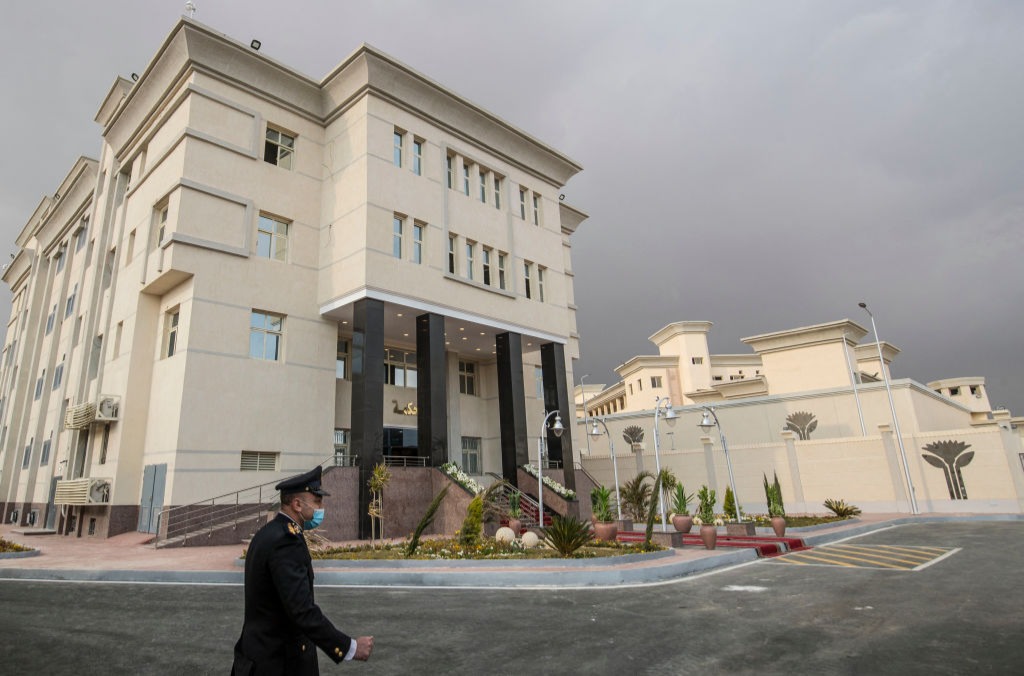
The following day, the Second Criminal Chamber of Badr placed 35 organizations and 36 individuals on the terrorist list… Among those named are the powerful Council of European Muslims, successor to the Federation of Islamic Organizations in Europe (FIOE); Musulmans de France; the League of Muslims of Belgium; and national organizations operating in Britain, Germany, and other European countries.
The ruling also names the European Council for Fatwa and Research, the European Council of Imams and the European Institute of Human Sciences.
[T]he Egyptian judiciary is not merely targeting political leaders and isolated local initiatives. What emerges is a distinctly European Islamist and terrorist network, driven by a single, coherent ideological project: that of the Muslim Brotherhood in Europe.
Political action does not necessarily begin at the ballot box. It begins much earlier, with the dissemination of religious doctrines and the patient construction of lasting institutions. The method is similar to that of the Italian communist Antonio Gramsci: conquer society from below, and political power will eventually fall into your hands.
Every link in the network shares one overriding point of reference: Sharia, “the divine guidance revealed in the Qur’an and the Sunnah, covering both worship and everyday dealings.”
Taken together, these provisions form a coherent logic: to undermine democracy. Islamic Sharia law is placed above all other laws — first for Muslims, then for everyone else.
Sharia offers no dialogue. It blocks all dissenting voices — Jewish, Christian, atheist — especially when Islamists consider themselves sufficiently numerous to impose their will.
The late, influential Sunni spiritual leader, Yusuf al-Qaradawi, forced to flee from Egypt to Qatar, admitted on his popular Al Jazeera television show, “Sharia and Life,” that “If they had gotten rid of the apostasy punishment Islam wouldn’t exist today.”
Does anyone grasp the magnitude of the humiliation involved in leaving it to Egypt to expose the Muslim Brotherhood’s sprawling network across Europe?
On November 10, 2026, an Egyptian court placed 35 organizations and 36 individuals on its list of terrorist entities and persons. Cairo is targeting far more than a handful of exiled leaders; also national federations, religious councils, training institutes, and organizations devoted to families, women and students. What the Egyptian government has brought to light is the institutional architecture built by the Muslim Brotherhood across Europe.
What purpose does this elaborate structure serve? What is its ultimate objective? And why Egypt?
The Court Ruling That Exposed an Entire Network
A day earlier, on November 9, 2026, on the basis of earlier criminal proceedings, Egypt formally confirmed the Muslim Brotherhood’s permanent designation as a terrorist organization.
The following day, the Second Criminal Chamber of Badr placed 35 organizations and 36 individuals on the terrorist list for five years, in State Security Case No. 11108/2026. The ruling was published in the Egyptian Official Gazette, No. 250.
Among those named are the powerful Council of European Muslims, successor to the Federation of Islamic Organizations in Europe (FIOE); Musulmans de France; the League of Muslims of Belgium; and national organizations operating in Britain, Germany, and other European countries. The ruling also names the European Council for Fatwa and Research, the European Council of Imams and the European Institute of Human Sciences.
At first glance, this may seem like a tedious inventory of institutions engaged in apparently innocuous activities: education, local community work and political organizing. But to stop at these lists would be to miss the essential point. What matters is the coherence of the whole.
For this is the decisive element: the Egyptian judiciary is not merely targeting political leaders and isolated local initiatives. What emerges is a distinctly European Islamist and terrorist network, driven by a single, coherent ideological project: that of the Muslim Brotherhood in Europe.
The Ideology: Transform Society to Capture the State
The Muslim Brotherhood was founded in 1928 by Hassan al-Banna. Its doctrine does not confine Islam to personal faith. It makes Islam an organizing principle for education, the family, social relations, government and law.
This is entirely consistent with Islamic scripture.
The Qur’an is by Muslims regarded as the word of Allah. In could be considered comparable to the Bible, except with severe real-time punishments for infractions. One cannot say, “Oh, God did not really mean that about adultery….”
“Muslims firmly believe that the Arabic words, phrases, and sentences of the Qur’an come directly from God,” writes Jane Dammen McAuliffe in The Qur’an: What Everyone Needs to Know. Muslims consider it a divine word that, through the interpretations of the Sunnah and fiqh (jurisprudence that implements Sharia law), provides guidance on how everyone should live.
Islam, not merely a religion, advances an all-encompassing, radical project: Sharia, literally, a clear path leading to a water source. “We believe that the doctrines and teachings of Islam are all-comprehensive and govern the affairs of men in this world and the next.” wrote al-Banna in Introducing Islam. Commercial law, family law, property law, labor law — absolutely everything, according to the Muslim Brotherhood, is contained within Sharia law. The very notion of a source of law outside of Sharia is not only inconceivable; it is an insult to the word of God (see Tamara Sonn, What is Shari’ah?, Oxford University Press, 2012).
The Brotherhood’s historical method of imposing Sharia follows a progression: shape the individual, direct the family, transform society and ultimately influence the state.
Political action does not necessarily begin at the ballot box. It begins much earlier, with the dissemination of religious doctrines and the patient construction of lasting institutions. The method is similar to that of the Italian communist Antonio Gramsci: conquer society from below, and political power will eventually fall into your hands.
A school transmits ideas. An imam teaches. A religious council interprets. An association brings people together. A federation coordinates. A representative organization makes demands of public authorities.
These are merely the individual cogs of a single, overarching mechanism: the imposition of Sharia.
The European Instruments: Doctrine, Cadres, Networks, Institutions
The organizations designated by the Egyptian government perform several complementary functions.
Coordination. The Council of European Muslims brings together national networks, trains leaders and promotes common positions. What begins as a scattering of small associations becomes an organized structure with continent-wide representation.
Defining religious doctrine. The European Council for Fatwa and Research issues opinions on the application of Islamic prescriptions to life in Europe: family, religious practices, personal conduct and social relations. The European Council of Imams operates in religious training and supervision. Their influence concerns the norms governing everyday life.
Training the next generation of cadres. The European Institute of Human Sciences trains imams, teachers and association leaders. To train a cadre is to prepare someone who will, in turn, teach, lead and transmit the doctrine to transform the society.
Shaping family life and youth. The Egyptian list includes organizations devoted to families, women and students. These are central domains in al-Banna’s doctrine: the environments in which values are reproduced and the next generation is formed.
Influencing public policy. Federations and associations seek a place at the table when public authorities discuss religious worship, education, religious practices, and the representation of Muslim communities.
These functions reinforce one another. A doctrine is formulated. Cadres are trained. Associations disseminate it. Federations carry it into the institutional and political arena.
And none of this requires a single, centralized command structure.
Every link in the network shares one overriding point of reference: Sharia, “the divine guidance revealed in the Qur’an and the Sunnah, covering both worship and everyday dealings.” Sharia is what gives coherence to this constellation of apparently modest, local initiatives: education and youth support.
Sharia offers no dialogue. It blocks all dissenting voices — Jewish, Christian, atheist — especially when Islamists consider themselves sufficiently numerous to impose their will.
Let us briefly recall what Sharia prescribes for “dissidents”: for Jews and Christians, it is a choice between conversion or dhimmi status (second-class, tolerated residents who are ordered to pay jizya protection money); for polytheists, it is a choice between conversion or death; for atheists and apostates, it is simply death.
The late, influential Sunni spiritual leader, Yusuf al-Qaradawi, forced to flee from Egypt to Qatar, admitted on his popular Al Jazeera television show, “Sharia and Life,” that “If they had gotten rid of the apostasy punishment Islam wouldn’t exist today.”
Evidence of Institutional Ambition: Their Own Charter
The “Charter of European Muslims,” published in 2008 by the Federation of Islamic Organisations in Europe (now the Council of European Muslims), sets out the federation’s objectives in its own words. It was developed with organizations from 28 countries, several of which have now been designated as terrorist organizations by the Egyptian government.
Several provisions are particularly revealing:
- Article 3: Sharia is a reference not only for religious worship but also for human relations.
- Article 15: Muslim organizations are encouraged to coordinate their activities across Europe in the service of a common ideology.
- Article 17: Where religious prescriptions conflict with national laws, the charter advocates seeking “solutions” from public authorities.
- Article 18: The Charter defends establishing religious, educational, and social institutions.
- Article 21: The Charter encourages political participation, including access to public institutions.
Taken together, these provisions form a coherent logic: to undermine democracy. Islamic Sharia law is placed above all other laws — first for Muslims, then for everyone else.
Sharia is Islamic supremacism in the strictest sense of the word.
What This Means in Practice: The Example of Sudan
In Sudan, the Muslim Brotherhood demonstrated what its ideological project could become when it controlled the machinery of the state.
In June 1989, the National Islamic Front (NIF), led by Hassan al-Turabi, a former leader of the Sudanese Muslim Brotherhood, seized control of the country through Omar al-Bashir’s military coup.
Political parties were banned. State institutions were purged of non-Islamists. Opponents and dissident were imprisoned and tortured.
In 1991, a new Sharia-inspired Penal Code introduced, among other provisions, the death penalty for apostasy (leaving Islam).
It was in southern Sudan’s Nuba Mountains, however, that the regime’s logic assumed its bloodiest form. In 1992, the authorities proclaimed jihad (holy war) against rebellious populations in this region inhabited by Muslims, Christians and followers of traditional religions.
A fatwa issued in April 1992, publicly endorsed at the highest levels of the state, declared Muslims who participated in the rebellion to be apostates and portrayed non-Muslim insurgents as obstacles to the spread of Islam.
The religious decree explicitly authorized their murder and led to a campaign of massacres, deportations and persecution. The Sudanese army and its allied Islamist militias burned villages, executed civilians, abducted women and children, and organized forced population transfers.
An official United Nations report published in February 1996 documented summary executions, rape, abductions, enslavement, forced conversions, and the separation of children from their families before placing them in camps for religious indoctrination and military training.
According to a 1998 estimate cited by the United States Holocaust Memorial Museum, approximately 100,000 Nuba people died as a result of government attacks in 1992-1993.
As early as 1994, Human Rights Watch described the regime’s objective as the establishment of a totalitarian Islamic state, in which people’s rights would depend, among other things, on their religion, sex, and political affiliation.
This was no mere theoretical pronouncement. A government emerging from the Muslim Brotherhood movement had combined religious legislation, the suppression of civil liberties, fatwas authorizing the killing of political opponents, and the massacre of “dissident” civilian populations. That is the reality of the Muslim Brotherhood once it seizes power – not exactly the “dialogue” it advocates in its early stages.
Conclusion
The major development of November 2026 in Egypt is twofold: the definitive designation of the Muslim Brotherhood as a terrorist organization, followed by the explicit judicial designation of its European institutional network.
The coherence of this network becomes clear in light of the Muslim Brotherhood’s historical doctrine: gradually intervening in education, the family, religious norms, associations, and public institutions to enshrine the totalitarian ideology called Sharia.
The real European issue, therefore, is not just a list of names. It is the existence of structures capable of transmitting an ideology, training cadres, coordinating networks, and influencing the rules governing collective life.
How will the authorities of the European countries named in the Egyptian ruling respond? What about the European Union? Does anyone grasp the magnitude of the humiliation involved in leaving it to Egypt to expose the Muslim Brotherhood’s sprawling network across Europe?
egretnewseditor@gmail.com