These events did not arise in a vacuum. France has long refused to confront three interlocking realities that its political class treats as taboos: mass uncontrolled immigration, the growing presence and separatism of Islam, and the unaffordable costs of the EU’s “energy transition.”
What gives these riots their strength is the role played by La France Insoumise (LFI), Jean-Luc Mélenchon’s party, which has for years indulged in toxic pro-Islamist tirades with openly antisemitic undertones.
The party seems to know that it will never come to power. It has therefore decided to fully embrace the politics of revolution and disorder, relying on and openly aligning itself with the most extreme elements of France’s Muslim population. In many respects, LFI is an openly Islamist party.
Not all Muslims, of course, are Islamist. Approximately 60% of young French Muslims, however, believe that Sharia law takes precedence over the laws of the French Republic, according to data from a 2020 official survey, with similar findings reported in subsequent surveys conducted in late 2025.
Immigration, Islam, and LFI are not the only factors involved. Insane energy costs compound the social and fiscal pressure. Fuel prices are high enough to revive Yellow Vest-style anger. The government has responded with releases from strategic diesel reserves, price caps, and targeted aid — not the needed structural reform.
The reality is that the French state appears less capable than ever of putting its disastrous finances in order; there is a looming risk of a snowball effect regarding interest on the debt.
France has not run a budget surplus since 1974; the structural drivers — high spending, demographic pressures, and refusal to prioritize growth-oriented reforms — remain intact.
Meanwhile, France remains locked into its taboos. The demented “energy transition” continues despite the visible cost-of-living backlash. Serious discussion of migration selection, remigration, assimilation requirements, or the cultural and security implications of Islam is still heavily constrained by elite consensus and legal or media norms.
On the night of October 17-18, 2026, France saw some of its worst urban violence in years. What began as largely peaceful demonstrations over the cost of living, high fuel prices, and the state of public services—especially schools—descended into widespread rioting, arson, and looting across multiple cities. The most established media outlets acknowledge “scenes of war.” Interior Minister Laurent Nuñez put the number of participants at roughly 550,000 nationwide (the communist union CGT claimed closer to 800,000), with about 110,000 in Paris. Police made approximately 1,800 arrests, including a record of more than 1,200 in the capital. More than 900 police officers were injured.
France’s “mostly peaceful protests”
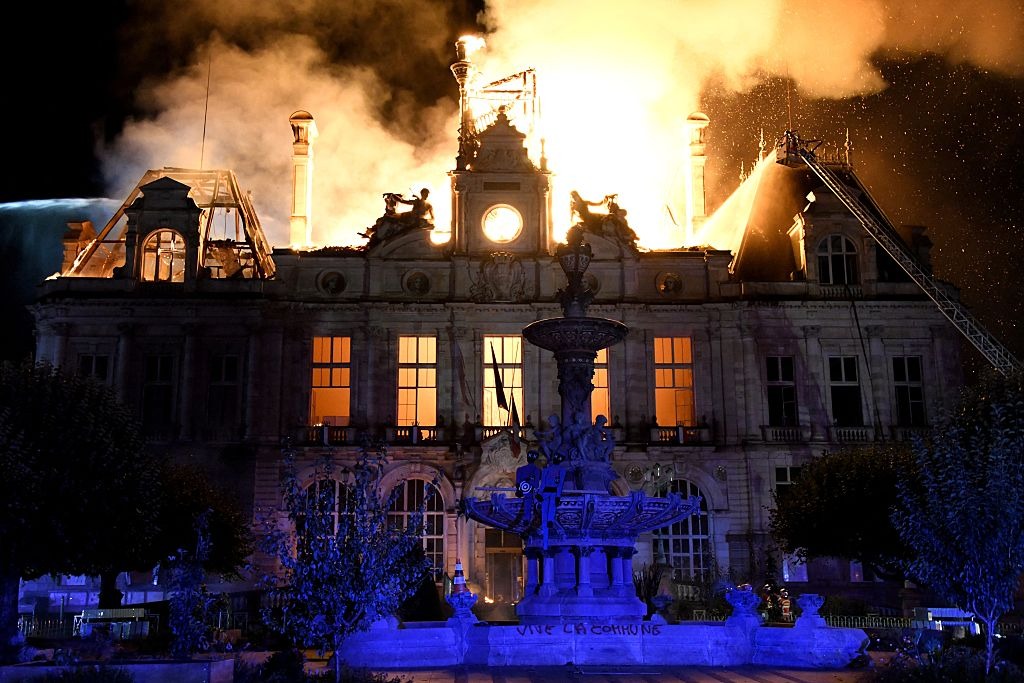
The physical damage is extensive. In Paris, shopfronts were smashed (luxury retailers but also many modest shops and private properties), cars and bicycles were torched, barricades of garbage dumpsters and bicycles were burned, and restaurants were gutted by fire. Whole streets were described by officials as “devastated.” In Limoges, the 19th-century town hall was destroyed by arson; in Lyon the tourist office was set alight; city halls and public buildings were attacked or defaced, notably in Marseille, the second-largest city in France. Looting targeted hundreds of shops in Paris, Marseille, Lille, Bordeaux, Nice, and Strasbourg.
Authorities attributed the worst violence to “far-left” or “ultra-left” elements joined by opportunistic delinquents. Groups in black, masked and wearing balaclavas, clashed with police who deployed tear gas and water cannons. Yet, everywhere, the instructions and rules of engagement for law enforcement remained clear: above all, no violence. This means that the rioters will prevail over the security forces, who are mainly reduced to mere spectators. Such is the cowardice of the Macron regime. More than 3,000 businesses were damaged, with losses estimated at more than a billion euros. A synagogue on Rue Burnouf in Paris’s 19th arrondissement was found vandalized and ransacked, with religious items scattered; reports differed on whether it was deliberate vandalism linked to the riots or an attempted robbery (Torah scrolls were reportedly left untouched.)
The causes
These events did not arise in a vacuum. France has long refused to confront three interlocking realities that its political class treats as taboos: mass uncontrolled immigration, the growing presence and separatism of Islam, and the unaffordable costs of the EU’s “energy transition.”
Immigrants and their descendants are disproportionately concentrated in certain banlieues and cities where public services are most strained and where earlier waves of unrest (including 2005) already originated. France’s welfare system, housing, education, and security budgets have been under continuous pressure from high inflows, low assimilation rates in segments of the population, and the existence of areas where republican authority is contested. Crime statistics, the dynamics of France’s 751 no-go zones, and repeated episodes of youth violence have been documented for years; the October looting and organized attacks proceeded according to established patterns.
The most recent riots are by no means an exception; they are rather another episode in a long series of events, with many more undoubtedly on the way.
What gives these riots their strength is the role played by La France Insoumise (LFI), Jean-Luc Mélenchon’s party, which has for years indulged in toxic pro-Islamist tirades with openly antisemitic undertones.
The party seems to know that it will never come to power. It has therefore decided to fully embrace the politics of revolution and disorder, relying on and openly aligning itself with the most extreme elements of France’s Muslim population. In many respects, LFI is an openly Islamist party. In the 2022 presidential election, according to polling institutes’ estimates, 69% of Muslim voters cast a ballot for Jean-Luc Mélenchon in the first round.
Official statistics and surveys place the French Muslim population at roughly 9–10 percent of the total (around 6–7 million people), up from roughly 1 percent in the 1960s. The Institut national d’études démographiques (INSEE) data show Muslims as the second-largest declared religious group among younger adults, with far higher rates of practice and intergenerational transmission than Catholicism: 91 percent of second-generation immigrants raised in Muslim families retain the faith as adults, versus much lower retention among those from Christian backgrounds. Strong religiosity is markedly higher among Muslims.
Not all Muslims, of course, are Islamist. Approximately 60% of young French Muslims, however, believe that Sharia law takes precedence over the laws of the French Republic, according to data from a 2020 official survey, with similar findings reported in subsequent surveys conducted in late 2025.
In France, antisemitic incidents have risen sharply in recent years, often linked to Islamist networks or radicalized youths; synagogue incidents occur against that backdrop. Islamist influence in neighborhoods, schools, and associations has been repeatedly flagged by security services and interior ministry reports. The political left, particularly La France Insoumise (LFI), has cultivated alliances with Islamist-adjacent or “pro-Palestinian” currents and is regularly accused of legitimizing or instrumentalizing disorder.
Nicolas Sarkozy, in a private remark reported in September 2025, put it bluntly: “The Rassemblement National of Marine Le Pen wants power and will obtain it; LFI does not want power—what it wants is disorder, anarchy, and violence.” These riots, and the driving role played by LFI, appear to prove him right. Sustained chaos seems to serve its revolutionary orientation better than ordinary governance.
Immigration, Islam, and LFI are not the only factors involved. Insane energy costs compound the social and fiscal pressure. Fuel prices are high enough to revive Yellow Vest-style anger. The government has responded with releases from strategic diesel reserves, price caps, and targeted aid — not the needed structural reform. France’s nuclear fleet remains a comparative advantage, yet years of green-transition policies, taxes, regulatory costs, and underinvestment have contributed to elevated prices and public resentment. Protesters explicitly cited fuel prices alongside school conditions.
Consequences
The plausible consequences of these riots are straightforward and already visible. Macron will not resign. He is in the final months of his second disastrous term ahead of the 2027 presidential elections next spring. His approval rate is low, but the institutional calendar and political incentives do not favor an early exit. The immediate fiscal outlook continues to worsen. France’s public deficit is projected around 5.4 percent of GDP for 2026 (among the eurozone’s highest), with debt near 120 percent of GDP. Prime minister Lecornu’s 2027 budget aims for roughly 5 percent via some €54 billion in savings and freezes, yet the National Assembly remains fragmented after the 2024 snap elections. The reality is that the French state appears less capable than ever of putting its disastrous finances in order; there is a looming risk of a snowball effect regarding interest on the debt.
Previous budgets have required the 49.3 constitutional tool to bypass a vote (Article 49.3 of the French Constitution is a powerful mechanism that allows the prime minister to force the passage of a bill through the National Assembly without a vote). Markets have pushed French yields much higher. Further unrest and political paralysis make credible consolidation harder, not easier. Interest costs are again rising. France has not run a budget surplus since 1974; the structural drivers — high spending, demographic pressures, and refusal to prioritize growth-oriented reforms — remain intact.
Sarkozy’s observation on LFI is being confirmed in real time. The party and its allies benefit from the perception of systemic failure while avoiding the responsibilities of office. Having spent years courting Muslims and engaging in antisemitic tropes with total impunity — often with the complicity of the Left — LFI (La France Insoumise) escalates its behavior further with each passing day.
Meanwhile, France remains locked into its taboos. The demented “energy transition” continues despite the visible cost-of-living backlash. Serious discussion of migration selection, remigration, assimilation requirements, or the cultural and security implications of Islam is still heavily constrained by elite consensus and legal or media norms. Marine Le Pen — a probable, though not certain, winner of the presidential election — has just declared that “Islam is compatible with the Republic.” She reportedly intends to lower the retirement age to 62—in a country with an increasingly aging population where, it should be remembered, the state pays out pensions.
The truth is that if France fails to confront its taboos, the October riots will, in retrospect, look like a practice run.
egretnewseditor@gmail.com