

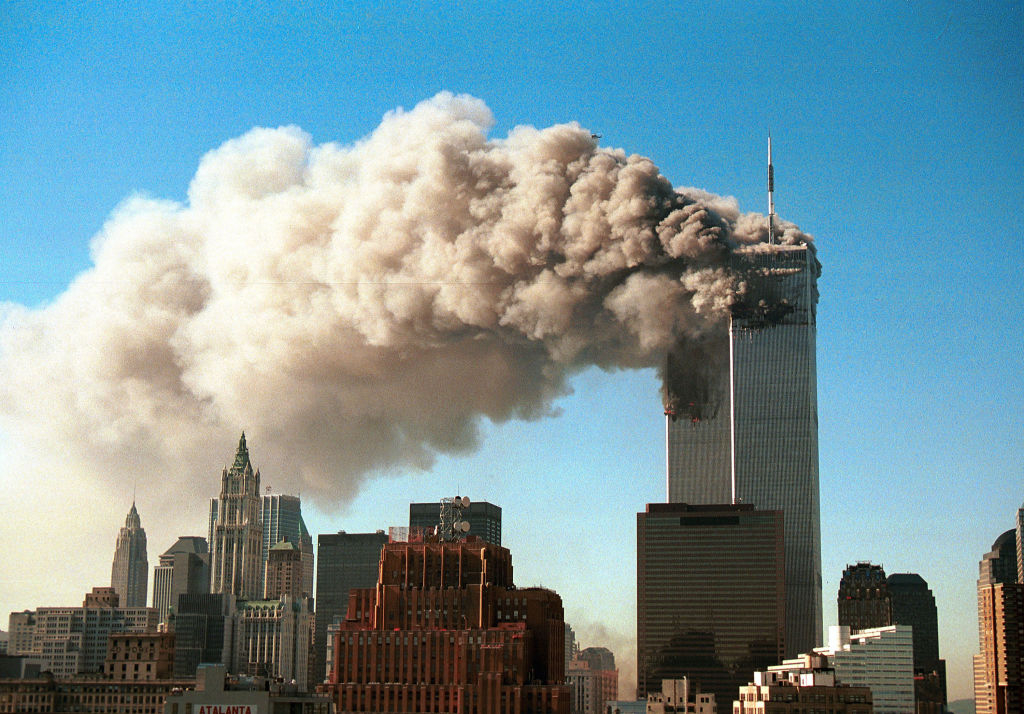
Tomorrow marks 25 years since the attacks of September 11, 2001 shattered America’s complacency and changed the course of the world. A quarter-century later, it is worth remembering that the warning signs were not invisible in the years — and even in the hours — before that day.
On that morning, the hijacked airliners struck the World Trade Center, the Pentagon, and a Pennsylvania field (a flight forced down and believed bound for Washington, D.C). Readers of The Washington Times opened an essay that began with a question that, within hours, would no longer be theoretical: Imagine a popular restaurant in Manhattan’s Times Square blown to bits by a terrorist’s bomb. Would Americans demand an immediate and aggressive effort to prevent the next attack — or would they prefer a wringing of hands so as not to perpetuate a “cycle of violence”?
The answer was obvious. So was the public’s answer. The column reported on a bipartisan poll that the American Middle East Information Network (AMEIN) — an organization this author founded — had commissioned only weeks earlier. Seventy-three percent of Americans said Israel, when it had proof that a suicide bombing or other attack was being planned against its citizens, was justified in attempting to kill a terrorist. A majority described Palestinian attacks as terrorism or warfare, not “resistance.” Americans, the poll showed, understood a distinction that too many editorial pages preferred to avoid addressing: eliminating those who would kill, before they kill, is rational self-defense.
The essay went further. It invoked the suicide attack on the USS Cole that nearly sank the warship. It argued that a nation under siege has the right to use force to protect its people — and that Washington should treat Israel’s fight against terrorism as America would treat its own. The poll revealed that two-thirds of Americans approved.
That column was written, edited, and set in type before the first 9/11 plane departed Logan Airport in Boston. It appeared in print on September 11, 2001. The date on the page and the date on the calendar were the same. History supplied the event that no one typesetting that page could have known but already feared.
This is not a claim that an opinion essay predicted the method or the hour of the attack. What the work did do — and what a number of analysts, investigators, and private citizens had been trying to do in the years before it — was insist that radical Islamic terrorism was not a distant quarrel among other people’s children. It was a terror campaign against civilians, already visible in Nairobi, Dar es Salaam, Aden, and the cafés and buses of Israel. It would not remain overseas out of courtesy to American ideals.
In the years leading to 2001, I invested private resources behind that kind of analysis: polling, research, and public argument meant to force a hearing for an uncomfortable conclusion. On the eve of September 11th, this work cautioned that the threat from radical Islamic fundamentalism was real and growing against the United States. It was one of several voices. Most were treated as background noise.
We now know, with the cruel clarity of hindsight, how right those warnings were. Nearly 3,000 people were murdered. Airports, wars, intelligence services, and the American sense of safety at home were remade. Even before the dust had settled, the country asked how so catastrophic an intelligence and policy failure could have occurred. Part of the answer is as old as Pearl Harbor on the morning of December 7, 1941: some people did see the shape of the danger. Their assessments never became prevention.
Twenty-five years is long enough to extract a few lessons that still apply.
The first is humility. Good analysis — well funded, clearly argued, even printed on the front of a national newspaper the morning the blow falls — can still go unheeded if there is no political will to carry it to the people who can act. Information is not the same thing as urgency.
The second is responsibility. Those who produce serious threat assessments, whether on terrorism, cyber vulnerability, biological risk, or the next instrument of mass harm we have not yet named, deserve a hearing before the disaster, not a commemorative plaque after it. A free society does not owe every alarmist a hearing. It does owe the serious ones one.
The third is moral clarity. The column drew a line Americans instinctively recognized: civilians under fire are not required to wait until the bomber has already chosen the restaurant. That line has been argued over for a generation. It has not become less true. A nation that cannot say the word “terrorism” when the facts require it will not stop the next attack in time.
Those lessons are not artifacts of 2001. They are a warning about what comes next.
The most dangerous unfinished business of the post-9/11 era is Iran. For a generation the regime in Tehran has armed, trained, and financed its proxies — Hezbollah, Hamas, Palestinian Islamic Jihad, the Houthis — while pursuing the one capability that would place its threats beyond recall. A nuclear Iran would not merely endanger Israel. It would put American cities, American forces, and the energy lanes of the world under a form of blackmail no sanctions regime has ever undone.
President Donald Trump has been right to treat that outcome as intolerable. His position has been consistent and plain: Iran cannot have a nuclear weapon — not in any way, shape, or form. That is not a slogan. It is the minimum condition of American security in this century. Diplomacy that buys time for enrichment is not strategy. Ambiguity is not strength. The lesson of September 11 is that the cost of waiting for “compelling evidence” to become a catastrophe is a cost a free country should refuse to pay twice.
As we mark this anniversary, the tribute owed the dead is not only remembrance. It is vigilance. A quarter-century ago, resources were put behind identifying a threat that produced warnings many preferred not to hear. They went unheeded. We cannot afford that strategic error a second time — not against the enemies we already know, and not against a nuclear-armed Iran we still have time to prevent.
egretnewseditor@gmail.com


