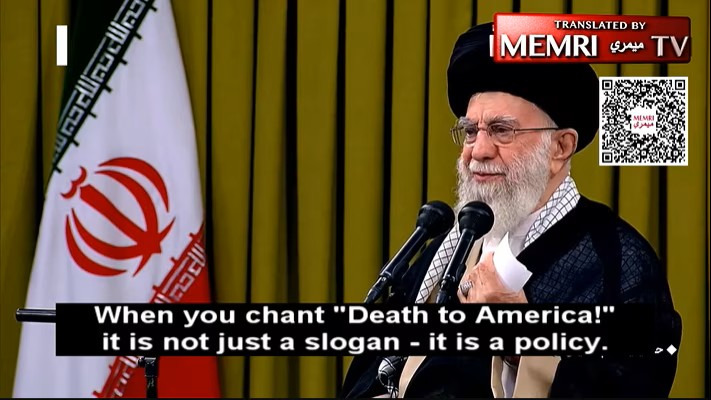
The regime that Ayatollah Ruhollah Khomeini founded has been and shall remain dangerous for the people of Iran, the region and beyond, without closing the strait or developing the bomb. As far as one can make out, a consensus is emerging in Iran today that this regime must go…
More than a year after the latest phase of the US-Israel war against Iran started with a 12-day mass bombing, a consensus is emerging among pundits that President Donald Trump, who casts himself as the commander-in-chief in this conflict, cannot win it.
One sign that Trump himself may have reached the same conclusion is his recent efforts to put some daylight between himself and his ally, Israeli Prime Minister Benjamin Netanyahu.
Another sign that Trump may be thinking of throwing in the towel is the purge of his swearing-infested vocabulary of the catchphrase “regime change”.
He now talks of two objectives: reopening the Strait of Hormuz and stopping Iran’s nuclear project.
The first of those objectives was achievable, albeit, as is often the case with the Islamic Republic of Iran, on no firm basis under the 14-Point Islamabad Memorandum of Understanding.
Elements within the leftover Islamic regime in Tehran who thrive on the continuation of the conflict sabotaged that by attacking ships passing through the Strait of Hormuz. The aim was seemingly for empty bragging by a humiliated bunch. Yet, they succeeded in provoking Trump into ordering a new round of aimless bombings.
Tehran has made its imaginary control of Hormuz a matter of honor but left the idea of charging a transit toll for an unknown future. If and when things return to normal, Iran, under any regime, won’t be able to defy the whole world and become a pariah in its neighborhood by closing the strait, let alone imposing a toll.
Trump’s second objective is to stop Tehran’s nuclear project.
Here, Israel seems to be on board. Defense Minister Israel Katz said last week that “the great and arrogant Persian empire that threatened and acted to destroy Israel has collapsed,” adding that what remains to be done is to prevent Iran from getting nuclear weapons, rebuilding capabilities that threaten Israel and continuing support for its terrorist proxies.
In that context the so-called “reformist wing” of the Tehran regime known as the “New York Boys” has revived the ghost of President Barack Obama’s 2015 JCPOA “nuclear deal”, the one that Trump tore up during his first term as president.
Former Foreign Minister Mohammad Javad Zarif, who negotiated the JCPOA, has penned an article in Foreign Affairs suggesting a second life for the zombie accord.
As a sweetener, he suggests that a fatwa sensibly issued by the late “Supreme Guide” Ali Khamenei forbidding the making of the bomb be passed as a law by the Islamic Majlis (Iran’s ersatz parliament). It is necessary to remember that Obama based his decision on that fatwa, which neither he nor anyone else has ever seen.
Will Trump rise to that bait? I hope not.
A fatwa by a mullah could be cancelled by another mullah, and a law passed by a dubious parliament could be annulled by the next dubious parliament.
The regime that Ayatollah Ruhollah Khomeini founded has been and shall remain dangerous for the people of Iran, the region and beyond, without closing the strait or developing the bomb. Thus, even if Trump secures paper accords on those two realities, he won’t be able to claim that he won a war that it seems he never wanted.
The year-long conflict has shown that a quick, straight military victory isn’t on the cards, and even if it were, it wouldn’t produce lasting results; Afghanistan and Iraq being two examples. In fact, in the past 80 years or so, the only war in which the US achieved lasting victory was in Grenada.
Having said all that, I still think that Trump can win this war provided he sets clear aims for it. The minimalist goal could be a change of behavior by the Khomeinist regime, which is easier said than done but not impossible.
The maximalist goal could be regime change, which paradoxically may have a better chance of being achieved than any time since the Islamic Republic was founded 47 years ago.
As far as one can make out, a consensus is emerging in Iran today that this regime must go, but not thanks to foreign military intervention. The war has done immense and, in some cases, irreparable damage to the Iranian economy and the nation’s industrial, scientific and civilian infrastructure. People we talk to in various parts of Iran do blame the US and Israel but end up pointing to what they term “delusional” and “provocative” behavior of the regime.
During the war, the regime’s repressive machinery has been seriously downgraded in both physical and financial terms, not to mention political authority. One theme echoed is that a regime that couldn’t protect its top leadership echelon had no business provoking a war that has led to so much destruction. In this war, many parts of Iran that had experienced no wars for up to 1,000 years have directly seen what war does. At least four million people across the county have lost their jobs while over a million small and medium businesses have gone under.
The economic mafia survives but is less able to buy loyalty or silence dissent. The latest public executions are supposed to restore fear but have so far had the opposite effect, as seen in last week’s mass protests in Isfahan and Qazvin.
To achieve either of the goals mentioned above, Trump must end this war.
This does not mean walking away with a worthless paper accord as Jimmy Carter did in 1979 and Barack Obama in 2015, thus bestowing a measure of legitimacy on a regime that hasn’t earned it. Nor does it mean giving it a free hand to brag, browbeat and bully people inside and outside Iran.
Without throwing the buoy of normalization at the leftover clique, Trump could let the Iranian people settle their own score with their oppressors either by tipping the balance in favor of those in the current power struggle who seek a change of behavior toward a measure of normality or those who urge straight regime change.
Orson Welles once wrote, “If you want a happy ending, that depends, of course, on where you stop your story.”
That is also true of wars.
egretnewseditor@gmail.com