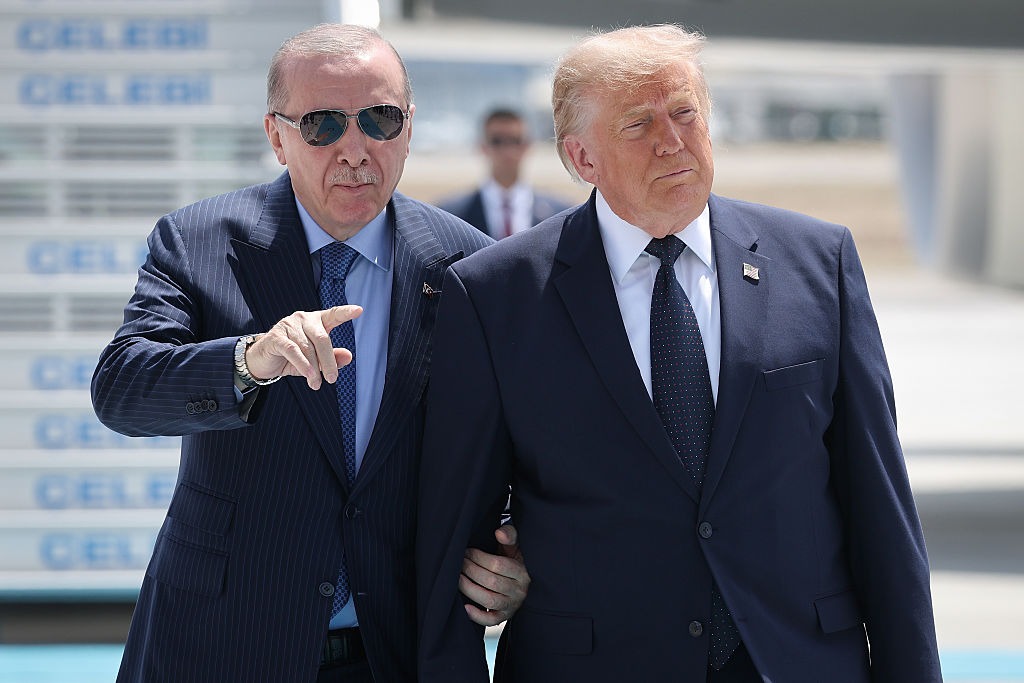
Trump’s remarks were seen as a rebuke to Israeli Prime Minister Benjamin Netanyahu, who is — quite rightly — opposed to F-35 sales to Turkey on the grounds that it could ultimately prove a direct threat to Israel’s security, as well as to Cyprus and Greece, which Erdogan has repeatedly threatened.
Turkey was suspended from the multinational F-35 program during Trump’s first term in 2019, after acquiring Russia’s S-400 air defense system. The purchase of the S-400 also prompted US sanctions against Turkey’s defense industry, imposed in 2020.
Although Turkey tested the S-400 following its delivery and has not returned it to Russia, the Turkish government claims that the system is in storage and has hinted that it could possibly be moved to another country for safekeeping. What could possibly go wrong?
Trump has even praised Erdogan for the role he has played in Syria, where his support for Syrian President Ahmed al-Sharaa, an Islamist former al-Qaeda terrorist now presenting himself to the world as a “moderate,” was crucial to Sharaa’s overthrowing the Assad regime in December 2024.
Meanwhile the terrorists who make up Sharaa’s regime have reportedly “gotten their hands on a modern military” and have been persecuting Christians, Alawites, Kurds and Druze.
Trump’s willingness to engage with Erdogan overlooks numerous troubling issues which, far from indicating that Ankara can be treated as a reliable ally of Washington, show that, under Erdogan’s leadership, Turkey’s policy is generally aimed at undermining American efforts to bring peace to the region.
While the US, together with a number of key regional allies such as Jordan, has worked hard to persuade Hamas’s terrorist leadership to disarm (a key demand in Trump’s 20-point peace plan to end the Gaza war), Erdogan and his Islamist allies in Qatar have tried to dissuade Hamas from disarming.
The Trump administration’s goals of disarming Hamas completely and ending its involvement in Gaza have, in fact, been constantly undermined by Erdogan. He has supported numerous counter-proposals, such as the suggestions that Hamas give up its weapons to the Palestinian Authority (PA) or that the weapons be transferred to some kind of “secure storage” under supposed oversight.
Both proposals, which have been rejected by Israel, were seemingly designed with the aim of preserving Hamas’ rule in Gaza.
Reports that “Turkey was prepared to provide Iran with aerial military support if Kurdish militias had invaded the country during the Israeli-US war on Iran” have laid bare the extent of Erdogan’s unmistakable double dealing on the Iran issue.
Trump might believe that Erdogan could prove to be a useful ally in terms of helping to achieve the Trump administration’s objectives in the Middle East and beyond. The reality, however, is that, in terms of his overall attitude towards the US and its objectives in the region, the Turkish leader deserves to be treated more as an enemy than an ally.
Turkish President Recep Tayyip Erdogan’s latest attempt to persuade the Trump administration to provide Ankara with state-of-the-art F-35 stealth warplanes is just the latest example of the Turkish leader’s willingness to indulge in double-dealing as part of his long-running campaign to establish Turkey as a dominant force in the Middle East.
Erdogan’s courtship of US President Donald Trump has so far succeeded to the extent that the American leader has publicly described Turkey as being “a tremendous ally for me” and also saying that he regards Erdogan as a personal friend.
Trump made the comments in response to the widespread criticism he has received over his announcement, made at the recent Nato summit held in Ankara, that he is considering reversing Turkey’s suspension from the F-35 program, which was imposed during his first term.
Speaking to reporters, Trump declared: “He’s a friend of mine. And nobody tells me what we should be selling or not. Turkey has been a tremendous ally for me. “
Trump’s remarks were seen as a rebuke to Israeli Prime Minister Benjamin Netanyahu, who is — quite rightly — opposed to F-35 sales to Turkey on the grounds that it could ultimately prove a direct threat to Israel’s security, as well as to Cyprus and Greece, which Erdogan has repeatedly threatened.
Turkey was suspended from the multinational F-35 program during Trump’s first term in 2019, after acquiring Russia’s S-400 air defence system. The purchase of the S-400 also prompted US sanctions against Turkey’s defence industry, imposed in 2020.
Although Turkey tested the S-400 following its delivery and has not returned it to Russia, the Turkish government claims that the system is in storage and has hinted that it could possibly be moved to another country for safekeeping. What could possibly go wrong?
Erdogan has previously described Turkey’s removal from the F-35 program as unjust, arguing that restoring Ankara’s participation would strengthen Nato’s collective security.
Irrespective of the concerns expressed by Israel and some Nato leaders about Trump’s openness to selling F-35s to Ankara, the US president appears determined to forge closer ties with Erdogan in the belief that he can be a valuable ally on a variety of fronts, from limiting Russian President Vladimir Putin’s expansionist aims to resolving seemingly intractable problems in the Middle East.
A key factor in Trump’s reasoning appears to be his belief that, having one of the most powerful militaries in the region, Turkey can play a key role in helping the Trump administration to achieve some of its key objectives in the Middle East, from ending the Iran war to resolving the Gaza crisis.
Trump has even praised Erdogan for the role he has played in Syria, where his support for Syrian President Ahmed al-Sharaa, an Islamist former al-Qaeda terrorist now presenting himself to the world as a “moderate,” was crucial to Sharaa’s overthrowing the Assad regime in December 2024.
Meanwhile the terrorists who make up Sharaa’s regime have reportedly “gotten their hands on a modern military” and have been persecuting Christians, Alawites, Kurds and Druze.
Trump’s willingness to engage with Erdogan overlooks numerous troubling issues which, far from indicating that Ankara can be treated as a reliable ally of Washington, show that, under Erdogan’s leadership, Turkey’s policy is generally aimed at undermining American efforts to bring peace to the region.
The Trump administration’s attempt to implement a lasting ceasefire in Gaza is a case in point. While the US, together with a number of key regional allies such as Jordan, has worked hard to persuade Hamas’s terrorist leadership to disarm (a key demand in Trump’s 20-point peace plan to end the Gaza war), Erdogan and his Islamist allies in Qatar have tried to dissuade Hamas from disarming.
The Trump administration’s goals of disarming Hamas completely and ending its involvement in Gaza have, in fact, been constantly undermined by Erdogan. He has supported numerous counter-proposals, such as the suggestions that Hamas give up its weapons to the Palestinian Authority (PA) or that the weapons be transferred to some kind of “secure storage” under supposed oversight.
Both proposals, which have been rejected by Israel, were seemingly designed with the aim of preserving Hamas’ rule in Gaza.
Trump’s announcement last week that a deal had finally been reached on the “complete disarmament” of Hamas has, therefore, been achieved despite the decidedly unhelpful interventions of Turkey and its ally Qatar, a fact the White House would be well-advised to take on board in any future dealings with Ankara.
Erdogan’s involvement in another of the key Middle East challenges facing Trump — namely, ending the Iran war — also cannot be interpreted as helping the Trump administration secure a successful outcome.
Reports that “Turkey was prepared to provide Iran with aerial military support if Kurdish militias had invaded the country during the Israeli-US war on Iran” have laid bare the extent of Erdogan’s unmistakable double dealing on the Iran issue.
During the early phase of the Iran conflict, the Trump administration gave serious consideration to backing a Kurdish-led military revolt against the ayatollahs, a move that was bitterly opposed by Erdogan. That the Turkish leader was prepared to deploy Turkish warplanes against US-backed militias in Iran would have meant that he was, in effect, launching military action to thwart American objectives — a move that is hardly consistent with Erdogan being “a tremendous ally”.
Trump might believe that Erdogan could prove to be a useful ally in terms of helping to achieve the Trump administration’s objectives in the Middle East and beyond. The reality, however, is that, in terms of his overall attitude towards the US and its objectives in the region, the Turkish leader deserves to be treated more as an enemy than an ally.
egretnewseditor@gmail.com