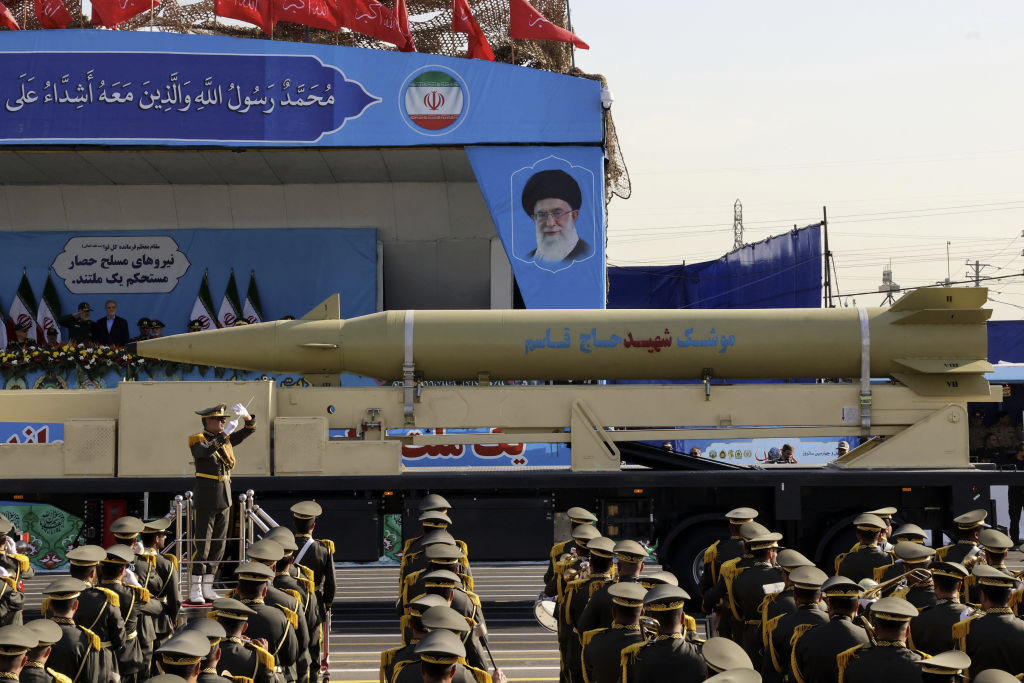
The Iranian regime’s strategy is clear: survive the pressure of President Donald J. Trump’s second term by any means necessary, secure breathing room through negotiations, and position itself for a far more aggressive posture once his administration is over.
Iranian Parliament Speaker and chief negotiator Mohammad Bagher Ghalibaf — Tehran’s “new rational mind” — who had just electronically signed the memorandum of understanding (MOU) with Vance, immediately went on television and called for the “liberation of Jerusalem (Quds)
Iran’s officials are not bound by election cycles; their singular mission is regime preservation to bring “Death to America” and “Death to Israel.”
Even if Iran’s new rulers from the Islamic Revolutionary Guard Corps (IRGC) temporarily say they will comply with everything in the agreement, they would view any restriction as temporary – and then wait for Trump to leave office.
Money has already started to flow again before even a single Iranian concession, especially the fake minuet of IAEA inspectors. Iran, in exchange for receiving billions of dollars, gave up precisely nothing – and the hapless US negotiators evidently agreed to that.
Post-Trump, Iran could impose tolls, “fees,” and “protection payments” on ships transiting the Strait, harass shipping, and assert control over this critical chokepoint if no one has the will to stop them — which is what Iran is probably counting on.
Why does virtually every commentator keep repeating that the Iranian people must change their regime? If even the mighty United States backs down from the task, why should anyone expect unarmed civilian protesters to do it for them? The regime mowed down more than 40,000 of its own citizens in January alone. That is precisely why the regime must be changed – the sooner the better. So long as the current regime remains in place, especially after being thoroughly enriched, there will be no peace in the Middle East.
Iran’s regime, to secure the economic lifeline it needs, will probably say it agrees to any terms to outlast Trump. At the end of Trump’s term, Iran’s regime will be poised to reassert dominance over the Strait of Hormuz, extort regional neighbors, crush opposition at home and abroad, and race once again toward nuclear weapons breakout.
Who then will be willing to take it on?
The Iranian regime’s strategy is clear: survive the pressure of President Donald J. Trump’s second term by any means necessary, secure breathing room through negotiations, and position itself for a far more aggressive posture once his administration is over. Iran has long mastered the art of playing for time: it sees that American presidential terms are finite, while its own project is not. With Trump’s decisive military actions having inflicted significant damage on Iranian capabilities and proxies, the regime finds itself economically crippled and militarily weakened, yet determined to drag out talks, extract concessions, and wait.
Last week, the U.S. and Iran signed an initial memorandum of understanding to end active hostilities, ease certain sanctions, facilitate reconstruction funds, and reopen the Strait of Hormuz. Trump’s team highlighted commitments on nuclear inspections. Vice President JD Vance noted progress on access for the International Atomic Energy Agency (IAEA) – to which, of course, Iran’s regime has never granted real, anytime-anywhere, access, so essentially the achievement is empty.
Even so, almost immediately, tensions resurfaced. Iran’s leaders threatened to reclose the Strait over alleged breaches, prompting sharp warnings from Trump.
Iranian Parliament Speaker and chief negotiator Mohammad Bagher Ghalibaf — Tehran’s “new rational mind” — who had just electronically signed the memorandum of understanding (MOU) with Vance, immediately went on television and called for the “liberation of Jerusalem (Quds)” :
“We must uphold that honor, remain committed to that vision, and carry out that mission. A hundred Netanyahus are not even worth the shoelace of our martyred Imam.”
He also wrote on X, concerning the very first point of the 14-point memorandum of understanding:
“They can never isolate any part of the pillars of resistance alone. The jihad efforts of Lebanon’s brave warriors and the powerful diplomacy of the Islamic Republic of Iran will guarantee the sovereignty and territorial integrity of dear Lebanon and will disrupt the crazy games and warmongering of the Israeli regime.”
In short, the West can never separate Hezbollah in Lebanon –Iran’s largest proxy and forward base right on Israel’s border — from Iran.
A few days after that – revealing the regime’s confidence in extracting maximum gains at the diplomatic table even amid recent setbacks — Ghalibaf declared :
“Everything we sought to achieve through military action, we obtained several times over through negotiation; it was not even comparable.”
This pattern — hard bargaining mixed with oscillating replies — reflects a regime that publicly projects defiance while privately craving the financial relief that sanctions relief provides.
Iran’s leaders know they cannot match Trump’s strength in the near term. Unlike previous administrations, Trump, in both of his, terms has featured maximum pressure: economic pressure as well as military strikes that degraded Iran’s missile arsenals, naval assets, and proxy networks.
The regime’s economy is gasping: inflation has soared, foreign currency reserves are depleted, and paying soldiers and maintaining patronage networks grows harder by the day. As Trump has noted, the mullahs lack the funds to sustain their apparatus without external relief. They are at the table not out of goodwill, but for survival. They drag out negotiations, starting with maximalist demands, testing Western patience, and ultimately aiming for a deal that lifts sanctions without delivering irreversible curbs on their nuclear ambitions.
In 2015, under then President Barack Obama, Iran secured the JCPOA “nuclear deal” – a 10-year runway to acquire nuclear weapons by 2025. Iranian officials have already been boasting, as above, that diplomacy delivered more than war could have done. Trump himself, highlighting the regime’s patient, long-term approach, noted that “Iran never won a war but never lost a negotiation.” Iran’s officials are not bound by election cycles; their singular mission is regime preservation to bring “Death to America” and “Death to Israel.”
Assume that a comprehensive deal materializes: robust inspections, enrichment limits, proxy restraints, and sanctions relief in exchange for verifiable compliance. The regime’s track record suggests that the probability of honoring the terms would be zero. Iran has repeatedly violated past agreements, while proclaiming adherence, as it was clandestinely advancing its nuclear weapons program. Even if Iran’s new rulers from the Islamic Revolutionary Guard Corps (IRGC) temporarily say they will comply with everything in the agreement, they would view any restriction as temporary – and then wait for Trump to leave office.
Money has already started to flow again before even a single Iranian concession, especially the fake minuet of IAEA inspectors. Iran, in exchange for receiving billions of dollars, gave up precisely nothing – and the hapless US negotiators evidently agreed to that. Reconstruction pledges so far amount to more than $300 billion — twice as much as the entire Marshall Plan for Europe, updated in today’s dollars.
The real danger looms after Trump’s term is up. Without his willingness to wield overwhelming force, his successors — whether Republican or Democrat — may well lack the resolve for decisive action. Iran has signaled as much through figures like Ghalibaf, who declared that “Hormuz will never return to pre-war status,” and, after US agreement, would take permanent control of the Strait.
Post-Trump, Iran could impose tolls, “fees,” and “protection payments” on ships transiting the Strait, harass shipping, and assert control over this critical chokepoint if no one has the will to stop them — which is what Iran is probably counting on.
Regionally, the regime would continue to expand its influence through reviving its proxies. The recent conflict revealed vulnerabilities of the Gulf states, which Iran would no doubt continue to attack or threaten to attack. A restored Iran would intensify pressure on neighbors, rebuild alliances with proxy militias, and pursue vengeance against external opponents. Domestically, the regime would continue to crush dissent, probably even more brutally. Iran has already, once again, stepped up executing its dissidents, most likely as a warning not even to think of challenging the rule of the IRGC.
Why does virtually every commentator keep repeating that the Iranian people must change their regime? If even the mighty United States backs down from the task, why should anyone expect unarmed civilian protesters to do it for them? The regime mowed down more than 40,000 of its own citizens in January alone. That is precisely why the regime must be changed – the sooner the better. So long as the current regime remains in place, especially after being thoroughly enriched, there will be no peace in the Middle East.
Above all, the regime, drawing lessons from North Korea, Libya and Ukraine, would restore and accelerate its nuclear weapons program.
Iranian regime insiders prioritize survival. Western leaders, by contrast, focus on legacy headlines within four- or eight-year windows. Trump stands out as the great exception — prioritizing American strength and long-term global security. Iran’s patience is nevertheless its greatest asset. The regime has outlasted eight presidents, who used tactics spanning from Bush-era sanctions to Obama-era diplomacy — why not one more?
If Iran’s strategy succeeds, the world after Trump will look markedly different. A regime flush with cash, dominant in the Gulf, unrestrained in its nuclear pursuits, and vengeful towards anyone it perceives as a foe poses incalculable risks. Proxies will reignite conflicts, nuclear breakout time shrinks back to near zero, and other leaders may not have the same courage as Trump to confront it.
Iran plans for the day when Trump’s term is at an end and American pressure along with it. The stakes extend far beyond the Middle East — to South America and ultimately the “Great Satan,” the United States.
Iran’s regime, to secure the economic lifeline it needs, will probably say it agrees to any terms to outlast Trump. At the end of Trump’s term, Iran’s regime will be poised to reassert dominance over the Strait of Hormuz, extort regional neighbors, crush opposition at home and abroad, and race once again toward nuclear weapons breakout.
Who then will be willing to take it on?
egretnewseditor@gmail.com