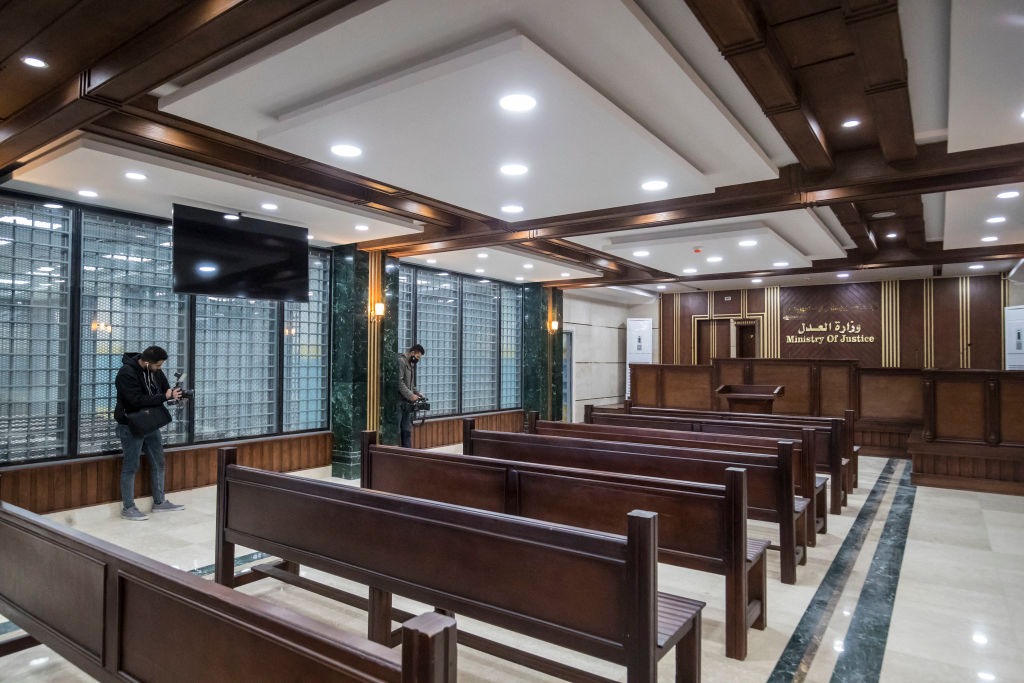
Said Mansour Rezk Abdelrazek, an Egyptian Christian convert, has been imprisoned and tortured simply for converting from Islam to Christianity. He now faces a possible death sentence or 25 years in prison. A hearing at the First Criminal Court in Badr scheduled for December 8, 2026 is expected to hear the defense’s closing arguments.
Imagine being hounded for a decade, imprisoned and tortured simply for changing your religion. That is the effect of Egypt’s application of blasphemy provisions (“contempt for religion”) and counter-terrorism laws against Muslims who convert to another religion.
A 2024 poll found that 43% of young Americans view Islamic Sharia law favorably; social media apparently “protects” them from knowing what is in store for them.
International attention, embassy monitoring of the December 8 proceedings, and consistent diplomatic pressure seem to remain the clearest near-term levers available.
Said Mansour Rezk Abdelrazek, an Egyptian Christian convert, has been imprisoned and tortured simply for converting from Islam to Christianity. He now faces a possible death sentence or 25 years in prison. A hearing at the First Criminal Court in Badr scheduled for December 8, 2026 is expected to hear the defense’s closing arguments.
Imagine being hounded for a decade, imprisoned and tortured simply for changing your religion. That is the effect of Egypt’s application of blasphemy provisions (“contempt for religion”) and counter-terrorism laws against Muslims who convert to another religion.
A 2024 poll found that 43% of young Americans view Islamic Sharia law favorably; social media apparently “protects” them from knowing what is in store for them.
Abdelrazek converted from Islam to Christianity in 2016 after studying the Bible. He has since faced repeated arbitrary arrests, physical and psychological abuse, denial of access to legal representation, forced divorce, and separation from his young son. Egyptian authorities have pressured him to renounce his faith.
He fled to Russia, formally joined the Russian Orthodox Church, and obtained documentation from the Office of the United Nations High Commissioner for Refugees confirming eligibility for international protection. After his public criticism of Islam angered members of Russia’s Muslim community, he was arrested and imprisoned for a year in Russia. Russian authorities subsequently revoked his asylum status and deported him to Egypt in 2024, in violation of the international principle of non-refoulement.
On July 15, 2025, Egyptian security officers arrested him at his Cairo home after he posted online about seeking to change the religion listed on his national identity card.
Reports from his fiancée, Sophie, and advocacy groups describe severe mistreatment, including being suspended for hours in a “crucifixion” position with handcuffs and ropes, coercion to undergo procedures to scrape or remove his tattoo of a cross, beatings, mockery, and denial of adequate food, hygiene items, warm clothing, medicine, visitors and access to a lawyer, as well as medical neglect for urinary problems and lower-back pain (and reportedly a heart stent). He is being held in Cairo’s Tenth of Ramadan Prison under conditions that Amnesty International and others have documented as cruel and inhuman.
He is being prosecuted before a terrorism court, primarily on charges of joining a “banned terrorist organization” (which his lawyer has stated does not exist), “contempt for Islam,” inciting unrest, and spreading false information. Advocacy groups including Coptic Solidarity and the U.S. Commission on International Religious Freedom (USCIRF) regard him Abdelrazek a religious prisoner of conscience.
After a hearing on November 3, 2026, prosecutors sought the maximum penalty: death or 25 years’ imprisonment. The court adjourned until December 8, 2026, when the defense is to present arguments. Sentencing is expected around that date, though not formally confirmed by the court.
Abdelrazek is not an isolated case. USCIRF’s 2026 report on Egypt documents continued use of Penal Code Article 98(f) (“contempt for the heavenly religions”) alongside security charges against Christians and others for online expression or religious activity. Examples include Augustinos Samaan (sentenced to five years for online content), Sherif Gaber (repeatedly targeted as an atheist blogger), and others.
Lindsay Rodriguez, Senior Director of Advocacy and External Relations at Coptic Solidarity, told Gatestone after the November 3 hearing that nothing had changed in Abdelrazek’s conditions: no visitors and no medical care. His fiancée Sophie, who lives in Australia, has described the crucifixion-style suspension, torture and other coercion to renounce faith and become an informer. There is evidence of gross medical neglect, bans on lawyer visits, and deprivation of basic needs. Prison authorities have denied Abdelrazek worship materials and a Bible. His family has little further information about the continuing abuse. Sophie is urging governments — especially Australia — to intervene and grant Abdelrazek a humanitarian visa.
Rodriguez has called for the U.S., EU, and Australian embassies to send monitors to the December 8 hearing, for these governments and EU member states to raise the case in diplomatic meetings, and for legislators to speak out via social media, parliamentary questions, and speeches.
She has also urged the U.S. Congress, the European External Action Service, and the EU Commission to scrutinize Egypt’s use of terrorism and blasphemy provisions against peaceful religious belief and expression, to demand transparent human rights benchmarks for assistance, and to assess Egypt’s claims of religious-freedom progress against independent evidence rather than official narratives.
U.S. lawmakers, including Sen. Josh Hawley and several House members, have written to Egyptian President Abdel Fattah el-Sisi demanding Abdelrazek’s release, citing torture allegations and international law.
The U.S. State Department has stated that it is monitoring the trial closely and encourages Egypt to protect religious freedom.
This case illustrates how Egypt’s legal framework treats conversion and related expression as if they are national security offenses. International attention, embassy monitoring of the December 8 proceedings, and consistent diplomatic pressure seem to remain the clearest near-term levers available.
egretnewseditor@gmail.com